家电

Search documents
最高补贴1500元!湖北以旧换新最全攻略来了
Xin Lang Cai Jing· 2026-01-18 04:03
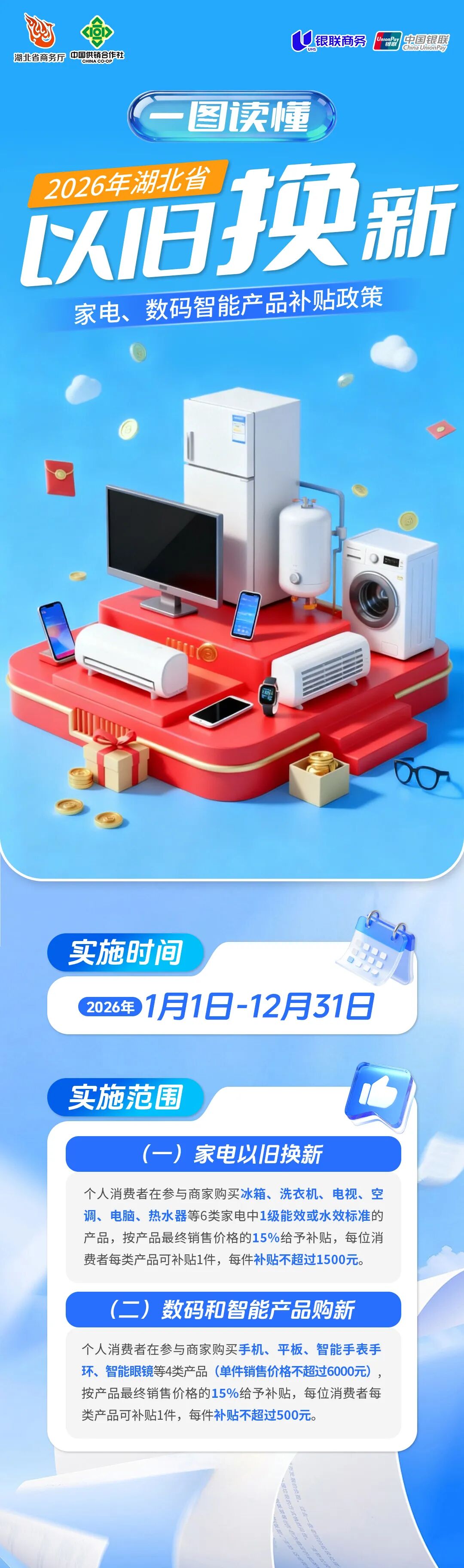
Core Viewpoint - The Hubei province has launched a "trade-in" subsidy policy for home appliances and digital smart products, effective from January 1, 2026, to December 31, 2026, aimed at encouraging consumer spending and upgrading household electronics [5][7][8]. Group 1: Subsidy Details - Consumers can receive a subsidy of 15% of the final sales price for purchasing energy-efficient home appliances, with a maximum subsidy of 1,500 yuan per item, limited to one item per category [7]. - The eligible home appliances include refrigerators, washing machines, televisions, air conditioners, computers, and water heaters [7]. - For digital smart products, consumers can receive a subsidy of 15% of the final sales price, with a maximum of 500 yuan per item, also limited to one item per category [8]. - Eligible digital products include smartphones, tablets, smartwatches, and smart glasses, with a single item price cap of 6,000 yuan [8]. Group 2: Implementation and Access - The subsidy program is accessible through participating merchants, and consumers must follow specific steps to claim their subsidies via the "Hubei Trade-in" WeChat public account [12][15]. - The program is designed to operate daily from 00:00 to 24:00, with the subsidy vouchers valid only for the day they are claimed [12]. - Consumers can check their eligibility and receive assistance through the WeChat mini-program dedicated to the trade-in program [15][21].

科技周报|闻泰科技印度相关资产被查封
Di Yi Cai Jing· 2026-01-18 02:33
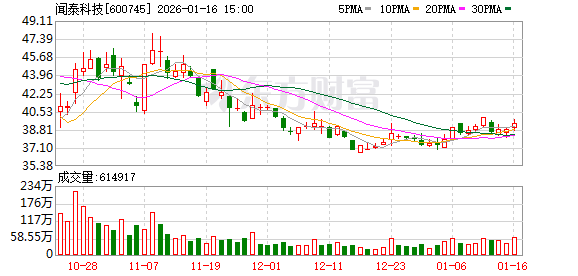
Group 1 - Wentech Technology's subsidiary in India is involved in a dispute with Luxshare's subsidiary over an asset transaction, with approximately 160 million yuan remaining unpaid [2] - Luxshare Precision announced that the asset transfer is hindered due to asset seizures and freezes, preventing ownership transfer procedures [2] - Wentech is divesting its product integration business, which has faced years of losses, and has been placed on the U.S. Entity List, affecting its ability to secure new orders [2] Group 2 - Midea Group's chairman emphasized the need to eliminate redundant businesses and low-efficiency assets, aiming for a streamlined organization and a focus on core markets and businesses by 2026 [3] - The company plans to enhance its core white goods and HVAC businesses while targeting growth in robotics, new energy, and medical sectors [3] Group 3 - Qianwen App has integrated with Alibaba's ecosystem, allowing users to order food, book hotels, and purchase tickets directly through the app, enhancing AI shopping experiences [4] - This move signifies Alibaba's strategy to leverage its ecosystem in the AI ToC market, emphasizing collaboration and payment integration with Alipay [4] Group 4 - Xunlei has filed a civil lawsuit against former CEO Chen Lei, seeking 200 million yuan for damages related to a shadow company allegedly controlled by him [5][6] - This lawsuit marks a new phase in a long-standing dispute that began in 2020, highlighting internal conflicts and power struggles within the company [6] Group 5 - Perfect World announced the detention of three art department heads for corruption, focusing on issues related to outsourcing and procurement management [7] - The company is part of a broader trend in the gaming industry, where marketing and procurement roles have been identified as high-risk areas for corruption [7] Group 6 - The World Economic Forum has recognized several Chinese companies, including Hisense, Haier, and Midea, as "lighthouse factories" for their digital transformation efforts [8] - This recognition reflects the increasing global acknowledgment of China's advancements in smart manufacturing [8] Group 7 - Aishi Technology launched PixVerse R1, a real-time world model capable of 1080P resolution, marking a significant advancement in video generation technology [9] - This model reduces video generation latency from seconds to instant response, representing a shift towards real-time interactive experiences in the AIGC field [9]

1月经济初窥-20260118
GF SECURITIES· 2026-01-18 02:26
Power Generation and Industrial Activity - As of January 8, the cumulative power generation from coal-fired power plants increased by 2.6% year-on-year, compared to a decrease of 8.5% in December[3] - The cumulative heating supply from coal-fired power plants rose by 5.1% year-on-year[3] - The operating rate of 247 blast furnaces nationwide increased by 1.4 percentage points year-on-year, reaching 79.0%[3] - The average daily crude steel output from key enterprises increased by 11.8% month-on-month but decreased by 4.1% year-on-year, averaging 1.997 million tons per day[4] Construction and Real Estate - The funding availability rate for construction sites decreased by 0.3 percentage points to 59.6% as of January 13[5] - The average daily transaction area of commercial housing in 30 major cities fell by 38.6% year-on-year from January 1 to January 16[8] - The year-on-year decline in second-hand housing agency subscriptions in 80 cities was 20.8%[10] Consumer Goods and Retail - Retail sales of passenger vehicles from January 1 to January 11 dropped by 32% year-on-year, with wholesale sales down by 40%[10] - The average wholesale price of pork increased by 2.7% to 18.1 yuan per kilogram as of January 16[16] - The production of household appliances showed a positive growth of 6% year-on-year, with air conditioner production up by 11%[11] Economic Indicators - The Business Price Index (BPI) rose by 3.8% to 933 points as of January 16, indicating a broad price increase across various sectors[13] - The photovoltaic manager index (SMI) decreased by 1.3 percentage points to 133.0 points, reflecting a decline in upstream manufacturing activity[7]
“粤”上新台阶丨从“能行”到“真行” 广货凭何“行天下”
Yang Shi Xin Wen Ke Hu Duan· 2026-01-18 01:54
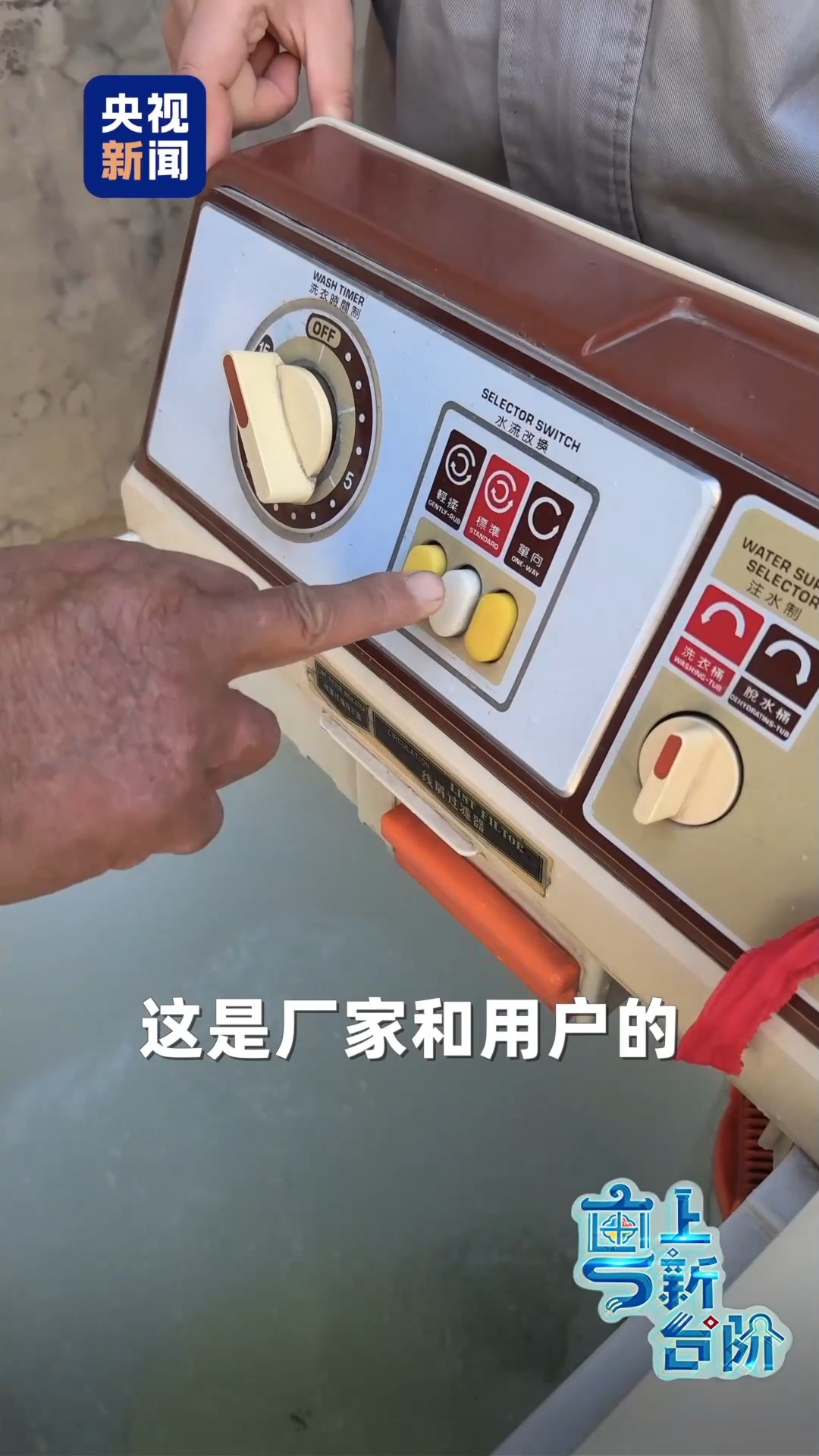
Core Viewpoint - The evolution of Guangdong manufacturing reflects a shift from traditional quality-focused products to innovative, consumer-oriented solutions that emphasize both product quality and service excellence [4][9][20]. Group 1: Historical Context and Brand Perception - A 1997 Guangdong-made washing machine has served a family for 26 years, symbolizing the long-standing trust in local products [1] - The initial perception of Guangdong products was that they were affordable and functional, but there remains a lingering impression of them being inferior compared to foreign goods [4][9]. Group 2: Transition in Manufacturing and Marketing Strategies - The recent "Guangdong Goods Going Global" initiative showcases a shift from traditional product displays to online marketing and live streaming, indicating a modern approach to consumer engagement [7][10]. - Quality remains a cornerstone for Guangdong products, but it is no longer sufficient alone; companies must also focus on understanding and meeting consumer needs [9][13]. Group 3: Product Innovation and Consumer Demand - A Foshan home appliance company presented new rice cookers developed in-house, highlighting the importance of adapting to changing consumer preferences and dietary habits [10]. - The small appliance sector is increasingly focused on creating unique, high-quality products that address specific consumer pain points, emphasizing the need for innovation and technical barriers [13]. Group 4: Service and Consumer Engagement - Guangdong manufacturers are recognizing the importance of not just good products but also excellent service, with a focus on customer experience and support [18]. - The concept of "New Guangdong Goods" extends beyond products to include comprehensive service offerings, enhancing the overall consumer experience [20]. Group 5: Broader Implications for Manufacturing - The evolution from traditional manufacturing to intelligent manufacturing reflects a broader trend in Chinese manufacturing, moving from durability and affordability to prioritizing consumer experience [20].
从造豪车到百万亿美元公司 追觅俞浩:怕我们膨胀,但我们稳得很
Xin Jing Bao· 2026-01-18 01:32
Core Viewpoint - The CEO of Chasing Technology, Yu Hao, aims to create the world's first trillion-dollar company ecosystem within the next 20 years, emphasizing that achieving such a milestone is a collective effort and not limited to his company alone [1]. Group 1: Company Performance and Goals - Chasing Technology's current focus is on the clean appliance sector, with competitors like Ecovacs and Roborock having market capitalizations of approximately 50 billion yuan and 40.1 billion yuan, respectively, and revenues below 13 billion yuan and 12.1 billion yuan for the first three quarters of 2025 [1]. - The company has diversified into the major appliance sector, launching products such as air conditioners, refrigerators, washing machines, and dishwashers, with plans to introduce a luxury electric product by 2027 [2]. - Yu Hao claims that Chasing Technology achieved several hundred billion yuan in revenue this year, asserting that the company's net profit is the highest in the industry, although these figures are difficult to verify as the company is not publicly listed [2]. Group 2: Industry Context and Competitors - In the major appliance sector, leading company Midea Group has a market capitalization of approximately 653.5 billion HKD, with revenues exceeding 400 billion yuan and net profits over 40 billion yuan for the first three quarters of 2025 [2]. - Haier Smart Home, the second-largest player in the appliance industry, has a market capitalization of around 261.5 billion HKD, with revenues just above 260 billion yuan and net profits below 20 billion yuan for the same period [2]. - The current highest market value company globally is Nvidia, valued at 4 trillion yuan, highlighting the significant gap to reach the trillion-dollar mark [1].
【西安】消费品以旧换新再出新举措
Shan Xi Ri Bao· 2026-01-18 00:37
Core Viewpoint - Xi'an is implementing a "trade-in" program for consumer goods to enhance quality and efficiency, with various promotional activities launched by shopping malls to stimulate the consumer market [4]. Group 1: Automotive Trade-in Program - The program supports the scrapping and replacement of gasoline and diesel vehicles, offering a 12% subsidy (up to 20,000 yuan) for consumers who scrap eligible vehicles and purchase new energy vehicles listed in the Ministry of Industry and Information Technology's directory [4]. - A 10% subsidy (up to 15,000 yuan) is available for consumers purchasing fuel vehicles with an engine size of 2.0 liters or less [4]. - Consumers can receive an 8% subsidy (up to 15,000 yuan) for purchasing new energy vehicles and a 6% subsidy (up to 13,000 yuan) for fuel vehicles when transferring their old cars [5]. Group 2: Home Appliance Subsidies - Consumers purchasing energy-efficient home appliances such as refrigerators, washing machines, televisions, air conditioners, computers, and water heaters can receive a 15% subsidy on the purchase price, with a maximum of 1,500 yuan per item [5]. - Each consumer can receive a subsidy for one item per category [5]. Group 3: Digital and Smart Products - A 15% subsidy is available for consumers purchasing mobile phones, tablets, smartwatches, and smart glasses, with a maximum of 500 yuan per item for products priced under 6,000 yuan [6]. - Consumers can obtain digital coupons for home appliances and smart products through the Yunshanfu platform, which are valid for a limited time [6].

俞浩,我帮你捋好了:怎样用20年干到百万亿美元
Sou Hu Cai Jing· 2026-01-17 14:41
Core Viewpoint - The ambitious goal of achieving a market value of 100 trillion USD in 20 years is presented as a feasible target based on historical trends of tech giants like Microsoft, Apple, and Nvidia, which have seen significant increases in their valuations over time [2][17]. Group 1: Strategic Recommendations - The company should leverage its core technology of "high-speed digital motors + AI algorithms" to expand into various sectors beyond home appliances, including automotive and aerospace [3][5]. - It is advised to adopt strategies from industry leaders: Nvidia's hardware and ecosystem integration, Apple's seamless user experience, and Microsoft's open platform approach to create a robust business model [5][6]. - The company should focus on global expansion and localization, establishing direct retail experiences in key markets to enhance brand presence and adapt products to local needs [6]. Group 2: Roadmap to Growth - The first phase (2026-2030) aims to solidify the company's foundation with a target market value of 50 billion USD, emphasizing R&D investment and market leadership in existing product categories [7][8]. - The second phase (2031-2035) focuses on expanding the ecosystem, targeting a market value of 500 billion USD, with plans to enter the automotive sector and develop partnerships for technology sharing [10]. - The third phase (2036-2040) aims for a market value of 3 trillion USD, with the goal of establishing industry standards and leading in smart living and robotics [11]. - The final phase (2041-2046) envisions a market value of 100 trillion USD, emphasizing groundbreaking technologies and a shift towards subscription services and data monetization [12][13]. Group 3: Financial Strategy - The company needs to secure diverse funding sources, including self-funding, equity financing, and strategic investments, to support its ambitious growth plans without relying solely on public offerings [16].
消费与科技不是“谁主谁次”,而是“共生共荣”|宏观经济
清华金融评论· 2026-01-17 10:35
Core Viewpoint - Consumption and technology are interdependent and should not be viewed as mutually exclusive; without consumer demand, technological innovation lacks sustainability and market value [2][4]. Group 1: Economic Growth and Innovation - Many people instinctively emphasize "technological innovation" as the core driver of economic growth, influenced by narratives around breakthroughs in chips, AI, and new energy [4]. - In 2024, China's total R&D expenditure is expected to exceed 4 trillion yuan, accounting for 2.8% of GDP, with the number of patents in fields like new energy vehicles and AI ranking first globally [4]. - However, technology that is detached from consumer demand often fails to achieve market success, as seen in cases where companies invested heavily in R&D but faced low order volumes due to weak consumer demand [4][5]. Group 2: Consumer Demand and R&D Investment - Over 70% of R&D investment in China comes from enterprises, which directly depends on their revenue situation; in 2024, the growth rate of retail sales of consumer goods is projected to be only 3.5% [5][7]. - The decline in consumer spending has led to a reduction in R&D budgets for many companies, with some cutting their innovation budgets by half due to lower sales [7]. - Consumer demand is crucial as it serves as both the endpoint of economic circulation and the source of funding for technological innovation [7]. Group 3: Policy Implications - Current policies tend to favor technological innovation over consumer stimulation, leading to an imbalance; while tax incentives for tech firms are increasing, consumer stimulus measures remain superficial [8]. - In 2024, the technology conversion rate in China is only about 30%, significantly lower than the 60%-70% seen in developed countries, indicating a gap in market acceptance of innovations [8]. Group 4: The Symbiotic Relationship Between Consumption and Technology - The relationship between consumption and technology is cyclical, akin to the "chicken and egg" scenario; successful technological advancements often depend on a robust consumer market [9][10]. - For China, while exports of "new three items" (likely referring to new energy vehicles, electronics, etc.) are growing, a weak domestic consumer market could lead to wasted production capacity and increased operational pressures on companies [10]. - To address these challenges, a dual approach is necessary: supporting technological innovation while also expanding domestic demand through job stability and income growth [10][11].
陆家嘴财经早餐2026年1月17日星期六
Sou Hu Cai Jing· 2026-01-17 10:26
Group 1 - The China Securities Regulatory Commission (CSRC) emphasizes maintaining market stability and enhancing monitoring and regulation to prevent excessive speculation and market manipulation [1] - Canada and China have reached a consensus on deepening economic and trade cooperation, signing the "China-Canada Economic and Trade Cooperation Roadmap," which includes an annual quota of 49,000 electric vehicles from China with a 6.1% most-favored-nation tariff rate [1] Group 2 - The State Council of China is focusing on boosting consumption and has outlined measures to clear corporate debts and ensure wage payments for migrant workers [2] - The Ministry of Commerce plans to support green and smart product consumption through a more robust recycling program for consumer goods [2] - The Ministry of Housing and Urban-Rural Development highlights significant investment opportunities in urban renewal projects during the 14th Five-Year Plan period [9] Group 3 - The State-owned Assets Supervision and Administration Commission (SASAC) is working on optimizing the layout and structure of state-owned enterprises to better serve the modern industrial system [3] - The Market Supervision Administration has introduced new guidelines for recognizing illegal gains in market regulation, effective from March 20 [3] - The Shanghai Stock Exchange is monitoring stocks with significant volatility and has conducted special investigations into major corporate events [7] Group 4 - The A-share market experienced fluctuations, with the Shanghai Composite Index closing at 4,101.91 points, down 0.26%, while the Shenzhen Component Index and the ChiNext Index also saw slight declines [4] - Hong Kong's Hang Seng Index closed down 0.29%, with significant trading activity in semiconductor and power equipment stocks [5] Group 5 - The CSRC has approved the IPO registration application for Fu'en Co., indicating ongoing activity in the capital markets despite regulatory scrutiny [6] - The China Securities Regulatory Commission reported a total of 701 cases of securities and futures violations in 2025, with penalties amounting to 15.47 billion yuan [6] Group 6 - The Ministry of Industry and Information Technology has released interim measures for the recycling and comprehensive utilization of used power batteries from electric vehicles, effective from April 1, 2026 [10] - The China Automotive Power Battery Industry Innovation Alliance reported a 60.1% year-on-year increase in the cumulative production of power and energy storage batteries in 2025 [10]

青岛距离“北方第二城”仅差42亿,三大产业胜负手决定最终归属
Sou Hu Cai Jing· 2026-01-17 10:18
Economic Competition - Qingdao's GDP is only 42 billion yuan behind Tianjin, indicating a potential shift in the title of "Northern Second City" [2][4] - The competition reflects deeper industrial transformation between the two cities [4] Marine Economy - Qingdao's cruise port has seen a 23% year-on-year increase in throughput, with 52 international cruise ships received in a single quarter, driving significant growth in coastal tourism revenue [2] - Qingdao's marine engineering equipment sector is growing faster than Tianjin's, with a 6% lead in output growth [2] Smart Home Appliances - Qingdao's home appliance industry has experienced a profit margin increase from 4.2% to 7.8%, with a 34% growth in exports in the first three quarters, particularly strong in the Russian market [2][3] - Tianjin's consumer electronics exports have only grown by 9%, widening the gap with Qingdao [3] Rail Transportation - Qingdao's rail transportation equipment output has surpassed 100 billion yuan, driven by significant orders from Southeast Asia [2] - Qingdao's high-speed rail export orders are 60% higher than those of Tianjin, indicating a growing international recognition of "Qingdao-made" high-speed trains [2] Industrial Chain Effects - Qingdao's local procurement for metro construction has reached 38 billion yuan, creating a tighter industrial chain compared to Tianjin [2] - The development model of "projects driving industries" is fostering new economic growth points in Qingdao [2] Future Outlook - The competition will hinge on which city can cultivate "new quality productivity" faster, with Qingdao showing explosive growth in emerging sectors like optoelectronics and virtual reality devices at 77% [2][4] - Ten years ago, Tianjin's GDP was 1.83 times that of Qingdao, but this has now decreased to 1.003, highlighting the ongoing economic transformation in the northern urban cluster [4]