
军工

Search documents
市场下行,红利支撑
Tebon Securities· 2025-11-04 12:14
Market Analysis - The A-share market experienced a volume contraction and a downward adjustment, with the Shanghai Composite Index closing down 0.41% at 3960.19 points, and the ChiNext Index down nearly 2% [3][6] - Despite the overall decline, dividend and micro-cap indices showed relative resilience, with the Wind Micro-Cap Index up 0.48% and the CSI Dividend Index up 0.37% [3][6] - The trading volume for A-shares was 1.94 trillion, down from 2.13 trillion the previous day, indicating a shrinking market activity [3][8] Sector Performance - The market rotation intensified, with sectors such as lithium batteries, gold, innovative pharmaceuticals, and consumer electronics experiencing significant declines, while banking stocks performed relatively well [6][12] - The ice and snow tourism sector saw some strength, with stocks like Jingxue Energy rising over 10% following a promotional event in Harbin [6][12] Policy and Economic Outlook - The market is entering a policy and earnings vacuum period, with a lack of driving factors for a mainline trend, but there are optimistic signs as external uncertainties are gradually alleviating [6][7] - The report suggests maintaining a balanced allocation strategy, focusing on dividend and micro-cap stocks while also paying attention to emerging technology sectors highlighted in the 14th Five-Year Plan [7][13] Bond Market - The bond market showed a weak oscillation, with most government bond futures closing down, reflecting a stable performance in the face of a declining stock market [11][12] - The central bank's recent operations indicated a net withdrawal of 357.8 billion, with short-term interest rates mostly rising [11][12] Commodity Market - The commodity market saw widespread declines, particularly in agricultural products, with red dates dropping 5.55% due to high inventory levels and lower-than-expected production cuts [10][12] - The price of polysilicon also decreased significantly, with a month-on-month production drop of approximately 10.4%, indicating a tightening supply situation [12][13] Investment Strategy - The report recommends a balanced investment approach, emphasizing the importance of dividend and small-cap stock rotations while also considering opportunities in technology sectors and the effects of monetary policy on the bond market [13][15] - The potential for gold and other precious metals to become more attractive for investment is highlighted, especially following anticipated interest rate cuts by the Federal Reserve [13][15]
国内海风陆续开工+欧洲风电供给紧缺,这家龙头同时布局海洋牧场、换流站、漂浮式基础等产品
摩尔投研精选· 2025-11-04 10:10
Macro Strategy Insights - The current market focus is on structural aspects, with expectations for next year's economic conditions becoming increasingly important, while current economic conditions have a diminishing impact on stock prices [1] - Two strategies for year-end market positioning are proposed: focusing on technology growth and cyclical sectors benefiting from supply-side adjustments and structural demand changes [1] - Key areas of interest include low-position technology growth (AI software applications, military industry, pharmaceuticals) and cyclical sectors (steel, chemicals, building materials, new consumption & service consumption, agriculture) [1] Industry Tracking - In November, lithium battery production reached 138.6 GWh, a month-on-month increase of 1.5%, indicating strong demand [2] - The increase in production is driven by seasonal demand and pre-installation needs, with significant growth in the domestic energy storage sector and accelerating sales in the European and U.S. electric vehicle markets [2][3] - The industry is experiencing tightening supply-demand dynamics, leading to price increases across various segments, including batteries and lithium hexafluorophosphate [2][3] - Major battery manufacturers are operating at full capacity and seeking external production to meet demand, with price increases for energy storage batteries already reflected in Q3 results [3] - The processing fees for lithium iron phosphate batteries have risen significantly, indicating a supply-demand imbalance that is expected to persist into next year [3]


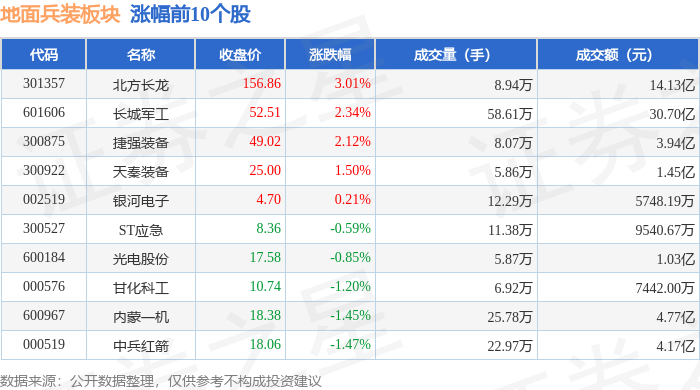
地面兵装板块11月4日跌0.22%,国科军工领跌,主力资金净流出6950.25万元
Zheng Xing Xing Ye Ri Bao· 2025-11-04 08:48
Market Overview - The ground armament sector experienced a decline of 0.22% on November 4, with Guoke Military leading the drop [1] - The Shanghai Composite Index closed at 3960.19, down 0.41%, while the Shenzhen Component Index closed at 13175.22, down 1.71% [1] Stock Performance - Notable gainers included: - Beifang Changlong (301357) with a closing price of 156.86, up 3.01% and a trading volume of 89,400 shares, totaling 1.413 billion yuan [1] - Great Wall Military (601606) closed at 52.51, up 2.34% with a trading volume of 586,100 shares, totaling 3.070 billion yuan [1] - Jieqiang Equipment (300875) closed at 49.02, up 2.12% with a trading volume of 80,700 shares, totaling 394 million yuan [1] - Notable decliners included: - Guoke Military (688543) closed at 52.25, down 2.39% with a trading volume of 49,200 shares, totaling 260 million yuan [2] - Beifang Navigation (600435) closed at 13.96, down 1.48% with a trading volume of 187,000 shares, totaling 262 million yuan [2] - ST Emergency (300527) closed at 8.36, down 0.59% with a trading volume of 113,800 shares, totaling 95.41 million yuan [2] Capital Flow - The ground armament sector saw a net outflow of 69.50 million yuan from institutional investors, while retail investors experienced a net inflow of 7.38 million yuan [2] - The main capital flow for key stocks included: - Great Wall Military had a net inflow of 88.34 million yuan from institutional investors, but a net outflow of 12.1 million yuan from retail investors [3] - Beifang Changlong saw a net inflow of 54.75 million yuan from institutional investors, with a net outflow of 30.39 million yuan from retail investors [3] - Jieqiang Equipment had a net inflow of 11.00 million yuan from institutional investors, but a net outflow of 11.52 million yuan from retail investors [3]



李在明就任后第二次发表施政演说:将大幅提升国防力量,切实实现“国防自主”
Huan Qiu Wang· 2025-11-04 04:05
Group 1 - The core message of the article emphasizes South Korea's commitment to pragmatic diplomacy focused on national interests, aiming to enhance national strength and international standing [1][3] - During the APEC meeting, South Korea and China agreed to cooperate for mutual benefit, with a notable bilateral currency swap agreement worth 70 trillion KRW [3] - The South Korean government reached a tariff agreement with the United States during the summit, and progress was made in acquiring nuclear submarine fuel, reinforcing the foundation for "self-defense" [3] Group 2 - The South Korean government is urged to accelerate its AI transformation, recognizing the critical challenges posed by the restructuring of international trade and the AI revolution [3] - Criticism was directed at the previous administration for wasting time and significantly cutting R&D budgets, which has led to a setback in national progress [3] - The government plans to significantly enhance national defense capabilities, with a historical high investment of 35.3 trillion KRW (approximately 174.7 billion RMB) allocated for core technology development in strategic industries such as AI, cultural creativity, and military [3]

广东宏大20251103
2025-11-03 15:48
Summary of Guangdong Hongda Conference Call Company and Industry Overview - **Company**: Guangdong Hongda - **Industry**: Defense and Military Equipment Manufacturing Key Points and Arguments 1. **Acquisition Strategy**: Guangdong Hongda enhanced its black powder production capacity through the acquisition of Jiangsu Hongguang, solidifying its position in the ammunition assembly industry. The company also partnered with Beijing Junhongrui to develop satellite internet and integrated aerospace electrical systems, while acquiring a stake in Changzhilin at a low valuation to synergize with its smart ammunition supply chain [2][5][17]. 2. **Order Backlog**: The company has approximately 40 billion in orders in the civil explosives and mining service sectors, supporting its first growth curve. The second growth curve is being developed through both organic growth and acquisitions, aligning with national defense strategic development trends [2][5]. 3. **Market Sentiment**: As of Q3 2025, the proportion of active funds holding positions in the defense and military sector has decreased compared to Q2, but there is an increasing recognition of the importance of safety in explosives and ammunition production [2][6]. 4. **Performance of Military Sector**: The overall performance of the military sector declined in Q3 2025, with a notable drop in stock prices during significant events like the September 3 military parade. However, companies like Feili Hua and Xinle Neng showed strong performance in AI computing for military applications [2][7][8]. 5. **Strategic Importance of "Fifteen" Plan**: The "Fifteen" plan emphasizes strategic pre-positioning, particularly in the safety production of explosives and ammunition, necessitating advancements in automation and safety measures across the entire production chain [2][11][12]. 6. **Emerging Opportunities**: Companies like Baiao Intelligent are leading in the field of safety production for explosives, with significant contracts and expanding market presence. Local state-owned military enterprises are also showing strong performance, indicating a demand-driven growth opportunity [2][14][15]. 7. **Future Trends**: The military industry is expected to focus on three main lines: military trade, internal installations, and military-to-civilian transitions. Guangdong Hongda is recommended as a key stock, particularly for its potential in high-precision missile exports [2][16][17]. 8. **Investment Recommendations**: Investors are advised to look for undervalued stocks with potential catalysts, particularly in the internal installation sector, where improvements in order data are anticipated [2][18][19]. Additional Important Insights - **Defense Market Dynamics**: Despite a lower market share in global military trade, Guangdong Hongda is positioned to capitalize on opportunities in the smart ammunition sector [2][4]. - **Sector Adjustments**: The military sector is undergoing significant adjustments, with a notable decrease in active fund holdings, indicating a cautious market sentiment [2][6][7]. - **Focus on Safety**: The emphasis on safety in explosives production is critical, with a need for innovation to mitigate risks associated with automation in manufacturing processes [2][12][13].

【公告全知道】可控核聚变+核电+芯片+机器人+储能+军工!公司核聚变超导系列材料已实现批量化供应
财联社· 2025-11-03 15:25
Group 1 - The article highlights the company's advancements in controllable nuclear fusion and superconducting materials, which have achieved mass production [1] - The company has successfully mass-produced rare earth permanent magnet materials for humanoid robots and other applications [1] - The company plans to acquire equity in a liquid cooling enterprise that indirectly supplies NVIDIA AI servers, indicating a strategic move in the AI and data center market [1]

探底回升暗藏玄机,后市聚焦这些方向
Sou Hu Cai Jing· 2025-11-03 11:30
Core Insights - The A-share and Hong Kong stock markets exhibited a mixed but generally strong performance, with A-shares seeing all major indices slightly rise and over 3,500 stocks gaining, indicating active market participation [1][3] - Key sectors driving the market include media, coal, and oil & petrochemicals, with AI applications and short drama games contributing to market sentiment recovery, while non-ferrous metals, home appliances, and lithium battery chains faced notable adjustments [1][4] - The Hong Kong market showed stronger performance, with major indices rising, driven by energy, finance, and consumer sectors, alongside continued inflow of southbound funds and increased foreign investment interest [1][5] Market Overview - A-shares saw a collective rebound with the Shanghai Composite Index rising 0.55% to 3976.52 points, while the Shenzhen Component and ChiNext Index saw minor increases of 0.19% and 0.29% respectively, with a trading volume of 2.11 trillion yuan [3] - The Hong Kong market's Hang Seng Index increased by 0.97% to 26158.36 points, with the Hang Seng China Enterprises Index also showing nearly a 1% rise, reflecting strong performance in energy and finance sectors [3][5] - The market is characterized by a rotation from high-priced themes to undervalued value stocks, while structural opportunities within the tech growth sector remain attractive [3][4] Sector Analysis - A-share sectors displayed significant divergence, with energy and AI applications as dual main lines; the coal sector saw a 10.29% increase in coking coal prices over 60 days, indicating the beginning of a new upward cycle [4] - The oil and petrochemical sectors strengthened due to OPEC+ announcing a production halt in Q1 2026, leading to tighter global energy supply expectations [4] - The media sector benefited from active AI applications, with multiple stocks hitting the daily limit up, enhancing market sentiment [4] Investment Recommendations - The current market phase is critical for "policy implementation" and "fund rebalancing," with a focus on industry trends and policy benefits to capture structural opportunities [6][7] - In the tech growth sector, emphasis should be placed on "hard tech breakthroughs + soft ecosystem implementation," particularly in AI applications and innovative pharmaceuticals [6] - The cyclical and resource sectors should leverage "global easing expectations + policy-driven recovery," with specific attention to gold and copper in the non-ferrous metals sector, and coal and oil sectors benefiting from energy security strategies [6][7]
“YYDS”的反击 | 谈股论金
水皮More· 2025-11-03 10:46
Market Overview - The three major A-share indices collectively rose slightly today, with the Shanghai Composite Index up 0.55% closing at 3976.52 points, the Shenzhen Component Index up 0.19% at 13404.06 points, and the ChiNext Index up 0.29% at 3196.87 points [3] - The total trading volume in the Shanghai and Shenzhen markets reached 2.1071 trillion yuan, a decrease of 210.7 billion yuan compared to the previous trading day [3] Private Fund Insights - Notable private fund managers, including Yang Dong and Chen Guangming, have announced fund closures, which should be taken seriously by investors. Chen Guangming, a former president of Dongfang Securities, has stated that his firm, Ruiyuan Fund, will no longer accept new subscriptions [4] - The key difference between private and public funds lies in their scale management, with private funds often making timely decisions to reduce size when indices reach certain highs [4] Market Dynamics - The Shanghai Composite Index showed resilience with minimal declines at the opening, primarily driven by major players like the "three oil giants" (PetroChina, CNOOC, Sinopec) and the banking sector, particularly Industrial and Commercial Bank of China [5] - The Shenzhen market experienced a maximum drop of 1.65% during the day but rebounded in the afternoon, largely due to the performance of four stocks, leading to a final increase of approximately 0.20% in the Shenzhen Component Index [6] Trading Sentiment - The market is currently in a phase of uncertainty regarding whether the recent small gains represent a continuation of a downtrend or a potential bottoming out, with further validation needed in upcoming sessions [6] - Approximately 3,479 stocks rose while about 1,500 fell today, with a median increase of around 0.6%. However, there was a net outflow of approximately 27 billion yuan from major funds, with northbound trading also seeing an outflow of about 25 billion yuan [6] Sector Performance - Strong performing sectors included AI applications (gaming, cultural media), military shipbuilding, photovoltaic, and coal, while underperforming sectors were primarily semiconductors, securities, insurance, and lithium batteries [6] - The current market sentiment and trading intensity are significantly lower compared to previous trends, indicating a lack of clear direction as mainstream funds have retreated [7]




军工行业2025年三季报业绩回顾:3Q利润系近9个季度首次正增长,行业回款仍有压力
Minsheng Securities· 2025-11-03 06:53
Investment Rating - The report maintains a positive outlook on the military industry, highlighting a significant recovery in demand and performance in 3Q25 [6]. Core Insights - The military industry experienced a revenue growth of 18.7% year-on-year in the first three quarters of 2025, with a notable recovery in demand since the beginning of the year [1][9]. - 3Q25 marked the first quarter of positive net profit growth in nearly nine quarters, with a year-on-year increase of 19.5% [2][67]. - The report emphasizes the non-linear relationship between revenue and profit growth, primarily influenced by price reductions and impairment losses [2][67]. - The inventory levels have shifted from negative to positive indicators, reflecting a proactive approach to production in response to order recovery [3][21]. - The report identifies key segments within the industry, such as weapons and drones, showing strong profit growth, while other segments like new materials are experiencing declines [4][53]. Summary by Sections Revenue and Profit Performance - In 1-3Q25, the military industry (excluding ships) achieved total revenue of 357.8 billion yuan, a year-on-year increase of 18.7%, while net profit decreased by 10% to 19.3 billion yuan [9][10]. - 3Q25 saw a revenue increase of 43.0% year-on-year, reaching 135.3 billion yuan, with net profit also increasing by 19.5% to 6.4 billion yuan [67][68]. Segment Analysis - The weapons segment showed a remarkable profit growth of 196.5% year-on-year, driven by significant increases in key companies [40][41]. - The drone segment also reported a revenue increase of 81.9% year-on-year, marking a return to profitability [44]. - The shipbuilding segment achieved a revenue of 176.8 billion yuan, with a net profit growth of 48.1% [45]. Inventory and Receivables - As of September 30, 2025, industry inventory reached 282.4 billion yuan, accounting for 79% of total revenue, indicating a positive shift in inventory management [3][21]. - Accounts receivable increased to 380.3 billion yuan, reflecting ongoing collection pressures but showing signs of improvement as the growth rate of receivables began to slow compared to revenue growth [23][28]. Cash Flow and Financial Health - The industry reported a net cash flow from operating activities of -39 billion yuan, although this represented a significant improvement compared to previous periods [28][29]. - The report highlights the importance of monitoring cash flow and receivables as indicators of financial health within the industry [28][23].
国防军工:军工本周观点:关注军贸及出口链-20251103
Huafu Securities· 2025-11-03 05:56
Investment Rating - The industry rating is "Outperform the Market" [4][60]. Core Insights - The report emphasizes the importance of military trade and export chains, highlighting the recent release of the "Suggestions on Formulating the 15th Five-Year Plan for National Economic and Social Development" by the Central Committee, which stresses the need for a modernized national security system and the high-quality advancement of national defense and military modernization [2][41]. - The report notes a significant increase in demand for the military industry expected in 2026, driven by multiple catalysts including the 15th Five-Year Plan and the centenary goals of the military [3][42]. - The current TTM price-to-earnings ratio for the military industry is 70.88, indicating a high configuration value at this time, especially with the anticipated strong recovery in the industry fundamentals by 2025 [3][42]. Summary by Sections 1. Market Review - The military index (801740) decreased by 0.07% from October 27 to October 31, while the CSI 300 index fell by 0.43%, resulting in an outperformance of 0.36 percentage points [8][13]. - Since the beginning of 2025, the military index has risen by 16.39%, compared to a 17.94% increase in the CSI 300 index, indicating a relative underperformance of -1.55 percentage points [15][21]. 2. Key Investment Opportunities - The report suggests focusing on various segments within the military industry, including: 1. Land Equipment: Tianqin Equipment, Gaode Infrared, Ligong Navigation, Baiao Intelligent, Great Wall Military Industry, and Zhongbing Hongjian [3][42]. 2. Stealth Materials: Jiachitech and Huaqin Technology [7][42]. 3. Deep Sea: Western Materials and China Marine Defense [7][42]. 4. Engines: Hangyu Technology, Hangya Technology, and Tunan Co [7][42]. 5. Unmanned & Anti-Unmanned: Zongheng Co, Aerospace Rainbow, Ruike Laser, Sichuang Electronics, and Xinjinggang [7][42]. 6. AI Intelligence: Xingtuxinke and Aerospace Electronics [7][42]. 7. Aircraft: AVIC Shenyang Aircraft and AVIC Xi'an Aircraft [7][42]. 8. Nuclear Fusion: Lianchuang Optoelectronics, Hezhuan Intelligent, Guoguang Electric, Jingye Intelligent, Weiteng Electric, Xinfengguang, Xuguang Electronics, Aike Saibo, Parker New Materials, Yongding Co, Wangzi New Materials, and Hongwei Technology [7][42]. 3. Funding and Valuation - There was a net outflow of 1.299 billion yuan from military ETFs during the week, indicating a decrease in passive fund size and share [25][32]. - However, leveraged funds saw an increase in net inflow, suggesting that risk capital is beginning to increase its allocation to the military sector [42][32]. - The report indicates that the military sector remains attractive for investment, with a high configuration value due to the expected recovery in demand [3][42].