焦煤

Search documents
中美在海事、物流和造船领域开启博弈
Guo Tai Jun An Qi Huo· 2025-10-15 01:41
1. Report Industry Investment Rating No relevant content provided. 2. Core Views of the Report - The US officially imposed restrictions such as port fees on China's maritime, logistics, and shipbuilding sectors. China strongly opposed this and announced counter - measures against 5 US - related subsidiaries of Hanwha Ocean Co., Ltd., highlighting China's determination to counter in key areas [7]. - For LPG, the price of domestic propane at the cost of arrival (tax - included) is basically below 4,000 yuan/ton. The demand has increased significantly, but it has not rebounded under speculative demand. The short - term pattern of strong domestic and weak foreign is clear, which is bullish for the long - short spread on the futures market, but the impact of Sino - US trade disputes and crude oil price trends should be noted [9][10]. - For cotton, the short - term trend is stable. Before mid - November, attention should be paid to the development of international economic and trade situations. The short - term trend of cotton futures is expected to be weakly volatile [11]. - For the container shipping index (European line), it will be volatile in the short term. Attention should be paid to the change in shipping capacity in November. The recent sharp rise was affected by China's counter - measures against Hanwha Ocean, but it has no substantial impact on the European line. The fundamentals show that most shipping companies are expected to be fully loaded in week 43, and the no - show rate needs further observation [12]. 3. Summary by Related Catalogs 3.1 Metal Products - **Gold**: Continues to reach new highs. The Fed Chairman Powell hinted at another interest rate cut and that the balance - sheet reduction is nearing the end, which is favorable for gold prices [21]. - **Silver**: The contradiction in the spot market has eased, and the price has risen and then fallen [21]. - **Copper**: The market is cautious, and the price is volatile. The production of Codelco in Chile has decreased, and China's copper imports in September have shown different trends [25][27]. - **Zinc**: The trend is weakly volatile. The Fed's attitude towards interest rates affects the market, and inventory and price data show certain changes [28]. - **Lead**: The inventory has increased, and the price is under pressure. The Fed's interest - rate policy also has an impact on the lead market [31]. - **Tin**: Attention should be paid to the macro - impact. The price of tin has declined, and inventory and price differences have changed [34]. - **Aluminum**: Ranges within a certain interval. Alumina's price center moves down, and cast aluminum alloy follows the trend of electrolytic aluminum. Market data such as inventory and price differences have changed [38]. - **Nickel**: The macro - sentiment has turned bearish, and the nickel price is oscillating at a low level. Stainless steel is under pressure from both the macro - environment and the actual situation, but the cost limits the downward space [41]. - **Lithium Carbonate**: The demand is improving, and the warehouse receipts are being cleared. The short - term trend is relatively strong [44]. - **Industrial Silicon**: The supply - demand pattern is weak [47]. - **Polysilicon**: Meetings are being held this week, and the futures market is expected to rise [48]. 3.2 Building Materials and Energy - **Iron Ore**: The price fluctuates widely. Market data such as inventory and price differences have changed, and relevant policies have an impact on the market [52]. - **Rebar and Hot - Rolled Coil**: The current situation is weak, and the expectation has also weakened. Steel prices may decline slightly [54]. - **Silicon Ferroalloy and Manganese Ferroalloy**: The quotations in the main production areas are unstable, and the prices fluctuate widely. The prices of manganese ore at ports have moved down [58]. - **Coke and Coking Coal**: The expectations are fluctuating, and the prices fluctuate widely. Market data such as inventory and price differences have changed [61][62]. - **Log**: The price oscillates repeatedly [64]. 3.3 Chemical Products - **Para - Xylene and PTA**: The medium - term trend remains weak [17]. - **MEG**: The spread between January and May contracts is in a reverse - arbitrage situation [17]. - **Rubber**: The price oscillates [17]. - **Synthetic Rubber**: The trend is weak [17]. - **Asphalt**: The price has declined following the oil price [17]. - **LLDPE and PP**: The trends are weak [17]. - **Caustic Soda**: Do not short in the short term [17]. - **Pulp**: The price oscillates [17]. - **Glass**: The price of raw glass is stable [17]. - **Methanol**: The price is under pressure and oscillates [17]. - **Urea**: The short - term trend is oscillating, and the medium - term trend is under pressure [17]. - **Styrene**: Stop loss on short positions [17]. - **Soda Ash**: The spot market has not changed much [17]. 3.4 Agricultural Products - **Palm Oil**: The driving force from the origin is limited. Attention should be paid to the support at the lower level [20]. - **Soybean Oil**: The price moves within a certain range. Attention should be paid to Sino - US economic and trade relations [20]. - **Soybean Meal and Soybean**: The trade concerns have resurfaced, and the prices may rebound and oscillate [20]. - **Corn**: The price has rebounded [20]. - **Sugar**: The price oscillates within a certain range [20]. - **Egg**: The price oscillates [20]. - **Live Pig**: The bottom of the spot price has not been reached [20]. - **Peanut**: Attention should be paid to the weather in the producing areas [20].

黑色金属日报-20251014
Guo Tou Qi Huo· 2025-10-14 12:34
Report Industry Investment Ratings - Thread steel: ☆☆☆, indicating a relatively balanced short - term multi/empty trend with poor operability on the current market, suggesting to wait and see [1] - Hot - rolled coil: ☆☆☆, same as above [1] - Iron ore: ☆☆☆, same as above [1] - Coke: ★☆★, with a bullish/ bearish bias but poor operability on the market [1] - Coking coal: ★☆★, same as above [1] - Silicon manganese: ☆☆☆, same as above [1] - Ferrosilicon: ☆☆☆, same as above [1] Core Viewpoints - The overall steel market is under pressure in the short term due to weak demand, negative feedback in the industrial chain, and macro - environment factors. Iron ore is expected to fluctuate at a high level. Coke and coking coal have support at previous lows, and silicon manganese and ferrosilicon have relatively stable demand and supply situations. External factors such as trade frictions and tariff policies need continuous attention [2][3][4] Summaries by Related Catalogs Steel - The steel futures market continued to decline today. During the long holiday, terminal demand decreased significantly month - on - month and remained weak year - on - year. Production decreased slightly, and inventory increased significantly. The recovery of post - holiday demand needs further observation. With the decline of steel mill profits, the negative feedback expectation in the industrial chain keeps fermenting. The overall domestic demand is still weak, and the steel export in September remained high. The market is under short - term pressure, and attention should be paid to the progress of bilateral games and domestic demand stimulus policies [2] Iron Ore - The iron ore futures market declined today. The global shipment decreased month - on - month but was stronger than the same period last year. The domestic arrival volume rebounded significantly and reached a new high this year. The iron - making water output decreased slightly but remained resilient at a high level. After the National Day, steel mills have a certain restocking demand, but the pressure of future production cuts is increasing. The negative feedback expectation in the industrial chain is strengthening, and the market sentiment has weakened. It is expected to fluctuate at a high level, and attention should be paid to the progress of Sino - US trade [3] Coke - The coke price rebounded after reaching the bottom during the day. The first round of price increases in the coking industry was fully implemented, and the second round was postponed. The profit level is average, daily production decreased slightly, and inventory decreased slightly. After pre - holiday restocking, downstream enterprises are mainly consuming inventory, and the purchasing intention of traders is general. The carbon element supply is abundant, and the high - level iron - making water provides support for raw materials. The support near the previous low is relatively solid. The futures price has a slight premium, and the market has certain expectations for the safety production assessment in the main coking coal production areas. Attention should be paid to the impact of US tariff increases [4] Coking Coal - The coking coal price rebounded after reaching the bottom during the day. The production of coking coal mines increased slightly, the spot auction turnover decreased slightly, and the transaction price remained stable. The terminal inventory decreased. The total coking coal inventory decreased significantly month - on - month, and the production - end inventory increased slightly. During the double festivals, some coking coal mines actively reduced production efficiency, resulting in a decrease in output. The carbon element supply is abundant, and the high - level iron - making water provides support for raw materials. The support near the previous low is relatively solid. The futures price has a slight discount to Mongolian coal, and the market has certain expectations for the safety production assessment in the main coking coal production areas. Attention should be paid to the impact of US tariff increases [6] Silicon Manganese - The silicon manganese price fluctuated during the day. The demand side, with high - level iron - making water production. The weekly production of silicon manganese decreased slightly but remained at a high level. The inventory decreased slightly, and the spot and futures demand is still good. The forward quotation of manganese ore increased slightly month - on - month, and the spot ore was boosted by the market. The manganese ore inventory decreased slightly, and the contradiction is not prominent. Attention should be paid to the impact of external trade frictions [7] Ferrosilicon - The ferrosilicon price fluctuated during the day. The demand side, with high - level iron - making water production. The export demand remained at about 30,000 tons, with a marginal impact. The production of magnesium metal increased slightly month - on - month, and the secondary demand increased marginally. The overall demand is acceptable. The supply of ferrosilicon remained at a high level, and the on - balance - sheet inventory continued to decline. Attention should be paid to the impact of external trade frictions [8]
广发期货《黑色》日报-20251014
Guang Fa Qi Huo· 2025-10-14 05:18
Report 1: Steel Industry Investment Rating No investment rating is provided in the report. Core View Although steel demand is weak, the cost side provides support. Pay attention to the support levels around 3000 and 3200 for the January contract of rebar and hot-rolled coil respectively. The short-term weak macro sentiment will suppress the black market, but if the Sino-US friction intensifies in the medium term, the inflation expectation of upstream resource products will increase. [1] Summary by Directory - **Steel Prices and Spreads**: Rebar and hot-rolled coil spot and futures prices mostly declined. For example, the spot price of rebar in East China dropped from 3230 to 3220 yuan/ton, and the 05 contract of rebar decreased from 3159 to 3139 yuan/ton. [1] - **Cost and Profit**: The steel billet price decreased by 10 to 2940 yuan/ton, and the profit of hot-rolled coil in East China decreased by 7. [1] - **Mills**: The daily average pig iron output decreased by 0.3 to 241.5 tons, a decline of 0.1%. The output of five major steel products decreased by 3.8 to 863.3 tons, a decline of 0.4%. [1] - **Inventory**: The inventory of five major steel products increased by 127.9 to 1600.7 tons, an increase of 8.7%. The rebar inventory increased by 57.4 to 659.6 tons, an increase of 9.5%. [1] - **Trading and Demand**: The building materials trading volume decreased by 0.7 to 9.1 tons, a decline of 7.1%. The apparent demand for five major steel products decreased by 153.4 to 751.4 tons, a decline of 17.0%. [1] Report 2: Iron Ore Industry Investment Rating No investment rating is provided in the report. Core View The iron ore market is in a balanced and slightly tight pattern. The weak performance of finished products drags down the raw materials. The iron ore is expected to fluctuate within a range. It is recommended to go long on the Iron Ore 2601 contract at low levels and conduct an arbitrage strategy of going long on iron ore and short on hot-rolled coil. [4] Summary by Directory - **Iron Ore Prices and Spreads**: The warehouse receipt costs of various iron ore powders increased, and the 1-5 spread increased by 3.0 to 23.5, an increase of 14.6%. [4] - **Supply**: The weekly global shipment volume of iron ore decreased by 71.5 to 3207.5 tons, a decline of 2.2%, and the 45-port arrival volume increased by 437.1 to 3045.8 tons, an increase of 16.8%. [4] - **Demand**: The weekly average daily pig iron output of 247 steel mills decreased by 0.3 to 241.5 tons, a decline of 0.1%. The national monthly crude steel output decreased by 229.0 to 7736.9 tons, a decline of 2.9%. [4] - **Inventory Changes**: The 45-port inventory increased by 46.7 to 14024.5 tons, an increase of 0.3%, and the imported ore inventory of 247 steel mills decreased by 990.6 to 9046.2 tons, a decline of 9.9%. [4] Report 3: Coke and Coking Coal Industry Investment Rating No investment rating is provided in the report. Core View For coke, it is recommended to go short on the Coke 2601 contract at high levels, with a reference range of 1550 - 1700, and conduct an arbitrage strategy of going long on iron ore and short on coke. For coking coal, it is recommended to go short on the Coking Coal 2601 contract at high levels, with a reference range of 1050 - 1200, and conduct an arbitrage strategy of going long on iron ore and short on coking coal. [6] Summary by Directory - **Coke and Coking Coal Prices and Spreads**: The prices of coke and coking coal contracts mostly declined. For example, the 01 contract of coke decreased from 1667 to 1643 yuan/ton, and the 01 contract of coking coal decreased from 1161 to 1146 yuan/ton. [6] - **Supply**: The daily average output of all-sample coking plants remained unchanged at 66.1 tons, and the output of raw coal decreased by 31.3 to 836.7 tons, a decline of 3.6%. [6] - **Demand**: The iron ore output decreased by 0.3 to 241.5 tons, a decline of 0.1%. [6] - **Inventory Changes**: The total coke inventory decreased by 10.1 to 909.8 tons, a decline of 1.1%, and the coking coal inventory of all-sample coking plants decreased by 78.7 to 959.1 tons, a decline of 7.6%. [6]
广发期货日评-20251014
Guang Fa Qi Huo· 2025-10-14 02:11
1. Report Industry Investment Ratings - No specific industry investment ratings are provided in the report. 2. Core Viewpoints - Trade friction disturbs the stock index, which opens lower but is expected to rebound after the initial decline, with the long - term upward trend remaining unchanged. The bond market influence is complex, and the 10 - year Treasury bond has increased allocation value when the interest rate rises above 1.8%. Gold has large fluctuations before the APEC meeting in South Korea at the end of October. Different commodities have different trends and corresponding trading suggestions based on their fundamentals and market conditions [3]. 3. Summary by Related Catalogs Financial Sector - **Stock Index**: Affected by trade friction, the stock index opens lower. It is recommended to sell put options near MO2512 - P - 7000 to collect premiums [3]. - **Treasury Bonds**: With the cooling of risk - aversion sentiment, the spot bond interest rate rises. The T2512 oscillation range may be between 107.4 - 108.3, and it is advisable to wait for oversold opportunities [3]. - **Precious Metals**: Due to the continuous fermentation of Sino - US trade friction concerns, precious metals reach new highs. It is recommended to buy gold at a light position above 910 yuan and maintain a long - silver strategy above 50 dollars [3]. - **Shipping Index (European Line)**: Given macro uncertainties, it is recommended to observe cautiously [3]. Black Sector - **Steel**: Affected by Sino - US friction, steel prices are weakly sorted. It is recommended to wait and see on a single - side basis and conduct reverse arbitrage on the monthly spread [3]. - **Iron Ore**: Supply disturbances weaken, and it is recommended to go long on iron ore 2601 at low prices, with a reference range of 780 - 850, and conduct arbitrage by going long on iron ore and short on hot - rolled coils [3]. - **Coking Coal**: After the festival, coking coal prices have a phased correction. It is recommended to go short on coking coal 2601 at high prices, with a reference range of 1050 - 1200, and conduct arbitrage by going long on iron ore and short on coking coal [3]. - **Coke**: The first round of price increases has been implemented before the festival, and there is limited room for further increases. It is recommended to go short on coke 2601 at high prices, with a reference range of 1550 - 1700, and conduct arbitrage by going long on iron ore and short on coke [3]. Non - ferrous Sector - **Copper**: With the easing of tariff concerns, copper prices are strongly running. It is recommended to take profits on long positions at high prices and pay attention to the support at 84000 - 85000 [3]. - **Alumina**: The market supply is sufficient, and the spot price continues to fall. The main operation range is 2850 - 3050 [3]. - **Aluminum**: The macro - environment boosts the price center to around 21000, and the main reference range is 20700 - 21300 [3]. - **Aluminum Alloy**: The scrap aluminum quotation is firm, and the finished ingot price rises with the aluminum price. The main reference range is 20200 - 20800 [3]. - **Zinc**: The fundamentals have limited support for prices, and zinc prices oscillate. The main reference range is 21500 - 22500 [3]. - **Tin**: With the repair of the macro - sentiment, tin prices rise slightly. It is recommended to wait and see [3]. - **Nickel**: The macro - expectations are volatile, and the main reference range is 120000 - 126000 [3]. - **Stainless Steel**: The macro - risk increases, and the industrial demand is still insufficient. The main reference range is 12500 - 13000 [3]. Energy and Chemical Sector - **Crude Oil**: The macro - sentiment repair promotes the oil price rebound, but the loose fundamentals suppress the oil price. It is recommended to take a short - selling approach on a single - side basis [3]. - **Urea**: The market trading sentiment improves, but the short - term rebound lacks fundamental support. It is recommended to take a short - selling approach on a single - side basis and reduce the implied volatility at high prices on the option side [3]. - **PX**: The supply - demand expectation is weak, and the oil price support is limited. It is recommended to wait and see on PX11 and look for short - selling opportunities on rebounds, and conduct reverse arbitrage on the monthly spread [3]. - **PTA**: The supply - demand expectation is weak, and the driving force is limited. It is recommended to wait and see on TA and pay attention to the support near 4500, and conduct rolling reverse arbitrage on TA1 - 5 [3]. - **Short - fiber**: The inventory pressure is not large, and there is short - term support. It is recommended to increase the spread at low positions, but the driving force is limited [3]. - **Bottle Chip**: The supply - demand pattern of bottle chips remains loose, but the cost side is weak, and the short - term processing fee improves. The trading suggestions are the same as those for PTA, and the main processing fee is expected to fluctuate between 350 - 500 yuan/ton [3]. - **Ethanol**: The port inventory accumulates, and the supply - demand structure of MEG in the far - month is weak. It is recommended to short - sell EG01 at high prices, hold the seller of the out - of - the - money call option EG2601 - C - 4350, and conduct reverse arbitrage on EG1 - 5 at high prices [3]. - **Caustic Soda**: The spot price is stable with a slight decline, and the short - term downstream demand for alumina is average. It is recommended to hold short positions [3]. - **PVC**: The spot procurement enthusiasm is average, and the disk continues to weaken. It is recommended to wait and see [3]. - **Benzene**: The supply - demand is relatively loose, and the price driving force is limited. BZ2603 is expected to oscillate following benzene ethylene and the oil price in the short term [3]. - **Styrene**: The supply - demand expectation is weak, and the benzene ethylene price may be under pressure. It is recommended to short - sell on the rebound of EB11 and increase the spread at the low level of the EB - BZ spread [3]. - **Synthetic Rubber**: The cost support weakens, and the supply - demand is relatively loose. It is recommended to hold the seller of the call option BR2511 - C - 11400 [3]. - **LLDPE**: The disk price drops, and the arbitrage transaction is average. It is recommended to pay attention to the inventory - reduction inflection point [3]. - **PP**: The PDH profit is significantly repaired, and the transaction improves. It is recommended to wait and see [3]. - **Methanol**: The basis strengthens significantly, and the transaction is acceptable. It is recommended to pay attention to the positive spread arbitrage opportunity between March and May [3]. Agricultural Sector - **Soybean and Related Products**: Affected by the changing Sino - US trade expectations, the supply pressure suppresses domestic prices. It is recommended to pay attention to the support of 01 near 2900 [3]. - **Live Pig**: The slaughter pressure of the breeding end is large, and the pig price remains low, showing a weak oscillating trend [3]. - **Corn**: As the supply increases, the disk price is under pressure and runs weakly [3]. - **Palm Oil**: Supported by the fundamentals, palm oil stops falling and recovers. The main short - term oscillation range may be between 9000 - 9500 [3]. - **Sugar**: The overseas supply outlook is broad, and the raw sugar price drops sharply. It is recommended to take a short - selling approach in the short term [3]. - **Cotton**: With the new cotton gradually coming onto the market, the supply pressure increases. It is recommended to hold short positions [3]. - **Egg**: After the festival, the demand weakens, and it maintains a short - bias trend. It is recommended to close short positions on the 2511 contract at low prices and pay attention to the monthly spread reverse arbitrage opportunity [3]. - **Apple**: The redness of late - Fuji apples is relatively light, and the high - quality apples have a significant price advantage. The main price runs near 8600 [3]. - **Jujube**: As the harvest time approaches, the long - short game intensifies, and it is bearish in the long - term [3]. - **Soda Ash**: The supply - demand surplus is difficult to reverse, and the soda ash price runs weakly. It is recommended to take a short - selling approach on the rebound [3]. Special Commodity Sector - **Glass**: The production and sales performance is average, and the logic of the off - peak season in the peak season continues. It is recommended to observe cautiously [3]. - **Rubber**: It is recommended to pay attention to the raw material price increase situation during the peak production season and wait and see [3]. - **Industrial Silicon**: The supply increases, and with cost support, the price oscillates between 8300 - 9000 yuan/ton [3]. New Energy Sector - **Polysilicon**: The supply increases, and polysilicon is under pressure. It is recommended to try to go long at low prices when the price returns to the lower edge of the range, and pay attention to the implementation of capacity storage [3]. - **Lithium Carbonate**: The macro - environment is weak, the fundamentals maintain a tight balance, and the main price center is expected to be in the range of 7 - 7.5 million [3].
黑色金属日报-20251013
Guo Tou Qi Huo· 2025-10-13 12:53
1. Report Industry Investment Ratings - The investment ratings for different products are as follows: - **Three-star ratings**: Thread steel, hot-rolled coil, and iron ore, indicating a clearer long/short trend and relatively appropriate investment opportunities currently [1]. - **One-star ratings**: Coke, coking coal, and silicon manganese, suggesting a bias towards long/short with a driving force for price increase/decrease, but poor operability on the trading floor [1]. - **One-star with one white-star rating**: Ferrosilicon, indicating a certain long/short tendency but relatively balanced short-term trends and poor operability on the trading floor [1]. 2. Core Views of the Report - The overall steel market is under pressure due to weak demand during the peak season, the resurgence of the US tariff - adding issue, and weak domestic demand. The iron ore market is expected to fluctuate at a high level. The coke and coking coal markets are supported by high - level pig iron production, and the silicon manganese and ferrosilicon markets are affected by high pig iron production and external trade frictions [2][3][4][6][7][8]. 3. Summaries by Relevant Catalogs **Steel** - The steel trading floor showed a weak oscillation today. During the holiday, the apparent demand for thread steel and hot - rolled coil decreased significantly, production declined slightly, and inventories accumulated substantially. Pig iron production remained high, and downstream carrying capacity was insufficient. With the decline in steel mill profits, the negative feedback expectation in the industry chain continued to ferment. Domestic demand was still weak, but steel exports in September remained high. The trading floor was under short - term pressure, and attention should be paid to the progress of the game between the two countries and the promotion of domestic demand stimulus policies [2]. **Iron Ore** - The iron ore trading floor rose today, and the basis fluctuated recently. On the supply side, global shipments decreased环比 but were stronger than the same period last year. Domestic arrivals rebounded significantly. On the demand side, pig iron production was highly resilient, and steel mills had certain replenishment needs after the National Day, but the pressure for future production cuts was increasing. Considering the low direct exports to the US and the upcoming important domestic meeting in October, the emotional impact was within expectations. It is expected that iron ore will mainly fluctuate at a high level [3]. **Coke** - The coke price oscillated upward today. The first round of price increases for coking was fully implemented, and the second round was postponed. Profits were average, daily production decreased slightly, and inventories decreased slightly. After pre - holiday replenishment, downstream enterprises were mainly consuming inventories, and traders' purchasing willingness was average. Overall, the carbon element supply was abundant, and high - level pig iron production provided support. The coke trading floor had a slight premium, and there were expectations for safety production assessments in major coking coal production areas. Attention should be paid to the impact of US tariff - adding [4]. **Coking Coal** - The coking coal price oscillated upward today. The production of coking coal mines increased slightly, spot auction transactions decreased slightly, and transaction prices remained stable. Terminal inventories decreased. The total coking coal inventory decreased significantly环比, and production - end inventories increased slightly. During the double festivals, some coking coal mines voluntarily reduced production efficiency, leading to a decline in production. Overall, the carbon element supply was abundant, high - level pig iron production provided support. The coking coal trading floor had a slight discount to Mongolian coal, and there were expectations for safety production assessments in major coking coal production areas. Attention should be paid to the impact of US tariff - adding [6]. **Silicon Manganese** - The silicon manganese price mainly oscillated today. On the demand side, pig iron production remained high. Weekly silicon manganese production decreased slightly but remained at a high level, inventories decreased slightly, and both futures and spot demand were still good. The forward quotation of manganese ore increased slightly环比, and spot ores were boosted by the trading floor. Manganese ore inventories decreased slightly, and the contradiction was not prominent. Attention should be paid to the impact of external trade frictions [7]. **Ferrosilicon** - The ferrosilicon price mainly oscillated today. On the demand side, pig iron production remained high. Export demand remained at around 30,000 tons, with a marginal impact. The production of magnesium metal increased slightly环比, and secondary demand increased marginally. Overall, demand was acceptable. Ferrosilicon supply remained at a high level, and on - balance - sheet inventories continued to decline. Attention should be paid to the impact of external trade frictions [8].
广发期货《黑色》日报-20251013
Guang Fa Qi Huo· 2025-10-13 06:20
Group 1: Report Summary - The report includes three industry period - spot daily reports on steel, iron ore, and coke & coking coal, dated October 10 - 13, 2025 [1][5][10] Group 2: Steel Industry Investment Rating - Not provided Core View - Short - term macro sentiment is bearish due to escalating Sino - US friction; industry supply - demand is balanced with low inventory pressure, but poor peak - season demand expectations suppress valuation; there is no trending market in the real - world industry; short - term weak macro sentiment will push black metals down; focus on the support levels of 3000 for rebar and 3200 for hot - rolled coils in the January contract [2] Section Summaries - **Prices and Spreads**: Rebar and hot - rolled coil spot prices mostly declined; some contract prices had small changes; steel billet prices decreased, while slab prices were stable; production costs and profits varied by region and production method [2] - **Production**: Daily average pig iron output decreased by 0.1% to 241.5 tons; five major steel product output decreased by 0.4% to 863.3 tons; rebar output decreased by 1.7% to 203.4 tons; hot - rolled coil output decreased by 0.4% to 323.3 tons [2] - **Inventory**: Five major steel product inventory increased by 8.7% to 1600.7 tons; rebar inventory increased by 9.5% to 659.6 tons; hot - rolled coil inventory increased by 8.5% to 412.9 tons [2] - **Trading and Demand**: Building material trading volume decreased by 7.1% to 9.1 tons; five major steel product apparent demand decreased by 17.0% to 751.4 tons; rebar apparent demand decreased by 36.5% to 153.2 tons; hot - rolled coil apparent demand decreased by 9.1% to 295.0 tons [2] Group 3: Iron Ore Industry Investment Rating - Not provided Core View - Last week, iron ore futures fluctuated upwards; supply concerns have weakened; demand from steel mills is weakening; the market will fluctuate within a range due to weak steel prices and falling mill profitability; pay attention to production control policies, Sino - Australian negotiations, and Sino - US tariff wars; consider going long on the 2601 contract at low prices and the spread trade of long iron ore and short hot - rolled coils [5][6] Section Summaries - **Prices and Spreads**: Warehouse receipt costs of various iron ore types increased slightly; spot prices at Rizhao Port rose slightly; price indices also increased; some spreads changed [5] - **Supply**: 45 - port weekly arrivals increased by 10.5% to 2608.7 tons; global weekly shipments decreased by 5.7% to 3279.0 tons; monthly national imports increased by 0.6% to 10522.5 tons [5] - **Demand**: 247 steel mills' weekly average pig iron output decreased by 0.1% to 241.5 tons; 45 - port weekly average ore - removal volume decreased by 2.8% to 327.0 tons; monthly national pig iron output decreased by 1.4% to 6979.3 tons; monthly national crude steel output decreased by 2.9% to 7736.9 tons [5] - **Inventory**: 45 - port inventory increased by 0.3% to 14024.5 tons; 247 steel mills' imported ore inventory decreased by 9.9% to 9046.2 tons; 64 steel mills' available inventory days decreased by 16.0% to 21.0 days [5] Group 4: Coke and Coking Coal Industry Investment Rating - Not provided Core View Coke - Last week, coke futures rebounded; spot prices are showing signs of weakness; there is a possibility of the coke futures price falling again; pay attention to production reduction policies in Shanxi and the steel market; consider shorting the 2601 contract at high prices and the spread trade of long iron ore and short coke [10] Coking Coal - Last week, coking coal futures rebounded; spot prices are weakening; the futures price may fall after rising; consider shorting the 2601 contract at high prices and the spread trade of long iron ore and short coking coal [10] Section Summaries Coke - **Prices and Spreads**: Some coke spot prices decreased; contract prices increased slightly; basis and spreads changed [10] - **Supply**: Total coke output was stable, with a slight decrease in 247 steel mills' output [10] - **Demand**: 247 steel mills' pig iron output decreased slightly [10] - **Inventory**: Total coke inventory decreased slightly; coking plants' inventory increased, while steel mills' and port inventories decreased [10] Coking Coal - **Prices and Spreads**: Some coking coal spot prices changed; contract prices decreased slightly; basis and spreads changed [10] - **Supply**: Coal mine output decreased after the holiday and will gradually recover; imported Mongolian coal prices weakened [10] - **Demand**: Pig iron output and coking plant operation decreased slightly; downstream replenishment demand weakened [10] - **Inventory**: Coal mines' inventory increased, while other sectors' inventories decreased [10]
《黑色》日报-20251013
Guang Fa Qi Huo· 2025-10-13 05:58
Group 1: Steel Industry Report Industry Investment Rating Not provided Core View The short - term macro sentiment is weak due to Sino - US friction, which will cause black metals to decline. There is no trend in the industrial reality. The 1 - month contract of rebar and hot - rolled coil should focus on the support levels around 3000 and 3200 respectively. The steel supply and demand are basically balanced, but the export demand is expected to weaken due to Sino - US friction escalation [2]. Summaries by Relevant Catalogs - **Prices and Spreads**: Rebar and hot - rolled coil spot prices mostly declined. Costs and profits showed mixed trends, with some costs increasing slightly and some profits decreasing. The daily average iron - making water output and the output of five major steel products decreased slightly [2]. - **Output**: The daily average iron - making water output was 241.5 (down 0.3 from the previous value, - 0.1%), the output of five major steel products was 863.3 (down 3.8, - 0.4%), and the rebar output was 203.4 (down 3.6, - 1.7%) [2]. - **Inventory**: The inventory of five major steel products increased by 8.7% to 1600.7, rebar inventory increased by 9.5% to 659.6, and hot - rolled coil inventory increased by 8.5% to 412.9 [2]. - **Trading and Demand**: The building materials trading volume decreased by 7.1%, and the apparent demand for five major steel products decreased by 17.0% [2]. Group 2: Iron Ore Industry Report Industry Investment Rating Not provided Core View Last week, iron ore futures fluctuated and rose. The supply concerns have weakened, but the demand is weakening due to the decline in steel mill profit margins and the weakening of steel mill restocking demand. The iron ore will fluctuate within a range. It is recommended to go long on the 2601 contract of iron ore at low prices and carry out an arbitrage strategy of long iron ore and short hot - rolled coil [5][6]. Summaries by Relevant Catalogs - **Prices and Spreads**: The prices of various iron ore varieties and price indices increased slightly. The spreads between different contracts also changed, with the 5 - 9 spread increasing by 4.9% and the 9 - 1 spread decreasing by 5.0% [5]. - **Supply**: The global shipping volume of iron ore decreased by 5.7% week - on - week, while the 45 - port arrival volume increased by 10.5%. The subsequent average arrival volume is expected to decline [5]. - **Demand**: The daily average iron - making water output of 247 steel mills decreased by 0.1%, the 45 - port daily average ore - handling volume decreased by 2.8%, and the national monthly pig iron and crude steel output decreased [5]. - **Inventory**: The 45 - port inventory increased by 0.3%, the imported ore inventory of 247 steel mills decreased by 9.9%, and the inventory - available days of 64 steel mills decreased by 16.0% [5]. Group 3: Coke and Coking Coal Industry Report Industry Investment Rating Not provided Core View - **Coke**: Last week, coke futures fluctuated and rebounded. The supply side has some problems, and the demand is weak. The coke inventory is moderately decreasing. The coke futures may fall again due to the weakening of spot prices and the weakening of steel prices. Attention should be paid to the implementation of capacity reduction in the coking industry and the steel market [10]. - **Coking Coal**: Last week, coking coal futures fluctuated and rebounded. The spot market is weakening, and the demand for restocking is weakening. Although the futures rebounded due to supply - side disturbances, the spot weakness may cause the futures to fall. It is recommended to go short on the 2601 contract of coking coal at high prices and carry out an arbitrage strategy of long iron ore and short coking coal [10]. Summaries by Relevant Catalogs - **Prices and Spreads**: Coke and coking coal contract prices showed different trends, with some contracts rising and some falling. The basis and spreads between different contracts also changed [10]. - **Supply**: The output of coking coal mines decreased during the holiday and will gradually resume production. The output of coke and coking coal has changed slightly [10]. - **Demand**: The iron - making water output decreased slightly, and the demand for coke and coking coal restocking is weakening [10]. - **Inventory**: The coke inventory of coking plants increased, while the inventory of steel mills and ports decreased. The coking coal inventory of mines increased, and the inventory of other links decreased [10].
广发期货《黑色》日报-20251010
Guang Fa Qi Huo· 2025-10-10 05:51
Report Industry Investment Rating - Not provided in the content Core Viewpoints - For the steel industry, after the holiday, steel prices rebounded slightly. Steel production decreased slightly during the holiday, and inventory increased significantly due to stagnant demand. The supply - demand gap narrowed at the end of September. In October, demand is expected to recover seasonally, and inventory is expected to decline seasonally. The short - term supply and demand are basically balanced, and inventory pressure is not large. Pay attention to the support levels of 3050 and 3200 for rebar and hot - rolled coil January contracts respectively. The unilateral drive is not obvious. For arbitrage, reverse arbitrage on the monthly spread at high levels and convergence of the hot - rolled coil to rebar spread are recommended [3]. - For the iron ore industry, on the first trading day after the holiday, iron ore showed an oscillating upward trend. There are many disturbances on the supply side, but the external iron ore swap still follows the domestic price trend. Iron ore has a rebound drive, but the upward space depends on steel prices to give steel mills profits. Short - term, buy iron ore 2601 at low prices, with a price range of 760 - 830, go long on iron ore and short on hot - rolled coil, and buy out - of - the - money call options on iron ore 2601 [5]. - For the coke and coking coal industries, after the holiday, coke and coking coal futures rebounded from the bottom, showing a divergence between futures and spot. The coke market is expected to have another round of price increase, but may face downward pressure due to compressed steel mill profits. The coking coal market is expected to be weak but the futures have a rebound expectation. For coke, buy coking coal 2601 at low prices in the price range of 1550 - 1750, conduct 1 - 5 reverse arbitrage on coke, and buy out - of - the - money call options on coke 2601. For coking coal, buy at low prices in the price range of 1080 - 1180, conduct 1 - 5 reverse arbitrage, and buy out - of - the - money call options on coking coal 2601 [8][9]. Summary by Relevant Catalogs Steel Industry Prices and Spreads - Rebar spot prices in East, North, and South China are 3240, 3210, and 3320 yuan/ton respectively. Rebar 01, 05, and 10 contracts are at 3096, 3159, and 3020 yuan/ton respectively. Hot - rolled coil spot prices in East, North, and South China are 3350, 3290, and 3320 yuan/ton respectively. Hot - rolled coil 01, 05, and 10 contracts are at 3293, 3259, and 3370 yuan/ton respectively [2][4]. Cost and Profit - Steel billet price is 2960 yuan/ton, up 10 yuan. Plate billet price is 3730 yuan/ton, unchanged. Profits of East, North, and South China hot - rolled coils are 66, 16, and 46 yuan/ton respectively, all decreasing [3]. Supply and Inventory - Daily average pig iron output is 241.5, down 0.3 (- 0.1%). Five - major steel products output is 863.3 (down 3.8, - 0.4%) million tons. Rebar output is 203.4, down 3.6 (- 1.7%). Five - major steel products inventory is 1600.7 (up 127.9, 8.7%) million tons, rebar inventory is 659.6 (up 57.4, 9.5%), and hot - rolled coil inventory is 412.9 (up 32.3, 8.5%) [3]. Demand - Building materials trading volume is 12.0, up 3.9 (49.0%). Five - major steel products apparent demand is 751.4, down 153.4 (- 17.0%) [3]. Iron Ore Industry Prices and Spreads - Warehouse receipt costs of various iron ore powders and spot prices at Rizhao Port have different changes. The 5 - 9 spread is 20.5, up 1.5 (7.9%); the 9 - 1 spread is - 40.0, unchanged; the 1 - 5 spread is 19.5, down 1.5 (- 7.1%) [5]. Supply - 45 - port weekly arrivals are 2608.7, up 248.2 (10.5%) million tons. Global weekly shipments are 3279.0, down 196.4 (- 5.7%) million tons. National monthly import volume is 10522.5, up 61.5 (0.6%) [5]. Demand - 247 steel mills' weekly average daily pig iron output is 241.5, down 0.3 (- 0.1%). 45 - port weekly average daily port clearance is 0.0, down 336.4 (- 100.0%) million tons. National monthly pig iron and crude steel outputs are 6979.3 and 7736.9 respectively, both decreasing [5]. Inventory - 45 - port inventory decreased by 22.5 (- 0.2%) million tons compared to Monday. 247 steel mills' imported iron ore inventory increased by 300.4 (3.1%). 64 steel mills' inventory available days decreased by 4.0 (- 16.0%) [5]. Coke and Coking Coal Industries Prices and Spreads - Coke and coking coal contract prices and basis have different changes. For example, coke 01 contract is 1654, up 31 (1.9%); coking coal 01 contract is 1164, up 38 (3.4%) [9]. Supply - Coke production: The daily average output of all - sample coking plants is 66.1, unchanged; 247 steel mills' daily average output is 241.8, down 0.6 (- 0.2%) million tons. Coking coal production: Raw coal output is 836.7, down 31.3 (- 3.6%); refined coal product is 426.3, down 19.8 (- 4.4%) million tons [9]. Demand - 247 steel mills' pig iron output is 241.5, down 0.3 (- 0.1%) million tons. The daily average output of all - sample coking plants for coke demand is 66.1, unchanged [9]. Inventory - Coke total inventory is 909.8, down 10.1 (- 1.1%). Coking coal inventory: Fenwei coal mine refined coal inventory increased by 14.1 (14.5%), and other inventories had different changes [9].
《黑色》日报-20251009
Guang Fa Qi Huo· 2025-10-09 03:20
Group 1: Steel Industry Report Industry Investment Rating - Not provided Core View - After the holiday, the demand for steel is expected to seasonally recover, and the inventory is expected to maintain a seasonal destocking trend. The short - term supply and demand are basically balanced, and the inventory pressure is not large. The steel price is expected to stabilize. For trading strategies, the unilateral driving force is not obvious. In terms of arbitrage, the monthly spread should be mainly reverse arbitrage at high levels, and the spread between hot - rolled coils and rebar should converge. [1] Summary by Directory - **Steel Prices and Spreads**: The prices of rebar and hot - rolled coil spot and futures contracts generally declined. For example, the rebar 05 contract decreased from 3155 to 3128 yuan/ton, and the hot - rolled coil 01 contract decreased from 3289 to 3253 yuan/ton. [1] - **Cost and Profit**: The steel billet price decreased by 20 yuan/ton, and the profits of various steel products generally declined. For example, the East China hot - rolled coil profit decreased by 35. [1] - **Production**: The daily average pig iron output increased by 0.4% to 242.0 tons, and the output of five major steel products increased by 0.2% to 867.1 tons. The electric - furnace output of rebar increased by 13.6%, while the converter output decreased by 1.4%. [1] - **Inventory**: The inventory of five major steel products decreased by 2.5% to 1472.9 tons, and the rebar inventory decreased by 5.4% to 602.3 tons. [1] - **Transaction and Demand**: The building materials transaction volume decreased by 26.5% to 8.0 tons, while the apparent demand for five major steel products increased by 3.5% to 904.8 tons, and the apparent demand for rebar increased by 9.4% to 241.1 tons. [1] Group 2: Iron Ore Industry Report Industry Investment Rating - Not provided Core View - There are many disturbances on the supply side of iron ore, but the upward space is limited. It is necessary to pay attention to the actual arrival situation of BHP's shipments. The trading strategies include short - term long - position trading of iron ore 2601 in the price range of 760 - 830, long - iron - ore and short - hot - rolled coil, and buying out - of - the - money call options of iron ore 2601. [4] Summary by Directory - **Prices and Spreads**: The basis of some iron ore varieties for the 01 contract increased, such as the 01 contract basis of PB powder increased from 40.9 to 44.4 yuan/ton. The 5 - 9 spread decreased by 2.6% to 19.0. [4] - **Supply**: The 45 - port arrival volume increased by 10.5% to 2608.7 tons, the global shipment volume decreased by 5.7% to 3279.0 tons, and the national monthly import volume increased by 0.6% to 10522.5 tons. [4] - **Demand**: The daily average pig iron output of 247 steel mills decreased by 0.2% to 241.8 tons, the 45 - port daily average unloading volume decreased by 100.0% to 0.0 tons, the national monthly pig iron output decreased by 1.4% to 6979.3 tons, and the national monthly crude steel output decreased by 2.9% to 7736.9 tons. [4] - **Inventory**: The 45 - port inventory decreased by 0.2% to 13977.79 tons, the imported ore inventory of 247 steel mills increased by 3.1% to 10036.8 tons, and the inventory available days of 64 steel mills increased by 4.2% to 25.0 days. [4] Group 3: Coke and Coking Coal Industry Report Industry Investment Rating - Not provided Core View - For coke, after the festival, there is still an expectation of a price increase, but it may face downward pressure due to the decline in steel prices. The downward space is limited, and it is regarded as a volatile market. For coking coal, due to the impact of imports and the pre - holiday market, it is also regarded as a volatile market. [8] Summary by Directory - **Prices and Spreads**: The prices of coke and coking coal futures contracts generally declined. For example, the coke 01 contract decreased from 1647 to 1623 yuan/ton, and the coking coal 01 contract decreased from 1154 to 1126 yuan/ton. [8] - **Supply**: The daily average output of all - sample coking plants decreased by 0.4% to 66.1 tons, and the daily average output of 247 steel mills decreased by 0.2% to 241.8 tons. The raw coal output of Fenwei sample coal mines increased by 0.5% to 876.6 tons. [8] - **Demand**: The pig iron output of 247 steel mills decreased by 0.2% to 241.8 tons, and the daily average output of all - sample coking plants decreased by 0.4% to 66.1 tons. [8] - **Inventory**: The total coke inventory decreased by 0.1% to 919.8 tons, the coking coal inventory of all - sample coking plants increased by 3.9% to 1037.7 tons, and the coking coal inventory of 247 steel mills decreased by 1.0% to 788.1 tons. [8] - **Supply - Demand Gap**: The calculated supply - demand gap of coke increased slightly from - 4.6 to - 4.5 tons. [8]
程强:三季度成长板块领涨市场
Sou Hu Cai Jing· 2025-10-01 05:30
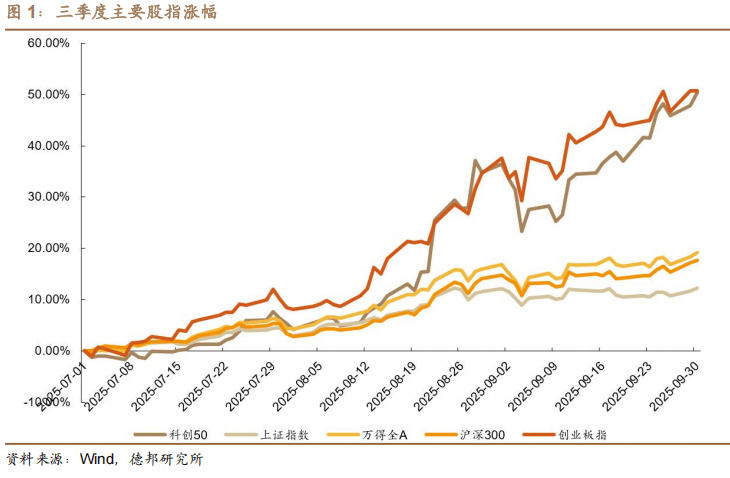
Market Overview - The A-share market showed a mixed upward trend, with technology stocks maintaining strength, while the 30-year treasury futures rebounded after hitting a new low [1] - The overall market liquidity remained abundant, supporting a structural market trend [2] Stock Market Analysis - In Q3, the ChiNext and Sci-Tech 50 indices rose approximately 50%, indicating a strong preference for technology growth sectors [3] - The last trading day before the holidays saw a divergence in market styles, with growth sectors continuing to perform well while defensive sectors like finance faced pressure [2][3] Bond Market Analysis - The treasury futures market strengthened, with the 10-year and 30-year contracts showing notable gains [5] - The overall funding environment was relaxed, alleviating cross-quarter pressures, and the short-term interest rates showed mixed trends [5] Commodity Market Analysis - The commodity market displayed significant divergence, with precious metals leading gains while black metals faced declines [6] - The focus has shifted from policy expectations to actual policy effects, particularly in the black metal sector, which has seen substantial price adjustments [6] Trading Hotspots - Key sectors to watch include precious metals, artificial intelligence, domestic chips, robotics, and consumer goods, driven by factors such as central bank policies and technological advancements [10][11] - The market is expected to transition from a "technology-led" rally to a more "balanced allocation" approach, with continued strong performance in specific segments of the technology sector [11]