
创新药

Search documents
创新药板块早盘走强,恒生创新药ETF(159316)标的指数涨超1%,行业并购整合机遇受关注
Mei Ri Jing Ji Xin Wen· 2025-12-04 03:53
Group 1 - The Hong Kong innovative drug sector showed strength in early trading, with companies like Kangfang Biopharma and Zai Lab rising over 3% [1] - The Hang Seng Innovative Drug ETF (159316) saw its index increase by over 1%, reflecting positive market sentiment [1] - Chinese innovative drug development is becoming a significant global player, with increasing overseas licensing transactions driving growth in the sector [1] Group 2 - The pharmaceutical industry is entering a critical phase characterized by "innovation realization + global layout," supported by population and domestic demand, as well as comprehensive manufacturing capabilities [1] - Companies are actively exploring diverse overseas expansion paths, indicating a strategic shift towards international markets [1] - By 2026, opportunities in innovative commercialization, global breakthroughs, policy optimization, and industry mergers and acquisitions are expected to emerge [1] Group 3 - The Hang Seng Hong Kong Stock Connect Innovative Drug Index is one of the first "pure" 100% innovative drug indices, accurately reflecting the overall performance of China's innovative drug companies [1] - The Hang Seng Innovative Drug ETF (159316) is currently the only product tracking this index, providing investors with a convenient way to seize industry development opportunities [1]
港股科技ETF(513020)盘中涨超1%,近10日净流入超2亿元,看好科技板块引领作用
Mei Ri Jing Ji Xin Wen· 2025-12-04 03:18
Group 1 - The core viewpoint is that major companies are accelerating their computing power layout, maintaining a positive outlook on the technology sector's leading role, and valuing the allocation of internet heavyweight assets [1] - The Q3 earnings season for the internet sector has concluded without significant narrative changes, but there is optimism for individual stock EPS recovery, especially for those previously impacted by competition, and for AI-related valuation increases in the coming year [1] - The recommendation is to strategically invest in fundamentally strong internet giants that will benefit from AI catalysts, particularly as the gaming sector is currently valued at a mid-low level, presenting opportunities for valuation recovery driven by AI applications [1] Group 2 - The Hong Kong Technology ETF (513020) tracks the Hong Kong Stock Connect Technology Index (931573), which covers core assets in sectors such as internet, innovative pharmaceuticals, and new energy vehicles, reflecting the diversified characteristics of the technology industry in the Hong Kong market [1] - The Hong Kong Stock Connect Technology Index has a higher allocation in new energy vehicles and innovative pharmaceuticals compared to the Hang Seng Technology Index, with a cumulative return of 256.46% from the base date at the end of 2014 to October 2025, outperforming the Hang Seng Technology Index by nearly 160% [1]
港股小幅高开 均胜电子纳入港股通标的
Mei Ri Jing Ji Xin Wen· 2025-12-04 02:46
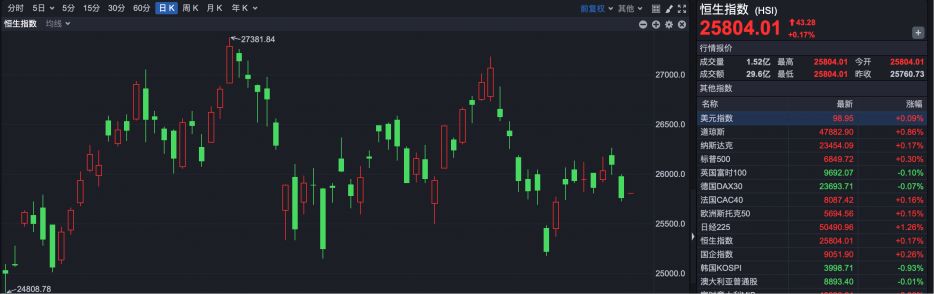
Market Overview - The Hong Kong stock market opened slightly higher on December 4, with the Hang Seng Index at 25,804.01 points, up 43.28 points, a gain of 0.17% [10] - The Hang Seng Tech Index reported 5,552.43 points, increasing by 17.51 points, a rise of 0.32% [12] Company News - Junsheng Electronics (HK00699) has been included in the Hong Kong Stock Connect list, effective December 4, 2025, following the end of its price stabilization period in the Hong Kong market and after being listed for 10 trading days [5][14] - Junsheng Electronics' H-shares were listed on November 6 at an issue price of HKD 22, but fell to a low of HKD 14.28 before recovering to HKD 18.22 at the time of reporting [5][14] Sector Performance - The technology sector showed mixed results, with Meituan rising over 1% and Alibaba declining by 0.33% [7][15] - The innovative drug sector opened higher, with Gilead Sciences rising over 5% [7][15] - The non-ferrous metals sector saw most stocks increase, with Chalco International up over 7%, Zijin Mining and Minmetals Resources up over 4%, and Jiangxi Copper up over 3% [7][15] Market Outlook - Brokerage firms remain optimistic about the medium to long-term prospects of the Hong Kong stock market despite short-term volatility [8][15] - Short-term opportunities are seen in high dividend defensive sectors and areas supported by policy expectations [8][15] - Long-term investments are recommended in reasonably valued and fundamentally sound technology stocks, as well as potentially undervalued consumer and pharmaceutical sectors [8][15] - Positive signals to watch for include expectations of interest rate cuts by the Federal Reserve, which may improve market liquidity, along with continued inflows of southbound capital providing support [8][15]


创新药情绪回暖,资金连续5日申购恒生医药ETF
Sou Hu Cai Jing· 2025-12-04 02:31
创新药板块在2025年迎来爆发行情,聚焦港股市场创新药的恒生医药ETF(159892)此前年内涨幅一度 突破100%,其二级市场价格在9月8日创年内新高,而随着市场担忧创新药泡沫及海外事件扰动,恒生 医药ETF震荡调整,自9月高位回调已超15%。 每日经济新闻 随着美国经济数据下滑、失业率创新高,美联储降息预期持续升温,对于全球流动性环境更敏感的医药 板块活跃度提升,恒生医药ETF已连续5日获得资金申购。 消息面来看,中国药品价格登记系统12月2日在北京正式发布,该系统有望通过信息的透明化,为各类 市场主体提供可靠的价格参考,促进形成更加理性、公平的市场定价环境。 ...
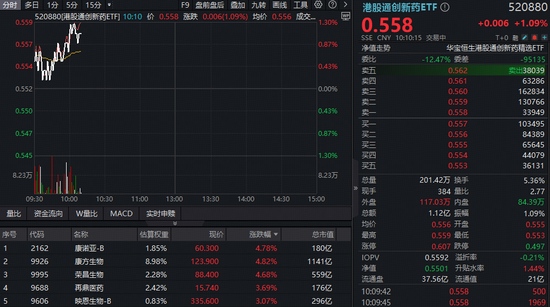
港股创新药逆市走强,康方生物领涨!520880拉升逾1%,机构:创新药跨年行情可期
Xin Lang Cai Jing· 2025-12-04 02:22
Group 1 - The core viewpoint of the news is that after a four-day decline, the Hong Kong innovative drug sector has rebounded, with leading stocks like Kangfang Biotech and Rongchang Biotech showing significant gains [1][7] - The Hong Kong Stock Connect Innovative Drug ETF (520880) has over 70% of its holdings in leading innovative drug stocks, indicating strong market confidence [1][7] - The innovative drug sector is expected to be a major upward trend in the cross-year market, supported by China's pharmaceutical industry entering a critical phase of "innovation realization + global layout" [3][9] Group 2 - The Hong Kong Stock Connect Innovative Drug ETF (520880) has a total scale of 2.142 billion yuan and an average daily trading volume of 458 million yuan since its listing, making it the largest and most liquid ETF tracking the same index [5][10] - The index tracked by the ETF, the Hang Seng Stock Connect Innovative Drug Select Index, has a high concentration of leading stocks, with the top ten stocks accounting for 72.57% of the total weight, showcasing the strength of the innovative drug sector [3][10] - The ETF is designed to cover pure innovative drug companies without including CXO, ensuring a comprehensive representation of the innovative drug research and development sector [4][9]

港股及海外市场展望
2025-12-04 02:22
Summary of Conference Call Notes Industry Overview - The conference call discusses the outlook for the Hong Kong and overseas markets in 2025, highlighting frequent asset rotation driven by credit expansion expectations [1][2] - The U.S. market is experiencing a credit cycle recovery, with expectations of a volatile or slowing trend in 2026, influenced by emerging demand, government spending, and potential Fed rate cuts [1][5] - The Chinese market is characterized by excess liquidity chasing scarce return assets, but reliance solely on liquidity is insufficient for sustained market growth [1][8] Key Points and Arguments Credit Cycle and Market Dynamics - The credit cycle is expected to gradually stabilize in Q4 2025, with a focus on the gap between actual and natural interest rates, industry trends, and policy support [1][10] - The investment strategy should align with credit expansion directions, favoring stable return assets during downturns and cyclical sectors during expansions [3][4][17] U.S. Market Insights - The U.S. market is projected to have a positive outlook, supported by a 13% to 16% earnings growth, despite high short-term valuations and risks [5] - AI technology is highlighted as a significant area of potential, with companies saving an average of 10% through AI, translating to approximately $300 billion in annual savings for S&P 500 companies [5][13] Gold Market Evaluation - Gold is viewed as a long-term value asset and a partial substitute for dollar credit, with a recommendation for a dollar-cost averaging investment strategy [1][7] - If gold prices reach $5,500, its total value could exceed the total value of U.S. Treasury bonds, indicating its potential as a hedge against dollar depreciation [7] Chinese Market Challenges - The Chinese market faces challenges related to excess liquidity and the need for fundamental support to sustain growth [8][9] - Historical lessons from Japan suggest that relying solely on liquidity without addressing income expectations and debt pressures can lead to market stagnation [9] Policy Effectiveness and Investment Strategy - The effectiveness of policies is prioritized as follows: finding new growth points, enhancing income expectations, and alleviating debt pressures [11] - The Hong Kong market index is projected to reach between 26,000 and 29,000 points under baseline scenarios, with a focus on dividend stocks and banking sectors as investment strategies [2][12] Sector Opportunities - Certain sectors, particularly those with low valuations and strong demand expectations, are identified as having trading opportunities [15] - External demand is significantly impacting the economic structure, with strong export demand driven by supply chain restructuring in emerging markets [16] Additional Important Insights - The bond market is experiencing unexpected rate cut expectations, suggesting a need for intermittent trading strategies to mitigate risks associated with Fed policy changes [6] - The potential for cyclical shifts in sectors like chemicals and coal is noted, as some investors may view these as opportunities for trading based on credit cycle dynamics [14]
中泰证券:创新药行情有望持续 积极布局2026年基本面有望改善的医药板块
Zheng Quan Shi Bao Wang· 2025-12-04 00:06
Group 1 - The core viewpoint of the article emphasizes that innovative drugs remain the most important theme in the pharmaceutical sector, with recent fluctuations leading to a return to relatively reasonable and low stock price levels, market expectations, and capital allocation, highlighting the investment safety margin and return value [1] - The report suggests that within the pharmaceutical sector, there has been a certain degree of high-low switching or thematic rotation due to the recent surge and subsequent adjustment in innovative drugs [1] - It is recommended to actively position in sectors and stocks that are expected to see fundamental improvements in 2026, driven by price clearing, demand recovery, and turning points in the business cycle [1]

金融活水润泽湾区 助力打造资本市场“广东样板”
Sou Hu Cai Jing· 2025-12-03 22:16
Group 1: Economic and Market Development - Guangdong is China's largest economic province and a vibrant capital market region, with significant achievements during the "14th Five-Year Plan" period, including advancements in the Greater Bay Area financial hub and increased activity in mergers and acquisitions [1][2] - The construction of the Greater Bay Area financial hub has seen the implementation of various financial support policies, resulting in a notable increase in cross-border investment participation, with 169,800 individual investors involved by September 2025, a 34.4% increase from pre-trial levels [2] Group 2: Financial Institutions and Capital Market Strength - By September 2025, the net capital of securities firms in Guangdong reached 139.36 billion yuan, with total assets of 1.01 trillion yuan, reflecting significant growth of 33.13%, 90.83%, and 43.06% respectively since the end of 2020 [2] - The establishment of investment advisory institutions in Guangzhou aims to enhance wealth management transformation, with the first approved fund sales license for a consulting firm achieving over 400 million yuan in sales on its opening day [3] Group 3: Innovation and Technology Financing - From January 2021 to October 2025, Guangdong saw 143 new IPOs, with 135 being technology companies, accounting for 94.41% of the total, indicating a strong focus on supporting technological innovation [6] - The issuance of innovation bonds has increased, with 118 technology innovation bonds issued, raising 88.68 billion yuan, and an average issuance interest rate of 1.91%, lower than the market average [7] Group 4: Mergers and Acquisitions Activity - Since the introduction of the "Mergers and Acquisitions Six Guidelines" in 2024, over 250 listed companies in Guangdong have engaged in mergers and acquisitions, with transaction volumes exceeding 150 billion yuan [9] - Notable merger activities include TCL Technology's acquisition of LG Guangzhou and Huaxing Semiconductor, enhancing Guangdong's position in the semiconductor and display industries [9] Group 5: Regulatory Support and Future Outlook - The Guangdong Securities Regulatory Bureau is actively supporting the establishment of a merger and acquisition alliance and has created a database to improve efficiency in corporate acquisitions [10] - Future initiatives will focus on enhancing the capital market ecosystem to support innovation and technology-driven enterprises, aiming to align with Guangdong's economic and technological strengths [8]
股价飙涨的热景生物急于寻找第二增长曲线
Guo Ji Jin Rong Bao· 2025-12-03 13:28
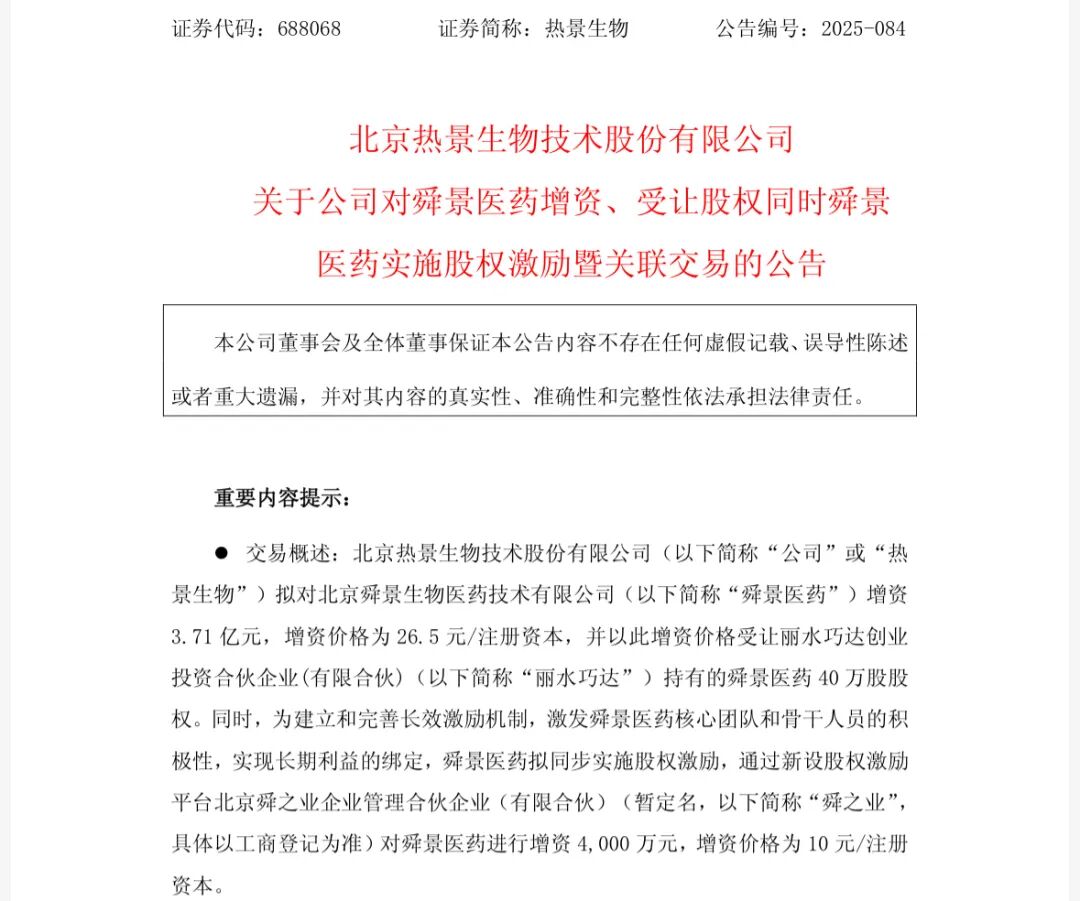
Core Viewpoint - The company, 热景生物, is significantly increasing its investment in 舜景医药 and 尧景基因, aiming to strengthen its position in the innovative drug sector while facing challenges in its core IVD business [1][4][10]. Investment Plans - 热景生物 plans to invest 371 million yuan in 舜景医药, increasing its stake from 43.18% to 50.23% and gaining control through board restructuring [1][4]. - The company will also invest 24 million yuan in 尧景基因 to enhance its gene technology capabilities [4][14]. - 舜景医药 is set to implement a 40 million yuan equity incentive plan [4]. Stock Performance - Following the announcement of these investment plans, 热景生物's stock price rose by 2.52% to 183.3 yuan per share, with an increase of over 900% since September 2024 [4][13]. - The company's market capitalization reached approximately 16.993 billion yuan [13]. Business Strategy - 热景生物 is pursuing a dual-driven strategy of "diagnostics + innovative drugs," focusing on antibody and nucleic acid drugs [6][7]. - The company aims to counteract the downward pressure in the IVD industry by diversifying into the innovative drug sector [11]. Financial Performance - In the first three quarters of 2025, 热景生物 reported a revenue of 310 million yuan, a year-on-year decrease of 19.8%, and a net loss of 109 million yuan, which is a 168.12% increase in losses compared to the previous year [10]. - The company's revenue has significantly declined from 5.14 billion yuan in 2020 to 5.41 million yuan in 2023, with a projected further decline to 5.11 billion yuan in 2024 [10][11]. Challenges in the IVD Industry - The IVD industry is experiencing a downturn due to policy impacts, leading to a 13.94% revenue decline and a 32.20% drop in net profit across the sector [11]. - Over 70% of IVD companies are expected to report losses in 2025, with a cumulative loss exceeding 5.6 billion yuan [11]. R&D and Future Prospects - 舜景医药 is in the early stages of development, with no profitable products yet, but has promising drug candidates like SGC001 for acute myocardial infarction [7][8]. - The company has reduced its R&D investment from 191 million yuan in 2022 to 113 million yuan in 2024, raising concerns about its ability to support innovative drug development [12].

2026年资本市场年度策略展望:全球格局重构与“十五五”战略新机遇
ZHONGTAI SECURITIES· 2025-12-03 13:24
Group 1 - The core driver of the current A-share market is the systematic increase in risk appetite, stemming from a profound "reconstruction" of the global landscape [6][29][37] - The ongoing geopolitical competition and the shift in national power dynamics have elevated the strategic position of capital markets, reflecting long-term expectations of national strength and institutional stability rather than short-term profit fluctuations [7][41][43] Group 2 - The report identifies two key time points in 2026 regarding the Federal Reserve and US-China relations, which will significantly influence market dynamics [8][10][62] - The potential change in the Federal Reserve's leadership could lead to a more dovish monetary policy, impacting global liquidity and risk appetite in emerging markets, including A-shares [10][60][61] Group 3 - The capital market is expected to play a crucial role in "debt management" and "expectation management," with a focus on stabilizing local government debt risks through asset securitization [12][46] - The market is anticipated to exhibit a "slow bull" characteristic, with accelerated rotation and the importance of retail investor sentiment as a contrarian indicator [12][46] Group 4 - The report emphasizes the significance of the AI industry, particularly in storage chips and humanoid robots, as key areas for investment due to their strategic importance in the AI era [20][22] - The focus on "反内卷" (anti-involution) will benefit upstream resources critical to national competitiveness, such as lithium and graphite materials, which are expected to see increased demand [22][23] Group 5 - The new consumption trends among younger generations are highlighted as structural opportunities, with sectors like gaming and pet products poised for growth [23] - The report suggests that safety asset allocations, such as high-dividend stocks and gold, will become increasingly attractive amid ongoing geopolitical tensions [24][25]