
国防军工

Search documents
十大券商:4000点后如何应对?结构性机会仍存,盘整震荡中布局再平衡
Zheng Quan Shi Bao Wang· 2025-11-02 23:09
Group 1 - The current index level is not as critical as the underlying quality of the market, with structural opportunities still present despite short-term fears in the technology sector [1] - The overall growth is entering a recovery phase, with improvements in net profit margins across various sectors, particularly in emerging technologies and cyclical industries [2] - The market is expected to experience a period of consolidation, with a potential shift in investment styles as the year-end approaches [4] Group 2 - The focus is shifting towards internal structural optimization following the completion of the third-quarter reports, with an emphasis on sectors like AI and export-related industries [6] - The technology sector remains a key investment theme, although short-term volatility may increase due to adjustments in fund allocations [8] - The outlook for the market remains optimistic in the medium to long term, supported by stable policies and a recovering economic environment [9]

【十大券商一周策略】4000点后如何应对?结构性机会仍存,盘整震荡中布局再平衡
Zheng Quan Shi Bao Wang· 2025-11-02 15:37
Group 1 - The current market index is at a similar level to 2015, but with significantly better quality and lower valuation, indicating that there is no need to overly focus on the index points themselves [1] - Structural opportunities still exist in various sectors such as new energy, chemicals, consumer electronics, resources, and machinery, despite short-term investor caution primarily in the technology sector [1] - The focus for the remainder of the year should be on structural adjustments, with recommendations to invest in traditional manufacturing upgrades, Chinese companies going abroad, and edge AI [1] Group 2 - The overall growth is entering a recovery cycle, with improvements in net profit margins across various sectors due to accelerated overseas expansion and the implementation of anti-involution measures [2] - The performance of large and mid-cap stocks, which are closely related to the overall economy, shows greater earnings elasticity, indicating a positive trend in China's asset growth [2] - Certain sectors, including emerging technology and cyclical industries, are in a recovery and expansion phase, while others face excess supply pressures [2] Group 3 - The A-share market is expected to experience a period of horizontal adjustment due to the exhaustion of previous upward momentum and the upcoming policy vacuum [4] - The electronic industry and innovation sectors have seen record high allocations in fund reports, suggesting potential structural adjustments in the market [4] - Key investment areas include coal, oil and gas, new energy, non-bank financials, public utilities, media, food and beverage, and transportation [4] Group 4 - The market trend remains positive, supported by macro policies and resilient fundamentals from third-quarter earnings reports [5] - Technology companies with real technological barriers and those aligned with national strategies are expected to be key investment themes [5] - The construction of projects is anticipated to enhance the industrial chain, benefiting companies through increased orders and performance releases [5] Group 5 - The focus is shifting from macro risks to internal structural optimization following the completion of the third-quarter reports and the resolution of U.S.-China trade discussions [6] - The AI sector remains a mid-term industry focus, with potential for rotation within growth sectors [6] - Attention is drawn to industries such as non-ferrous metals, AI applications, power storage, and emerging themes like controlled nuclear fusion and commercial aerospace [6] Group 6 - The market is expected to experience short-term fluctuations and adjustments, with a long-term optimistic outlook due to stable internal and external policies [7] - The new profit growth cycle has begun, with a focus on low-base sectors that may release greater elasticity next year [7] - The technology sector's high allocation in institutional portfolios indicates a need to monitor performance and potential shifts in investment strategies [7] Group 7 - The market is undergoing a rebalancing phase, with a high concentration of active equity fund holdings in the TMT sector, indicating a shift in investor sentiment [8] - There is a growing skepticism towards capital expenditure expansion in overseas markets, while domestic industries are expected to benefit from improved operational conditions [8] - Attention is recommended for upstream resources and sectors benefiting from domestic price stabilization and economic recovery [8] Group 8 - The technology growth sector is experiencing a slowdown in short-term over-allocation, leading to increased volatility [9] - The TMT sector's allocation by funds has reached historical highs, indicating a strong focus on technology growth as a primary market driver [10] - The potential for further increases in fund allocations to the TMT sector suggests ongoing interest and investment opportunities in technology [10] Group 9 - The expectation of a shift from strategic decoupling to a phase of cooperation between the U.S. and China is likely to enhance risk appetite for RMB assets [11] - The market is not expected to experience a straightforward upward trajectory, but the overall bullish sentiment remains intact despite potential high-level fluctuations [11] - The focus on low-position cyclical sectors and overseas opportunities is anticipated to be a key investment strategy moving forward [11]

A股财报深度分析系列:2025年三季报深度分析:两非盈利改善,ROE低位反弹
Soochow Securities· 2025-11-02 04:01
Overall Analysis - The overall performance of A-shares in Q3 2025 shows a significant improvement in profitability, with a year-on-year growth rate of 11.55% in net profit attributable to shareholders, a substantial increase compared to Q2 2025 [1][11] - The cumulative net profit growth rate for the first three quarters of 2025 reached 5.55%, indicating a recovery in profitability driven by active trading in the A-share market and notable improvements in non-banking sectors [1][10] Industry Analysis - The industries with the highest year-on-year net profit growth in Q3 2025 include steel (+202.9%), defense industry (+73.2%), non-bank financials (+64.9%), media (+57.2%), and non-ferrous metals (+50.9%), primarily concentrated in anti-involution and high-prosperity TMT sectors [3][4] - The recovery in profitability is particularly evident in upstream and midstream sectors, while downstream consumption remains under pressure [3][4] Profitability Analysis - The return on equity (ROE) for A-shares (excluding financials and petrochemicals) rebounded slightly to 6.31% in Q3 2025, although it remains at a low level, necessitating further observation for upward elasticity [2][25] - The main drivers for the ROE rebound include improvements in net profit margin and stabilization of asset turnover, with a slight decrease in the debt-to-asset ratio [2][25] Cash Flow Analysis - The net cash flow as a percentage of revenue in Q3 2025 is at a relatively low level compared to the past decade, with operating cash flow showing improvement year-on-year [2][3] - The financing cash flow has also increased year-on-year, indicating some debt repayment pressure on enterprises [2][3] Sector Performance - The growth rates of net profit attributable to shareholders in various sectors show that the innovation and entrepreneurship sector has significantly improved, while the growth style continues to lead in profitability [2][21] - The main board, STAR Market, and ChiNext have shown stable performance, with the STAR Market achieving a remarkable year-on-year net profit growth of 65.40% in Q3 2025 [2][21]
投资策略专题:2025年三季报速览:量价改善,行业轮动力量积蓄
KAIYUAN SECURITIES· 2025-11-02 03:15
Core Insights - The report highlights a significant improvement in both revenue and profit growth for the A-share market in Q3 2025, with a notable turnaround in net profit growth for non-financial sectors [3][4] - The overall revenue growth for the A-share market reached 3.7% year-on-year in Q3 2025, compared to -0.2% in Q1 and 0.4% in Q2, while non-financial sectors saw a revenue growth of 2.3% [3][4] - Net profit growth for the entire A-share market was 11.4% year-on-year in Q3 2025, a significant increase from 3.8% in Q1 and 1.4% in Q2, with non-financial sectors showing a profit growth of 3.9% [3][4] Structural Perspective - The report indicates that the performance of major broad-based indices has improved across the board, with the ChiNext and STAR Market showing the highest earnings elasticity [4][10] - In Q3 2025, the ChiNext and STAR Market reported net profit growth rates of 58.3% and 32.8% respectively, with significant quarter-on-quarter improvements [4][10] - The dual drivers of high-tech prosperity and cyclical recovery are emphasized, with sectors like media, electronics, power equipment, and defense showing substantial profit growth exceeding 30% year-on-year [4][10] Stock Price Performance - The report notes that stock prices in the real estate and construction sectors have been more active following the mid-year earnings disclosures, indicating a market expectation for sector rotation [5] - The sectors with the most notable mid-year earnings growth are concentrated in technology manufacturing and certain cyclical industries like steel and non-ferrous metals [5] - The report suggests that the market's expectation for sector rotation is strengthening, particularly in sectors with high policy expectations, such as real estate and cyclical products [5]
航天电器(002025):业绩符合预期,公司加强降本增效,Q3经营质量有所回升
Orient Securities· 2025-10-31 11:13
Investment Rating - The report maintains a "Buy" rating for the company with a target price of 52.65 yuan, based on a revised EPS forecast for 2025, 2026, and 2027 of 0.71, 1.35, and 1.79 yuan respectively [3][5]. Core Insights - The company reported a revenue of 4.349 billion yuan for the first three quarters of 2025, reflecting an increase of 8.87%, while the net profit attributable to shareholders decreased by 62.77% to 146 million yuan. In Q3 alone, revenue reached 1.414 billion yuan, a year-on-year growth of 31.73%, and net profit increased by 122.54% year-on-year and 47.88% quarter-on-quarter [2][10]. - The company is experiencing a recovery in operational quality due to cost reduction and efficiency improvement measures, with Q3 showing a rebound in performance and profitability [10]. - The defense market is witnessing a recovery, and the company has seen significant growth in both military and civilian product orders since the beginning of the year, although revenue recognition has been delayed due to extended customer acceptance periods [10]. Financial Summary - For 2025, the company expects revenues of 5.907 billion yuan, with a year-on-year growth of 17.6%. The operating profit is projected at 422 million yuan, a slight increase of 3.8% compared to the previous year. The net profit attributable to shareholders is forecasted to be 325 million yuan, a decrease of 6.5% [4][14]. - The gross margin is expected to decline to 34.3% in 2025, while the net margin is projected at 5.5% [4]. - The company's inventory as of Q3 2025 stood at 2.477 billion yuan, a 33.84% increase from the beginning of the year, indicating strong order demand and production capacity improvements [10].

光启技术现3笔大宗交易 总成交金额3.15亿元
Zheng Quan Shi Bao Wang· 2025-10-31 10:02
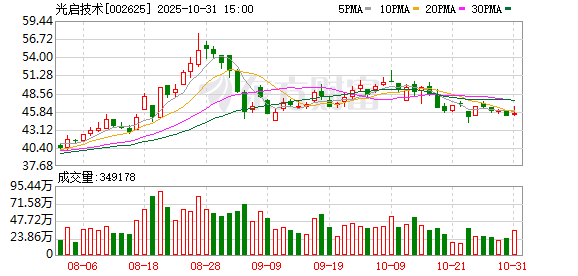
Core Insights - On October 31, 2023, Guangqi Technology executed three block trades totaling 7.10 million shares, with a transaction value of 315 million yuan [2] - The block trades were conducted at a discount relative to the closing price, indicating bearish market sentiment [2] - Over the past three months, the stock has seen a total of 107 block trades, amounting to 8.01 billion yuan [2] Trading Performance - The closing price of Guangqi Technology on October 31 was 45.56 yuan, reflecting a 0.86% increase, with a turnover rate of 1.62% and a total trading volume of 1.60 billion yuan [2] - The stock experienced a net outflow of 15.81 million yuan in principal funds for the day, and a cumulative decline of 2.21% over the past five days, with a total net outflow of 634 million yuan [2] Margin Financing - The latest margin financing balance for Guangqi Technology stands at 8.30 billion yuan, with a decrease of 45.16 million yuan over the past five days, representing a decline of 0.54% [2] Company Background - Guangqi Technology Co., Ltd. was established on July 18, 2001, with a registered capital of 2.15 billion yuan [2]

国科军工:截至2025年9月30日公司的股东人数为16757户
Zheng Quan Ri Bao· 2025-10-31 09:39
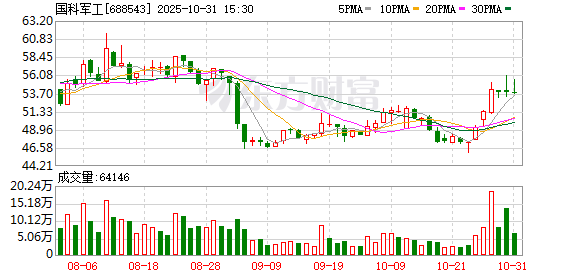
Group 1 - The company Guokai Military Industry reported that as of September 30, 2025, the number of shareholders is 16,757 [2]

3Q2025业绩速览:电力设备、军工和医药业绩加速向上
CAITONG SECURITIES· 2025-10-31 08:50
Core Insights - The report highlights that in Q3 2025, the performance of the power equipment, military industry, and pharmaceuticals has accelerated upward, with a disclosure rate of 99.5% for quarterly reports. The cumulative year-on-year net profit for the entire A-share market and non-financial A-shares increased by 5.9% and -0.1%, respectively, compared to Q2, which represents an improvement of 3.2 and 0.3 percentage points. Revenue year-on-year decreased by 1.2% and 3%, respectively, but showed a marginal improvement compared to Q2 [2][6][9] Performance Overview - In terms of sectors, the ChiNext board outperformed, with a cumulative year-on-year net profit growth of 18.8%, an increase of 7.4 percentage points from Q2. The Sci-Tech Innovation Board saw a year-on-year decline of 3.9%, but this was an improvement of over 20 percentage points compared to Q2 [6][9] - From an index perspective, the ChiNext Index and CSI 300 performed well, with cumulative year-on-year net profit growth of 0.7% and 0.2% in Q3 2025, while the North Star 50 index lagged behind [6][9] - Industry-wise, power equipment, military, pharmaceuticals, and communications showed continuous improvement in both performance and revenue over two consecutive periods, indicating a strong upward trend. The steel, military, non-bank financials, and non-ferrous metals sectors exhibited the most significant quarter-on-quarter improvements in Q3 [6][9][10] Sector Performance - The report provides detailed performance metrics for various sectors in Q3 2025. For instance, the power equipment sector recorded a 50% year-on-year growth in net profit, while the military sector saw a 73% increase. The pharmaceuticals sector, however, reported no growth in net profit [10] - The report also highlights that the coal sector experienced a significant decline, with a year-on-year net profit decrease of 24%, while the steel sector showed a remarkable recovery with a 203% increase [10]
粤开市场日报-20251031
Yuekai Securities· 2025-10-31 07:54
Market Overview - The main indices showed a decline today, with the Shanghai Composite Index down by 0.81%, the Shenzhen Component down by 1.14%, and the ChiNext Index down by 2.31% [1] - In terms of industry performance, the pharmaceutical and biological, media, and retail sectors led the gains, while non-bank financials, public utilities, and defense industries lagged behind [1] Concept Sector Performance - Overall, the lithium battery electrolyte, innovative drugs, and vaccine concepts performed relatively well, whereas rare earths, memory storage, and large-scale infrastructure state-owned enterprises showed weaker performance [1]
机构风向标 | 迈信林(688685)2025年三季度已披露持仓机构仅3家
Xin Lang Cai Jing· 2025-10-31 03:04
Group 1 - The core point of the article is that Maxinlin (688685.SH) reported its Q3 2025 results, revealing a decrease in institutional investor holdings compared to the previous quarter [1] - As of October 30, 2025, three institutional investors disclosed holding a total of 9.0597 million shares of Maxinlin, representing 6.23% of the total share capital [1] - The institutional holding ratio decreased by 0.90 percentage points compared to the previous quarter [1] Group 2 - The public funds that did not disclose holdings in the current period totaled 192, including notable funds such as Changxin National Defense Military Industry Quantitative Mixed A and Dongfang Alpha Zhaoyang Mixed A [1]
