
汽车

Search documents
雷军称十五五小米将重点攻坚芯片等底层核心技术 猫眼娱乐去年净利同比增超190%
Xin Lang Cai Jing· 2026-02-24 23:26
Group 1: Company Developments - Xiaomi plans to focus on core technologies such as chips, AI, and operating systems over the next five years to become a global hard-tech company [1] - Meta has reached an AI device procurement agreement with AMD, involving the deployment of 6 gigawatts of AMD GPUs and a potential sale of AI chips worth up to $60 billion [1] - Cat's Eye Entertainment expects revenue of 4.6 to 4.7 billion yuan for FY2025, representing a year-on-year growth of approximately 12.7% to 15.1%, with net profit projected at 540 to 590 million yuan, a year-on-year increase of about 196.9% to 224.4% [5] - Green Tea Group anticipates a net profit of 460 to 508 million yuan for 2025, reflecting a year-on-year increase of approximately 31.4% to 45.1% [6] - Baosheng Group forecasts total operating revenue of 3.698 billion yuan for 2025, a year-on-year decrease of 0.8%, with same-store sales expected to decline by 16.6% [7] - Haizhi Technology Group has entered into a strategic cooperation framework agreement with Zhiyu to collaborate on model training and application scenarios [8] Group 2: Market Performance - The Nasdaq China Golden Dragon Index rose by 1.37%, with notable performances from Alibaba (up 0.22%), Pinduoduo (up 1.06%), and JD.com (up 1.07%) [3] - The Hang Seng Index fell by 1.82% to 26,590.32 points, with the technology index down 2.13% [4] - The S&P 500 Index increased by 0.77% to 6,890.07 points, while the Nasdaq Composite Index rose by 1.04% to 22,863.68 points [2]


新浪财经隔夜要闻大事汇总:2026年2月25日
Xin Lang Cai Jing· 2026-02-24 23:18
来源:芝麻AI 一、市场: ●2月25日收盘:美股周二收高,芯片与软件股带领大盘反弹 北京时间2月25日凌晨,美股周二收高,AMD和软件类股领涨。投资者对人工智能颠覆某些行业的担忧 缓解,道指、纳指、标普500指数均上涨。家得宝、IBM等股价上涨支撑大盘,AMD因与Meta达成协议 股价大涨。软件股也因人工智能或补充而非取代的乐观预期上涨。Savvy Wealth首席投资官称这是抛售 之后的释压性反弹。此外,美联储古尔斯比呼吁暂停降息,认为在通胀回落至2%前不宜大幅降息;沃 勒态度更谨慎,还提及推进在银行系统部署人工智能。2月上旬美国劳动力市场有改善迹象。 [1] ●2月25日美股成交额前20:AMD达成巨额AI芯片协议,股价大涨 周二美股成交额前20中,英伟达收高0.68%,汇丰下调其目标股价;特斯拉收高2.39%,首台Cybercab量 产车提前下线,但面临监管挑战,2025年财务及交付数据下滑。闪迪收跌4.20%,遭香橼做空。AMD收 高8.77%,与Meta达成超千亿美元AI芯片协议,Meta或持有其10%股份。苹果收高2.24%,首批触控版 Mac秋季发布。Meta与AMD扩大合作,协议金额或超60 ...

常州市56家重点监测商贸企业 春节假期销售额同比增5.5%
Jiang Nan Shi Bao· 2026-02-24 23:11
Core Insights - The article highlights the efforts of Changzhou city to promote consumption, ensure supply, and maintain safety during the Spring Festival, resulting in a prosperous and orderly market [1] Group 1: Sales Performance - From February 15 to 23, sales revenue of 56 monitored comprehensive and retail catering enterprises in Changzhou reached 790 million yuan, representing a 5.5% increase compared to the same period last year [1] Group 2: Promotional Activities - Changzhou implemented "trade-in" programs for automobiles and home appliances, along with personal new car purchase subsidies, to stimulate sales [1] - Between February 15 and 22, the automobile scrapping and replacement subsidy amounted to 970,000 yuan, driving sales of 15.24 million yuan; the home appliance trade-in subsidy reached 8.87 million yuan, leading to sales of 71.07 million yuan [1] - Over 5 million yuan in dining consumption vouchers were distributed, alongside the introduction of promotional meal sets to enhance the overall consumer experience [1]
21社论丨用好优势抓住机遇,促进广东制造业与服务业协同发展
2 1 Shi Ji Jing Ji Bao Dao· 2026-02-24 23:09
Group 1 - The core theme of the Guangdong conference is the collaborative development of manufacturing and service industries to explore new paths for high-quality development [1] - Guangdong's manufacturing sector accounts for 1/8 of the national manufacturing value added and approximately 1/3 of the province's GDP, establishing it as a global manufacturing hub [1] - The manufacturing industry in Guangdong is transitioning towards intelligent, green, and integrated development, aiming to move from low-value assembly to high-value design and sales [1] Group 2 - The historical evolution of developed economies shows that manufacturing and service industries have always evolved dynamically and collaboratively, leading to deeper industrial division and tighter integration [2] - The rapid development of information technology since the 1990s has empowered manufacturing through service-oriented manufacturing and the integration of the digital economy with the real economy [2] - The current technological revolution and industrial transformation necessitate a strong collaboration between manufacturing and services, leveraging advancements in AI, biomanufacturing, and quantum communication [2] Group 3 - Guangdong has unique advantages in the global technological revolution, with the Guangdong-Hong Kong-Macao Greater Bay Area being the only region with both mechanical and AI technologies [3] - The manufacturing sector in Guangdong includes leading industries such as home appliances, mobile phones, and automobiles, which need to collaborate with intelligent technologies to enhance their competitive edge [3] - A supportive market environment is essential for the collaborative innovation of manufacturing and services, requiring regulatory frameworks that facilitate new products, business models, and technological innovations [3]
近半高管害怕失业,汽车业挤满焦虑的中年人
汽车商业评论· 2026-02-24 23:06
Core Insights - The automotive industry is currently facing unprecedented disruption, with a Disruption Index score of 74, making it the most impacted sector globally for the second consecutive year [4][6] - Over 40% of automotive executives express concerns about job security, significantly higher than the average of 28% across other industries [6] - The survey indicates that new competition and business models are perceived as the most significant disruptive challenges, surpassing traditional concerns like tariffs and geopolitical conflicts [11] Group 1: Executive Concerns - Executives in the automotive sector are particularly anxious, with shared mobility and fleet operators showing the highest disruption index at approximately 85 [11] - The automotive aftermarket, dealership sales, and related services follow closely with disruption indices around 78-80, indicating a widespread concern about the pace of transformation [11] - Nearly 59% of automotive executives admit their companies are lagging in technological advancements, highlighting a personal and corporate crisis [17] Group 2: Industry Transformation - The shift towards electric and intelligent vehicles is creating structural challenges for traditional automotive giants, with Chinese brands gaining a competitive edge due to faster product development cycles [12] - 81% of executives wish to pursue vertical integration as a response to supply chain and technological uncertainties [17] - Despite the anxiety, 72% of executives see potential in autonomous vehicles and advanced driver-assistance systems, while 69% recognize the positive impact of AI and machine learning [18] Group 3: Operational Strategies - The automotive industry is focusing on improving operational efficiency and capital management as primary growth levers, with only 20% of executives considering new products and services as key growth drivers [20] - The lengthy development cycles in the automotive sector hinder the rapid monetization of AI technologies, which are primarily used for cost reduction rather than revenue generation [18][20] - The industry is currently prioritizing efficiency improvements to maintain stability amid rising costs of raw materials and logistics [20]

用好优势抓住机遇,促进广东制造业与服务业协同发展
2 1 Shi Ji Jing Ji Bao Dao· 2026-02-24 22:40
Group 1 - The core theme of the Guangdong conference is the collaborative development of manufacturing and service industries to explore new paths for high-quality development [1] - Guangdong's manufacturing sector accounts for 1/8 of the national manufacturing value added and approximately 1/3 of the province's GDP, establishing it as a global manufacturing hub [1] - The manufacturing industry in Guangdong is transitioning towards intelligent, green, and integrated development, aiming to move from low-value assembly to high-value design and sales [1] Group 2 - The historical evolution of developed economies shows that manufacturing and service industries have always evolved dynamically and collaboratively, leading to deeper industrial division and tighter integration [2] - The rapid development of information technology since the 1990s has empowered manufacturing through service-oriented manufacturing and the integration of digital and physical economies [2] - The current technological revolution and industrial transformation necessitate a strong collaboration between manufacturing and services, leveraging advancements in AI, bio-manufacturing, and quantum communication [2] Group 3 - Guangdong has unique advantages in the global technological revolution, with the Guangdong-Hong Kong-Macao Greater Bay Area being a leading region in both mechanical and AI technologies [3] - The manufacturing sector in Guangdong includes leading industries such as home appliances, mobile phones, and automobiles, which need to collaborate with intelligent technologies to enhance their competitive edge [3] - A supportive market environment is essential for the collaborative innovation of manufacturing and services, requiring regulatory frameworks that facilitate new products, business models, and technological innovations [3]
7 以新质生产力为高质量发展注入澎湃动力
Xin Lang Cai Jing· 2026-02-24 22:23
Core Viewpoint - The article emphasizes the importance of new productive forces in driving high-quality development in China, highlighting advancements in technology and industry that are expected to shape the future economy. Group 1: Industrial Upgrading - The transition from mechanization to electrification, and then to information and intelligence, signifies the ongoing industrial revolution, with China's annual production of new energy vehicles projected to rise from approximately 1.4 million in 2020 to over 16 million by 2025 [2] - Traditional industries such as metallurgy, chemicals, and machinery are accelerating their high-end, intelligent, and green transformations, with the global share of newly installed industrial robots in China expected to exceed 50% during the 14th Five-Year Plan period [2] - The new productive forces are anticipated to create an additional market space of around 10 trillion yuan during the 15th Five-Year Plan period, with high-tech industries expected to double in scale over the next decade [2] Group 2: Supply and Demand Coordination - The new productive forces are driving disruptive innovations on the supply side, leading to a significant increase in exports, with integrated circuit exports projected to reach 1.444 trillion yuan in 2025, a year-on-year increase of 27.4% [3] - The automotive sector, including chassis, is expected to see exports amounting to 1.018 trillion yuan, reflecting a 22% year-on-year growth, with electromechanical products making up over 60% of total exports [3] Group 3: Green Transformation - The shift towards sustainable development is underscored by the increasing share of non-fossil energy, which is expected to become the second-largest energy type by 2025, with clean energy accounting for 35.2% of industrial power generation [4] - The implementation of energy-saving and carbon reduction initiatives is projected to save approximately 150 million tons of standard coal and reduce carbon dioxide emissions by about 400 million tons during the 15th Five-Year Plan period [4] Group 4: Regional Optimization - The development of new productive forces requires a tailored approach, fostering unique regional advantages and complementary competition, as demonstrated by collaborative efforts in the Yangtze River Delta and the utilization of green energy in the Northwest [4] Group 5: Technological Self-Reliance - The focus on self-reliance in key technologies is crucial for high-quality development, with significant investments in areas such as 5G communication, ultra-high voltage transmission, and new energy batteries, leading to the establishment of independent intellectual property rights [5] - The ongoing efforts to overcome "bottleneck" issues in critical sectors are expected to enhance resilience against external risks, contributing to the overall strength of China's economy and technological capabilities [5]
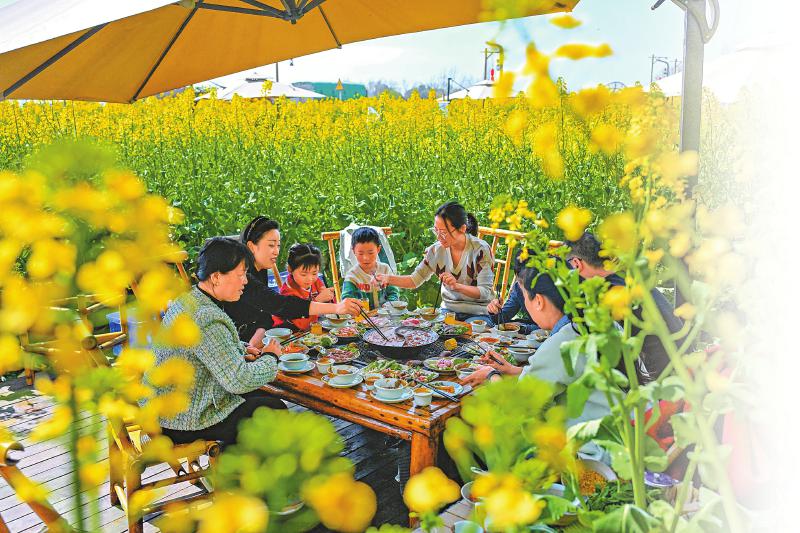
这个春节 成都吸睛又吸金
Xin Lang Cai Jing· 2026-02-24 22:23
Core Insights - Chengdu's consumer market experienced a strong start post-Spring Festival, with total online and offline consumption reaching 631.7 billion yuan, a year-on-year increase of 10.3% [3] Group 1: Consumer Market Performance - All shopping districts in Chengdu reported increases in both foot traffic and sales during the Spring Festival, with the total foot traffic in 11 monitored districts reaching 20.9 million and total sales amounting to 4.88 billion yuan [4] - The iconic Chunxi Road shopping area attracted over 10 million visitors and generated sales of 2.68 billion yuan, driven by the "Spring Six Treasures" event that combined traditional customs with modern technology [4] - Chengdu's 215 featured commercial streets attracted 37.875 million visitors and achieved sales of 6.51 billion yuan during the nine-day holiday [4] Group 2: Events and Activities - Over 600 events were organized during the Spring Festival, with 45 key activities attracting 14.569 million visitors and generating 1.1 billion yuan in consumption [5] - Notable events included the "New Year Theme Activity" at Jiezi Ancient Town, which drove 400 million yuan in consumption, and the "Chess Encounter" event at Times Outlet, contributing 130 million yuan [5] Group 3: Policy Support - The "old-for-new" vehicle and appliance replacement policies significantly boosted consumer activity, with applications for vehicle replacements reaching 25,600 and appliance replacements totaling 1.181 million, driving consumption of 4.396 billion yuan and 4.53 billion yuan respectively [6] - Chengdu's new energy vehicle purchase subsidies and the expansion of the appliance replacement policy to include additional categories are expected to further stimulate consumer spending [6] - A prize invoice initiative attracted over 1.139 million participants, with a total fund of 21 million yuan allocated for the program, enhancing consumer engagement [7]
产品碳足迹管理体系持续完善
Jing Ji Ri Bao· 2026-02-24 22:09
Core Viewpoint - The establishment of a carbon footprint management system for industrial products is crucial for promoting green and low-carbon transformation in the industry, as highlighted by the recent release of a recommended list of carbon footprint accounting rules for 73 industrial products by four government departments [1][3]. Group 1: Carbon Footprint Definition and Importance - Carbon footprint refers to the total greenhouse gas emissions caused directly and indirectly by individuals, organizations, events, or products, typically expressed in carbon dioxide equivalents [2]. - Product carbon footprint is the most widely applied concept, encompassing emissions throughout the product lifecycle, making it a key indicator for assessing the green and low-carbon levels of production enterprises [2]. - Understanding product carbon footprints helps enterprises recognize their impact on climate change and take actionable measures to reduce emissions in their supply chains, enhancing international competitiveness for export manufacturers [2]. Group 2: Standardization and Development of Carbon Footprint Rules - The standardization of product carbon footprint accounting rules is essential for the green and high-quality development of the manufacturing industry, with over 111 key product carbon footprint accounting rules recommended across 13 major industries [3][4]. - The lack of unified technical requirements for carbon footprint accounting rules at the national level has led to significant discrepancies in results across industries, necessitating the establishment of a comprehensive management system [3][4]. Group 3: Industry Applications and Case Studies - Companies like Xinwangda Electronics are integrating carbon footprint accounting into their entire product lifecycle management, achieving ISO 14067 certification for over 20 products, which enhances their environmental performance credibility [4]. - Baosteel has implemented a systematic carbon data collection mechanism that tracks emissions throughout the production process, aligning with unified carbon footprint accounting standards to facilitate compliance with international market requirements [6]. Group 4: Future Directions and Recommendations - The ongoing development of carbon footprint standards is expected to support the transition to low-carbon industries, with recommendations for further applications in carbon emission control, zero-carbon factory construction, and low-carbon technology promotion [7][8]. - There is a call for dynamic updates to the carbon footprint accounting rules based on industry needs and for promoting international recognition of China's carbon footprint standards to enhance its influence in the global green and low-carbon sector [8].
成都产业链高质量发展的实践探索与未来路径
Xin Lang Cai Jing· 2026-02-24 20:22
Core Viewpoint - Chengdu is focusing on high-quality development through industrial chain enhancement and innovation, aiming to establish a modern industrial system and improve its competitive edge in the global market [1][6]. Group 1: Industrial Cluster Development - Chengdu is promoting industrial clustering as a core form of high-quality development, transitioning from dispersed layouts to concentrated clusters through systematic policy design [2]. - The city has implemented a "chain leader + special class" mechanism to establish a focused industrial chain promotion system, creating a multi-level industrial cluster framework [2]. - Chengdu has formed trillion-level industrial clusters and hundreds of billion-level industrial chains, leading in the number of national advanced manufacturing clusters among sub-provincial cities [2]. Group 2: Innovation and Digital Transformation - Innovation is identified as the primary driver for high-quality industrial development, with Chengdu focusing on integrating innovation chains with industrial chains [3]. - The city has launched the "Smart Transformation" initiative, establishing a policy support system to facilitate digital transformation for small and medium-sized enterprises [4]. - Chengdu has achieved significant results in digital transformation, becoming the only city in the western region to win three national-level digital transformation pilot projects [4]. Group 3: Element Supply and Business Environment - Chengdu is addressing enterprise development challenges through institutional innovation to optimize resource allocation and enhance service efficiency [5]. - The city has introduced financial tools and investment funds to support key projects and small and medium-sized enterprises, ensuring land supply for priority industrial chains [5]. - Continuous improvement of the business environment has led to increased vitality in the private economy, fostering a favorable development landscape for state-owned, private, and foreign enterprises [5]. Group 4: Strategic Focus Areas - Chengdu is focusing on key areas to deepen the "building circles and strengthening chains" initiative, emphasizing innovation, ecological cultivation, and open collaboration [6][7]. - The city aims to enhance the overall competitiveness of industrial chains by promoting differentiated development of specialized industrial parks and supporting leading enterprises [7]. - Efforts are being made to accelerate industrial transformation and cultivate new productive forces, including the development of green manufacturing and strategic emerging industries [8]. Group 5: Global Integration - Chengdu is enhancing international industrial cooperation through initiatives like the China-Europe Railway Express and the Western Land-Sea New Corridor [8]. - The city is actively engaging in international capacity cooperation and promoting the "Chengdu-made, global sales" campaign to strengthen its manufacturing brand [8]. - Chengdu is working to align with international high-standard trade rules to create a market-oriented, law-based, and international business environment [8].