钢铁

Search documents
钢铁基本面有望逐步修复,钢铁ETF(515210)收涨超1.7%
Mei Ri Jing Ji Xin Wen· 2026-02-11 11:08
Group 1 - The steel industry's fundamentals are expected to gradually improve, with the steel ETF (515210) rising over 1.7% on February 11 [1] - Demand is anticipated to stabilize while supply is expected to continue contracting. Since 2021, the decline in new real estate projects has led to a decrease in the proportion of steel demand from the real estate sector, with the negative impact of real estate on steel demand significantly weakening [1] - Steel demand from infrastructure and manufacturing sectors is expected to grow steadily. Currently, about 60% of steel companies are operating at a loss, indicating that market-driven supply adjustments are beginning to occur [1] Group 2 - The steel ETF (515210) tracks the CSI Steel Industry Index (930606), which selects listed companies involved in various steel sectors to reflect the overall performance of the steel industry [1]
消息密集期可别误读,换个角度用数据看行情
Sou Hu Cai Jing· 2026-02-11 10:45
Core Insights - The article emphasizes the importance of tracking institutional trading activities rather than solely relying on company announcements for investment decisions [1][3][4] Group 1: Institutional Trading Insights - Institutions are actively involved in trading even when stock prices are volatile, indicating their confidence in the stock's potential [3][11] - The "institutional inventory" data serves as a key indicator of institutional participation, with sustained activity suggesting a positive outlook for the stock [3][4] - The article highlights that institutional investment logic applies across various sectors, not just popular ones, making it essential to monitor institutional activity regardless of the industry [6][9] Group 2: Investment Strategy Evolution - The shift from emotional trading to a more data-driven approach allows investors to make informed decisions based on objective metrics rather than subjective feelings [4][14] - Recognizing the absence of institutional activity in certain stocks can serve as a warning sign for potential underperformance, guiding investors away from poor choices [11][14] - The article advocates for a cognitive upgrade in investment strategies, emphasizing the use of quantitative data to minimize emotional interference and enhance decision-making processes [14]


新春走基层 | “闯关夺隘”再冲刺
Xin Lang Cai Jing· 2026-02-11 10:32
Core Viewpoint - The company has successfully transformed its production line from furnace-rolling to direct-rolling, achieving significant efficiency improvements and cost savings in steel production [2][4]. Group 1: Production Efficiency - The new direct-rolling production line can process steel from slab to finished product in just 34 seconds, showcasing high efficiency [2][9]. - The transformation from furnace-rolling to direct-rolling eliminates the heating furnace process, reducing gas consumption and preventing slab burn loss, saving over 150 yuan per slab [2][9]. - The overall rolling line speed has increased by approximately 2 meters per second, now stabilizing at 12.5 meters per second [2][10]. Group 2: Technological and Operational Improvements - Continuous optimization of die design and rolling processes has led to a significant reduction in changeover times, with slot and die change times now controlled within 15 minutes and 60 minutes, respectively [2][10]. - Close collaboration between steelmaking and continuous casting processes has minimized waiting times for slabs, enhancing production flow [10]. Group 3: Employee Engagement and Performance - The company implements a performance-oriented approach where value creators share in the value, fostering employee motivation through a piece-rate compensation system and internal market simulations [10]. - The company aims to reduce rolling costs by an additional 20 yuan per ton this year, emphasizing a commitment to lean management and continuous improvement [4][10].


贯彻落实马钢集团“四会”精神(二)| 冶服公司 行政事务中心
Xin Lang Cai Jing· 2026-02-11 10:32
Core Viewpoint - The company aims to enhance service quality and drive development through a "Six Hearts" empowerment strategy, focusing on becoming a reliable supplier for its main business [3][7]. Group 1: Company Performance and Goals - In 2025, the company achieved dual breakthroughs in revenue scale and operational efficiency, with significant progress in business structure optimization and transformation [3][7]. - The year 2026 is identified as a critical year for deepening reforms, improving quality, and promoting high-quality transformation, with a commitment to implement the directives from the parent group [3][7]. Group 2: Strategic Focus and Initiatives - The company emphasizes the importance of a service philosophy characterized by "careful, attentive, and meticulous" approaches to ensure the main business is "reassured, worry-free, and confident" [3][7]. - There is a strong focus on enhancing service value creation and strengthening capabilities to ensure survival in a competitive market [4][5]. Group 3: Organizational Changes and Development - The company is advancing a simulated departmental reform to establish a "Ma Steel Administrative Logistics" brand, transitioning from a traditional "cost center" to a modern "value creation center" [4][8]. - Key initiatives include the construction of a smart logistics system, implementation of brand service standards, and optimization of standardized service processes [5][9].
黑色产业链日报-20260211
Dong Ya Qi Huo· 2026-02-11 10:29
Report Industry Investment Rating - Not provided in the content Core Views - **Steel**: Before the Spring Festival, terminal demand for steel shrinks, trading is lackluster, inventory accumulation of rebar accelerates year - on - year, and hot - rolled coil shifts from inventory reduction to accumulation. The fundamentals are weakening. Blast furnace profits are stable, leading to stable output, while EAF output is likely to significantly reduce. Supply is relatively stronger than demand, and falling raw material prices further suppress the market, though cost and policy provide support at the bottom [3]. - **Iron Ore**: On the supply side, overseas shipments of iron ore decline seasonally, and the rainy season in the Southern Hemisphere may affect Australian ore shipments. On the demand side, steel mills' restocking is nearly complete, hot - metal production is expected to rise, but it's the off - season for terminal consumption. Port inventories are accumulating above the seasonal norm, with high inventory pressure, and reduced market risk appetite is suppressing prices [23]. - **Coking Coal and Coke**: Before the festival, domestic coking coal mines reduce production, leading to a seasonal contraction in coking coal supply. Imported coal arrivals are at a low level, and there is an inverted price difference between domestic and international markets. The first round of coke price increase has been implemented, improving coking profits. Coke production is expected to pick up, and steel mills'复产 is leading to a slow increase in demand. In the short term, the supply - demand pattern is loose, and the post - festival resumption of production rhythm is the key factor to watch [34]. - **Ferroalloys**: Both silicon manganese and silicon iron face a game between cost support and downstream terminal inventory accumulation. Manganese ore prices are firm, providing bottom - line support. Ferroalloy profits have rebounded but are still in the red, and production remains low. Steel mills'复产 may drive demand, but the off - season for downstream steel consumption limits demand growth. Silicon manganese has a large inventory base and high de - stocking pressure, while the fundamentals of silicon iron are slightly better [48]. - **Soda Ash**: The rigid demand for soda ash is expected to weaken, and its price is oscillating weakly, with industrial contradictions still accumulating. If the futures price rises, there is some restocking space for mid - stream players such as futures - cash arbitrageurs, but the demand elasticity is limited. The downward price space needs to be opened up by inventory accumulation. In terms of supply - demand, with the release of new production capacities, daily soda ash output is at a high level, and the medium - to - long - term supply is expected to remain high. The inventory of the photovoltaic glass industry is at a high level, daily melting is temporarily stable, and overall rigid demand is weakening. The heavy - soda balance remains in surplus. Soda ash exports remain high, alleviating domestic pressure to some extent [67]. - **Glass**: Market news indicates that due to environmental protection pressure, four coal - fired production lines in Shahe may be cold - repaired before the Spring Festival, with a total daily melting capacity of 2,700 tons. Coupled with the 1,200 - ton cold - repair of Dongtai Zhongbo last week and the expected 1,000 - ton cold - repair of Deyang Xinyi before the Spring Festival, float glass will experience concentrated cold - repair before the Spring Festival, which is slightly beyond expectations. The daily melting capacity will drop to around 146,000 - 147,000 tons. Although there are many new production lines to be ignited in Shahe, the earliest they can be implemented is after the Spring Festival, and it will take months to produce products. The pre - festival concentrated cold - repair helps relieve the inventory and spot pressure after the Spring Festival. Float glass is in a pattern of weak supply and demand, and the high inventory in the middle - stream is a risk point. If a negative feedback occurs, the spot pressure will be large [91]. Summary by Related Categories Steel - **Price Data**: On February 11, 2026, the closing price of rebar 01 contract was 3132 yuan/ton, 05 contract was 3054 yuan/ton, and 10 contract was 3103 yuan/ton. The closing price of hot - rolled coil 01 contract was 3273 yuan/ton, 05 contract was 3228 yuan/ton, and 10 contract was 3247 yuan/ton. The rebar and hot - rolled coil spot prices in various regions remained stable compared to the previous day [4][9][12]. - **Ratio and Spread Data**: The 01 rebar/01 iron ore ratio was 4, and the 01 rebar/01 coke ratio was 2. The 01 - 05 month spread of rebar was 78, and that of hot - rolled coil was 45 [4][20]. Iron Ore - **Price Data**: On February 11, 2026, the closing price of iron ore 01 contract was 733.5 yuan/ton, 05 contract was 762.5 yuan/ton, and 09 contract was 745 yuan/ton. The 01 basis was 31 yuan/ton, 05 basis was 1.5 yuan/ton, and 09 basis was 19 yuan/ton [24]. - **Fundamental Data**: As of February 6, 2026, the daily average hot - metal output was 228.58 tons, the port desilting volume of 45 ports was 341.08 tons, the apparent demand of five major steel products was 761 tons, the global shipment volume was 2535.3 tons, the Australia - Brazil shipment volume was 1881.1 tons, the arrival volume at 45 ports was 2361.3 tons, the inventory at 45 ports was 17140.71 tons, the inventory of 247 steel mills was 10316.64 tons, and the available days for 247 steel mills were 36.55 days [28]. Coking Coal and Coke - **Price and Spread Data**: On February 11, 2026, the 09 - 01 spread of coking coal was - 173.5, the 05 - 09 spread was - 80, and the 01 - 05 spread was 253.5. The 09 - 01 spread of coke was - 90, the 05 - 09 spread was - 75, and the 01 - 05 spread was 165. The spot prices of coking coal and coke in various regions showed different degrees of change compared to the previous day and the previous week [35][37][38]. - **Profit Data**: The on - disk coking profit was - 37 yuan/ton, the main ore - coke ratio was 0.457, the main rebar - coke ratio was 1.832, and the main coke - coal ratio was 1.474 [37]. Ferroalloys - **Silicon Iron**: On February 10, 2026, the silicon iron basis in Ningxia was 40, the 01 - 05 spread was 144, the 05 - 09 spread was - 60, and the 09 - 01 spread was - 84. The spot prices in different regions showed a slight decline compared to the previous week [49]. - **Silicon Manganese**: On February 11, 2026, the silicon manganese basis in Inner Mongolia was 176, the 01 - 05 spread was 104, the 05 - 09 spread was - 42, and the 09 - 01 spread was - 62. The spot prices in various regions remained stable [50][52]. Soda Ash - **Price and Spread Data**: On February 11, 2026, the closing price of soda ash 05 contract was 1178 yuan/ton, 09 contract was 1240 yuan/ton, and 01 contract was 1288 yuan/ton. The 5 - 9 month spread was - 62, the 9 - 1 month spread was - 48, and the 1 - 5 month spread was 110. The spot prices of heavy and light soda ash in various regions remained stable [68]. - **Production and Inventory Data**: The daily production of soda ash is at a high level, the inventory of the photovoltaic glass industry is at a high level, and the rigid demand is weakening. Soda ash exports remain high [67]. Glass - **Price and Spread Data**: On February 11, 2026, the closing price of glass 05 contract was 1087 yuan/ton, 09 contract was 1189 yuan/ton, and 01 contract was 1226 yuan/ton. The 5 - 9 month spread was - 102, the 9 - 1 month spread was - 37, and the 1 - 5 month spread was 139 [92]. - **Production and Sales Data**: The daily production and sales data of glass in Shahe, Hubei, East China, and South China regions showed fluctuations in the recent period [92].
东北最壕“霸总”,给员工发40亿红包
创业家· 2026-02-11 10:23
Core Viewpoint - The article highlights the unique management philosophy of Fang Wei, the owner of Liaoning Fangda Group, who believes in the principle of "distributing wealth to gather people" as a means to enhance employee morale and company performance [6][62]. Group 1: Employee Welfare and Company Performance - Fang Wei has distributed nearly 4 billion yuan in cash bonuses to employees over the past decade, establishing a tradition of "cash walls" as a motivational tool [7][8]. - In 2021, Fang Wei took over HNA Aviation for 41 billion yuan, cleared all employee back wages, and distributed over 300 million yuan in bonuses to more than 60,000 employees, significantly boosting morale and leading to a turnaround in company performance [14][15]. - By the third quarter of 2025, HNA achieved a profit of 2.845 billion yuan, ranking first among A-share listed airlines, showcasing a remarkable recovery from previous losses [15][52]. Group 2: Business Strategy and Acquisitions - Fang Wei's acquisition of HNA was initially met with skepticism due to the differences between the aviation and steel industries, but he successfully implemented strategies that led to profitability [49][50]. - The company has focused on expanding international routes, with a 67.62% year-on-year increase in international passenger volume in the first half of 2025, establishing a global network [55]. - Fang Wei has also emphasized cost reduction and efficiency improvements, identifying nearly 10,000 cost-saving opportunities that have resulted in over 17 billion yuan in savings [60][61]. Group 3: Personal Background and Management Philosophy - Fang Wei's background as a child who collected scrap metal with his father has shaped his understanding of the importance of employee welfare and loyalty [26][27]. - His management approach prioritizes employee interests, even during industry downturns, as seen in his commitment to not reduce staff or salaries during tough times [22][23]. - Fang Wei's belief that employee success is tied to company success has fostered a culture of mutual benefit, leading to a strong alignment between employee and company goals [24][68].


螺纹热卷日报-20260211
Yin He Qi Huo· 2026-02-11 09:56
Group 1: Market Information - Current spot prices include Shanghai Zhongtian Thread at 3190 yuan, Beijing Jingye at 3120 yuan, Shanghai Angang Hot Rolled Coil at 3240 yuan, and Tianjin Hegang Hot Rolled Coil at 3140 yuan [4] Group 2: Market Analysis - The steel futures market maintained a volatile trend today, with further decline in volatility. Last week, the overall production of the five major steel products decreased, but hot metal production increased. Steel mills are gradually entering the holiday shutdown and maintenance mode. Steel inventories are accumulating at an accelerated pace, with thread inventory accumulating faster than hot - rolled coil. The overall social inventory pressure is greater than the mill inventory. Due to the cold weather, downstream construction sites are gradually shutting down, and the demand for building materials is rapidly declining. Steel exports are affected by the decline in export licenses, and overseas manufacturing has ended the restocking process, leading to a decline in hot - rolled coil demand. The overall fundamentals of the steel market are weakening marginally [5] - It is expected that steel prices will maintain a volatile and weak trend before the Spring Festival. Currently, steel inventories are high, post - holiday capital expenditure may fall short of expectations, and the recovery of demand remains to be seen. The pessimistic expectations of steel mills may also limit the production of hot metal this year, putting pressure on raw materials. The positions of the main steel contracts are currently high, and attention should be paid to sudden capital movements before the holiday. Future focus should be on the resumption of coal mine production, hot metal production, downstream demand performance, overseas tariffs, and domestic macro and industrial policies [5] Group 3: Trading Strategies - Unilateral: Maintain a volatile and weak trend before the holiday [6] - Arbitrage: It is recommended to short the hot - rolled coil to coking coal ratio on rallies and continue to hold the short position on the hot - rolled coil to thread spread [6] - Options: It is recommended to wait and see [7] Group 4: Important Information - China's CPI annual rate in January was 0.2%, lower than the expected 0.4% and the previous value of 0.80%. The CPI monthly rate in January was 0.2%, lower than the expected 0.3% and the same as the previous value. The PPI annual rate in January was - 1.4%, better than the expected - 1.5% and the previous value of - 1.90% [8] - In 2025, the China Development Bank, as the main bank for infrastructure construction, issued loans of 1.64 trillion yuan to infrastructure in five major areas: network - type, industrial upgrading, urban, agricultural and rural, and national security. It supported the opening and operation of projects such as the Guangzhou - Zhanjiang High - speed Railway and the acceleration of projects like the Middle Route of the South - to - North Water Diversion Project's Yangtze River Water Diversion and Han River Supplement Project. It also promoted the construction of the "East - to - West Computing" project in the national hub nodes of the national integrated computing power network and actively served the construction of scientific and technological infrastructure [8][9] Group 5: Related Attachments - The report includes various charts related to steel, such as price charts, basis charts, spread charts, and profit charts for different contracts of thread and hot - rolled coil, with data sources from Galaxy Futures, Mysteel, and Wind [11][12]
现实格局偏弱,钢矿低位震荡:钢材&铁矿石日报-20260211
Bao Cheng Qi Huo· 2026-02-11 09:49
Report Industry Investment Rating No relevant information provided. Core Views - The main contract price of rebar oscillated, recording a daily decline of 0.07%, with increasing volume and decreasing positions. Currently, although rebar supply has shrunk, demand has also weakened. The fundamental contradictions of rebar in the off - season are accumulating, and steel prices continue to be under pressure. The relative positive factor is cost support. It is expected to maintain an oscillating bottom - seeking trend, and attention should be paid to inventory changes [5]. - The main contract price of hot - rolled coil oscillated, recording a daily increase of 0.06%, with decreasing volume and increasing positions. Currently, the demand for hot - rolled coil has weakened, and there is still supply pressure under the situation of high production and high inventory. The fundamentals are weak, and prices continue to be under pressure. Attention should be paid to demand performance [5]. - The main contract price of iron ore oscillated, recording a daily decline of 0.07%, with decreasing volume and positions. Currently, due to weather factors, overseas ore supply has shrunk in the short term, while demand is weakly stable. The fundamentals of iron ore have not improved, and ore prices will still be under pressure under the high - inventory pattern. Attention should be paid to steel price performance [5]. Summary by Directory 1. Industry Dynamics - In January, the construction of a unified national market continued to drive up prices in some industries. The CPI increased by 0.2% month - on - month and 0.2% year - on - year, and the core CPI excluding food and energy prices increased by 0.8% year - on - year. Affected by factors such as the construction of a unified national market, increased demand in some industries, and the transmission of international commodity prices, the PPI increased by 0.4% month - on - month and decreased by 1.4% year - on - year [7]. - In January, the production and sales of new energy vehicles in China increased by 2.5% and 0.1% year - on - year respectively. The overall operation of the automobile industry was stable, the passenger car market declined, the commercial vehicle market continued to improve, the new energy vehicle market operated steadily, and automobile exports continued to grow. The main factors leading to the market decline were the adjustment of the new energy vehicle purchase tax policy, the annual alternation of car purchase subsidy policies in many places, and the pre - release of some consumer demand in 2025 [8]. - Swedish state - owned iron ore producer LKAB's operation was stable in the fourth quarter of 2025, and iron ore shipments reached a new high for the year. In the fourth quarter of 2025, LKAB's iron ore production was 6.5 million tons, a 5.8% decrease from the previous quarter and a 14% increase from the same period last year. The annual cumulative production in 2025 was 25.9 million tons, a 14.1% increase from the previous year. In the fourth quarter of 2025, the iron ore shipment volume was 7 million tons (pellets accounted for 85%), a 12.9% increase from the previous quarter and a 4.5% increase from the same period last year. The annual cumulative shipment volume in 2025 was 25.8 million tons, a 17.8% increase from the previous year [9]. 2. Spot Market - Rebar: The spot prices in Shanghai, Tianjin, and the national average were 3,190, 3,150, and 3,304 respectively [10]. - Hot - rolled coil: The spot prices in Shanghai, Tianjin, and the national average were 3,240, 3,140, and 3,279 respectively [10]. - Tangshan billet: The spot price was 2,900 [10]. - Zhangjiagang heavy scrap: The spot price was 2,160 [10]. - Main variety spreads: The coil - rebar spread was 50, and the rebar - scrap spread was 1,030 [10]. - Iron ore: The price of PB powder at Shandong ports was 758, and the price of Tangshan iron concentrate (wet basis) was 767. The previous - day's sea freight from Australia was 8.06, from Brazil was 22.89, the SGX swap (current month) was 100.64, and the iron ore price index (61% FE, CFR) was 100.20 [10]. 3. Futures Market - Rebar: The closing price of the active contract was 3,054, with a decline of 0.07%. The highest price was 3,068, the lowest price was 3,043, the trading volume was 557,284, the volume difference was 28,957, the open interest was 2,063,660, and the position difference was - 1,877 [14]. - Hot - rolled coil: The closing price of the active contract was 3,228, with an increase of 0.06%. The highest price was 3,239, the lowest price was 3,216, the trading volume was 255,255, the volume difference was - 81,368, the open interest was 1,552,374, and the position difference was 9,529 [14]. - Iron ore: The closing price of the active contract was 762.5, with a decline of 0.07%. The highest price was 767.5, the lowest price was 758.5, the trading volume was 133,786, the volume difference was - 9,498, the open interest was 506,957, and the position difference was - 6,983 [14]. 4. Related Charts - Steel inventory: Included charts of rebar inventory (weekly change, total inventory of steel mills + social inventory), hot - rolled coil inventory (weekly change, total inventory of steel mills + social inventory) [16][17][22]. - Iron ore inventory: Included charts of 45 - port iron ore inventory (total inventory, seasonal inventory), 247 steel mills' iron ore inventory, and domestic mine iron concentrate inventory [23][27][29]. - Steel mill production: Included charts of the blast furnace operating rate and capacity utilization rate of 247 sample steel mills, the operating rate of 94 independent electric furnace steel mills, the proportion of profitable steel mills among 247 steel mills, and the profitability of 94 independent electric arc furnace steel mills [31][33][35]. 5. Market Outlook - Rebar: Both supply and demand are seasonally weak, and inventory continues to accumulate. The weekly output of rebar decreased by 81,500 tons compared with the previous week. Although supply has shrunk, the inventory level is significantly higher than the same period last lunar year, and the pressure relief is limited. Demand is also in a weak seasonal pattern. The weekly apparent demand and high - frequency daily transactions have both shrunk significantly and are at the lowest level in the same lunar period in recent years. Considering that the downstream industry has not improved, the weak demand pattern is difficult to change, which continues to drag down steel prices. The relative positive factor is the post - holiday policy expectation. It is expected to maintain an oscillating bottom - seeking trend, and attention should be paid to inventory changes [39]. - Hot - rolled coil: The supply - demand pattern has not changed much, and inventory has increased again. The production of plate steel mills is stable. The weekly output of hot - rolled coil decreased slightly by 50 tons compared with the previous week, remaining at a relatively high level, and the inventory level is high, so the supply pressure remains. At the same time, the demand for hot - rolled coil has weakened. The weekly apparent demand decreased by 58,700 tons compared with the previous week, and high - frequency daily transactions continued to operate at a low level. The relative positive factor is that the production of downstream cold - rolled products remains at a high level, which supports the demand for hot - rolled coil, but attention should be paid to the accumulation of contradictions in cold - rolled products themselves. In addition, the external demand for exports is average, and there are concerns about the demand for hot - rolled coil. The fundamentals are weak, and prices continue to be under pressure. Attention should be paid to demand performance [39]. - Iron ore: The supply - demand pattern remains weak, and inventory continues to rise. Steel mill production is stable, and the terminal consumption of ore has increased slightly. However, considering that the profitability of steel mills has not improved and the contradictions in the steel market are accumulating, the demand improvement is limited, and the positive effect is not strong. At the same time, the arrival volume at domestic ports has declined again, and the shipments of miners have decreased significantly due to hurricane disturbances. Overseas ore supply has shrunk in the short term, and domestic ore supply has shrunk seasonally. Under the high - inventory pattern, the relief of ore supply pressure is limited. The fundamentals of iron ore have not improved, and ore prices will still be under pressure. Attention should be paid to steel price performance [40].
河钢股份:公司为华龙一号核电项目的建设供应了部分品种的钢材产品
Zheng Quan Ri Bao· 2026-02-11 08:37
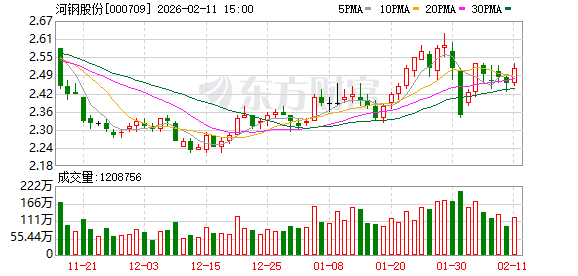
Group 1 - The company, Hebei Iron and Steel Co., Ltd., has supplied various steel products for the construction of the Hualong One nuclear power project [2] - The company provides comprehensive services related to product supply, which have received high recognition for both product quality and service [2]

午后拉升涨停!超14万手封单
Xin Lang Cai Jing· 2026-02-11 08:01
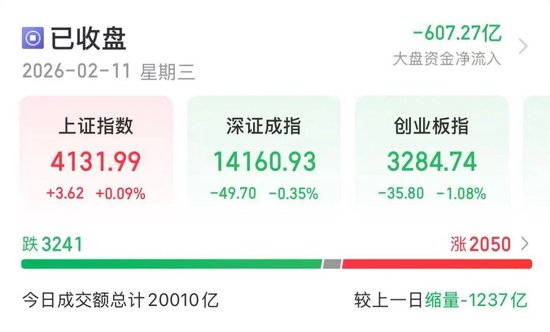
Market Overview - The A-share market experienced fluctuations with the Shanghai Composite Index rising by 0.09%, while the Shenzhen Component and ChiNext Index fell by 0.35% and 1.08% respectively, with a total trading volume of 20,010 billion yuan [1][13]. Investment Opportunities - According to Minsheng Securities, the market is expected to see a shift towards small and medium-sized growth stocks as the Spring Festival approaches, with historical data indicating that the week before the holiday is an optimal time for A-share investments [3][15]. - Recommended sectors for investment include cyclical assets (coal), technology growth, pharmaceuticals, and military industries, which are anticipated to experience a turnaround in high prosperity [3][15]. Metal Sector Performance - Various metal-related concepts, such as small metals, energy metals, and metals like cobalt and nickel, topped the gainers' list, with companies like Zhongtung High-tech and Zhangyuan Tungsten hitting the daily limit [3][15]. - Specific gains included small metals up by 3.64%, energy metals by 3.44%, and notable stocks like Dongfang Lithium Industry and Zhongtung High-tech both achieving a 10% increase [4][16]. Steel Industry Insights - The steel sector showed strong performance, with Baodi Mining hitting the daily limit and other companies like Dazhong Mining and Ordos also seeing significant gains [5][17]. - Baodi Mining's stock price rose to 8.71 yuan per share, with a trading volume exceeding 140,000 hands on the limit-up board [18][20]. Corporate Developments - Baodi Mining announced the completion of the acquisition of 82% of Congling Energy's shares, which is expected to enhance its iron ore resource capacity to approximately 460 million tons, increasing reserves by about 21.75% [20]. - The acquisition is aligned with the company's core business and is expected to improve its operational capabilities [20]. Regulatory Environment - The National Market Supervision Administration has announced initiatives to optimize traditional industries and promote high-quality development in sectors including steel and non-ferrous metals, which is expected to support industry transformation [20]. Banking Sector Trends - Recent reports indicate a focus on the banking sector's earnings certainty, with expectations that high-growth banks may see their valuations return above 1 times price-to-book ratio [11][23]. - The banking sector is anticipated to provide long-term excess returns as market sentiment shifts from liquidity-driven factors to valuation and profitability considerations [11][23].