
钢铁

Search documents
马钢股份股价震荡,机构看好盈利修复空间
Jing Ji Guan Cha Wang· 2026-02-11 05:44
Core Viewpoint - The stock price of Maanshan Iron & Steel Co., Ltd. has shown a fluctuating trend over the past week, with a range of -0.98% and a volatility of 3.93% [1] Company Summary - The latest stock price is 4.03 yuan, with a daily increase of 0.75%, underperforming the steel sector but slightly outperforming the broader market [1] - Institutional views on Maanshan Iron & Steel's medium to long-term fundamentals are moderately optimistic, with expectations of a turnaround in net profit by 2025 and a projected year-on-year growth rate of 1244.93% in 2026, driven by supply-side adjustments and demand improvements [2] - The current comprehensive target price set by institutions is 3.93 yuan, indicating limited upside potential from the latest price, and the fund holding ratio is only 0.11% [2] Industry Summary - Recent policies in the steel industry have released positive signals, with the National Development and Reform Commission indicating plans to formulate a strategy for expanding domestic demand from 2026 to 2030, which may boost steel demand in the medium to long term [3] - Industry data shows a 5.6% month-on-month increase in social steel inventory and a 5.1% decrease in apparent consumption, indicating ongoing short-term supply and demand pressures [3] - Steel pipe companies are expected to benefit from energy investments despite the current supply-demand challenges [3]

黑色建材日报:淡季格局显现,钢价震荡偏弱-20260211
Hua Tai Qi Huo· 2026-02-11 05:31
1. Report Industry Investment Ratings - Steel: Sideways [2] - Iron Ore: Sideways to Bearish [4] - Coking Coal and Coke: Sideways [6] - Thermal Coal: Stable to Slightly Bullish [7] 2. Core Views - The steel market is in a slack season with prices oscillating weakly. The overall contradiction in the steel market is not prominent, but poor building material demand, weak downstream purchasing sentiment, and higher seasonal inventory accumulation are suppressing rebar prices. High inventory is also constraining the price space of hot-rolled coils. Before the holiday, steel inventories continue to rise, and supply-demand pressure increases slightly. With weakening raw material prices, steel prices will maintain a weakly oscillating trend [1]. - The iron ore market sentiment is weak, and prices are oscillating. High prices have led to high non-mainstream shipments, but global shipments are seasonally declining. Daily average hot metal production is stable, and iron ore consumption has slightly increased month-on-month. Port inventories are continuously rising, and as steel mill restocking nears completion, the support for raw material prices is weakening. The supply-demand contradiction in the iron ore market is deepening, and if port liquidity issues are resolved, port supplies could cause a significant supply shock [3]. - The coking coal and coke market is experiencing weak trading, with prices oscillating weakly. As the holiday approaches, more coal mines are announcing shutdowns, leading to a light trading atmosphere, with many auctions failing and prices falling in the coking coal market. After the first round of coke price increases, coke producers' profits have improved, but most steel mills have completed winter restocking, leading to a sharp decline in speculative demand for coke [5]. - The thermal coal market is experiencing weak supply and demand, with prices remaining stable. As the Spring Festival approaches, more private mines in the main production areas are on holiday, leading to a tightening supply. Downstream demand, except for some chemical industries, has shrunk significantly. The market is characterized by low activity, with supply and demand both weak. Import coal prices are rising due to supply uncertainties in Indonesia. Before the holiday, the upside for prices is limited, and they are expected to remain stable to slightly bullish. After the holiday, as coal mine supply resumes and the peak season nears its end, prices may face downward pressure [7]. 3. Summary by Related Catalogs Steel - **Market Analysis**: Yesterday, steel futures prices oscillated downward. On Monday, the rebar inventory in Hangzhou was 79.3 million tons, with an outbound volume of 0.2 million tons, compared to 58.5 million tons and 0.5 million tons respectively in the same period last year. Building material demand is poor, and downstream purchasing sentiment is weak. Seasonal inventory accumulation is slightly higher than last year, suppressing rebar prices. Plate demand is relatively stable, but high inventory is constraining the price space of hot-rolled coils [1]. - **Supply and Demand Logic**: Before the holiday, steel inventories continue to rise, and supply-demand pressure increases slightly. With weakening raw material prices, steel prices will maintain a weakly oscillating trend. Later, attention should be paid to winter restocking and changes in raw material prices [1]. - **Strategy**: Sideways for single - sided trading, no strategies for inter - period, inter - variety, spot - futures, or options trading [2]. Iron Ore - **Market Analysis**: Yesterday, iron ore futures prices oscillated. In the spot market, the prices of mainstream imported iron ore varieties at Tangshan Port fluctuated slightly. Traders' quotes mostly followed the market, and steel mills' purchases were mainly for刚需. The cumulative transaction volume of iron ore at major national ports was 55.5 million tons, a 13.01% month - on - month decrease. The cumulative transaction volume of forward - looking spot iron ore was 69.5 million tons (5 transactions), a 13.93% month - on - month increase (with all transactions from mines) [3]. - **Supply and Demand Logic**: High prices have led to high non - mainstream shipments, but global shipments are seasonally declining. Daily average hot metal production is stable, and iron ore consumption has slightly increased month - on - month. Port inventories are continuously rising, and as steel mill restocking nears completion, the support for raw material prices is weakening. The supply - demand contradiction in the iron ore market is deepening, and if port liquidity issues are resolved, port supplies could cause a significant supply shock. Later, attention should be paid to changes in iron ore inventories and negotiation progress [3]. - **Strategy**: Sideways to bearish for single - sided trading, no strategies for inter - period, inter - variety, spot - futures, or options trading [4]. Coking Coal and Coke - **Market Analysis**: Yesterday, the main futures contracts of coking coal and coke oscillated weakly. As the holiday approaches, more coal mines are announcing shutdowns, leading to a light trading atmosphere, with many auctions failing and prices falling in the coking coal market. The spot prices of coke in the main production areas and ports are relatively stable, and coke producers' production is relatively stable. After the first round of coke price increases, coke producers' profits have improved, but most steel mills have completed winter restocking, leading to a sharp decline in speculative demand for coke [5]. - **Supply and Demand Logic**: In the short term, coke prices are expected to oscillate and follow cost fluctuations. For coking coal, as steel mill hot metal production has recovered, the rigid demand for coking coal remains resilient. However, as downstream restocking nears completion, speculative demand has declined. As the Spring Festival approaches, more coal mines are shutting down for the holiday, and Mongolian coal imports will be suspended during the Spring Festival, alleviating the supply pressure on coking coal. Before the Spring Festival, coal prices are expected to remain stable with narrow adjustments. Attention should be paid to the resumption of domestic coal production after the festival [6]. - **Strategy**: Sideways for both coking coal and coke in single - sided trading, no strategies for inter - period, inter - variety, spot - futures, or options trading [6]. Thermal Coal - **Market Analysis**: In the production areas, more private mines in the main production areas are on holiday, leading to a tightening supply. Downstream demand, except for some chemical industries, has shrunk significantly. Before the holiday, prices are expected to change little, and attention should be paid to the recovery of market supply and demand after the holiday. At ports, as the Spring Festival approaches, downstream users are on holiday, and terminal daily consumption is continuously declining, resulting in low market activity. Affected by the tightening supply at the mine mouth, market supplies to ports are tight, and port shipments are in a continuous loss - making situation. Currently, the market shows weak supply and demand, and prices remain stable. In the import market, the tender prices of imported coal are continuously rising. Due to uncertainties in the later production policies of Indonesian mines, prices are relatively high [7]. - **Supply and Demand Logic**: Recently, due to coal mine holidays, supply has shrunk, and downstream factories are also gradually taking holidays, resulting in weak supply and demand. Affected by supply in the import market, domestic thermal coal prices have maintained a slight upward trend. Recently, the full approval of the RKAB of a leading Indonesian mine is expected, and the approval results of other mines will be announced successively. In the later period, Indonesian supply is expected to recover. Overall, before the holiday, the upside for prices is limited, and they are expected to remain stable to slightly bullish. After the holiday, as coal mine supply resumes and the peak season nears its end, prices may face downward pressure [7].
黑色建材日报:淡季格局明显,钢价震荡偏弱-20260211
Hua Tai Qi Huo· 2026-02-11 05:18
1. Report Industry Investment Rating - Not provided in the given content 2. Core Views of the Report - The market is in a clear off - season pattern, with steel prices fluctuating weakly. Glass and soda ash markets also show a weakening trend due to shrinking downstream demand. The double - silicon market in the black sector is in a state of consolidation [1][3] - The glass market has an increasing expectation of production line cold - repair in the Shahe area, which provides some support to the market. The soda ash supply pressure is increasing with new projects, and the downstream consumption is seasonally declining [1] - The fundamentals of silicon manganese have improved slightly, but the inventory pressure is still high. The fundamentals of silicon iron are controllable, and the demand is expected to improve marginally [3] 3. Summary by Related Catalogs Glass and Soda Ash Market Analysis - Glass: The main glass contract fluctuated weakly yesterday, and the trading volume decreased approaching the Spring Festival. The spot price was stable, and downstream enterprises mainly made purchases based on rigid demand [1] - Soda Ash: The main soda ash contract continued to show a weakening trend, and the market sentiment was cautious. In the traditional off - season, the spot market mainly had transactions based on rigid demand [1] Supply - Demand and Logic - Glass: There is a strong expectation of production line cold - repair in the Shahe area, which supports the market. However, the fundamental contradictions have not been effectively resolved, and attention should be paid to cold - repair progress, terminal demand recovery, and coal price impact on costs [1] - Soda Ash: The current production of soda ash is high, and the supply pressure is increasing with new projects. Downstream consumption is seasonally declining, the total inventory of domestic soda ash manufacturers is high, and the de - stocking process is slow. Attention should be paid to new project situations [1] Strategy - Glass: Expected to fluctuate [2] - Soda Ash: Expected to fluctuate weakly [2] Double - Silicon (Silicon Manganese and Silicon Iron) Market Analysis - Silicon Manganese: The silicon manganese futures weakened yesterday, and the spot market was filled with a festive atmosphere. The price of 6517 in the northern market was 5580 - 5680 yuan/ton, and in the southern market was 5700 - 5750 yuan/ton [3] - Silicon Iron: The silicon iron futures fluctuated downward, the market was weak, and the sentiment of cautious waiting and seeing was strong. The ex - factory price of 72 - grade silicon iron in the main production area was 5250 - 5350 yuan/ton, and the price of 75 - grade silicon iron was 5850 - 6000 yuan/ton [3] Supply - Demand and Logic - Silicon Manganese: The fundamentals have improved, and the demand is expected to increase marginally. However, the inventory pressure is still high, and the supply - demand pattern is relatively loose. The South African tariff policy may increase the manganese ore cost, and attention should be paid to cost support and inventory changes [3] - Silicon Iron: The fundamental contradictions are controllable, and enterprises have actively reduced production loads. Considering the resumption of steel mills, the demand is expected to improve marginally. The overall over - capacity suppresses the price increase, and attention should be paid to the de - stocking situation and power price policies in production areas [3] Strategy - Both silicon manganese and silicon iron are expected to fluctuate [4]
黑色商品日报-20260211
Guang Da Qi Huo· 2026-02-11 05:02
黑色商品日报(2026 年 2 月 11 日) 一、研究观点 | 品种 | 点评 | 观点 | | --- | --- | --- | | 钢材 | 螺纹钢:昨日螺纹盘面延续跌势,截止日盘螺纹 2605 合约收盘价格为 3052 元/吨,较上一交易收盘价格 | 弱势整理 | | | 下跌 12 元/吨,跌幅为 0.39%,持仓增加 6 万手。现货市场已处于有价无市局面,报价稳中有跌,唐山地 | | | | 区迁安普方坯价格下跌 10 元/吨至 2900 元/吨,杭州市场中天螺纹价格持平于 3160 元/吨。目前钢厂产量 | | | | 仅小幅下降,需求快速收缩,近期各地库存加速累积,杭州市场螺纹钢库存达到 79.3 万吨,唐山钢坯库 | | | | 存达到约 154 万吨,均明显超出去年同期水平,节后库存面临较大的消化压力,对市场情绪形成一定影 | | | | 响。同时,近期铁矿石、煤焦库存持续累积,随着钢厂补库结束,原料端价格连续下跌,原料对钢价支撑 | | | | 力度减弱。预计短期螺纹盘面仍以弱势整理运行为主。 | | | | 昨日铁矿石期货主力合约 i2605 价格窄幅震荡,收于 761.5 元/吨, ...
鞍钢股份逆势上涨,业绩减亏预期提振市场信心
Jing Ji Guan Cha Wang· 2026-02-11 04:52
Core Viewpoint - Ansteel Co., Ltd. (鞍钢股份) has shown a counter-trend increase in stock price due to improvements in its fundamentals, industry environment, and market capital flow, with a closing price of 2.59 yuan on February 11, 2026, up 1.57% [1] Current Operating Status - Ansteel is expected to report a net loss of 4.077 billion yuan for 2025, which represents a reduction in losses of approximately 4.275 billion yuan compared to 2024. This improvement is attributed to cost control, production line upgrades, and a shift towards high-end products, alongside a decline in raw material costs [2] Financial Situation - On February 11, 2026, the net inflow of main funds was 11.6773 million yuan, a significant increase from the previous day's net inflow of 630,800 yuan. This consecutive net inflow indicates a rising short-term interest from investors. Additionally, in early December 2025, net purchases from financing reached a cumulative total of 3.956 million yuan over three days, reflecting a gradual recovery of some investors' long-term confidence [3] Industry Status - The steel industry in 2025 has not fundamentally changed its supply-demand dynamics, but the decline in raw material costs has provided support for loss reduction across the industry. Some steel companies have already turned profitable, and Ansteel's progress in reducing losses has attracted market attention. Furthermore, prior to the Spring Festival, coke prices remained stable, allowing steel mills to purchase based on demand, which slightly alleviated cost pressures and provided mild support for stock prices [4] Stock Price Situation - Technically, Ansteel's stock price has been fluctuating within a range, with the closing price on February 11, 2026, nearing the 20-day moving average, and the middle band of the Bollinger Bands providing short-term support. Additionally, as the market overall shrank in volume before the Spring Festival, funds flowed into undervalued sectors, with the steel sector rising by 1.90%, benefiting Ansteel as an industry leader [5] Future Development - It is important to note that the company is still in a loss-making position, and the industry's supply-demand imbalance has not fundamentally improved. Future profit recovery will depend on the progress of high-end product transformation and the revival of end-user demand. Stock price fluctuations will also be influenced by macro policies, steel prices, and capital flows [6]

春节错月致1月CPI同比涨幅回落,反内卷带动相关领域价格改善
Di Yi Cai Jing· 2026-02-11 04:17
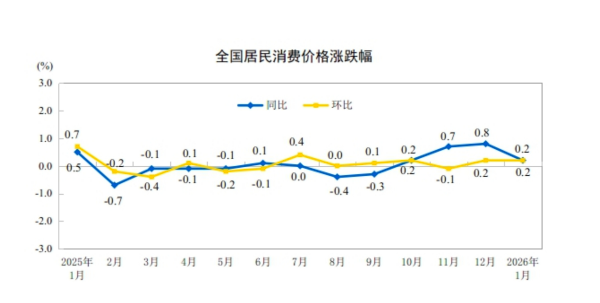
Group 1: Consumer Price Index (CPI) - In January, the CPI increased by 0.2% month-on-month and year-on-year, reflecting a decrease of 0.6 percentage points compared to December [1] - The decline in CPI is attributed to the Spring Festival timing and a significant drop in energy prices, which decreased by 5.0%, impacting CPI by approximately 0.34 percentage points [3] - Core CPI, excluding food and energy, rose by 0.8% year-on-year and 0.3% month-on-month, marking the highest increase in six months, indicating a steady recovery in consumer demand [3] Group 2: Producer Price Index (PPI) - The PPI rose by 0.4% month-on-month in January, marking the fourth consecutive month of increase, with an expansion of 0.2 percentage points from the previous month [5] - Factors contributing to the PPI increase include the ongoing construction of a unified national market and rising demand in certain industries [5] - Prices in sectors such as photovoltaic, battery, cement, and steel have shown positive improvements due to the "anti-involution" policies implemented last year [5] Group 3: Industry-Specific Price Changes - In January, prices for cement manufacturing and lithium-ion battery manufacturing increased by 0.1%, continuing a four-month upward trend [5] - The price of photovoltaic equipment and components shifted from a 0.2% decrease to a 1.9% increase, while basic chemical raw materials saw a 0.7% increase [5] - The prices of non-ferrous metal mining and smelting industries rose significantly, with silver smelting prices increasing by 38.2% and copper smelting by 8.4% [6] Group 4: Future Price Trends - The National Bureau of Statistics indicates that favorable factors for moderate price recovery are accumulating, supported by policies aimed at boosting consumption and stabilizing market expectations [6] - The implementation of coordinated fiscal and financial policies is expected to gradually expand consumer demand, providing a foundation for stable price operations [6] - Emphasis on industry self-regulation and capacity management is anticipated to further enhance price recovery in key sectors [6]

光大证券:钢铁电解铝企业潜在分红比例提升 重点推荐华菱钢铁(000932.SZ)等
智通财经网· 2026-02-11 04:02
Core Viewpoint - The report from Everbright Securities highlights that by 2026, companies with high undistributed profits, ample cash reserves, and low debt ratios are expected to have strong dividend potential, supported by favorable conditions in market value management, high dividend strategies, and declining capital expenditures in the steel and aluminum industries [1] Group 1: Dividend Potential of Companies - Companies recommended for strong dividend potential include Hualing Steel (000932.SZ), Baosteel (600019.SH), and Jiuli Special Materials (002318.SZ), with China Aluminum (601600.SH) suggested for further observation [1] - China Shenhua's cash dividend ratio increased significantly from an average of 39% (2008-2016) to 151% in 2017, with an average of 74% from 2018 to 2024, driven by low debt ratios, reduced capital expenditures, and high undistributed profits [1] Group 2: High Dividend Yield Companies - As of February 6, 2026, there are only eight companies in the steel and electrolytic aluminum sectors with dividend yields above 3%, including Youfa Group (6.90%), Baosteel (4.18%), and Jiuli Special Materials (3.23%) [2] Group 3: Factors Supporting Dividend Increases - Three favorable factors for potential dividend increases in the steel and aluminum sectors include: 1. Market value management being included in assessments, encouraging companies to enhance cash dividends [3] 2. Large-scale entry of insurance capital, making high dividend strategies a core asset allocation choice [3] 3. Gradual decline in capital expenditures in the steel and aluminum industries, allowing for increased cash dividends [3] - A scoring system based on undistributed profits, cash reserves, and debt ratios identifies 14 companies with strong dividend potential, with Hualing Steel and Baosteel scoring highest in the steel sector [3]



光大证券:钢铁电解铝企业潜在分红比例提升 重点推荐华菱钢铁等
智通财经网· 2026-02-11 03:58
Core Viewpoint - The report from Everbright Securities highlights that by 2026, certain companies with high undistributed profits, ample cash reserves, and low debt ratios are expected to have strong dividend potential, supported by favorable conditions in market value management, high dividend strategies, and declining capital expenditures in the steel and aluminum industries [1] Group 1: Dividend Potential of Companies - Companies recommended for strong dividend potential include Hualing Steel (000932.SZ), Baosteel (600019.SH), and Jiuli Special Materials (002318.SZ), with China Aluminum (601600.SH) suggested for further attention [1] - The analysis indicates that only 14 companies in the steel and aluminum sectors meet the criteria for strong dividend potential based on undistributed profits to total market value, cash reserves to total market value, and debt ratios [4] Group 2: Factors Supporting Dividend Increases - Three key factors are identified that may enhance the dividend potential of steel and aluminum companies: 1. Inclusion of market value management in assessments, encouraging companies to increase cash dividends [3] 2. Significant entry of insurance capital into the market, making high-dividend assets a core investment strategy [3] 3. Anticipated decline in capital expenditures in the steel and aluminum industries, which may lead to higher cash dividend ratios [3] Group 3: Current Dividend Yields - As of February 6, 2026, there are only eight companies in the steel and aluminum sectors with dividend yields above 3%, with notable yields from Youfa Group (6.90%), Erdos (4.62%), and Baosteel (4.18%) [2]
行业高股息系列报告之四:以煤为鉴:探讨钢铝分红率增加的可能性
EBSCN· 2026-02-11 03:48
Investment Rating - Steel industry: Maintain "Overweight" rating [6] - Non-ferrous industry: Maintain "Overweight" rating [6] Core Insights - The report highlights the potential for increased dividend payouts in the steel and aluminum sectors, driven by three main factors: the inclusion of market value management in assessments, significant insurance capital entering the market, and a gradual decline in capital expenditures within the steel and aluminum industries [3][5][29]. Summary by Sections Dividend Potential Analysis - The report identifies that only 8 companies in the steel and aluminum sectors currently have dividend yields above 3%, with notable companies including Youfa Group (6.90%), Ordos (4.62%), and Baosteel (4.18%) [2][22]. - A total of 14 companies in the steel and aluminum sectors meet the criteria for strong dividend potential, which includes having a high ratio of undistributed profits to total market value, sufficient cash reserves, and a debt ratio below 60% [4][32]. Factors Supporting Dividend Increases - The inclusion of market value management in the assessment of central enterprises is expected to accelerate the realization of dividend potential, as it encourages companies to enhance their market performance and return value to investors through increased cash dividends [3][25]. - The influx of insurance capital into the market is pushing for a revaluation of dividend-paying assets, as high dividend strategies become a core choice for insurance companies seeking stable returns [3][27]. - Capital expenditures in the steel and aluminum industries are anticipated to decline as the steel industry's ultra-low emission upgrades conclude and aluminum production approaches capacity limits, which may lead to higher future dividend payouts [3][30]. Company Recommendations - The report recommends focusing on companies with high undistributed profits, ample cash reserves, and low debt ratios, specifically highlighting Huazhong Steel, Baosteel, and Jiuli Special Materials as key investment opportunities, while suggesting to keep an eye on China Aluminum [5][34].
印尼减产+进口通道畅通,能源国企有望持续受益,国企红利ETF(159515)涨0.25%
Xin Lang Cai Jing· 2026-02-11 03:38
Group 1 - The core viewpoint of the news highlights the performance of the China Securities State-Owned Enterprises Dividend Index, which saw an increase of 0.21% as of February 11, 2026, with notable gains from constituent stocks such as Yuntianhua (up 3.92%) and Conch Cement (up 3.15%) [1] - Huatai Securities predicts that in 2025, the secondary equity investment from insurance funds, including stocks and funds, may reach 1 trillion yuan, with a secondary equity position of around 16%, making it a significant source of capital for the stock market [1] - Dividend stocks are increasingly important in the equity allocation of insurance funds, driven by the rising importance of cash dividend income and the need to reduce the volatility of equity assets as positions reach historical highs [1] Group 2 - Guolian Minsheng Securities notes that Indonesia plans to significantly reduce coal production to 600 million tons in 2026, a decrease of 40%-70% from 2025, which, combined with a 117.3% year-on-year increase in transportation capacity at the Ganqimaodu port, highlights the dual support of rigid overseas supply and improved domestic import efficiency [2] - Dongfang Securities emphasizes that sectors with dividend attractiveness during low cycles are worth monitoring, as the current macroeconomic environment is at a low point for PPI, with expectations of recovery in PPI and industry profitability [2] - The China Securities State-Owned Enterprises Dividend ETF closely tracks the China Securities State-Owned Enterprises Dividend Index, selecting 100 listed companies with high cash dividend yields and stable dividends from state-owned enterprises, reflecting the overall performance of high-dividend securities [2]