国防军工

Search documents
沪指创新高,“十五五”政策点燃三大赛道!
Sou Hu Cai Jing· 2025-10-24 05:27
Core Viewpoint - The A-share market is experiencing a strong performance led by growth sectors, with significant capital inflow into technology and growth themes, while the Hong Kong market shows a mild upward trend driven by technology stocks [1][2][3] Market Overview - A-share market opened high and continued to rise, with the Shanghai Composite Index reaching a new yearly high of 3946.16 points, closing up 0.42% at 3938.98 points [2] - The Shenzhen Component Index and ChiNext Index also saw gains of 1.30% and 2.09% respectively, while the Sci-Tech 50 Index surged by 2.98% [2] - Total market turnover reached 1.24 trillion yuan, an increase of 180.8 billion yuan from the previous trading day, indicating strong investor interest in technology and growth sectors [2] - The Hong Kong market also rebounded, with the Hang Seng Index rising 0.59% to 26122.10 points, supported by technology and semiconductor stocks [2] Industry Highlights and Driving Logic - The technology growth sector in the A-share market is experiencing a comprehensive surge, driven by policy catalysts and industry cycles [3] - The storage chip sector saw a wave of limit-up stocks, driven by major companies like Samsung and SK Hynix planning to raise DRAM and NAND flash prices by 30% in Q4 [3] - The commercial aerospace sector also saw significant gains, benefiting from the strategic deployment of building a strong aerospace nation [3] - The semiconductor industry chain is performing well, with strong capital inflow across equipment, materials, and manufacturing segments [3] - The communication and defense sectors are also strong, with the communication sector up 2.80% driven by 5G-A and computing network construction expectations [3] Sector Adjustments - The cyclical and consumer sectors are experiencing adjustments, with the coal sector down 1.61% due to profit-taking and commodity price fluctuations [4] - The food and beverage sector fell by 0.96%, reflecting a slowdown in consumer recovery and reduced demand for defensive stocks [4] - In the Hong Kong market, technology stocks are the core driving force, with the Hang Seng Tech Index rising 4.77% [4] Investment Strategy Recommendations - The current market is in an active phase driven by strong policies and technology leadership, with a focus on structural opportunities in the fourth quarter [6] - Emphasis on technology growth sectors, particularly in AI and storage chips, with attention to companies benefiting from domestic substitution logic [6] - The military and aerospace sectors are highlighted for their policy certainty, with a focus on satellite manufacturing and rocket launch industries [6] - For cyclical and resource sectors, opportunities are identified in precious metals and the new energy chain, particularly lithium mining [7] Overall Market Sentiment - The market's increased volume supports the continuation of the technology growth theme, while caution is advised regarding potential over-speculation in certain stocks [8] - The technology growth sector remains a primary source of excess returns, while cyclical resource and policy-driven opportunities provide value for phased allocation [8]
【盘中播报】沪指涨0.22% 电子行业涨幅最大
Zheng Quan Shi Bao Wang· 2025-10-24 04:35
Core Points - The Shanghai Composite Index rose by 0.22% as of 10:28 AM, with a trading volume of 593.20 billion shares and a transaction value of 927.6 billion yuan, an increase of 11.89% compared to the previous trading day [1] Industry Performance - The electronics sector led the gains with a rise of 3.06%, followed by defense and military industry at 2.41%, and communication at 1.90% [1] - The sectors with the largest declines included oil and petrochemicals at -1.36%, coal at -1.31%, and transportation at -1.11% [2] Detailed Industry Data - **Electronics**: - Change: +3.06% - Transaction Value: 195.65 billion yuan - Change from Previous Day: +46.12% - Leading Stock: N Chao Ying with a rise of 394.44% [1] - **Defense and Military**: - Change: +2.41% - Transaction Value: 37.54 billion yuan - Change from Previous Day: +66.07% - Leading Stock: Tongyi Aerospace with a rise of 25.34% [1] - **Communication**: - Change: +1.90% - Transaction Value: 49.76 billion yuan - Change from Previous Day: +5.54% - Leading Stock: Kunheng Shunwei with a rise of 8.06% [1] - **Oil and Petrochemicals**: - Change: -1.36% - Transaction Value: 8.61 billion yuan - Change from Previous Day: -19.59% - Leading Stock: Zhun Oil with a decline of 6.95% [2] - **Coal**: - Change: -1.31% - Transaction Value: 12.22 billion yuan - Change from Previous Day: -8.20% - Leading Stock: Antai Group with a decline of 9.72% [2] - **Transportation**: - Change: -1.11% - Transaction Value: 15.02 billion yuan - Change from Previous Day: +19.28% - Leading Stock: Qin Port with a decline of 6.14% [2]
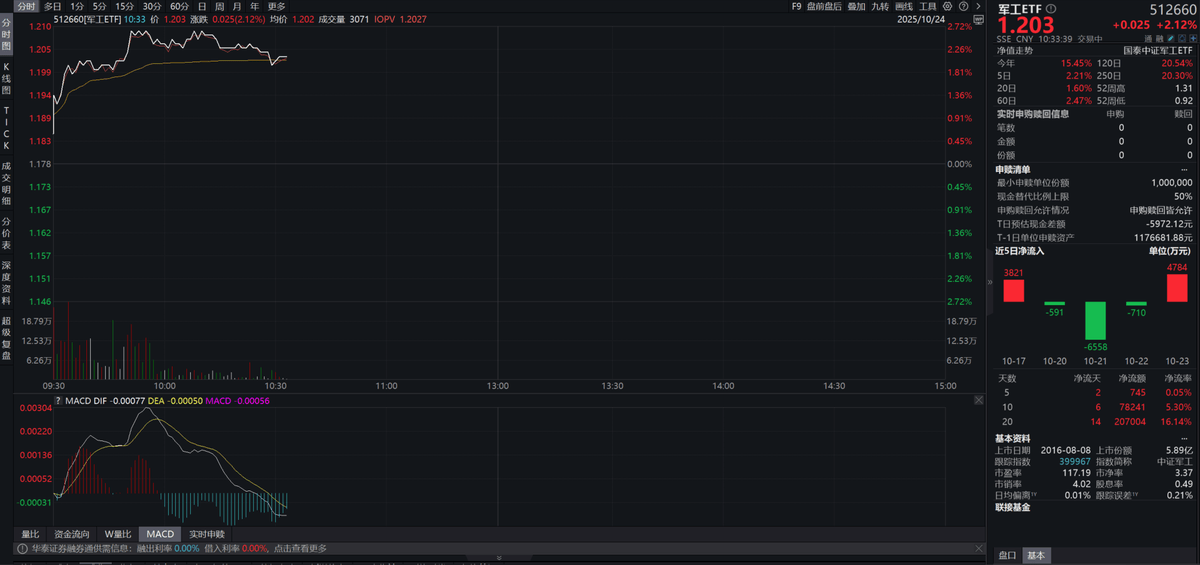
重磅会议提振国防军工,军工ETF(512660)涨超2%,资金积极布局
Sou Hu Cai Jing· 2025-10-24 04:01
Core Viewpoint - The recent major conference emphasized the importance of national defense strength and international influence, which is expected to boost the military industry sector and enhance market recognition of its high prosperity [1][3]. Group 1: National Defense and Military Industry Outlook - The conference report highlighted a shift in focus towards national defense and international influence, aiming for significant advancements by 2035 in economic, technological, and military capabilities [3]. - The change in emphasis is attributed to the demands of great power strategic competition, with a recognition of the evolving international landscape and the need for proactive responses [3]. - The military industry is expected to see a recovery in demand as the "14th Five-Year Plan" approaches its final year, with long-term growth certainty supported by clear development goals for 2035 and 2050 [4]. Group 2: Military ETF and Investment Opportunities - The military ETF (512660) covers the entire military industry chain and is the largest in its category, reflecting a solid fundamental outlook for the defense sector [5][6]. - The ETF tracks the CSI Military Index, which includes representative listed companies in aerospace, aviation, shipbuilding, weaponry, and military electronics, indicating a high concentration in the military sector [5]. - The military sector is poised for a new wave of prosperity driven by the release of new models and increased domestic demand, with significant contracts already announced to support future revenue growth [5].

尤洛卡10月23日获融资买入852.90万元,融资余额4.09亿元
Xin Lang Cai Jing· 2025-10-24 01:47
Group 1 - The core point of the news is that Youloka's stock performance and financial metrics indicate a stable yet cautious investment environment, with significant activity in both financing and securities lending [1][2]. Group 2 - As of October 23, Youloka's stock price remained unchanged at 0.00%, with a trading volume of 50.04 million yuan [1]. - The financing data shows that on the same day, Youloka had a financing buy-in of 8.53 million yuan and a net financing buy of 3.21 million yuan, with a total financing and securities lending balance of 409 million yuan [1]. - The financing balance represents 8.06% of the circulating market value, exceeding the 60th percentile of the past year, indicating a high level of financing activity [1]. - In terms of securities lending, Youloka repaid 100 shares and sold 400 shares, with a selling amount of 2,752 yuan, while the remaining securities lending balance was 33.78 million yuan, also above the 50th percentile of the past year [1]. Group 3 - As of October 20, Youloka had 32,500 shareholders, a decrease of 0.90% from the previous period, with an average of 17,873 circulating shares per person, an increase of 0.91% [2]. - For the first half of 2025, Youloka reported a revenue of 240 million yuan, a year-on-year decrease of 5.08%, while the net profit attributable to shareholders was 38.53 million yuan, reflecting a year-on-year increase of 11.22% [2]. - Since its A-share listing, Youloka has distributed a total of 978 million yuan in dividends, with 400 million yuan distributed over the past three years [2].

【环时深度】当“日本重回巅峰”遇上“让美国再次伟大”,新首相上台,日美同盟是共振还是错位
Huan Qiu Shi Bao· 2025-10-23 22:59
Group 1 - The election of Sanna Takashi as Japan's new Prime Minister marks a significant shift towards conservatism in Japanese politics, echoing the policies of former Prime Minister Shinzo Abe, particularly in terms of national security and economic strategies [2][3] - Takashi's administration aims to achieve strong economic growth, develop local industries, and enhance diplomatic and defense capabilities, continuing the trajectory set by Abe's government [3][6] - The upcoming meetings with U.S. President Trump are expected to focus on defense spending, trade negotiations, and the Indo-Pacific strategy, with Japan planning to increase defense expenditures and procure American goods [5][6] Group 2 - Takashi's government plans to accelerate the revision of key security documents and aims to meet the target of defense spending constituting 2% of GDP by 2025, up from the current 1.8% [6][7] - The relationship between Japan and the U.S. is characterized by mutual signals of alignment, with Takashi positioning herself as a reliable partner for the U.S. [5][9] - There are potential conflicts between Japan's "Japan is Back" initiative and the U.S. "America First" policy, particularly regarding trade agreements and defense responsibilities [10][12] Group 3 - The new administration faces challenges in balancing strong ties with the U.S. while maintaining Japan's strategic autonomy, especially in light of regional tensions with countries like China and South Korea [8][11] - Takashi's approach to foreign policy may lead to a more assertive Japan in the Indo-Pacific region, but it also risks marginalizing relationships with neighboring countries [11][12] - The internal political landscape in Japan, including the need for quick achievements to stabilize her government, will significantly influence Takashi's policy decisions and international relations [11][12]

300520,垂直20%涨停!超级赛道,尾盘突发异动!什么情况?
中国基金报· 2025-10-23 15:25
Market Overview - The A-share market opened lower on October 23, with the Shanghai Composite Index maintaining above 3900 points and the Shenzhen Component regaining 13000 points in the afternoon. The market turnover fell to 1.66 trillion yuan, marking a new low in two and a half months [4]. Sector Performance - Energy, near-term new stocks, film and television, and quantum technology sectors saw significant gains, while cultivated diamonds, glass fiber, communication equipment, and engineering machinery sectors experienced declines. Quantum technology stocks surged in the last trading minutes, with Keda Guokuan (300520) hitting a 20% limit up [5]. Key Developments - On October 22, Google announced a new algorithm named "Quantum Echo" developed by its quantum computing research team, which can compute molecular structures 13,000 times faster than the best supercomputers [8]. - Major inflows of over 3.2 billion yuan were observed in non-ferrous metals, with coal, media, basic chemicals, and non-bank financials also receiving over 2 billion yuan each. However, the electronics sector saw a net outflow exceeding 6.7 billion yuan [8]. Future Outlook - According to Debon Securities, the reduced trading volume indicates cautious market sentiment, with financial and energy sectors providing support. The focus may shift to the "14th Five-Year Plan" policies, particularly in expanding domestic demand and consumer sectors [9]. - Huajin Securities anticipates that the implementation of the "14th Five-Year Plan" will strengthen the technology sector, benefiting industries such as electronics and robotics, as well as innovative pharmaceuticals and green energy sectors [9]. Company Earnings - Several new stocks reported strong growth in their Q3 earnings. Guangdong Jianke turned a profit in the first three quarters of 2025, while Aifenda reported a net profit of 96.41 million yuan, a year-on-year increase of 11.71% [11]. - Jianfa Zhixin expects a net profit of 200 to 222 million yuan for the first three quarters of 2025, a growth of 30% to 40%, with Q3 results to be disclosed on October 28 [11].


划重点:二十届四中全会公报对A股投资的启示
Yin He Zheng Quan· 2025-10-23 12:11
Core Insights - The report emphasizes the importance of high-quality economic development during the "15th Five-Year Plan" period, highlighting the need for significant improvements in technological self-reliance and national security [2][6] - The "15th Five-Year Plan" suggests favorable conditions for various themes and industries, including the construction of a modern industrial system, development of new quality productivity, and expansion of domestic demand [2][7] Summary by Sections 1. Main Content of the 20th Central Committee's Fourth Plenary Session - The session reviewed and approved the "Suggestions on Formulating the 15th Five-Year Plan for National Economic and Social Development" [4] 2. Deep Impact on the A-Share Market - Short-term, the session provides new policy expectations and investment clues for the A-share market, potentially boosting market confidence and attracting incremental capital [10] - Long-term, the strategic direction outlined in the session reinforces confidence in the long-term resilience of the Chinese economy, particularly in key areas like modern industrial system construction [10] 3. Theme Investment Opportunities - New Quality Productivity: The focus on enhancing technological self-reliance is a key investment theme, with technology companies that align with national strategies expected to be significant investment targets [11] - Consumption Sector: The emphasis on expanding domestic demand and promoting consumption indicates that consumer sectors, especially new consumption trends, will be critical areas for investment [12][13] - "Two Heavy" Projects: The report highlights the importance of major strategic projects and infrastructure development, which will benefit related sectors such as construction and machinery [13][14] - Anti-Overcompetition: The report discusses the need to address disordered competition, which will enhance the long-term investment value of related sectors [14] - Real Estate Chain: The focus on promoting high-quality development in real estate suggests potential trading opportunities within the real estate sector [15]
风险月报 | 情绪大幅降温,估值与预期走出分化
中泰证券资管· 2025-10-23 11:32
Market Overview - The risk scoring for the stock market by Zhongtai Asset Management is 45.79, a significant drop from 62.77 last month, primarily due to a notable decline in market sentiment [2] - The valuation of the CSI 300 index has increased to 64.74 from 61.90 last month, marking a continuous rise in the overall valuation center for six months [2] - There is a clear differentiation in valuations across sectors, with industries like steel, electronics, real estate, and others remaining above the historical 60th percentile, while the agriculture sector remains below the 10th percentile [2] Economic Indicators - Market expectation scores have slightly improved to 55.00 from 50.00 last month, driven by better-than-expected import and export growth in September [3] - Economic growth has slowed since Q3, but there is no acceleration in the downturn compared to the same period last year [3] - The global liquidity environment is becoming more accommodative due to the Federal Reserve's preventive rate cuts, but geopolitical conflicts and uneven recovery among major economies add uncertainty to the domestic economic environment [3] Market Sentiment - Market sentiment has experienced a drastic decline to 22.24 from 70.03 last month, indicating a shift from a significantly positive to a low sentiment range [5] - Various sentiment indicators have shown a cooling trend, with margin financing scores dropping significantly and retail fund inflows into the equity market slowing down [5] - The current market presents a mixed pattern of rising valuation centers, stable expectations, and sharply declining sentiment, suggesting a need for investors to approach market indicators with rationality [5] Bond Market Analysis - The risk scoring for the bond market is 61.7, reflecting a continuation of weak economic data, particularly in consumption [7] - Fixed asset investment growth has turned negative for the first time since the pandemic, with a cumulative year-on-year decline of 0.5% [8] - The overall liquidity in the market has shown signs of marginal weakening, with a decline in social financing growth since July [9] Key Economic Data - In Q3 2025, the actual GDP growth rate is 4.8%, with nominal GDP growth at 3.7% [8] - The industrial value-added growth in September is reported at 6.5%, while retail sales growth is at 3.0% [8] - The total social financing in September is 3.53 trillion yuan, with new RMB loans amounting to 1.61 trillion yuan [9]

10月23日沪投资品(000102)指数涨0.5%,成份股德业股份(605117)领涨
Sou Hu Cai Jing· 2025-10-23 09:05
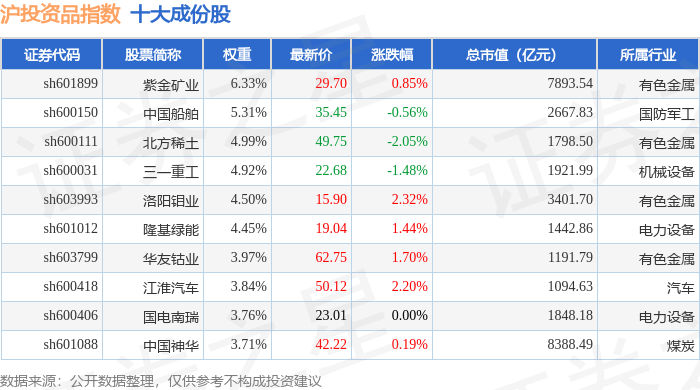
Core Points - The Shanghai Investment Products Index (000102) closed at 7184.98 points, up 0.5%, with a trading volume of 649.17 billion yuan and a turnover rate of 1.29% [1] - Among the index constituents, 32 stocks rose while 15 fell, with DeYe Co., Ltd. leading the gainers at 4.61% and Hengli Hydraulic leading the decliners at 2.9% [1] Index Constituents Summary - The top ten constituents of the Shanghai Investment Products Index include: - Zijin Mining (6.33% weight, latest price 29.70, market cap 789.35 billion yuan) in the non-ferrous metals sector [1] - China Shipbuilding (5.31% weight, latest price 35.45, market cap 266.78 billion yuan) in the defense industry [1] - Northern Rare Earth (4.99% weight, latest price 49.75, market cap 179.85 billion yuan) in the non-ferrous metals sector [1] - SANY Heavy Industry (4.92% weight, latest price 22.68, market cap 192.20 billion yuan) in the machinery sector [1] - Luoyang Molybdenum (4.50% weight, latest price 15.90, market cap 340.17 billion yuan) in the non-ferrous metals sector [1] - Longi Green Energy (4.45% weight, latest price 19.04, market cap 144.29 billion yuan) in the power equipment sector [1] - Huayou Cobalt (3.97% weight, latest price 62.75, market cap 119.18 billion yuan) in the non-ferrous metals sector [1] - JAC Motors (3.84% weight, latest price 50.12, market cap 109.46 billion yuan) in the automotive sector [1] - Guodian NARI Technology (3.76% weight, latest price 23.01, market cap 184.82 billion yuan) in the power equipment sector [1] - China Shenhua Energy (3.71% weight, latest price 42.22, market cap 838.85 billion yuan) in the coal sector [1] Capital Flow Summary - The net outflow of main funds from the index constituents totaled 627 million yuan, while retail investors saw a net inflow of 527 million yuan [3] - Key stocks with significant capital flow include: - China Aluminum (net inflow of 43.41 million yuan from main funds) [3] - Luoyang Molybdenum (net inflow of 33.70 million yuan from main funds) [3] - Jianghuai Automobile (net inflow of 19.50 million yuan from main funds) [3] - Longi Green Energy (net inflow of 16.40 million yuan from main funds) [3] - Huayou Cobalt (net inflow of 158 million yuan from main funds) [3]






新余国科:第三季度净利润2183.45万元,下降1.04%
Xin Lang Cai Jing· 2025-10-23 07:59
新余国科公告,第三季度营收为9722.31万元,下降1.69%;净利润为2183.45万元,下降1.04%。前三季 度营收为2.62亿元,下降17.89%;净利润为4818.57万元,下降26.72%。 ...