
能源

Search documents
美股市场速览:贸易冲突再起,全风格恐慌下跌
Guoxin Securities· 2025-10-12 05:14
Investment Rating - The report maintains a "Weaker than Market" rating for the U.S. stock market [1] Core Insights - The report highlights a significant market downturn due to renewed trade conflicts, with the S&P 500 dropping by 2.4% and the Nasdaq by 2.5% [3] - Only three sectors experienced gains, while 21 sectors saw declines, indicating widespread market fear [3] - The semiconductor sector attracted substantial capital inflows, contrasting with the overall outflow from the market [4] Summary by Sections Price Trends - The S&P 500 fell by 2.4%, and the Nasdaq decreased by 2.5% due to trade tensions [3] - The performance of sectors varied, with the Food, Beverage & Tobacco sector increasing by 1.7%, while Durable Goods & Apparel dropped by 8.4% [3] Capital Flows - The estimated capital flow for S&P 500 components was -$40.6 billion, indicating a significant outflow compared to the previous week [4] - The semiconductor products and equipment sector saw a capital inflow of $83.2 million, while the automotive sector experienced a $25.7 million outflow [4] Earnings Forecast - The report indicates a 0.3% upward adjustment in the earnings per share (EPS) forecast for S&P 500 components, with 21 sectors seeing an increase in earnings expectations [5] - The materials sector led the upward revisions with a 1.0% increase, while the energy sector faced a downward adjustment of 0.5% [5]




欧洲快顶不住了,默克尔突然开炮:别怪我,要怪就怪波兰!
Sou Hu Cai Jing· 2025-10-12 03:41
Core Viewpoint - The recent statements by former German Chancellor Angela Merkel regarding the EU's approach to Russia have sparked significant controversy, highlighting deep divisions within Europe over foreign policy and energy dependence [1][3][5]. Background - In June 2021, Merkel and French President Macron proposed a direct dialogue between the EU and Russia to address issues related to energy, security, and borders, amidst rising tensions due to Russian military buildup near Ukraine [1][3]. - The proposal was met with strong opposition from Poland and the Baltic states, who feared it would undermine a unified EU stance against Russia and jeopardize Eastern European security [3][5]. Reactions from Eastern European Countries - Poland's government criticized Merkel for shifting blame and emphasized its support for EU unity against Russian aggression, highlighting military aid provided to Ukraine since 2022 [5][7]. - The Baltic states expressed outrage, with officials stating that Merkel's comments were misguided and that Germany's energy policies, particularly the Nord Stream pipeline, exacerbated Europe's reliance on Russian energy [7][9]. Russian Response - Interestingly, the Kremlin supported Merkel's assertions, claiming that Eastern European countries hindered peace efforts and that internal EU divisions left Russia with no choice but to act [9]. Economic Implications - Since 2022, the EU has paid over €213 billion to Russia for energy, indirectly funding military actions, while sanctions imposed on Russia have led to significant economic repercussions for Europe, including soaring inflation rates [7][9].

全线暴跌!下周怎么办?
格隆汇APP· 2025-10-11 11:55
Core Viewpoint - The article discusses the significant market downturn triggered by Trump's announcement of a 100% tariff on Chinese goods, leading to a sharp decline in major stock indices and concerns about the upcoming market reactions in Hong Kong and A-shares [3][8][20]. Market Reaction - The Nasdaq index fell over 3%, marking its largest single-day drop since April, with major tech stocks like TSMC, Tesla, and Nvidia experiencing declines of over 5% [9][10]. - Chinese stocks were particularly hard hit, with the Nasdaq Golden Dragon China Index dropping over 6% [10]. - European markets also saw declines, with the Euro Stoxx 50 index down 1.75% [10]. Commodity and Asset Movements - Oil prices plummeted, with WTI crude down over 4.24% and Brent crude down 4.62% [10]. - Bitcoin experienced a significant drop, falling over 13% to a low of $104,920, while Ethereum dropped over 17% [10]. - In contrast, safe-haven assets like gold rose over 1%, surpassing $4,000 per ounce, and the yield on the 10-year U.S. Treasury fell to 4.034% [13]. Tariff Implications - The announcement of the 100% tariff is reminiscent of the market turmoil seen in April, where the Shanghai Composite Index experienced a drop of nearly 9% [16]. - The article highlights the potential for significant market volatility if no positive developments occur before the opening of the domestic markets [20]. Sector Performance - The article provides a table showing sector performance in response to previous tariff announcements, indicating varying impacts across sectors such as consumer goods, utilities, and technology [18]. - It notes that sectors with high export exposure, like consumer electronics and power equipment, may be particularly vulnerable to tariff impacts [17]. Future Outlook - The article suggests that unless there are significant positive developments, the domestic stock market is likely to face a substantial correction [20]. - It emphasizes the importance of monitoring the evolving situation regarding tariffs and potential negotiations between the U.S. and China [29][30]. Investment Opportunities - The article identifies potential investment opportunities in sectors that may benefit from domestic policy support, such as semiconductor equipment, high-end manufacturing, and military-related industries [31]. - It also mentions the appeal of high-dividend blue-chip stocks and sectors less affected by tariffs, such as essential consumer goods and agriculture [32].



宁德时代参投基金入股达卯科技,后者为AI虚拟电厂运营商
Qi Cha Cha· 2025-10-11 06:07
Group 1 - The core point of the article is that CATL has invested in Damo Technology, which operates AI virtual power plants, indicating a strategic move into the energy sector leveraging AI technology [1] Group 2 - Damo Technology has undergone a business change, with CATL and other investment firms becoming shareholders, increasing its registered capital from approximately 12.09 million RMB to about 12.77 million RMB [1] - The company was established in March 2021 and focuses on building an Energy MaaS platform and AI virtual power plant applications using General Artificial Intelligence (AGI) technology [1] - Damo Technology provides technical consulting, operational services, and energy efficiency management software [1]

【环球财经】美股再次大跌,发生了什么?
Xin Lang Cai Jing· 2025-10-11 05:24
Core Points - The US stock market experienced significant declines due to uncertainties surrounding government tariff policies, with the S&P 500 index dropping 2.71%, marking its largest single-day decline since April [1] - Analysts indicate that the market's reaction reflects both policy impacts and a recent trend of investor optimism, which may be unwarranted given the recent market performance [1] - Concerns are rising regarding whether the substantial investments in AI by companies will yield proportional returns, leading to fears that the tech-driven market rally may be nearing a critical point [2] Market Performance - The S&P 500 index closed at 6552.51 points, with a cumulative decline of 2.43% for the week, while the Nasdaq Composite index fell 3.56% to 22204.43 points, also reflecting a cumulative weekly drop of 2.53% [1] - The Dow Jones Industrial Average decreased by 1.9%, ending at 45479.6 points, with a total weekly decline of 2.73% [1] - The VIX, a measure of market volatility, rose by 31.65% to 21.63 points, indicating increased investor fear, with a cumulative increase of 29.91% for the week [1] AI Investment Concerns - Despite expectations of improved corporate revenues driven by AI, doubts are growing about the value of the massive investments in AI technology [2] - The upcoming earnings season, starting with major banks like JPMorgan, is expected to provide insights into whether the market is in a bubble, with the projected year-over-year profit growth for S&P 500 companies at 7.2%, the slowest in eight quarters [2] - Companies are facing pressure to monetize their AI investments, as many are currently incurring costs rather than generating revenue from these technologies [2]
突发!美国股债汇“三杀”,全球资产巨震→
Guo Ji Jin Rong Bao· 2025-10-11 00:48
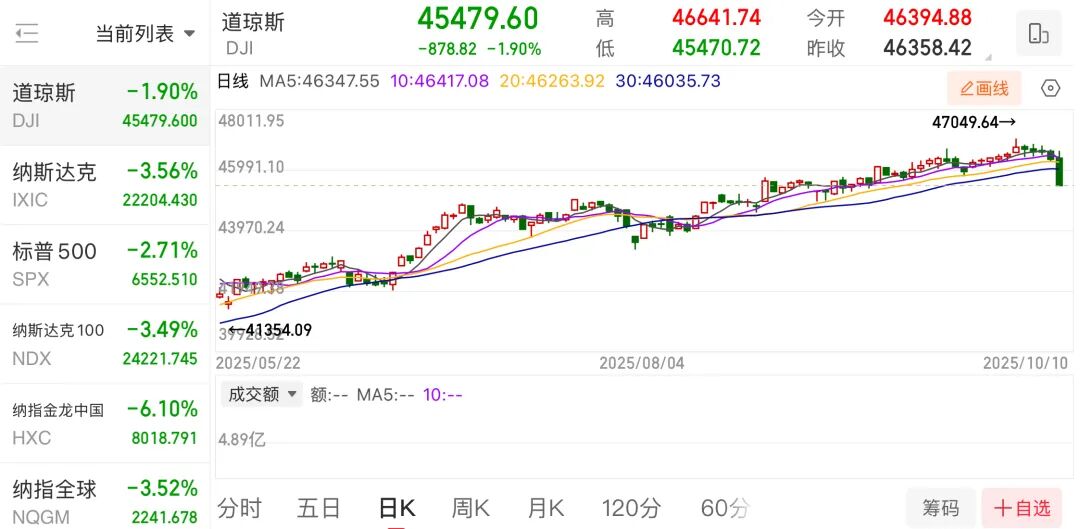
银行股集体下跌,摩根大通跌超1%,高盛跌近2%,花旗跌超2%,摩根士丹利跌近3%,美国银行跌超2%,富国银行跌逾2%。 当地时间10月10日,美股三大指数集体大跌,道指跌1.9%,纳指跌3.56%,标普500指数跌2.71%。纳指、标普500指数创4月以来最大单日跌幅。 与此同时,全球资产巨震,美债收益飙升,美元下跌,黄金大涨,加密货币集体下跌,全球爆仓人数超16万。 道指收跌878.82点,报45479.60点,跌幅为1.90%;纳指收跌820.20点,报22204.43点,跌幅为3.56%;标普500指数收跌182.60点,报6552.51点,跌幅为 2.71%。 大型科技股全线下跌,特斯拉跌超5%,亚马逊跌约5%,英伟达跌近5%,脸书跌近4%,苹果跌超3%,微软跌超2%,谷歌跌近2%。 国际油价显著下跌。截至当天收盘,纽约商品交易所11月交货的轻质原油期货价格下跌2.61美元,收于每桶58.90美元,跌幅为4.24%;12月交货的伦敦布 伦特原油期货价格下跌2.49美元,收于每桶62.73美元,跌幅为3.82%。 比特币一度跌破110000美元,截至10月11日8时,比特币下跌近7%。加密货币集体下跌, ...
全球闪崩!
Wind万得· 2025-10-11 00:25
Market Overview - The US stock market experienced significant declines, with the Dow Jones Industrial Average dropping 878.82 points, a decrease of 1.9%, closing at 45,479.60 points. The S&P 500 fell by 2.71%, ending at 6,552.51 points, marking its largest single-day drop since April 10. The Nasdaq Composite plummeted 3.56%, closing at 22,204.43 points after reaching a historical high earlier in the day [1][3]. Factors Influencing Market Sentiment - Increased trade war risks and the ongoing US government shutdown have led to a rapid decline in global market risk sentiment, causing collective sell-offs in US and European markets. The Dow fell nearly 2%, the S&P 500 over 2.5%, and the Nasdaq more than 3.5%. European indices such as Germany's DAX and France's CAC40 also saw declines of approximately 1.5% [3][9]. Sector Performance - Technology stocks were the primary drivers of the market downturn, with significant losses in sectors such as semiconductors and electric vehicles. Many leading stocks in these sectors experienced declines between 5% and 8%. Concerns arose regarding the impact of global supply chain issues and slowing growth expectations in their sales markets [9][10]. Volatility and Investor Behavior - The CBOE Volatility Index (VIX), often referred to as Wall Street's fear gauge, surged above 22, indicating heightened investor anxiety and a rush to purchase protective options against potential further declines. This spike in volatility reflects a shift in investor sentiment from optimism to caution, particularly in a high-valuation environment [9][10]. Economic and Political Context - The ongoing US government shutdown, now in its tenth day, has exacerbated market uncertainties. The Senate's failure to pass a temporary funding bill has raised concerns about its impact on economic growth in the fourth quarter. Analysts warn that prolonged political deadlock could undermine consumer and business confidence, affecting economic data releases and fiscal spending [10][11]. Weekly Market Performance - For the week, the S&P 500 fell by 2.4%, while the Nasdaq and Dow Jones recorded declines of 2.5% and 2.7%, respectively. The previous market support from corporate earnings and interest rate cut expectations has been overshadowed by emerging risks, prompting a shift towards defensive sectors and cash assets [11].

突然变盘!全线大跳水
Zhong Guo Ji Jin Bao· 2025-10-11 00:08
Market Overview - The U.S. stock market experienced a significant decline, with the Nasdaq and S&P 500 indices recording their largest single-day drops since April 10, 2023 [1][2] - The Nasdaq index fell by 3.56% to 22,204.43 points, while the S&P 500 dropped by 2.71% to 6,552.51 points, marking a weekly decline of 2.43% for the S&P 500 and 2.53% for the Nasdaq [2] Technology Sector - Major technology stocks saw substantial losses, with the "Big Seven" tech index down by 3.65% [3] - Individual stocks such as Tesla, Amazon, and Nvidia each fell over 5%, while Facebook and Apple dropped more than 3% [3] Chinese Stocks - Chinese stocks also faced significant declines, with the Nasdaq Golden Dragon China Index down by 6.1% [4] - Alibaba's stock fell by 8.45%, and other companies like Bilibili and Baidu saw declines exceeding 8% [4] Commodity Prices - International oil prices dropped sharply, with U.S. crude futures down 4.24% to $58.90 per barrel, and Brent crude futures falling nearly 3.82% to $62.73 per barrel [5] - In contrast, spot gold prices increased by over 1%, reaching a high of $4,022.901 per ounce [5] Federal Employment and Economic Outlook - The Trump administration confirmed the initiation of large-scale federal employee layoffs, with 200,000 federal employees already reduced this year and an additional 100,000 expected by year-end [6] - The likelihood of the U.S. government shutdown extending beyond 30 days has increased, with predictions now at 37% [6] Federal Reserve Insights - Federal Reserve officials expressed a willingness to consider further interest rate cuts as a precaution against a weakening labor market, with inflation significantly above target levels [7] - The labor market is perceived to be in a negative growth phase, prompting discussions on the need for cautious policy adjustments [7]


多地抢抓重大项目建设“黄金期” 新型政策性金融工具加速落地
Zhong Guo Zheng Quan Bao· 2025-10-10 23:02
Core Viewpoint - The article highlights the acceleration of major project construction across various regions in China, driven by the introduction of a new policy financial tool worth 500 billion yuan aimed at supplementing project capital. This initiative is expected to boost infrastructure investment growth in the fourth quarter [1][5]. Group 1: Major Project Developments - Significant progress has been made in major projects, such as the successful completion of the Xiaolongtan Grand Bridge on the Yukun High-speed Railway, which is part of the national "eight vertical and eight horizontal" high-speed railway network [2]. - The Guangxi Qinzhou Pumped Storage Power Station's underground traffic tunnel has been completed, with an expected annual clean energy consumption of 2.16 billion kilowatt-hours upon its completion in 2029, reducing carbon emissions by 1.6 million tons [2]. - Various provinces have held meetings to promote major project construction, with Hubei and Anhui provinces launching initiatives to boost project investments, including 587 new projects with a total investment of 332.38 billion yuan [2][3]. Group 2: Financial Support and Policy Tools - The National Development and Reform Commission has announced a new policy financial tool totaling 500 billion yuan to support project capital, which is crucial for the construction of major projects [3][4]. - Local governments are actively utilizing this financial tool, with Jiangsu's Taicang Water Group receiving 20.76 million yuan for a water supply project, and Guangxi Energy Group securing funding for the Bailong Nuclear Power Project, which has a total investment of 41 billion yuan [3]. - The article notes that the total investment for this year's "two heavy" construction projects has reached 800 billion yuan, with central budget investments of 735 billion yuan also being allocated [4]. Group 3: Investment Growth Expectations - Experts predict that the new policy financial tool will stimulate effective investment and promote stable economic growth, with infrastructure investment growth rates expected to recover in the fourth quarter [5][6]. - It is estimated that the new financial tool could leverage an additional 2 trillion to 5 trillion yuan in infrastructure investment, addressing capital shortages for projects [6]. - Recommendations for further policy measures include accelerating the use of special bonds and government bonds to enhance investment and stimulate domestic demand [6].
2025年7月捷克通胀率放缓至2.7%
Shang Wu Bu Wang Zhan· 2025-10-10 18:02
根据捷克统计局数据,7月捷克消费者价格同比上涨自6月的2.9%放缓至2.7%,环比下降0.5%。价 格同比上涨放缓主要受食品价格涨幅放缓及燃料价格同比下降的影响。食品和非酒精饮料价格同比上涨 5.2%。燃料价格同比下降8.8%,电力价格下降4%,天然气价格下降7.9%。环比看,商品价格下降 0.2%,服务价格上涨1.4%。 (原标题:2025年7月捷克通胀率放缓至2.7%) ...