通信

Search documents
1.4犀牛财经晚报:2025年私募持有上市ETF超过33亿份
Xi Niu Cai Jing· 2026-01-04 10:18
Group 1 - In 2025, private equity firms held over 3.34 billion shares of listed ETFs, with technology sector ETFs accounting for over 30% of the total holdings [2] - The top three private equity firms by ETF holdings were Zhufeng Asset with 280 million shares, followed by Zhongyi Asset and Shanghai Binghao Private Equity, each holding 176 million shares [2] - The National Silver LOF fund has issued a risk warning regarding its secondary market price, which has been trading at a significant premium over its net asset value [2] Group 2 - In 2026, two companies, Derun Electronics and Jintongling, were flagged for financial fraud, with Derun Electronics having fabricated over 500 million yuan in receivables [3] - Over 80 A-share companies were investigated for disclosure violations in 2025, with about 40% being ST companies [3] - The regulatory environment in China's capital markets has become stricter, reflecting the ongoing commitment to rigorous oversight since the introduction of the "New National Nine Articles" [3] Group 3 - Berkshire Hathaway's new CEO, Greg Abel, has been given full decision-making authority, with Warren Buffett expressing confidence in the company's future [4] - Following Buffett's retirement, Berkshire's stock price fell by 1.4%, raising concerns about the company's future performance under new leadership [4] - Buffett stated that he would continue to participate in company meetings but would no longer speak publicly, leaving his role to Abel [4] Group 4 - The National Supercomputing Internet platform has surpassed 1 million registered users, integrating over 30 national supercomputing and intelligent computing centers [5] - The platform has developed the largest computing power network in the country, offering 70 types of computing services for various applications [5] Group 5 - SAIC Motor Corporation reported sales of 4.507 million vehicles in 2025, a year-on-year increase of 12.3%, with electric vehicle sales reaching 1.643 million, up 33.1% [8] Group 6 - Century Huatong plans to repurchase shares worth between 300 million and 600 million yuan to implement employee stock ownership plans [16] - Nine Ding New Materials announced an investment of 246 million yuan to build a large-scale wind turbine blade production line, aligning with industry trends [19] - Baolong Oriental expects a net profit increase of 46.34% to 70.73% for 2025, driven by strong order volumes and improved production capacity [20]


——策略周报专题:若人民币汇率持续升值,风格行业如何选择-20260104
Guohai Securities· 2026-01-04 09:03
2026 年 01 月 04 日 策略周报 研究所: 证券分析师: 赵阳 S0350525100003 zhaoy05@ghzq.com.cn 证券分析师: 陈艺鑫 S0350525010003 chenyx03@ghzq.com.cn [Table_Title] 若人民币汇率持续升值,风格行业如何选择 ——策略周报专题 最近一年走势 相关报告 鹏》——2025-06-17 本篇报告解决了以下核心问题:1、人民币强升值或弱升值期间,配置什 么风格或行业胜率弹性较高?2、当下应该关注哪些性价比较高的行业? 核心要点: 国海证券研究所 请务必阅读正文后免责条款部分 《投资黄金如何增强收益——策略周报*陈艺鑫, 胡国鹏》——2025-09-28 《策略周报:反内卷行情有望进入第二阶段*陈艺 鑫,袁稻雨》——2025-08-24 《投资红利如何增强收益-——红利系列报告*陈艺 鑫,胡国鹏》——2025-07-25 《基于"三步走"的黄金交易策略*陈艺鑫,胡国 《我国财政货币双宽松下,大类资产如何配置*陈 艺鑫,胡国鹏》——2025-03-09 1、根据内需经济复苏强弱,将 2015 年 811 汇改后人民币升值阶段 ...
光大证券:对春季行情保持耐心
Xin Lang Cai Jing· 2026-01-04 08:53
Group 1 - The A-share market experienced a narrow fluctuation from December 2025, with a decline followed by an increase, supported by medium to long-term capital inflows and continued resident fund inflows, leading to a sustained rise in late December, indicating an expected spring market performance [1][4] - Historical patterns suggest that the January performance of the Shanghai Composite Index often inversely correlates with its December performance, indicating that if December sees gains, January may see losses, and vice versa, suggesting that investors should remain patient regarding January's market performance [1][4] Group 2 - The spring market typically focuses on growth and cyclical sectors, with growth sectors historically performing well, and the dual focus on growth and cyclical sectors appearing in 6 out of the last 13 spring markets, indicating potential strong performance in consumption and growth sectors this year [2][5] - For January's industry allocation, attention should be given to sectors such as electronics, electric equipment, non-ferrous metals, and automobiles, with a scoring framework indicating that if the market leans towards growth, top sectors include electronics, electric equipment, communication, non-ferrous metals, automobiles, and defense; if defensive, top sectors include non-bank financials, electronics, non-ferrous metals, electric equipment, automobiles, and transportation [2][5] Group 3 - The Hong Kong market presents good allocation value, with a strong RMB exchange rate potentially benefiting the market, and expectations of a Federal Reserve rate cut improving external liquidity conditions; there are investment opportunities in Hong Kong dividend stocks, which still offer a dividend yield advantage for long-term equity investors [3][6] - Attention is drawn to the progress of AI transformation in internet companies and the timing of performance recovery for companies facing competitive pressures in the Hong Kong internet technology sector [3][6]

量化择时周报:上行趋势仍在持续,板块如何选择-20260104
ZHONGTAI SECURITIES· 2026-01-04 08:46
- Model Name: Timing System Model; Model Construction Idea: The model uses the distance between the long-term moving average (120 days) and the short-term moving average (20 days) to distinguish the overall market environment[2][6][11] - Model Construction Process: The model calculates the distance between the 20-day moving average and the 120-day moving average. The latest data shows the 20-day moving average at 6298 points and the 120-day moving average at 6090 points. The difference between the two lines is 3.41%, and the absolute value of the distance continues to be greater than 3%, indicating that the market is in an upward trend[2][6][11] - Model Evaluation: The model effectively identifies the market's upward trend, providing a positive signal for market timing[2][6][11] - Model Name: Industry Trend Allocation Model; Model Construction Idea: The model identifies industry trends and allocates based on medium-term reversal expectations and sector performance[2][5][7] - Model Construction Process: The model signals to focus on service consumption sectors such as tourism and media based on medium-term reversal expectations. The TWO BETA model continues to recommend the technology sector, focusing on AI applications and commercial aerospace. The industry trend model shows that the communication, industrial metals, and energy storage sectors continue their upward trend[2][5][7] - Model Evaluation: The model provides clear guidance on sector allocation, helping investors to focus on promising sectors[2][5][7] - Model Name: Position Management Model; Model Construction Idea: The model suggests stock allocation based on valuation indicators and short-term trends[5][7] - Model Construction Process: The model uses the PE and PB ratios of the WIND All A Index. The PE ratio is near the 90th percentile, indicating a relatively high valuation, while the PB ratio is at the 50th percentile, indicating a moderate level. Based on these indicators and short-term trends, the model suggests an 80% stock allocation for absolute return products[5][7] - Model Evaluation: The model provides a balanced approach to stock allocation, considering both valuation and market trends[5][7] Model Backtest Results - Timing System Model, Moving Average Distance: 3.41%[2][6][11] - Timing System Model, Market Trend Line: 6262 points[2][6][11] - Timing System Model, Profit Effect: 2.71%[2][6][11] - Position Management Model, PE Ratio: 90th percentile[5][7] - Position Management Model, PB Ratio: 50th percentile[5][7] - Position Management Model, Stock Allocation: 80%[5][7]
华金证券:节后春季行情进行中 聚焦成长
Xin Lang Cai Jing· 2026-01-04 08:42
Group 1 - The short-term performance of A-shares after the New Year is mainly influenced by policies, external events, liquidity, and overseas market trends [1][6] - Since 2010, in 16 years, the Shanghai Composite Index has risen in 11 instances during the 10 trading days before the holiday and has shown similar patterns after the holiday [1][6] - Positive policies and external events are core influencing factors for post-holiday A-share performance, with examples including the resolution of the "fiscal cliff" in the US in January 2013 and the easing of US-China trade tensions in early 2019 [1][6] Group 2 - Current observations suggest that the A-share spring market is ongoing, with potential for a strong but volatile performance post-New Year [1][6] - There is a likelihood of further positive policy implementation after the holiday, including the rollout of guidelines for equipment updates and trade-in policies, as well as local government meetings to stimulate consumption [1][6] Group 3 - External risks post-holiday are expected to be limited, with a high probability of a Federal Reserve rate cut in January and stable US-China relations, although tensions with Japan may persist [2][7] - Liquidity is anticipated to further loosen, with potential for accelerated capital inflow into the stock market [2][7] Group 4 - The economic recovery remains weak, with industrial profits continuing to decline, but there is potential for recovery in certain sectors, particularly in technology and cyclical industries [2][7] - Historical trends indicate that industries driven by upward policies and trends before the holiday are likely to maintain their strength afterward [3][8] Group 5 - Recommendations for post-holiday investment include focusing on technology, certain cyclical sectors, and consumer industries, with specific mention of machinery, military, new energy, media, computing, electronics, telecommunications, and pharmaceuticals [4][9] - Current PEG ratios for growth sectors like power equipment and media are relatively low, indicating potential for investment [4][9]
中信证券:开年后市场震荡向上的概率更高
Xin Lang Cai Jing· 2026-01-04 08:31
Core Viewpoint - The market is experiencing a structural bull market driven by a significant re-evaluation of China's technological capabilities and the complexities of US-China relations, alongside resilient external demand and an explosion in AI inference demand [1][2][3] Group 1: Market Performance and Expectations - In 2025, the median return of actively managed public funds is projected to be 28.2%, ranking third in the past decade and sixth in the last twenty years [1][12] - The overall market performance can be divided into five phases, with the total return of the CSI All A Shares Index at 27.7% and the Hang Seng Tech Index at 23.4% for the year [2][13] - The first phase shows a brief market excitement before the Spring Festival, while the second phase sees a significant rally in the Hang Seng Tech Index due to a shift in narrative regarding China's autonomous technology [2][13] Group 2: Structural Bull Market Dynamics - The "big money" in the structural bull market comes from substantial expected differences and performance growth, primarily driven by the correction of pessimistic expectations regarding external demand and the AI industry's evolution [3][14] - The market's perception of external demand shifted from pessimism to optimism throughout the year, culminating in a consensus on external demand exposure by year-end [3][14] - The AI industry's demand surge has filled gaps during transitional phases, leading to significant valuation recoveries for key companies [4][14] Group 3: Liquidity and Market Dynamics - Incremental liquidity is viewed as a result of the expected difference and performance realization, rather than a primary driver of market growth [5][15] - The net inflow of ETFs was 230.6 billion yuan for the year, indicating that liquidity does not directly correlate with market index increases [5][15] - The market is not lacking in funds but rather in investable assets and imaginative space [5][15] Group 4: Future Expectations and Strategies - The largest expected difference for 2026 will stem from balancing external and internal demand, with a trend towards taxing external trade and subsidizing domestic demand [6][16] - The market sentiment at the end of 2025 was relatively restrained, suggesting a higher probability of upward market movement in early 2026 [7][17] - Investment strategies should focus on sectors with lower heat and concentration but increasing attention and catalysts, such as chemicals, engineering machinery, and renewable energy [9][19]

光大证券:消费与成长有望成为春季行情的两条主线
Di Yi Cai Jing· 2026-01-04 07:15
(文章来源:第一财经) 光大证券研报表示,当前来看,2025年12月下旬的上涨或许是本轮春季行情起点。对于1月份指数的行 情,投资者或许应该保持耐心。消费与成长有望成为今年春季行情的两条主线。1月行业配置方面,关 注电子、电力设备、有色金属、汽车等。若市场风格为成长,五维行业比较框架打分靠前的行业分别为 电子、电力设备、通信、有色金属、汽车、国防军工;若1月份市场风格为防御,五维行业比较框架打 分靠前的行业分别为非银金融、电子、有色金属、电力设备、汽车、交通运输等。 ...
新一轮消费品以旧换新政策全面启动 广西消费市场火热
Zhong Guo Xin Wen Wang· 2026-01-04 06:54
Core Insights - Guangxi's new round of consumer goods exchange policy is set to stimulate consumption during the New Year holiday period in 2026, with various promotional activities organized to enhance consumer engagement and sales [1] Group 1: Consumer Activity and Sales Performance - The consumer goods exchange initiative launched on December 31, 2025, has seen over 10,000 applications for subsidies amounting to over 5.87 million RMB, leading to sales exceeding 41.25 million RMB within two days [1] - During the New Year holiday, sales of major appliances and communication equipment in Guangxi increased by 4.2% and 5.0% year-on-year, respectively [1] - Key monitored pedestrian streets and commercial areas in Guangxi experienced a 21% increase in average daily foot traffic and a 16% increase in sales revenue year-on-year [1] Group 2: Online Promotions and Tourism - Over 400 "Guangxi Products Chain ASEAN" live streaming events were organized to promote local and ASEAN products, enhancing online traffic and boosting offline sales [2] - The number of visitors to Guangxi during the New Year holiday increased by 35.2% compared to the previous year, with a significant recovery in dining consumption [2] - Major events such as concerts featuring popular artists have led to a dramatic increase in hotel bookings around the Guangxi Sports Center, with orders surging by several times year-on-year [2] Group 3: Cultural and Entertainment Activities - Guangxi planned over 400 key cultural and tourism activities, including New Year music festivals and parades, with Beihai's Weizhou Island emerging as a top destination for New Year tourism, ranking second nationally in ticket sales [2] - Movie screenings of popular films like "Zootopia 2" and "Avatar 3" have contributed to a vibrant cultural consumption market during the holiday [2] Group 4: Market Stability - Prices of essential goods in Guangxi remained stable during the New Year holiday, with no reports of shortages, price fluctuations, or other abnormal market conditions [2]
活力大湾区开年气象新 人潮涌动经济旺
2 1 Shi Ji Jing Ji Bao Dao· 2026-01-04 04:52
Economic Activity - Guangdong's economy shows strong momentum with significant increases in consumer confidence and activity, as evidenced by record passenger flows in public transport and border crossings [1][6] - Guangzhou Metro set a new national record with 14.09 million passenger trips on New Year's Eve, while Shenzhen Metro reached 13.05 million, marking historical highs [5] - BYD's overseas vehicle sales surpassed 1 million for the first time, reflecting a 145% year-on-year increase, highlighting the growth of the electric vehicle sector [1][8] Cultural and Tourism Events - The integration of culture, tourism, and sports has revitalized consumer engagement, with events like concerts and food festivals attracting large crowds [3][4] - The New Year celebrations included a marathon in Shunde, drawing 18,000 participants, and various local festivals that enhanced community engagement and tourism [4][3] - Traditional festivals have been modernized to attract visitors, such as the carrot festival in Zhongshan, which has become a popular destination with over 2,000 visitors monthly [3] Transportation Infrastructure - Guangdong's transportation network has effectively supported the massive flow of people, with record numbers at land and air ports, showcasing the region's capacity as a key node in domestic and international logistics [6][5] - The Zhuhai Gongbei Port recorded over 440,000 border crossings, the highest in six years, indicating robust cross-border travel [6] - The development of modern infrastructure has facilitated economic circulation and enhanced the "one-hour living circle" concept in the Greater Bay Area [6] Government and Business Initiatives - Local governments are actively enhancing the business environment and supporting consumer markets through initiatives like the "Nanhai Old Store Carnival" in Foshan, which promotes local brands [7] - Companies like Huawei and BYD are making significant advancements, with Huawei's 5G-A network supporting 60 million users and BYD achieving record vehicle sales [8][9] - The collective efforts of government and businesses are aimed at fostering high-quality economic development and responding to the growing cultural and recreational demands of the population [9]

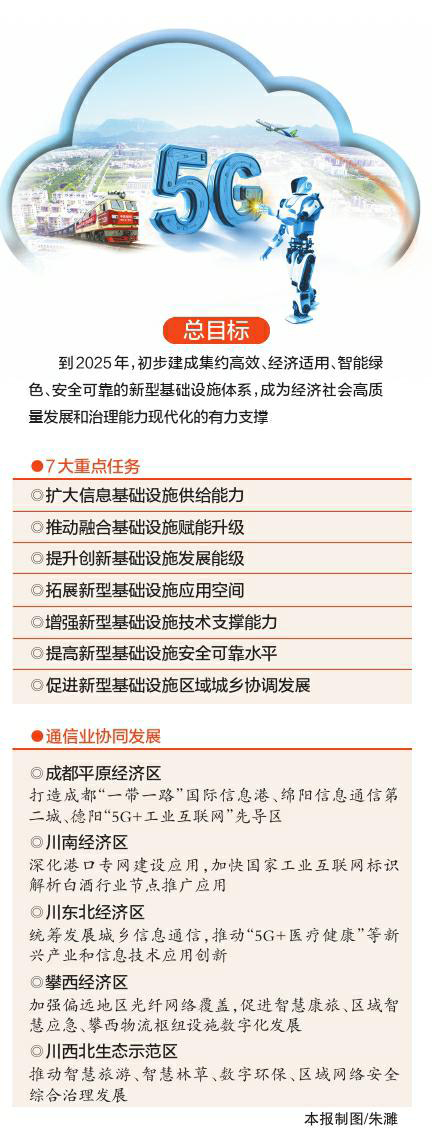
建成5G基站25万个、取消川渝座机通话长途费、已成功发射14颗AI卫星…… 四川“新基建”还有哪些大动作?
Si Chuan Ri Bao· 2026-01-04 03:58
Core Viewpoint - The Sichuan Provincial Government has issued the "14th Five-Year Plan for New Infrastructure Construction," aiming to establish a high-efficiency, economical, intelligent, green, safe, and reliable new infrastructure system by 2025, supporting high-quality economic and social development and modern governance capabilities [3][5][6]. Group 1: Key Tasks - The plan outlines seven key tasks, including expanding information infrastructure supply capacity, promoting integrated infrastructure upgrades, enhancing innovation infrastructure development capabilities, expanding application space for new infrastructure, strengthening technical support for new infrastructure, improving safety and reliability, and promoting coordinated urban-rural development [6][8]. - Specific focus areas include accelerating the construction of communication networks, data center systems, intelligent computing systems, industrial internet systems, and future networks, as well as smart transportation, smart energy, smart water conservancy, and smart logistics [6][9]. Group 2: Information Infrastructure Investment - Sichuan plans to invest a total of 100 billion yuan in building a leading information infrastructure, including the construction of 250,000 5G base stations to achieve widespread coverage in townships and administrative villages [8]. - The province aims to create a "Belt and Road" international information port in Chengdu, a second city for information communication in Mianyang, and a "5G + Industrial Internet" pilot area in Deyang [8]. Group 3: Industrial Internet Development - The plan emphasizes the construction of an industrial internet system as a crucial task, with Sichuan's data centers and 5G base stations ranking among the top in the country [9]. - The province has already established nearly 40 provincial-level industrial internet platforms and has facilitated over 240,000 enterprises to transition to cloud services [9]. Group 4: Innovation Infrastructure - The plan aims to enhance the development level of innovation infrastructure, focusing on source innovation and industrial innovation capabilities [11]. - Sichuan will create a world-class cluster of major scientific and technological infrastructure, including advanced nuclear energy, aerodynamics, and biomedical fields, and will establish a national laboratory base in Tianfu New Area [11].