债券

Search documents
新刊速读 | 可持续发展挂钩债券“五维协同”驱动低碳转型
Xin Hua Cai Jing· 2025-09-24 20:15
Core Viewpoint - The article discusses the role of Sustainable Linked Bonds (SLB) in promoting the transformation of high-carbon enterprises in China, emphasizing that the true value of SLBs lies in their ability to enforce substantial transformation commitments through institutional design rather than merely expanding financing scale [1][6]. Group 1: Institutional Logic of Core Elements - The effectiveness of SLBs depends on the institutional design of five core elements: Key Performance Indicators (KPI), Sustainability Performance Targets (SPT), bond characteristics, information disclosure and reporting, and third-party verification [2]. - These elements are interrelated; for instance, if KPIs lack direct correlation with carbon reduction, subsequent target setting and constraints will lose focus [2]. Group 2: International Practices as Reference - International markets provide valuable insights for the evolution of SLBs, with examples such as Enel's phased design and Schneider Electric's inclusion of social issues in performance assessments [3]. - Compared to international practices, China's SLB design remains relatively simplistic, particularly in terms of constraint clauses and target aggressiveness, indicating a need for market-oriented incentives and international benchmarking [3]. Group 3: Progress and Issues in China's Market - China's SLB market has developed a diverse indicator system covering various areas, and most enterprises provide historical performance data for comparability [4]. - However, issues persist, such as KPIs not being closely linked to carbon emission targets and the need for enhanced flexibility and constraint in bond characteristics [4]. Group 4: Case Analysis and Common Issues - The "22 Tianan Coal Industry MTN002 (Sustainable Linked)" bond serves as a case study, showing reasonable KPI and SPT settings, but with room for improvement in direct correlation with carbon emission indicators [5]. - This case illustrates that while SLBs can incentivize enterprises to fulfill transformation commitments, there are still areas for enhancement in terms of penalty clauses and overall effectiveness [5]. Group 5: Optimization Paths and Policy Implications - The article proposes four optimization strategies to address the "five-dimensional mismatch": establishing unified performance target standards, introducing phased goals and dynamic adjustment mechanisms, enhancing mandatory information disclosure, and promoting the marketization of third-party verification [7]. - By addressing these shortcomings, SLBs can evolve from mere financing innovations to key institutional tools for driving low-carbon transformation and implementing the "dual carbon" strategy [7].
债券通“南向通”上线四周年:助推香港离岸人民币债券市场发展
Zhong Guo Jing Ying Bao· 2025-09-24 18:36
Core Insights - The "Southbound Bond Connect" has successfully completed four years since its launch, enhancing the interconnectivity between the mainland and Hong Kong bond markets, thus accelerating the integration of China's financial market with international markets [1][2]. Group 1: Performance Metrics - As of the end of August 2025, the Shanghai Clearing House has managed 971 types of bonds under the "Southbound Bond Connect," with a total balance of 574.21 billion yuan, representing an increase of over 26 times in the number of bonds and over 102 times in balance compared to four years ago [1]. Group 2: Market Impact - The "Southbound Bond Connect" has diversified asset allocation channels for mainland institutional investors, allowing them to invest in the offshore bond market in Hong Kong, which helps mitigate single market risks and enhance asset return stability [1][2]. - The influx of mainland capital through the "Southbound Bond Connect" has increased the activity and liquidity of the Hong Kong bond market, reinforcing its status as an international financial center and promoting the development of the offshore RMB bond market, thereby contributing to the internationalization of the RMB [1]. Group 3: Future Developments - Recent measures announced by the People's Bank of China and the Hong Kong Monetary Authority aim to expand the range of participating institutions in the "Southbound Bond Connect" to include brokers, funds, insurance, and wealth management firms, which will better meet diverse investment needs and optimize asset allocation [2]. - There is a discussion regarding the potential gradual opening of the bond market to individual investors; however, current conditions are deemed not mature enough due to the complexities and risks associated with the Hong Kong bond market [3].
半导体板块爆发!多只ETF盘中涨停
Zhong Guo Zheng Quan Bao· 2025-09-24 14:01
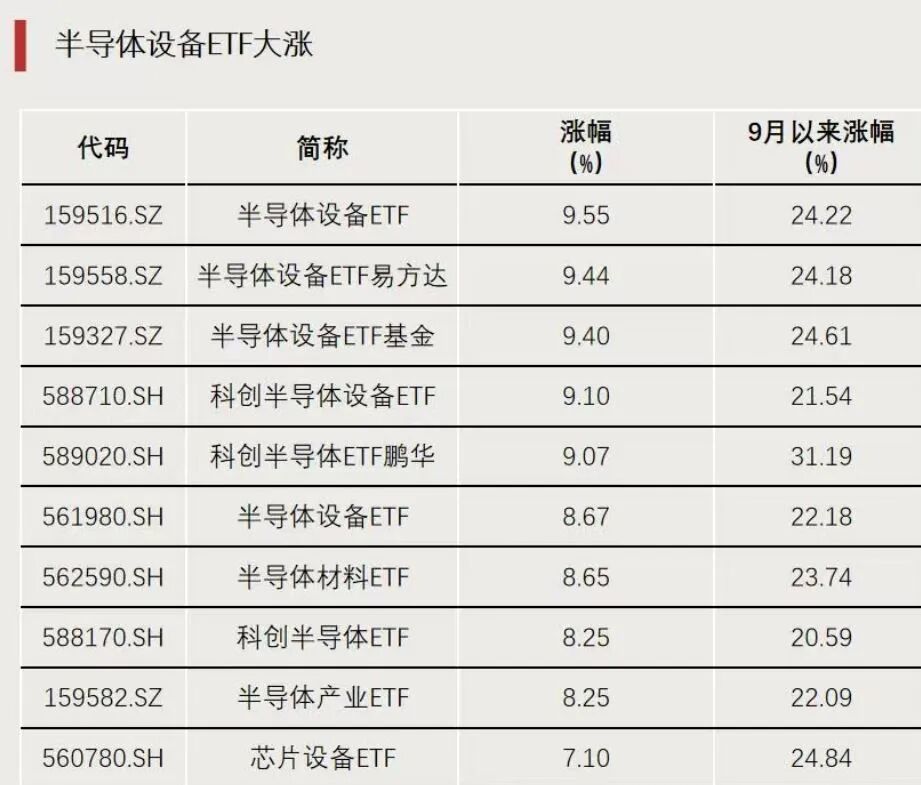
半导体设备相关ETF大涨 9月24日,半导体板块全线走强,相关ETF交投活跃,多只半导体设备相关ETF涨超9%,半导体设备ETF(159516)、半导体设备ETF 易方达(159558)等多只ETF盘中一度涨停。其中,科创半导体设备ETF(588710)上涨9.1%,9月以来涨幅已超过20%。该ETF今日全 天成交额为3.88亿元,环比大增超213%,创成立以来历史新高。 此外,科创半导体设备ETF(588710)9月以来规模增幅已达188%;场外投资者可关注其联接基金(A类:024974、C类:024975), 助力投资者布局半导体产业链投资。 01 9月24日,半导体板块全线走强,多只半导体设备相关ETF盘中一度涨停。 02 第二批科创债ETF今日集体上市,首日成交活跃,汇添富、国泰基金旗下科创债ETF成交额均超过100亿元。 | | 乐-机代创顶CIT工中目口以义/白灰 | | | | | --- | --- | --- | --- | --- | | 代码 | 简称 | 今日成交额 (亿元) | 上市日期 | 发行总规模 (亿元) | | 551520.SH | N科创债ETF汇添富 | 151.96 ...

财政前景堪忧!英国新国债发行接连遇冷 认购需求创近两年新低
Zhi Tong Cai Jing· 2025-09-24 12:01
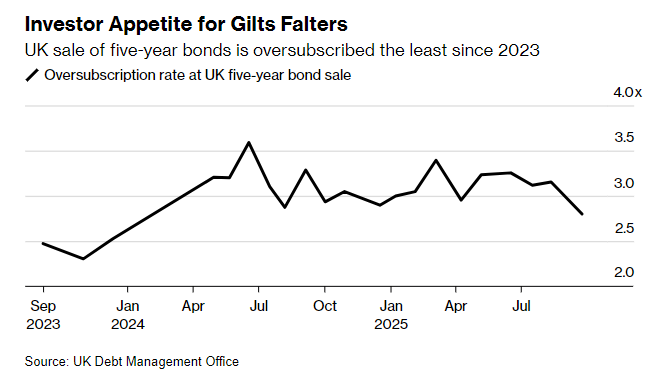
Core Insights - The latest five-year UK government bond auction recorded the lowest oversubscription rate in nearly two years, indicating that despite high bond yields, concerns over fiscal outlook are deterring investors [1][3] - The UK Debt Management Office planned to issue £4.75 billion (approximately $6.4 billion) of bonds maturing in 2030, achieving a subscription amount of 2.80 times the issuance size [1] - The long-term bond yields have surged to multi-decade highs, yet the demand for new bond issues has shown signs of weakening, particularly with the recent five-year and thirty-year bonds [3] Demand Indicators - The five-year bond auction's bid-to-cover ratio was 2.80, while the thirty-year bond auction saw the lowest demand since 2022 [1][3] - The bid spread for the five-year bonds was 0.4 basis points, indicating a healthy demand, compared to 1.4 basis points for the thirty-year bonds, which reflects a more cautious market sentiment [3] - The five-year UK government bond yield remains stable at 4.10% as of now [3] Market Adjustments - The UK Debt Management Office is gradually adjusting the bond issuance structure in response to investor feedback, reducing the proportion of long-term bonds issued [3] - The Bank of England announced plans to shift its bond sale focus towards short-term and medium-term bonds starting next month [3]
【笔记20250924— 债农:萧瑟秋风今又是,换了人间】
债券笔记· 2025-09-24 11:28
Core Viewpoint - The article discusses the varying market expectations and bond price fluctuations influenced by data, policies, and funding conditions at different stages [1]. Group 1: Market Conditions - The central bank conducted a 401.5 billion yuan reverse repurchase operation, with 418.5 billion yuan maturing, resulting in a net withdrawal of 17 billion yuan [3]. - The funding environment shifted from tight to loose, with long-term bond yields slightly rising [3]. - The overnight funding rate (DR001) was around 1.44%, while the 7-day rate (DR007) increased to approximately 1.59% due to month-end factors [3]. Group 2: Bond Market Performance - The bond market showed a stable sentiment in the morning, with the 10-year government bond yield starting at 1.7975% and slightly decreasing to around 1.795% [5]. - The afternoon saw a peak in yields, with the 10-year bond rate reaching up to 1.82% before closing at 1.815% after the central bank injected an additional 300 billion yuan into the Medium-term Lending Facility (MLF) [5][6]. - The article reflects on the bond market's struggles, contrasting the current situation with the previous year when the 30-year government bond yield was around 2.2% [6]. Group 3: Interest Rates Overview - The weighted rates for various repo codes were reported, with RO01 at 1.50%, R007 at 1.71%, and R014 at 1.84%, indicating changes in the market dynamics [4]. - The government bond yields for different maturities were detailed, with the 1-year yield at 1.3650%, 2-year at 1.5150%, and 10-year at 1.8150% [10].
债市收益率重新回归上行通道,30年国债ETF博时(511130)红盘震荡
Sou Hu Cai Jing· 2025-09-24 09:45
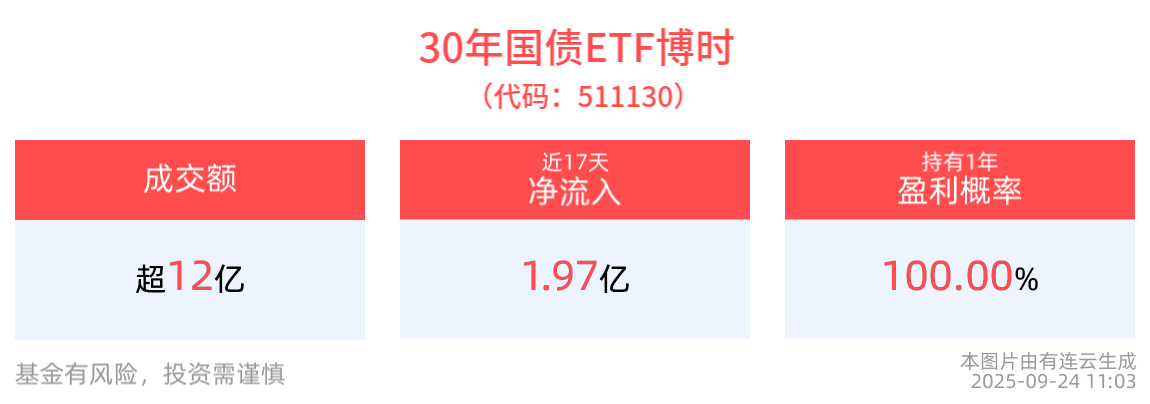
Group 1 - The 30-year government bond ETF from Bosera (511130) has seen a decline of 0.17%, with the latest price at 106.23 yuan [2] - The trading volume for the 30-year government bond ETF was 12.71 billion yuan, with a turnover rate of 6.64% [2] - The average daily trading volume over the past month for the 30-year government bond ETF was 41.79 billion yuan [2] Group 2 - The central bank's net liquidity withdrawal and concerns over new fund redemption regulations have led to a rise in yields for major interest rate bonds, with 10-year and 30-year government bond yields reaching 1.80% and 2.10% respectively [2] - The 30-year government bond futures saw a decline of 0.67%, marking a new low in over six months [2] - The yields on most bonds from Vanke and Shenzhen Metro Group have increased, with bank "two eternal bonds" yields rising by 3-4 basis points [2] Group 3 - The bond market's yield has returned to an upward trend after a brief recovery, primarily driven by the potential impact of the new redemption fee regulations [3] - Many institutions have accelerated the redemption of bond funds, indicating a possible early release of market risks [3] - On September 23, only insurance companies showed significant net subscriptions for pure bond funds, while other institutions like wealth management and public FOFs exhibited net redemption scales around or above the 60th percentile [3] Group 4 - The latest scale of the 30-year government bond ETF from Bosera reached 19.109 billion yuan [4] - The fund experienced a net outflow of 40.4282 million yuan recently, but has attracted a total of 197 million yuan over the past 17 trading days [4] - The 30-year government bond ETF closely tracks the Shanghai Stock Exchange's 30-year government bond index, which reflects the overall performance of corresponding maturity government bonds in the Shanghai market [4]
中国逃命式抛美债,日本1.15万亿美债恐成“死亡陷阱”!
Sou Hu Cai Jing· 2025-09-24 08:40
Core Viewpoint - The article discusses the contrasting strategies of China and Japan regarding U.S. Treasury bonds, highlighting China's proactive approach to reduce reliance on the dollar while Japan remains dependent on it due to economic constraints [1][2][3][4]. Group 1: China's Strategy - China is aggressively selling U.S. Treasury bonds and increasing its gold reserves, now holding nearly 2,400 tons, which is more than many developed countries [1][2]. - The country is moving towards using the yuan or mutually accepted currencies in international trade, reducing its dependence on the dollar and mitigating the risks associated with U.S. monetary policy [2][3]. - China's ability to develop its own technology, such as domestically produced 28nm chips, allows it to assert more control over its economic future and reduce reliance on U.S. technology [3][4]. Group 2: Japan's Dilemma - Japan holds approximately $1.15 trillion in U.S. Treasury bonds, which it uses to stabilize its currency and economy, despite being aware of the risks involved [2][3]. - The Japanese economy is heavily reliant on exports, and fluctuations in the yen's value necessitate the purchase of U.S. bonds to manage exchange rates, creating a cycle of dependency [2][3]. - Japan's security and technological reliance on the U.S. limits its options, forcing it to continue purchasing U.S. debt even when it may not be in its best interest [3][4]. Group 3: U.S. Position - The U.S. is facing a significant national debt, with projections indicating that the deficit could reach $1.9 trillion by 2025, raising concerns about its long-term fiscal sustainability [2][3]. - The U.S. leverages its position to pressure allies like Japan into purchasing more Treasury bonds, creating a cycle where Japan's economic health is tied to U.S. fiscal policy [3][4].

债市日报:9月24日
Xin Hua Cai Jing· 2025-09-24 08:30
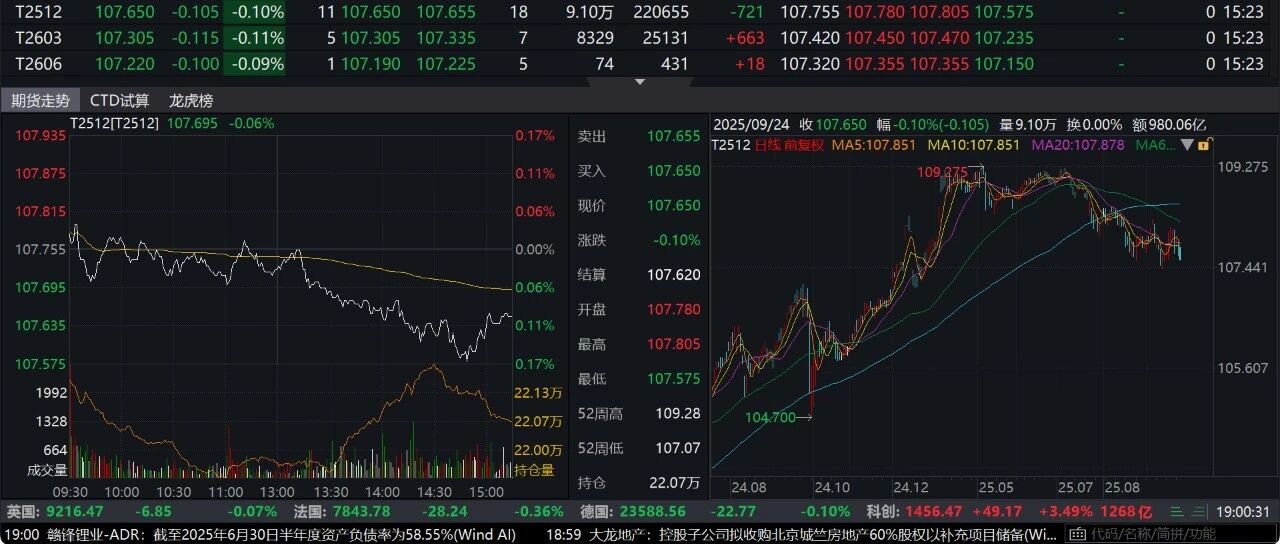
Core Viewpoint - The bond market is experiencing a correction, with government bond futures declining and interbank bond yields rising, indicating tightening liquidity as the month-end approaches [1][2]. Market Performance - Government bond futures closed lower across the board, with the 30-year main contract down 0.41% to 114.070, marking a new closing low since March 19 [2]. - Interbank bond yields mostly increased, with the 30-year government bond yield rising 1.3 basis points to 2.112% and the 10-year government bond yield up 1.4 basis points to 1.812% [2]. Overseas Bond Market - In North America, U.S. Treasury yields fell across the board, with the 10-year yield down 4.06 basis points to 4.106% [3]. - In Asia, Japanese bond yields also decreased, while in the Eurozone, the 10-year French bond yield rose by 0.4 basis points to 3.561% [3]. Primary Market - The Ministry of Finance's weighted average bid yields for 91-day and 182-day government bonds were 1.2473% and 1.3405%, respectively, with bid-to-cover ratios of 2.84 and 2.31 [4]. Liquidity Conditions - The central bank conducted a 7-day reverse repo operation of 401.5 billion yuan at a rate of 1.40%, resulting in a net withdrawal of 17 billion yuan for the day [5]. - Short-term Shibor rates increased, with the overnight rate rising 2.1 basis points to 1.434% [5]. Institutional Perspectives - Citic Securities noted that the urgency for the central bank to restart government bond trading is not strong in the short term, but the increased bond purchases by state-owned banks reflect a relatively loose liquidity environment [6]. - China International Capital Corporation (CICC) observed that while the bond market is experiencing volatility, credit bonds in the short to medium term are performing relatively well [7].
大类资产早报-20250924
Yong An Qi Huo· 2025-09-24 01:09
Report Overview - Report Title: Global Asset Market Performance - Major Asset Morning Report - Report Date: September 24, 2025 - Research Team: Macro Team of the Research Center 1. Report Industry Investment Rating - No industry investment rating is provided in the report. 2. Report's Core View - The report presents the performance data of various global asset markets on September 23, 2025, including 10 - year and 2 - year government bond yields of major economies, exchange rates of the US dollar against major emerging - economy currencies, major economy stock indices, credit bond indices, stock index futures trading data, and government bond futures trading data. 3. Summary by Relevant Catalogs 3.1 Global Asset Market Performance - Bond Yields - **10 - Year Government Bond Yields**: On September 23, 2025, the 10 - year government bond yields of the US, UK, France, etc. were 4.107%, 4.679%, 3.563% respectively. The latest changes ranged from - 0.041 (US) to 0.004 (France), with weekly changes from - 0.030 (Switzerland) to 0.078 (US), monthly changes from - 0.155 (US) to 0.065 (France), and annual changes from - 0.220 (Switzerland) to 0.912 (UK) [2]. - **2 - Year Government Bond Yields**: On September 23, 2025, the 2 - year government bond yields of the US, UK, Germany, etc. were 3.570%, 3.950%, 2.019% respectively. The latest changes ranged from 0.000 (US, Japan) to 0.011 (South Korea), with weekly changes from - 0.014 (China 1Y) to 0.058 (Japan), monthly changes from - 0.012 (UK) to 0.084 (Germany), and annual changes from - 0.432 (South Korea) to 0.544 (Japan) [2]. 3.2 Global Asset Market Performance - Exchange Rates - **US Dollar against Major Emerging - Economy Currencies**: On September 23, 2025, the exchange rates of the US dollar against the Brazilian real, South African rand, etc. were 5.282, 17.245 respectively. The latest changes ranged from - 0.99% (Brazil) to 0.24% (South Korean won), with weekly changes from - 0.54% (South African rand) to 1.09% (South Korean won), monthly changes from - 2.75% (Brazil) to 0.05% (South Korean won), and annual changes from - 5.07% (Brazil) to 4.58% (South Korean won) [2]. - **Renminbi**: On September 23, 2025, the on - shore RMB, off - shore RMB, and the central parity rate were 7.113, 7.113, 7.106 respectively. The latest changes were - 0.02%, - 0.03%, - 0.07% respectively, with weekly changes of - 0.02%, 0.12%, 0.04% respectively, monthly changes of - 0.55%, - 0.56%, - 0.18% respectively, and annual changes of 0.23%, 0.18%, 0.04% respectively [2]. 3.3 Global Asset Market Performance - Stock Indices - **Major Economy Stock Indices**: On September 23, 2025, the S&P 500, Dow Jones Industrial Average, and NASDAQ were 6656.920, 46292.780, 22573.470 respectively. The latest changes ranged from - 0.95% (NASDAQ) to 0.59% (Mexican stock index), with weekly changes from - 0.03% (Spanish stock index) to 1.21% (German DAX), monthly changes from - 2.24% (German DAX) to 7.29% (Mexican stock index), and annual changes from 5.45% (French CAC) to 31.35% (Spanish stock index) [2]. 3.4 Global Asset Market Performance - Credit Bond Indices - **Credit Bond Indices**: The latest changes of the US investment - grade credit bond index, euro - zone investment - grade credit bond index, etc. ranged from - 0.03% (euro - zone investment - grade credit bond index) to 0.40% (emerging - economy high - yield credit bond index), with weekly changes from - 0.39% (US investment - grade credit bond index) to 0.27% (euro - zone high - yield credit bond index), monthly changes from 0.26% (euro - zone investment - grade credit bond index) to 1.61% (US investment - grade credit bond index), and annual changes from 3.66% (US investment - grade credit bond index) to 13.30% (emerging - economy high - yield credit bond index) [2][3]. 3.5 Stock Index Futures Trading Data - **Index Performance**: The closing prices of A - shares, CSI 300, SSE 50, etc. were 3821.83, 4519.78, 2919.51 respectively, with changes of - 0.18%, - 0.06%, - 0.09% respectively [4]. - **Valuation**: The PE (TTM) of the CSI 300, SSE 50, and CSI 500 were 14.01, 11.64, 34.17 respectively, with环比 changes of 0.04, 0.07, - 0.25 respectively [4]. - **Fund Flow**: The latest values of the fund flow of A - shares, the main board, and small - and medium - sized enterprise boards were - 1566.78, - 1050.60, etc., with 5 - day average values of - 1037.14, - 806.14, etc. respectively [4]. - **Trading Volume**: The latest trading volumes of the Shanghai and Shenzhen stock markets, CSI 300, and SSE 50 were 24943.82, 6805.14, 1689.87 respectively, with环比 changes of 3728.99, 1173.65, 125.86 respectively [4]. - **Main Contract Premium/Discount**: The basis of IF, IH, and IC were - 35.98, 5.49, - 240.11 respectively, with premiums/discounts of - 0.80%, 0.19%, - 3.34% respectively [4]. 3.6 Government Bond Futures Trading Data - **Government Bond Futures**: The closing prices of T00, TF00, T01, and TF01 were 107.715, 105.625, 107.385, 105.505 respectively, with changes of 0.13%, 0.09%, 0.12%, 0.09% respectively [5]. - **Funding Rates**: The funding rates of R001, R007, and SHIBOR - 3M were 1.4619%, 1.5218%, 1.5620% respectively, with daily changes of - 7.00 BP, - 1.00 BP, 0.00 BP respectively [5].
机构称超长债期限利差难以持续大幅扩张 配置价值逐步显现
Xin Hua Cai Jing· 2025-09-23 14:49
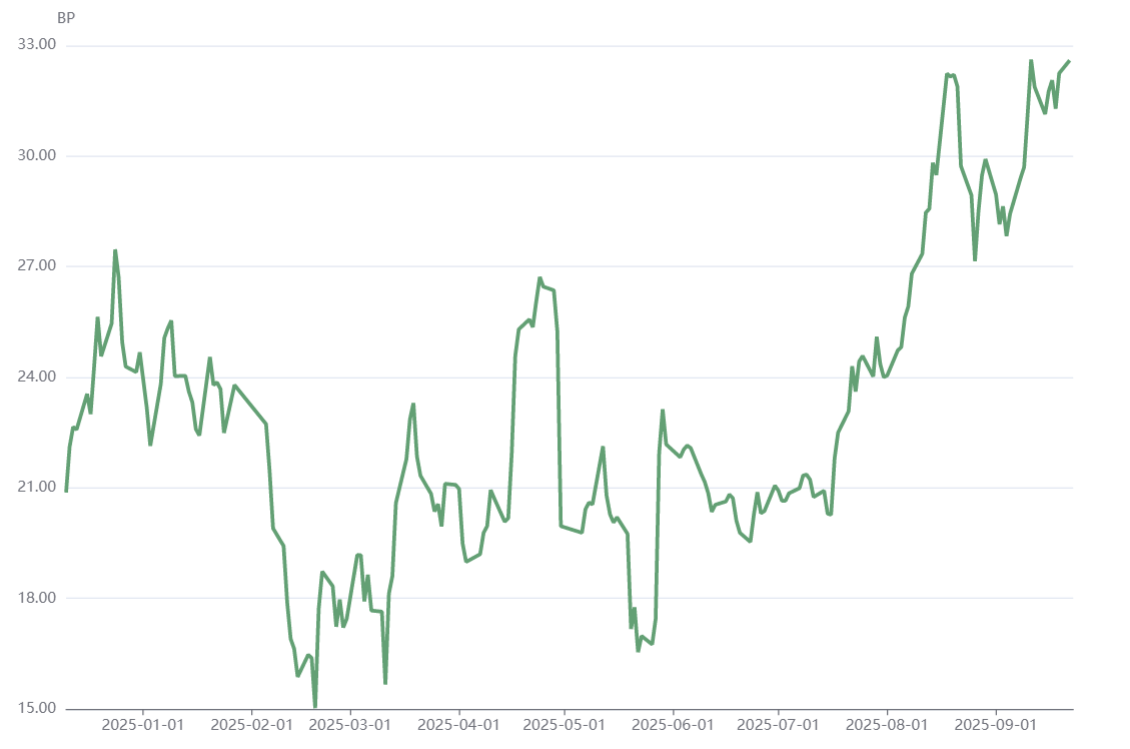
Core Viewpoint - The recent adjustment in the bond market has led to an expansion of the yield spread between ultra-long-term government bonds and 10-year government bonds, reaching a year-to-date high, but this trend is expected to stabilize with limited further expansion potential [1][3]. Group 1: Market Performance - Since mid-September, the yield spread between 30-year and 10-year government bonds has consistently remained above 30 basis points, peaking at 33.31 basis points on September 11 [1]. - The overall bond market has been adjusting, with ultra-long bonds showing relatively weaker performance, as the yield on 30-year government bonds did not experience significant downward movement despite the recovery in 10-year government bonds, which surpassed 1.8% [1][3]. Group 2: Factors Influencing Yield Spread - The widening yield spread for ultra-long bonds is attributed to multiple factors, including market risk appetite, supply, and funding conditions. The rise in stock market sentiment has weakened bond market sentiment, leading to a corresponding adjustment in bond yields [3]. - Since May, there has been a peak in the issuance of ultra-long special government bonds, which has contributed to the widening of the yield spread due to increased supply expectations [3]. Group 3: Future Outlook - Analysts from Zhongyou Securities predict that the yield spread for ultra-long bonds is unlikely to expand significantly, suggesting that it will not return to historical levels above 40 basis points prior to 2023 [5]. - The liquidity of ultra-long bonds is deemed crucial, and as long as liquidity remains stable, the yield spread is unlikely to revert to levels seen before 2024. Current liquidity conditions show no significant decline, maintaining a high turnover rate [5]. - The current high yield spread of 30 basis points between 30-year and 10-year government bonds indicates limited further adjustment space for ultra-long bonds, suggesting potential value for allocation and trading [5].