光伏设备

Search documents
中信博:第三季度净利润亏损3596.1万元,同比转亏
Xin Lang Cai Jing· 2025-10-27 09:23
Core Insights - The company reported a significant decline in revenue and net profit for the third quarter, indicating financial challenges [1] - Year-to-date figures also show a downward trend in both revenue and net profit compared to the previous year [1] Financial Performance - Q3 revenue was 1.341 billion, a year-on-year decrease of 48.54% [1] - Q3 net loss was 35.961 million, compared to a net profit of 121 million in the same period last year [1] - Year-to-date revenue reached 5.378 billion, down 10.11% year-on-year [1] - Year-to-date net profit was 121 million, reflecting a 71.59% decline compared to the previous year [1]

钧达股份:第三季度净利润亏损1.55亿元 同比减亏
Zheng Quan Shi Bao Wang· 2025-10-27 08:37
Core Insights - The company reported a third-quarter revenue of 2.018 billion yuan, representing a year-on-year increase of 10.42% [1] - The net profit attributable to shareholders for the third quarter was a loss of 155 million yuan, an improvement from a loss of 251 million yuan in the same period last year [1] - For the first three quarters, the company recorded a revenue of 5.682 billion yuan, a year-on-year decline of 30.72% [1] - The net profit attributable to shareholders for the first three quarters was a loss of 419 million yuan, slightly worse than a loss of 417 million yuan in the same period last year [1] - The decline in revenue for the first three quarters was primarily due to a decrease in shipment volume and selling prices [1] - The narrowing of losses in the third quarter was mainly attributed to an increase in gross profit and a reduction in operating expenses [1]

光伏设备板块10月27日涨0.97%,阿特斯领涨,主力资金净流出6.92亿元
Zheng Xing Xing Ye Ri Bao· 2025-10-27 08:25
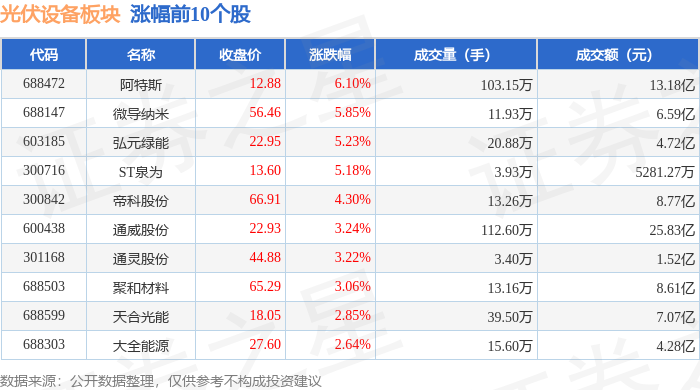
Market Overview - The photovoltaic equipment sector rose by 0.97% on October 27, with Canadian Solar leading the gains [1] - The Shanghai Composite Index closed at 3996.94, up 1.18%, while the Shenzhen Component Index closed at 13489.4, up 1.51% [1] Top Gainers in Photovoltaic Equipment Sector - Canadian Solar (688472) closed at 12.88, up 6.10% with a trading volume of 1.0315 million shares and a transaction value of 1.318 billion [1] - Micro導Nano (688147) closed at 56.46, up 5.85% with a trading volume of 119,300 shares and a transaction value of 659 million [1] - Hongyuan Green Energy (603185) closed at 22.95, up 5.23% with a trading volume of 208,800 shares and a transaction value of 472 million [1] - Other notable gainers include ST Quanwei (300716), Dike Co., Ltd. (300842), and Tongwei Co., Ltd. (600438) with respective increases of 5.18%, 4.30%, and 3.24% [1] Top Losers in Photovoltaic Equipment Sector - Zhonglai Co., Ltd. (300393) closed at 5.93, down 6.17% with a trading volume of 577,500 shares and a transaction value of 34.6 million [2] - ST Muban (603398) closed at 7.65, down 4.85% with a trading volume of 289,400 shares and a transaction value of 223 million [2] - Jing Sheng Mechanical and Electrical (300316) closed at 40.15, down 4.59% with a trading volume of 430,500 shares and a transaction value of 174.2 million [2] Fund Flow Analysis - The photovoltaic equipment sector experienced a net outflow of 690 million from institutional investors, while retail investors saw a net inflow of 377 million [2] - Notable net inflows from retail investors were observed in stocks like Canadian Solar and Micro導Nano, while institutional investors showed significant outflows from Tongwei Co., Ltd. and TCL Zhonghuan [3]




恒生科技指数ETF(513180)午后涨超1.5%,机构称科技成长继续占优
Mei Ri Jing Ji Xin Wen· 2025-10-27 06:00
Core Viewpoint - The Chinese asset market experienced a significant surge on October 27, with major indices in both A-shares and Hong Kong stocks rising, particularly in the technology sector, indicating a strong market sentiment and potential investment opportunities in tech growth [1]. Group 1: A-shares Performance - The three major A-share indices collectively rose, with growth-oriented indices like the Growth Enterprise Market and the Sci-Tech Innovation 50 leading the gains [1]. - Key sectors such as CPO optical modules and memory chips showed strong upward momentum, reflecting investor interest in technology-related stocks [1]. Group 2: Hong Kong Stocks Performance - The Hang Seng Technology Index saw an increase of over 1.5% in the afternoon session, driven by active trading in major tech stocks like Baidu, Alibaba, and Tencent, as well as semiconductor companies like Huahong and SMIC [1]. - Mainstream ETFs, including the Hang Seng Technology Index ETF (513180) and the Sci-Tech Innovation 50 ETF (159783), also experienced gains exceeding 1.5% [1]. Group 3: Market Outlook - Huafu Securities expressed optimism about the continued dominance of tech growth, highlighting the upcoming U.S.-China economic discussions and the APEC summit as critical observation points for market movements [1]. - The firm anticipates that after these events, there will be a resurgence of observing funds entering the market, which could enhance market risk appetite and trading activity [1]. - The recommendation includes focusing on the Hang Seng Technology sector, identifying low-positioned stocks with clear industry trends, and maintaining attention on cyclical sectors [1]. Group 4: Investment Strategies - For Hong Kong stocks, the focus is on the Hang Seng Technology Index ETF (513180), which supports T+0 trading and is driven by a dual engine of "hard technology + new consumption" [2]. - In A-shares, the emphasis is on the Sci-Tech Innovation 50 ETF (159783), which targets high elasticity stocks covering popular tech sectors such as communication equipment, batteries, and photovoltaic devices [2].
锦浪科技跌2.01%,成交额6.44亿元,主力资金净流出7590.53万元
Xin Lang Cai Jing· 2025-10-27 02:49
Core Viewpoint - Jinlang Technology's stock price has shown volatility, with a recent decline of 2.01% and a year-to-date increase of 27.42% [1][2]. Financial Performance - For the period from January to September 2025, Jinlang Technology achieved a revenue of 5.663 billion yuan, representing a year-on-year growth of 9.71%, and a net profit attributable to shareholders of 865 million yuan, reflecting a growth of 29.39% [3]. Stock Market Activity - As of October 27, 2023, Jinlang Technology's stock price was 77.56 yuan per share, with a total market capitalization of 30.878 billion yuan. The trading volume was 644 million yuan, with a turnover rate of 2.54% [1]. - The stock has experienced a net outflow of 75.9053 million yuan from main funds, with significant buying and selling activity from large orders [1]. Shareholder Information - As of October 20, 2023, the number of shareholders for Jinlang Technology was 76,800, a decrease of 1.47% from the previous period. The average number of circulating shares per person increased by 1.49% to 4,185 shares [3]. - The company has distributed a total of 660 million yuan in dividends since its A-share listing, with 318 million yuan distributed in the last three years [4]. Institutional Holdings - As of September 30, 2025, notable changes in institutional holdings include a decrease in shares held by major shareholders such as Hong Kong Central Clearing Limited and E Fund's ChiNext ETF, while new shareholders like the Photovoltaic ETF have entered the top ten list [4].

2025年中国光伏预制舱行业市场政策、产业链图谱、市场规模、竞争格局及发展趋势分析:下游市场需求旺盛[图]
Chan Ye Xin Xi Wang· 2025-10-27 01:24
Core Viewpoint - The photovoltaic prefabricated cabin industry in China is expected to reach a market size of 224 million yuan in 2024, with a year-on-year growth of 13.71%, driven by the transition towards standardized, modular, and rapid construction of photovoltaic power plants, and the ongoing growth in installed capacity under the "dual carbon" goals [1][7]. Overview - Photovoltaic prefabricated cabins are integrated photovoltaic power generation devices that combine key electrical equipment and auxiliary systems in a factory setting, allowing for quick deployment on-site [2][3]. Market Policy - The Chinese government has issued several policies to support the development of the power equipment industry, including the photovoltaic prefabricated cabin sector, creating a favorable policy environment for growth [4][5]. Industry Chain - The upstream of the photovoltaic prefabricated cabin industry includes suppliers of raw materials and core components, while the midstream involves design and manufacturing, and the downstream focuses on the photovoltaic market, including centralized and distributed photovoltaic power plants [6]. Development Status - The photovoltaic prefabricated cabin industry is experiencing rapid growth, with significant applications in large ground-mounted photovoltaic power plants and distributed photovoltaic projects, supported by a robust downstream market [7][8]. Competitive Landscape - The market is becoming increasingly competitive, with key players including Qingdao Teruid Electric Co., Ltd., XJ Electric Co., Ltd., and others, each focusing on different aspects of the photovoltaic prefabricated cabin business [9][11]. Company Analysis - Qingdao Teruid Electric Co., Ltd. reported a total revenue of 15.37 billion yuan in 2024, with significant contributions from various segments including electric vehicle charging networks and box-type equipment [9][10]. - XJ Electric Co., Ltd. achieved a revenue of 17.09 billion yuan in 2024, with a diverse product range including smart power distribution systems and renewable energy solutions [11][12]. Development Trends - Future advancements in photovoltaic prefabricated cabins are expected to focus on integrating various components to enhance space utilization, reduce costs, and improve performance, alongside the incorporation of AIoT technologies for better monitoring and efficiency [12].


浦发转债即将完美“退场” 超预期完成“债转股”
Shang Hai Zheng Quan Bao· 2025-10-27 00:55
Core Insights - The successful conversion of the 50 billion yuan SPDB convertible bonds marks a significant milestone in the convertible bond market, with a conversion rate of 99.67% [1][2][4] - The involvement of strategic investors, including China Mobile, has played a crucial role in the successful debt-to-equity conversion, enhancing SPDB's capital quality [3][5] - The completion of this conversion is expected to influence the broader convertible bond market, as institutional investors shift their focus to other sectors such as solar energy, agriculture, and technology [7] Group 1: SPDB Convertible Bonds - The SPDB convertible bonds, issued in November 2019, have reached their final conversion day on October 27, 2023, with only 0.33% remaining unconverted [1][2] - The bonds were initially expected to be redeemed early, but market conditions led to their extension until maturity [2] - The successful conversion is significant for SPDB as it will bolster its core Tier 1 capital, allowing the bank to navigate industry challenges effectively [2][5] Group 2: Strategic Investors and Market Impact - China Mobile's increased stake in SPDB from 17.88% to 18.18% through the conversion process exemplifies the "white knight" strategy in the debt-to-equity conversion [4] - Other asset management companies, such as Cinda Investment and Dongfang Asset, also contributed to the conversion by increasing their holdings [5] - The overall convertible bond market has seen a decline, with the total market size dropping below 600 billion yuan, prompting institutional investors to explore new opportunities in sectors like solar energy and technology [6][7]

浦发转债即将完美“退场”
Shang Hai Zheng Quan Bao· 2025-10-26 17:24
Core Viewpoint - The successful conversion of the 50 billion yuan SPDB convertible bonds marks a significant milestone in the convertible bond market, with a conversion rate of 99.67% [2][3][5]. Group 1: SPDB Convertible Bonds - The SPDB convertible bonds, issued on November 15, 2019, have reached their final conversion day on October 27, 2023, with only 0.33% remaining unconverted [2][3]. - The successful conversion is attributed to the support from major shareholders and strategic investors, including China Mobile, which increased its stake from 17.88% to 18.18% [5][6]. - The conversion will enhance SPDB's core Tier 1 capital, allowing the bank to maintain a strong capital quality and level amid industry challenges [3][6]. Group 2: Market Impact - The completion of the SPDB bond conversion has led to a significant reallocation of assets within the convertible bond market, with institutions now favoring sectors such as solar energy, agriculture, and technology [2][7]. - The overall convertible bond market has seen a decline, with the total market value dropping below 600 billion yuan, from 168 billion yuan at the beginning of the year to 11.5 billion yuan by the third quarter [7]. - As institutions reduce their holdings in SPDB bonds, they are increasingly investing in other promising sectors, particularly in solar and agricultural bonds [7][8].
科技股分歧渐显基金经理详解AI产业链纵深机会
Shang Hai Zheng Quan Bao· 2025-10-26 15:37
Core Insights - The recent market adjustment in A-shares, particularly in the technology sector, is primarily a result of profit-taking after significant gains, rather than a fundamental shift in the long-term growth trajectory of AI and other tech industries [1][2] - The AI industry, along with digital economy and integrated circuits, remains a hot investment area, with many funds reporting substantial net value growth over the past year [1] Group 1: Market Trends - The technology sector, especially AI, has seen a significant rise, with passive index funds related to communication, AI, and chips showing over 50% net value growth in the past year [1] - Active funds focusing on technology, such as China Europe Digital Economy and Huafu Technology Momentum, have reported net value growth exceeding 100% over the same period [1] Group 2: Investment Opportunities - The AI industry chain is identified as a core investment theme, with various segments like large models, GPU chips, and optical modules leading in performance and stock price realization [3] - The demand spillover effect from AI is benefiting midstream sectors such as storage, semiconductor equipment, and new materials, which are now seen as more reasonably valued [3] Group 3: Sector Focus - Key application areas for AI include intelligent driving and humanoid robots, with intelligent driving showing early signs of scalable implementation [3] - The recent energy bottlenecks in the US AI industry present significant opportunities for domestic new energy sectors, including photovoltaics, wind power, and energy storage, aligning strategically with AI's electricity demands [3] Group 4: Market Sentiment - The market is expected to refocus on sectors with favorable economic conditions, particularly in technology, new energy, and pharmaceuticals, as consensus builds around the growth potential in these areas [3]
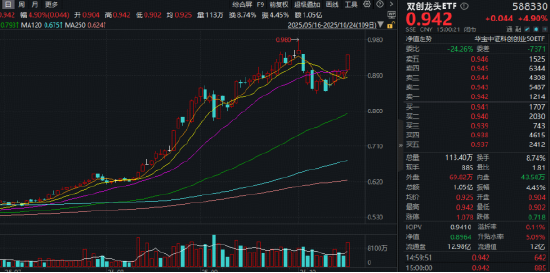
领跑全市场宽基!百分百布局新质生产力的——双创龙头ETF暴拉4.9%!寒武纪股价超越茅台,中际旭创再创新高
Xin Lang Ji Jin· 2025-10-26 11:46
Core Viewpoint - The technology sector has become a driving force in the market, with significant gains in the ChiNext and STAR Market, particularly in hard technology stocks, as evidenced by the strong performance of the Double Innovation Leader ETF (588330) [1][3]. Market Performance - The Double Innovation Leader ETF (588330) surged by 4.9% in a single day, with a trading volume of 105 million yuan, marking a 128% increase compared to the previous day [1]. - Key sectors such as semiconductors and computing power are experiencing remarkable growth, with leading stocks like Jiangbolong and Cambricon seeing gains of over 16% and 9% respectively [3][4]. Sector Highlights - In the semiconductor sector, Jiangbolong, a leader in storage chips, rose by 16.73%, while Cambricon, a leader in computing chips, increased by 9.01%, surpassing the stock price of Kweichow Moutai [4]. - Other notable performers include Zhongji Xuchuang, which gained over 12%, and companies in the optical module and PCB sectors, such as Shenghong Technology and Sunshine Power, which rose by over 7% [3][4]. Policy and Strategic Insights - A recent high-level meeting emphasized the importance of "new quality productivity" in the context of China's economic development, with a focus on enhancing technological self-reliance and innovation [5]. - The National Development and Reform Commission indicated plans to rebuild China's high-tech industry over the next decade, highlighting the strategic importance of computing power, algorithms, and data supply [4][5]. Investment Opportunities - The Double Innovation Leader ETF (588330) is characterized by its cross-market diversification, focusing on strategic emerging industries, including new energy, semiconductors, and medical devices [6]. - The ETF offers a low entry point for investors, allowing participation in the technology sector with a minimum investment of less than 100 yuan, making it an attractive option for capturing market rebounds [6].