
债券

Search documents
债欲静而风未止
Shenwan Hongyuan Securities· 2025-09-14 08:44
Group 1 - The current market status indicates increasing pressure in the bond market, primarily due to redemption pressures from fixed income products rather than the stock-bond relationship [7][12][15] - The risk in the bond market may have exceeded the influences of fundamentals, liquidity, and the stock-bond relationship, with the stock market showing signs of structural volatility without alleviating bond market pressure [22][26][30] - Institutional buying power for bonds is weak, and trading desks are in a phase of reducing positions under pressure, indicating a lack of enthusiasm for bond purchases compared to previous years [15][19][20] Group 2 - Observing signals for market sentiment turning points is crucial, including monitoring deposit certificate rates, which can indicate liquidity conditions and the attractiveness of bond assets [32][33] - The bond market is still returning to reasonable valuation levels, with current adjustments potentially setting the stage for a bullish trend by the end of 2024 [37][41][44] - The bond market may be in a phase of accelerated risk release, with limited opportunities for bullish positions until clearer signals of easing emerge [37][39][45]
Markets have been acting ‘super weird’ lately. Just look at gold prices vs. the dollar and bonds
Yahoo Finance· 2025-09-13 21:30
Core Insights - Financial markets have exhibited unusual behavior following the Federal Reserve Chairman Jerome Powell's speech at the Jackson Hole symposium, which hinted at potential rate cuts [1] - Gold has emerged as a significant safe haven asset, experiencing a price increase of nearly 10% and closing at $3,680.70 per ounce [2] - The bond market's reaction has been unexpected, with the 30-year Treasury yield not falling immediately after Powell's speech, only declining after a weak jobs report [3] Market Reactions - The S&P 500 and commodity prices did not respond as anticipated to the prospect of rate cuts, contrasting with the expected market behavior [2] - The dollar index has remained stable, returning to pre-speech levels, which is considered counterintuitive given the expectations for Fed easing [3] - Bitcoin's volatility has led to a sell-off post-Jackson Hole, but it has also returned to its starting point, diverging from its previous behavior as a risk asset [4] Global Economic Factors - Concerns over a potential debt crisis in France and the U.K. have contributed to rising global bond yields, with political gridlock in France affecting fiscal discipline [4] - Fitch's downgrade of France's credit rating from AA- to A+ reflects the challenges in achieving fiscal discipline, potentially driving investors towards safe-haven assets like the dollar [5]
债市定价围绕风险偏好及机构行为展开
Qi Huo Ri Bao· 2025-09-12 22:28
Group 1 - The bond market has accelerated its correction since early September, with 10-year and 30-year treasury yields falling below 1.80% and 2.10% respectively as of September 10 [1] - Short-term treasury yields have seen a marginal increase of around 1 basis point, supported by a slight easing in the funding environment [1] - The yield curve for treasury bonds exhibits a pronounced bear steepening characteristic [1] Group 2 - The China Securities Regulatory Commission (CSRC) has released a draft regulation on the management of public fund sales fees, aiming to lower investment costs and encourage long-term value investing [2] - The new regulation increases the punitive redemption fee rates for bond funds, leading some institutions to sell bonds as a precautionary measure [2][3] - The existing redemption fee structure for bond funds is being simplified, with new minimum rates set for different holding periods, requiring investors to hold for at least six months to avoid high fees [2] Group 3 - Recent economic data shows a marginal improvement in fundamentals, with August CPI down 0.4% year-on-year and PPI down 2.9%, but the decline in PPI has narrowed [4] - The central bank is expected to maintain a relatively stable funding environment, with a focus on protecting liquidity [5] - The bond market sentiment remains cautious, with yields breaking through key levels, and further declines in yields will require more positive developments such as new monetary policies or resumption of central bank bond transactions [5]
Bond market focuses on inflation as yields overtake yesterday's highs
Youtube· 2025-09-12 18:48
Group 1 - The market is reacting to a significant increase in initial jobless claims, leading to a drop in yields despite CPI being close to expectations [2][4] - There is a focus on inflation data, with two-year and ten-year yields reaching higher highs, indicating a potential stagflation scenario [2][3] - The Federal Reserve is expected to raise rates by 25 basis points instead of 50, with market participants reassessing the aggressiveness of the easing cycle if inflation remains persistent [4][5] Group 2 - The reversal in yields suggests a double bottom formation, with a rejection of the 4% yield level, which is the lowest close of the year [4][5] - High-yield junk bonds are attracting investors as rate cuts are anticipated, with high yield ETFs closing at their highest level in approximately three and a half years [5]
重阳问答︱如何看待最近债券市场不断下跌的情况
Jing Ji Guan Cha Bao· 2025-09-12 11:44
Group 1 - The bond market has experienced a decline since September, with the 10-year government bond yield surpassing 1.8% and the 30-year yield exceeding 2.1%, marking new lows in the current bond market cycle [1] - The recent regulatory changes regarding redemption fees for mutual funds have triggered a wave of redemptions, particularly affecting pure bond funds, which are primarily used by institutional investors for diversification and liquidity management [2] - The increase in redemption fees, particularly for holdings less than 7 days, is expected to significantly reduce the attractiveness of bond funds for institutions, leading to a redemption trend [2] Group 2 - The potential for further declines in the bond market appears limited, with the configuration value gradually returning as the macroeconomic fundamentals in China do not support a prolonged bear market [3] - Institutional behavior indicates that most funds redeemed from bond funds will eventually flow back into the bond market, suggesting that the impact of redemptions is more about timing rather than a fundamental shift [3] - The current yield on new 10-year government bonds is comparable to the dividend yield of the A-share market, indicating that the configuration value of bonds is becoming more apparent [3]
8月首发债主体数量减半,新增47家主体声明市场化
Xinda Securities· 2025-09-12 09:33
1. Report Industry Investment Rating There is no information provided regarding the industry investment rating in the given content. 2. Core Viewpoints of the Report - In August, urban investment bonds turned into a net repayment of 11.1 billion yuan, with the net financing scale decreasing by 37.3 billion yuan compared to July but higher than -41.7 billion yuan in the same period last year. The net financing situation varied among different regions and bond - issuing channels [4]. - The actual early repayment scale of urban investment bonds in August increased by 880 million yuan to 10.3 billion yuan compared to July, but the scale of announced early repayment and cash tender offers decreased month - on - month. The number and scale of exchange termination approvals also decreased [4]. - In August, there were 17 first - time bond - issuing entities, 17 fewer than in July, and the scale of raised funds also significantly declined. These entities were mainly distributed in Shandong, Guangdong, and Jiangsu [4]. - The proportion of urban investment bonds issued for debt roll - over in August rebounded by 1.7 percentage points to 83.7%, and the proportion of debt repayment also increased, while the proportions of supplementary liquidity, project construction, and equity investment declined. All debt roll - over bonds issued in August did not cover interest [4]. - In August, 30 entities issued 41 products in the association, achieving a new - added scale of 36.991 billion yuan, mainly for debt repayment. 33 entities issued 37 exchange - traded bonds, with a new - added scale of 32.125 billion yuan [4]. - As of the end of August, a total of 475 urban investment entities declared themselves as "market - oriented operating entities" when issuing bonds. In August, 47 new entities made such declarations, but the spread between market - oriented and non - market - oriented entities did not show significant differentiation [4]. 3. Summary According to the Directory 3.1 8 - month Urban Investment Bonds Re - turned to Net Repayment, and the Number of First - time Bond - issuing Entities Decreased - **Net Repayment Situation**: In August, urban investment bonds turned into a net repayment of 11.1 billion yuan, with the net financing scale decreasing by 37.3 billion yuan compared to July. The net financing situation varied among regions, with 17 provinces having positive net financing and 10 provinces showing net repayment. In the past year, 18 provinces had net repayment, and the net repayment scale of most provinces increased [4][8][11]. - **Early Repayment**: The actual early repayment scale in August increased by 880 million yuan to 10.3 billion yuan compared to July, but the scale of announced early repayment and cash tender offers decreased [4][14]. - **Exchange Termination Approval**: The number and scale of exchange termination approvals in August decreased compared to July. There were 14 bonds with termination approvals, and the proposed issuance scale was 16.303 billion yuan, a decrease of 9.238 billion yuan compared to July [20]. - **First - time Bond - issuing Entities**: There were 17 first - time bond - issuing entities in August, 17 fewer than in July, and the raised funds scale also decreased. These entities were mainly in Shandong, Guangdong, and Jiangsu, and most issued through exchange private placement bonds [25]. 3.2 In August, the Number of New - added Financing Entities in the Association Exceeded that in the Exchange, and New - added Financing in the Association was Still Dominated by Transportation Infrastructure - **Purpose of Bond Issuance**: The proportion of urban investment bonds issued for debt roll - over in August rebounded by 1.7 percentage points to 83.7%, and the proportion of debt repayment also increased, while the proportions of supplementary liquidity, project construction, and equity investment declined. All debt roll - over bonds issued in August did not cover interest [29][30]. - **New - added Financing in the Association**: 30 entities issued 41 products in the association, with a new - added scale of 36.991 billion yuan. Most of the new - added financing entities were transportation infrastructure entities, mainly distributed in Guangdong, Jiangsu, and Fujian. Two entities were on the Wind urban investment list [35][36]. - **New - added Financing in the Exchange**: 33 entities issued 37 exchange - traded bonds, with a new - added scale of 32.125 billion yuan. Only Xiamen Anju Group was on the Wind urban investment list [37]. 3.3 In August, 47 Entities Made New Market - oriented Declarations, and 2 Entities Made Declarations in Both the Association and the Exchange - **Accumulated Market - oriented Declarations**: As of the end of August, a total of 475 urban investment entities declared themselves as "market - oriented operating entities" when issuing bonds, mainly concentrated in 12 regions such as Jiangsu, Zhejiang, and Shandong [42]. - **New Declarations in August**: In August, 47 new entities made market - oriented declarations. Among them, 33 entities declared in the association, 16 in the exchange, and 2 in both. Most of the funds raised by these entities were for debt roll - over and did not cover interest [46]. - **Spread Analysis**: The spread between market - oriented and non - market - oriented entities did not show significant differentiation. For AA - rated and AA(2) - rated bonds, the spreads of most regions first decreased and then increased [5].
如何看待最近债券市场不断下跌的情况︱重阳问答
重阳投资· 2025-09-12 07:30
Core Viewpoint - The recent decline in the bond market is attributed to a combination of factors, including new regulations on redemption fees for funds, which have triggered a wave of redemptions, and a general decrease in the attractiveness of bonds compared to stocks and commodities [3][4]. Group 1: Bond Market Performance - Since September, the bond market has experienced a downturn, with the yield on 10-year government bonds surpassing 1.8% and 30-year government bonds exceeding 2.1%, marking new lows in the current bond market cycle [2]. - The recent regulations from the China Securities Regulatory Commission (CSRC) have increased redemption fees for funds, leading to significant redemptions from pure bond funds, which are primarily used by institutional investors for diversification and liquidity management [3]. Group 2: Market Dynamics and Institutional Behavior - The increase in redemption fees is expected to reduce the cost-effectiveness of bond funds for institutions, prompting a wave of redemptions that has contributed to the current bearish sentiment in the bond market [3]. - Despite the current downturn, the potential for recovery in the bond market is noted, as the fundamental macroeconomic conditions in China do not support a prolonged bear market [4]. Group 3: Investment Opportunities - The bond market's configuration value is gradually becoming apparent, especially as the dividend yield of the CSI All Share Index has fallen to 1.89%, comparable to the yield on newly issued 10-year government bonds [4]. - Historical trends suggest that the impact of institutional redemptions on the bond market is often severe but short-lived, indicating potential mid-term investment opportunities [4].


地方政府债与城投行业监测周报2025年第33期:专项债会计处理新规强化资金监管,山东力争10月底前完成专项债发行-20250912
Zhong Cheng Xin Guo Ji· 2025-09-12 06:43
1. Report Industry Investment Rating - No relevant content found 2. Core Views of the Report - The new regulations on the accounting treatment of special-purpose bonds strengthen capital supervision, aiming to improve the full-life cycle management of special-purpose bonds, prevent and resolve local government debt risks, and enhance the efficiency of fiscal fund use [4][5][6] - Sichuan has implemented a new management mechanism for special-purpose bonds, and Shandong aims to complete the issuance of special-purpose bonds by the end of October to promote economic development [4][8][9] 3. Summaries According to Related Catalogs 3.1 News Review - **New Accounting Regulations for Special-Purpose Bonds**: The Ministry of Finance issued the "Interim Provisions on the Accounting Treatment of Related Business of Local Government Special-Purpose Bonds," which standardizes the accounting treatment of special-purpose bond projects for administrative and enterprise project units and requires the submission of relevant information. This is an important measure to improve the full-life cycle management of special-purpose bonds and enhance fiscal governance efficiency [4][5][6] - **Implementation of New Management Mechanisms in Sichuan and Shandong**: Sichuan has established a "2+N" management mechanism for special-purpose bonds, and Shandong plans to complete the issuance of special-purpose bonds by the end of October and use a special bond quota to support key projects [4][8][9] - **Early Redemption and Cancellation of Bond Issuance**: Thirty城投 enterprises redeemed bond principal and interest in advance this week, and one城投 bond cancelled its issuance [4] 3.2 Issuance of Local Government Bonds and Urban Investment Bonds - **Local Government Bonds**: This week, the issuance scale and net financing of local government bonds decreased, with the issuance progress of new special-purpose bonds exceeding 70%. The issuance interest rate and spread both declined [4][13][14] - **Urban Investment Bonds**: The issuance scale and net financing of urban investment bonds decreased this week, while the issuance interest rate increased and the spread widened. The issuance of overseas urban investment bonds totaled 9, with a total scale of 6755 million yuan [4][18][19] 3.3 Trading of Local Government Bonds and Urban Investment Bonds - **Level Adjustment and Credit Events**: There were no level adjustments or credit risk events for urban investment enterprises this week [26] - **Trading Volume and Yield**: The trading volume of local government bonds and urban investment bonds decreased this week. The yield of local government bonds mostly increased, while the yield of urban investment bonds mostly decreased [26] - **Abnormal Trading of Urban Investment Bonds**: There were 11 abnormal trades of 10 bonds from 8 urban investment entities this week, with a decrease in the number of entities and abnormal trades compared to last week [27] 3.4 Important Announcements of Urban Investment Enterprises - Eighty urban investment enterprises announced changes in senior management, legal representatives, directors, supervisors, etc., as well as changes in controlling shareholders, actual controllers, equity/asset transfers, cumulative new borrowings, name changes, and external guarantees [31]
《中国金融》|完善科技创新债券信用增进机制
Sou Hu Cai Jing· 2025-09-12 05:22
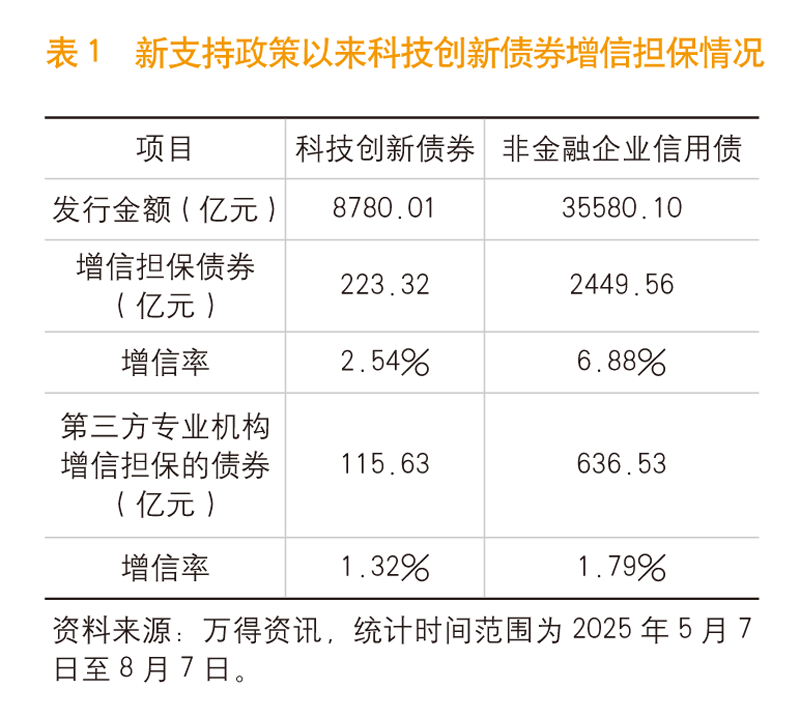
Core Viewpoint - The necessity of credit enhancement for technology innovation bonds is highlighted, as many technology companies have weak fundamentals and require support to improve their financing capabilities [1] Group 1: Current Status of Credit Enhancement for Technology Innovation Bonds - The credit enhancement model has become more diverse, incorporating policy tools and market-based guarantees, encouraging local governments to establish risk compensation funds [2] - The credit enhancement rate for technology innovation bonds is low, with only 2.54% of newly issued bonds having credit guarantees, significantly lower than the 6.88% rate for non-financial corporate bonds [3][4] - Third-party credit enhancement institutions are actively participating, with a wide range of organizations involved, creating a multi-layered credit enhancement system [4] Group 2: Support for Private Technology Companies - Private technology companies face challenges in bond market financing, but recent policies have provided significant support, including risk mitigation tools and layered guarantees from central and local entities [5] Group 3: Challenges Facing Credit Enhancement for Technology Innovation Bonds - There is a lack of risk-sharing policy arrangements for credit enhancement institutions, leading to a predominance of national institutions over local ones [6] - A shortage of specialized talent in credit enhancement institutions limits their ability to support technology innovation bonds effectively [7] Group 4: Recommendations for Improving Credit Enhancement Mechanisms - Continuous innovation in credit enhancement models is recommended, including the establishment of joint credit enhancement bodies and the application of credit derivatives [8] - Optimizing the review mechanism for technology innovation bonds is suggested, such as creating green channels for qualified companies and including intangible assets as collateral [9] - Strengthening policy arrangements for risk sharing in technology innovation bonds is advised, including the establishment of risk funds led by local governments [9]
债市策略思考:如何看待本轮债市调整?
ZHESHANG SECURITIES· 2025-09-12 04:49
Core Insights - The current bond market is in a bottoming phase characterized by a converging triangle pattern and insufficient long positions, suggesting investors should wait patiently for opportunities to gradually accumulate positions when the 10-year government bond yield is in the range of 1.80-1.85% [1][2][27] Historical Context of Bond Market Bottoming - Historically, the bond market has experienced a smooth downward trend followed by prolonged bottoming phases, as seen in early 2015 and before 2019, which eventually led to new downward trends in yields. The current situation in 2025 shows similarities but lacks the stability in high and low points seen in previous bottoming phases, indicating a converging range and insufficient long positions [1][9][11] Current Stage of the Bond Market - The bond market is currently at a stage where the converging triangle pattern indicates a lack of momentum for further price movement in either direction, suggesting a potential re-evaluation of direction. Positive signals include the duration of the current bottoming phase, which has lasted about 7 months, and a recovery in long sentiment in government bond futures as of September 11 [2][28][27] Technical Analysis and Market Signals - The technical analysis indicates that the converging triangle pattern typically signifies a lack of strong momentum, leading to a potential directional choice ahead. The bond market has shown signs of recovery in trading volume and sentiment, with a notable increase in positions across various futures contracts [2][28][30] Economic and Monetary Policy Context - The economic environment in 2025 is comparable to that of early 2015 and 2019, with a slow recovery in the economy and weak financing demand from both households and enterprises. The GDP growth is expected to remain around 5%, supporting a downward trend in bond yields. Additionally, the monetary policy remains accommodative, with recent rate cuts and liquidity injections providing a supportive backdrop for the bond market [13][19][27] Equity Market Performance - The equity market has shown structural differentiation, with growth stocks outperforming value stocks across different periods. In 2025, the market has seen significant gains in mid and small-cap sectors, indicating a trend where growth outperforms traditional sectors, which aligns with historical patterns observed in previous years [23][27]