
外汇

Search documents
圣诞美欧韩股休市,离岸人民币破7,黄金失守4500美元,白银高位震荡
Sou Hu Cai Jing· 2025-12-25 11:07
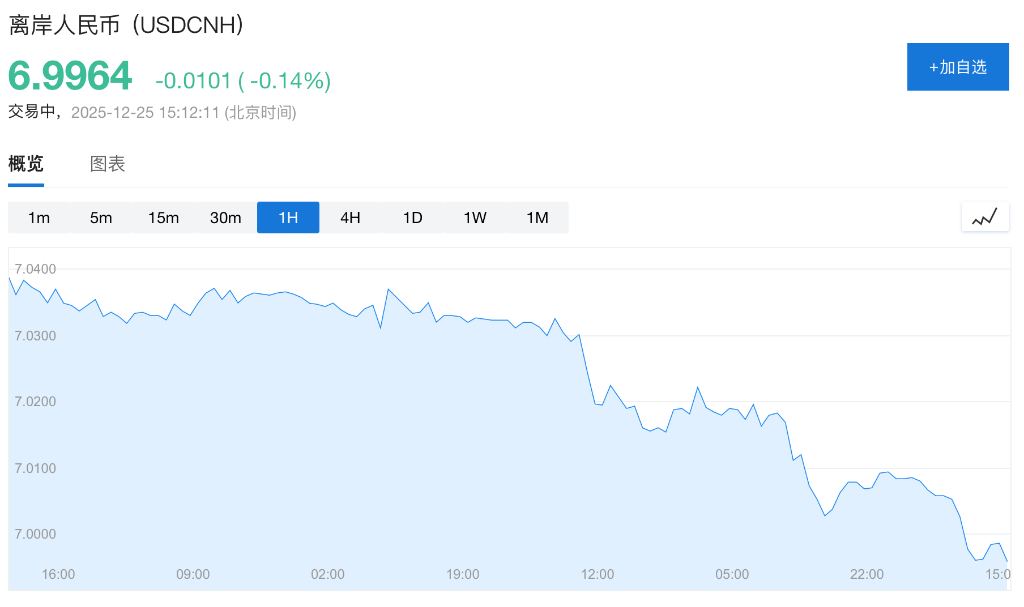
Market Overview - The Christmas holiday has led to a one-day closure of U.S. stock and bond markets, with major European stock markets also closed [1] - Asian stock indices showed mixed results, with the Nikkei 225 index rising by 0.13% to 50,407.79 points [1] - The offshore RMB broke the 7.0 mark against the USD for the first time since September 2024, indicating a strengthening of the Chinese currency [1][2] Currency Movements - The Japanese yen rebounded to around 155.8, supported by comments from the Bank of Japan's governor regarding approaching the 2% inflation target [1][5] - The offshore RMB's appreciation is attributed to increased market capital inflows and demand for currency settlement, driven by expectations of a shift towards a more accommodative U.S. monetary policy [2] Bond Market - The yield on Japan's 2-year government bonds rose to 1.125%, marking a new high since 1996, due to weak demand in recent auctions [1][8] Precious Metals - Gold prices fell below $4,500 per ounce after reaching a historical high of $4,525.18, with analysts remaining optimistic about future price targets [1][11] - Silver maintained a strong performance, fluctuating around $71.80 per ounce after hitting a historical high of $72.70, with a year-to-date increase of 149% [1][14]

破7!人民币大幅升值,有人年初存美元,如今倒亏钱!
Mei Ri Jing Ji Xin Wen· 2025-12-25 03:51
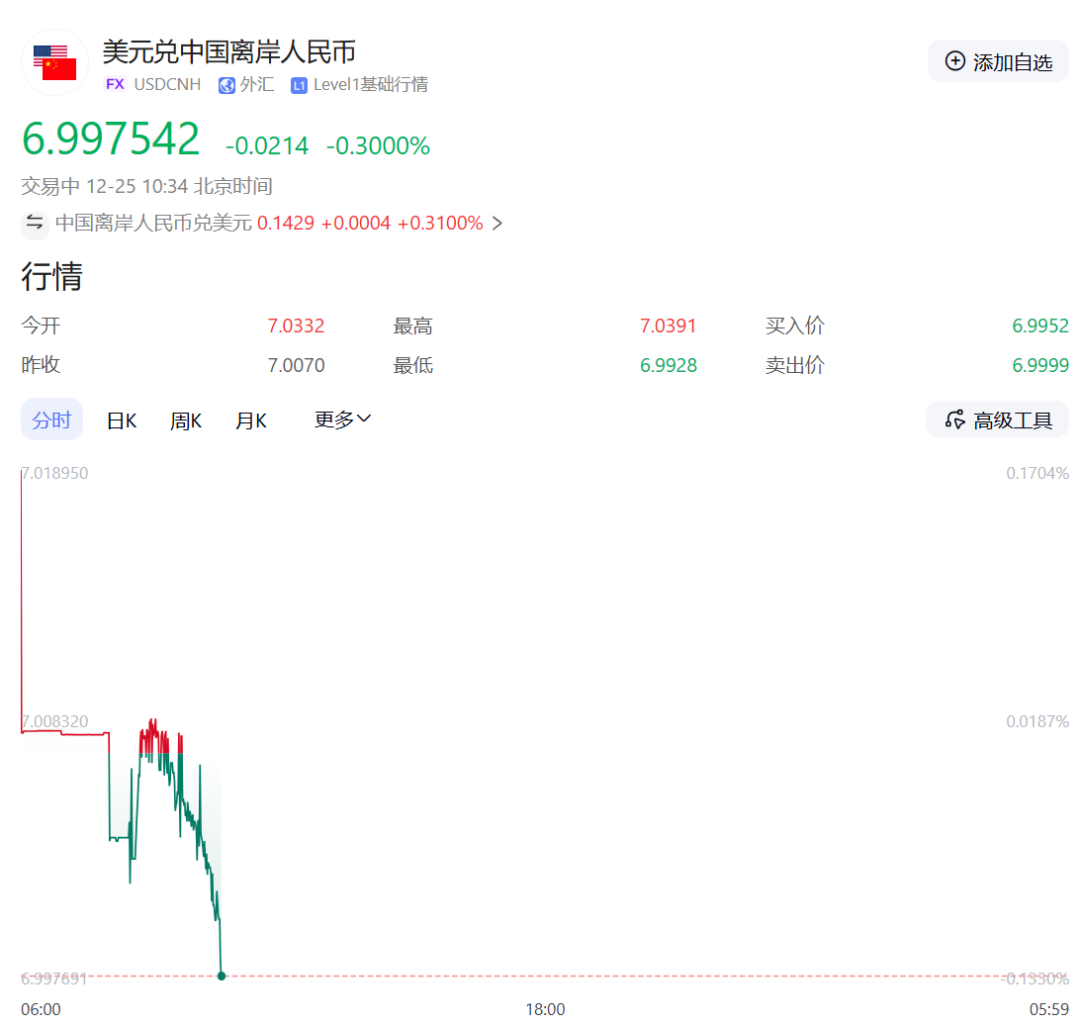
专题:离岸人民币升破7关口 为2024年以来首次!影响几何? 热点栏目 自选股 数据中心 行情中心 资金流向 模拟交易 客户端 每经编辑|段炼 12月25日,离岸人民币兑美元汇率升破7.0大关。 | 今开 | | 7.0332 | | 最高 | 7.0391 | 买入价 | | 6.9952 | | --- | --- | --- | --- | --- | --- | --- | --- | --- | | 昨收 | | 7.0070 | | 最低 | 6.9928 | 卖出价 | | 6.9999 | | 分时 | 日K | | 更多い | | | | 6 高级工具 | | 今年以来,人民币兑美元整体震荡上扬态势。2024年12月31日收盘,离岸人民币兑美元汇率为7.3368。 有人年初存美元,如今倒亏钱 人民币的大幅升值,也使得美元存款成了"负收益"。杭州市民张凯(化名)手头上有1万多美元外汇,今年2月份一部分美元(8400美元)办了13个月的定 期存款,到期利率为2.8%,到期收益254.8美元。如果按目前的汇率计算,本金加利息相当于人民币60596元;而年初的时候,8400美元相当于61629元人 ...
破7!人民币大幅升值,有人年初存美元,如今倒亏钱
Mei Ri Jing Ji Xin Wen· 2025-12-25 03:28
Core Viewpoint - The recent appreciation of the Chinese yuan against the US dollar has led to negative returns for dollar deposits, impacting individuals and families with foreign currency holdings [2][3][6]. Group 1: Currency Exchange Trends - The offshore yuan has shown a significant upward trend against the US dollar, with the exchange rate reaching 7.3368 by December 31, 2024 [1]. - Since November 21, the yuan has been steadily rising from around 7.11, with expectations of breaking the 7 mark increasing [6]. - The yuan's appreciation is attributed to a combination of external pressures easing, internal economic resilience, and market expectations shifting [7]. Group 2: Impact on Individuals and Families - Individuals holding dollar deposits have experienced losses due to the yuan's appreciation, with one case showing a loss of 1,033 yuan on an 8,400 dollar deposit [2]. - Families with children studying abroad benefit from the yuan's strength, as it reduces the cost of tuition and living expenses in foreign currencies [3][8]. Group 3: Market Implications - The appreciation of the yuan is expected to positively influence the Chinese stock and bond markets, enhancing the attractiveness of yuan-denominated assets [8]. - Increased demand for yuan due to seasonal currency exchange needs from businesses is contributing to the currency's strength [7].
外汇市场成交量整体下降 人民币汇率创年内新高
Jin Rong Shi Bao· 2025-12-25 03:11
Group 1: Foreign Exchange Market Overview - In November, the average daily trading volume in the interbank foreign exchange market decreased to $191.46 billion, a year-on-year decline of 2.57% and a month-on-month decline of 6.69% [1] - The average daily trading volume for the RMB foreign exchange market was $146.23 billion, down 5.11% year-on-year [1] - The RMB to USD exchange rate strengthened, breaking through the 7.12 to 7.08 levels, reaching a year-to-date high of 7.0794 by the end of November [1][3] Group 2: USD Index and Interest Rate Expectations - The USD index experienced fluctuations, initially maintaining a narrow range due to cautious Fed rate cut expectations, but later fell to 99.45 by the end of November, a decrease of 0.35% from the previous month [2] - The market's risk aversion increased mid-month, leading to a temporary rise in the USD index above 100 points, but it subsequently declined as Fed officials indicated support for rate cuts [2][3] Group 3: RMB Exchange Rate Dynamics - The RMB to USD exchange rate showed a strong upward trend, with the onshore RMB closing at 7.0794, appreciating 0.48% from the previous month, while the offshore RMB was at 7.0754, appreciating 0.58% [3] - The CFETS RMB exchange rate index rose to 97.92, reflecting a 0.32% appreciation from the previous month [3] Group 4: Derivatives Market Activity - In November, the average daily trading volume of RMB foreign exchange options was $5.44 billion, an increase of 3.93% month-on-month [4] - The implied volatility of RMB to USD options showed a downward trend initially, followed by an increase, indicating a rise in short-term appreciation expectations for the RMB [4] Group 5: Swap Market Trends - The one-year swap points decreased by 9 basis points to -1296 basis points by the end of November, influenced by market supply and demand factors [5] - The spread between onshore and offshore one-year swap points narrowed to around 50 basis points, the lowest in three months [6] Group 6: Dollar Liquidity Conditions - Domestic dollar liquidity tightened slightly in November, while offshore dollar liquidity remained tight, with the SOFR rate fluctuating between 3.91% and 4.12% [7] - The overnight dollar borrowing rate in the domestic market rose to 3.87% by the end of November, reflecting a tightening trend [7] Group 7: Market Sentiment - The sentiment index for dollar borrowing funds showed increased volatility, rising from 54 points to 57 points in the first half of the month, before falling back to 46 points by the end of November [8]
破“7”渐近,人民币中间价今日调升79个基点
Sou Hu Cai Jing· 2025-12-25 03:11
Core Viewpoint - The recent appreciation of the Renminbi (RMB) against the US dollar is attributed to the weakening of the US dollar index and increased demand for currency exchange by enterprises as the year-end approaches, which may enhance the attractiveness of China's capital markets to foreign investors [1][3]. Group 1: Currency Exchange Rate Movements - On December 25, the People's Bank of China announced that the central parity rate of the RMB against the US dollar was set at 7.0392, a significant increase of 79 basis points from the previous trading day [1]. - The RMB's central parity rate had already risen by 52 basis points on December 24, marking the highest appreciation since September 30, 2024 [1]. - The offshore RMB hit a low of 7.0032 against the US dollar, while the onshore RMB also fell to 7.0133, indicating a strong upward trend towards the "7.0" threshold [1]. Group 2: Factors Influencing RMB Strength - The RMB's strength in December is primarily driven by two factors: the weakening of the US dollar index, which fell below 100 due to market expectations of continued interest rate cuts by the Federal Reserve in 2026, and increased seasonal demand for currency exchange from enterprises as the year-end approaches [1][3]. - The recent appreciation of the RMB has also boosted market sentiment, further pushing up the RMB's value [1]. Group 3: Implications for Trade and Investment - The appreciation of the RMB is expected to increase foreign exchange gains for foreign investors, thereby enhancing confidence in the domestic capital market [3]. - For foreign trade enterprises, the recent RMB appreciation may reduce exchange profits for exporters while lowering costs for importers [3]. - Experts advise foreign trade companies to avoid betting on a one-sided RMB exchange rate trend and to utilize foreign exchange derivatives to manage exchange rate risks effectively [3]. Group 4: Regulatory Outlook and Future Expectations - The financial regulatory authorities have maintained a clear stance on stabilizing the exchange rate, emphasizing the importance of keeping the RMB at a reasonable and balanced level [3][4]. - The market anticipates that the RMB may continue to approach the 7.0 threshold in the short term, with a possibility of temporarily breaking below it, but a sustained one-sided appreciation is not expected in the medium to long term [3][4].
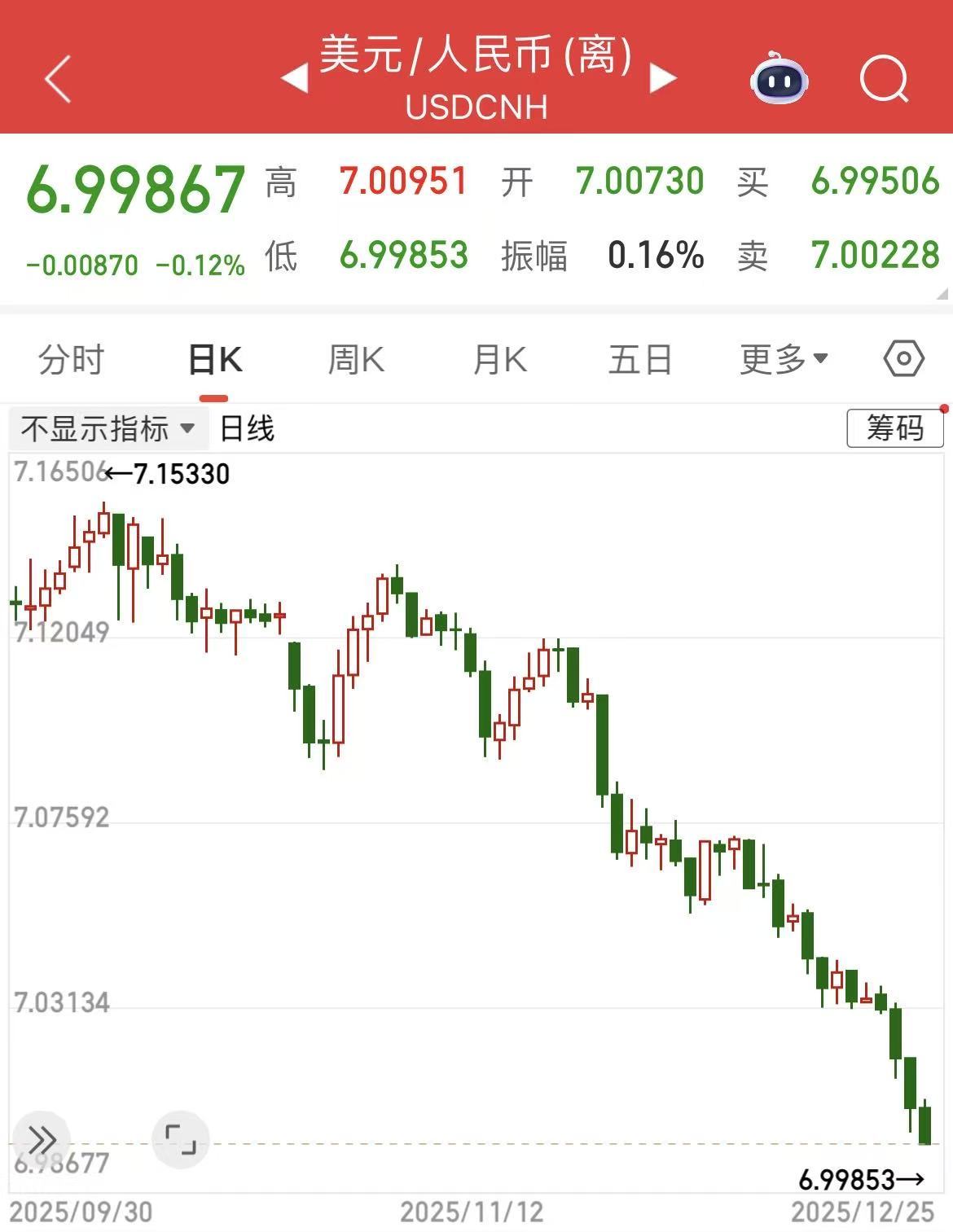
离岸人民币兑美元升破7.0大关,为2024年9月以来首次
Feng Huang Wang· 2025-12-25 02:57
美元/人民币(离) USDCNH 6.99867 高 7.00951 开 7.00730 6.995 买 6.99853 0.16% 7.002 振幅 代 20 -0.00870 -0.12% 日K 月K 分时 五日 車零 围K 不显示指标 ▼ 日线 美 7.16506-7.15330 7.07592 7.03134 6.99853 2025/11/12 2025/09/30 2025/12 12月25日,离岸人民币兑美元升破7.0大关,最高触及6.9985,为2024年9月以来首次。据央行官网12月24日消息,中国人民银行货币政策委员会2025年第四 季度例会于12月18日召开。会议认为,今年外汇市场供求基本平衡,外汇储备充足,人民币汇率双向浮动,在合理均衡水平上保持基本稳定。会议同时指 出,增强外汇市场韧性,稳定市场预期,防范汇率超调风险,保持人民币汇率在合理均衡水平上的基本稳定。 ...
爆拉!澳元冲破0.67创14个月新高 加息预期点燃涨势
Jin Tou Wang· 2025-12-25 02:45
Core Viewpoint - The Australian dollar (AUD) maintains a strong position against the US dollar (USD), with a slight decline of 0.0447% and a trading range of 0.6698-0.6710, following a significant rise that broke the 0.67 mark, reaching a 14-month high since October 2024 [1][2]. Group 1: Economic Factors - The Reserve Bank of Australia (RBA) has kept the policy interest rate at 3.6%, with a hawkish tone suggesting potential rate hikes in the future, which has increased market expectations for a rate increase in early 2025 [1]. - Domestic demand in Australia remains robust, with private consumption and investment data showing resilience, which offsets some external pressures and enhances confidence in the AUD [2]. - The RBA's cautious optimism regarding the economic outlook, without concerns of recession, further supports the strength of the AUD [2]. Group 2: Currency Dynamics - The USD index has declined over 9% this year, primarily due to the Federal Reserve's rate cuts and internal policy discrepancies, which have weakened the dollar and increased the relative attractiveness of the AUD [2]. - The AUD/USD exchange rate is currently in an upward channel, with key support at 0.6620 and resistance at 0.6707, indicating a solid bullish structure [2]. Group 3: Future Considerations - Upcoming key indicators include the Australian fourth-quarter CPI data at the end of January, which could reinforce rate hike expectations if inflation rises [3]. - Monitoring the Federal Reserve's policy direction and US economic performance is crucial, as these factors will directly impact the strength of the USD [3].
震荡回升!加元站稳1.3670 降息分歧油价成关键博弈点
Jin Tou Wang· 2025-12-25 02:40
Core Viewpoint - The USD/CAD exchange rate is experiencing a rebound, currently at 1.3670, influenced by central bank policy divergences and economic data fluctuations [1][2]. Group 1: Exchange Rate Dynamics - The USD/CAD exchange rate has shown resilience, stabilizing above 1.3670 after a high of 1.3944 in September, reflecting strong market dynamics despite fluctuations in oil prices and policy expectations [1]. - The Bank of Canada maintained its benchmark interest rate at 2.25% on December 10, indicating a resilient economy despite challenges from U.S. tariffs, with future policy adjustments dependent on inflation and economic data [1][2]. Group 2: Inflation and Economic Indicators - Canada's Consumer Price Index (CPI) rose by 2.4% year-on-year in September, up from 1.9% in August, driven by narrowing gasoline price declines and rising food prices, with core CPI at 2.6% [2]. - The Canadian economy is characterized by a mix of resilience and pressure, with a strong GDP growth of 2.6% in Q3, but expected weakness in Q4 due to declining net exports and uncertainties from U.S. tariff policies [2]. Group 3: Commodity Influence and Market Sentiment - The structural weakening of the U.S. dollar index, which has fallen over 9% this year, is countered by the weakening commodity attributes of the Canadian dollar, limiting the upward movement of USD/CAD [3]. - Technical analysis indicates a clear short-term oscillation pattern for USD/CAD, with key support levels at 1.3321 and 1.3265, and resistance levels at 1.3383 and 1.3480, with potential volatility due to holiday liquidity constraints and economic data releases [3].
大类资产早报-20251225
Yong An Qi Huo· 2025-12-25 01:15
1. Report Information - Report title: "Big Asset Morning Report" - Report date: December 25, 2025 - Report team: Macro Team of the Research Center [1] 2. Global Asset Market Performance 2.1 Bond Market - **10 - year Treasury Bonds**: The latest yields of 10 - year Treasury bonds in major economies are as follows: US 4.136%, UK 4.504%, France 3.561%, Germany 2.861%, Italy 3.550%, Spain 3.286%, Switzerland 0.293%, Greece 3.444%, Japan 2.042%, Brazil 6.159%, China 1.835%, Australia 4.740%, New Zealand 4.448% [2] - **2 - year Treasury Bonds**: The latest yields of 2 - year Treasury bonds in major economies are: US 3.506%, UK 3.721%, Germany 2.140%, Japan 1.098%, Italy 2.261%, China (1 - year yield) 1.336%, Australia 4.031% [2] 2.2 Exchange - rate Market - **USD against Major Emerging - economy Currencies**: The latest exchange rates of the US dollar against major emerging - economy currencies are: Brazil 5.540, South Africa (zar) 16.665, South Korea (won) 1446.900, Thailand (baht) 31.022, Malaysia (ringgit) 4.047. The latest rates of on - shore RMB, off - shore RMB, RMB central parity rate, and RMB 12 - month NDF are 7.016, 7.007, 7.047, and 6.886 respectively [2] 2.3 Stock Market - **Major Economies' Stock Indexes**: The latest values of major economies' stock indexes are: S&P 500 6932.050, Dow Jones Industrial Average 48731.160, NASDAQ 23613.310, Mexico Stock Index 65616.430, UK Stock Index 9870.680, France CAC 8103.580, Spain Stock Index 17172.900, Russia Stock Index (not available), Nikkei 50344.100, Hang Seng Index 25818.930, Shanghai Composite Index 3940.947, Taiwan Stock Index 28371.980, South Korea Stock Index 4108.620, India Stock Index 8537.911, Thailand Stock Index 1275.330, Malaysia Stock Index 1678.310, Australia Stock Index 9068.961, Emerging - economy Stock Index 1392.070 [2] 2.4 Credit - bond Market - **Credit - bond Indexes**: The latest values of credit - bond indexes are: US investment - grade credit - bond index 3545.840, Euro - zone investment - grade credit - bond index 265.380, emerging - economy investment - grade credit - bond index 290.210, US high - yield credit - bond index 2909.190, Euro - zone high - yield credit - bond index 409.840, emerging - economy high - yield credit - bond index 1822.849 [2] 3. Stock - index Futures Trading Data 3.1 Index Performance - The closing prices of A - share, CSI 300, SSE 50, ChiNext, and CSI 500 are 3940.95, 4634.06, 3025.18, 3229.58, and 7352.04 respectively. The percentage changes are 0.53%, 0.29%, - 0.08%, 0.77%, and 1.31% respectively [3] 3.2 Valuation - The PE (TTM) of CSI 300, SSE 50, CSI 500, S&P 500, and Germany DAX are 14.11, 11.78, 33.37, 27.69, and 18.84 respectively. The环比changes are 0.02, - 0.02, 0.41, 0.09, and 0.00 respectively [3] 3.3 Risk Premium - The risk premiums (1/PE - 10 - year interest rate) of S&P 500 and Germany DAX are - 0.52 and 2.45 respectively. The环比changes are 0.02 and 0.00 respectively [3] 3.4 Fund Flow - The latest values of fund flow in A - share, main board, ChiNext, and CSI 300 are 626.94, 328.21, 247.71, and 85.15 respectively. The 5 - day average values are - 22.94, - 42.38, 19.99, and 73.46 respectively [3] 3.5 Transaction Amount and Basis - The latest transaction amounts of Shanghai and Shenzhen stock markets, CSI 300, SSE 50, small - and medium - sized board, and ChiNext are 18802.68, 4063.76, 912.64, 3992.53, and 5025.69 respectively. The环比changes are - 195.73, - 267.65, - 192.06, 102.09, and 88.86 respectively. The basis of IF, IH, and IC are - 39.06, 1.82, and - 111.64 respectively, with the corresponding basis spreads of - 0.84%, 0.06%, and - 1.52% [4] 4. Treasury - futures Trading Data - The closing prices of T2303, TF2303, T2306, and TF2306 are 108.23, 106.03, 108.23, and 106.02 respectively. The percentage changes are 0.01%, 0.00%, 0.01%, and - 0.01% respectively. The funding rates of R001, R007, and SHIBOR - 3M are 1.3568%, 1.5198%, and 1.6000% respectively, with the daily changes of - 14.00 BP, 2.00 BP, and 0.00 BP [4]
【西街观察】人民币升值,别期待“一口吃成胖子”
Bei Jing Shang Bao· 2025-12-24 14:21
Group 1 - The offshore and onshore RMB against the USD have both reached 14-month highs, with offshore RMB appreciating by 4.4% and onshore RMB by 3.7% year-to-date, while volatility has dropped to a near ten-year low [1] - Over 30 A-share companies have engaged in foreign exchange hedging activities since December, demonstrating a rational response to currency fluctuations [3] - Regulatory authorities are encouraged to enhance expectation management and macro-prudential oversight, providing better support for companies to mitigate exchange rate risks [3] Group 2 - The appreciation of the RMB reflects the resilience of the domestic economy, but a gradual and stable approach is deemed more sustainable than rapid increases [3] - The dual forces of expanding trade surplus and insufficient domestic demand keep the RMB exchange rate in a dynamic equilibrium adjustment process [2] - Companies are advised to focus on core business development and use foreign exchange hedging tools to manage currency mismatch and exchange rate exposure risks [2]