
氯碱

Search documents
华泰期货:烧碱上涨,核心驱动因素是什么?
Xin Lang Cai Jing· 2026-01-08 01:47
Group 1 - The core viewpoint of the article is that the price of caustic soda futures has significantly strengthened, with the main contract SH2603 closing up by 4.34% due to various driving factors [7][9]. Group 2 - On the macroeconomic level, the central bank's work meeting has included promoting high-quality economic development and reasonable price recovery as key monetary policy focuses, boosting market macro expectations [9]. - The policy aspect includes a proposed differential electricity pricing policy in Shaanxi province, which plans to increase prices for restricted capacity in caustic soda and other industries by 0.1 yuan/kWh and by 0.3 yuan/kWh for eliminated capacity. This policy affects companies like Shaanxi Beiyuan (1.2 million tons) and Shaanxi Jintai (830,000 tons) [9]. - The cost side indicates that some downstream chlorine-consuming industries are reducing purchases due to weather and price acceptance, with liquid chlorine demand weakening and prices declining, indirectly strengthening the cost support for the chlor-alkali industry [9]. Group 3 - Current caustic soda spot prices are stable but declining, with a loose supply-demand situation unchanged. Inventory in Shandong and Jiangsu continues to accumulate, and there are fewer maintenance shutdowns in January [3][9]. - Downstream purchasing enthusiasm is generally low, with alumina plants operating steadily but unloading efficiency being average, leading to a 32% reduction in alkali procurement prices [3][9]. - In the medium to long term, alumina demand for caustic soda may decline due to industry internal competition policies, and non-alumina demand is weakening as January enters a seasonal off-peak period. Short-term caustic soda prices may fluctuate with macroeconomic sentiment [3][9].


【光大研究每日速递】20260108
光大证券研究· 2026-01-07 23:04
Macro - The bond market has partially digested three major concerns, with actual impacts being lower than market expectations. However, upward policy impulses and a positive start for the economy and stock market may continue to pressure bond market sentiment. Favorable factors include the lack of strong explanatory power of government bond supply on interest rate trends and the central bank's willingness and ability to maintain liquidity. The overall outlook for the bond market is not pessimistic, and current strategies should focus on allocation while patiently waiting for trading opportunities [5]. Non-ferrous Metals - As of January 5, 2026, domestic electrolytic aluminum prices reached 23,300 yuan/ton, the highest since March 2022. The copper-aluminum price ratio peaked at 4.5, the highest since 2003, indicating potential acceleration in aluminum replacing copper in certain sectors. Disruptions in overseas electrolytic aluminum supply and limited short-term expansion of new capacity are noted. The aluminum consumption in 2026 is expected to remain resilient due to the transformation of old and new driving forces and the rise of emerging fields. Policy expectations in both domestic and international markets are gradually solidifying the bottom for alumina prices [5]. Petrochemical - Future policies will focus on "anti-involution" and the elimination of outdated production capacity. The profitability of high-energy-consuming industries like calcium carbide and chlor-alkali is at a low point, and intensified competition on the cost side is expected to accelerate the exit of outdated facilities. This will help reduce industry supply and increase concentration, while also promoting the modernization and large-scale development of facilities, thereby enhancing the overall competitiveness of the calcium carbide and chlor-alkali industries [5]. Overseas TMT - Minimax, a leading general multimodal large model platform, has entered a phase of scaled commercialization as of 2025. The company's business model centers on self-developed general large models, achieving commercialization through API calls, model customization, solution output, and proprietary AI applications. The company is increasing R&D investment to enhance model training, inference efficiency, and multimodal capabilities, establishing technical and data barriers. Additionally, the open platform model lowers the entry threshold for downstream customers, increasing model usage and ecosystem stickiness [7]. - The company, Zhiyuan Huazhang, is a provider of general multimodal large models and AI native applications, focusing on commercializing model capabilities. Its commercialization path centers on model API calls, while also offering model customization, project solutions, and AI native application services. Revenue recognition is primarily linked to model usage volume, service fulfillment progress, and specific delivery situations. The prospectus indicates that the company is still in the commercialization development stage, with continuous growth in model usage expected as downstream application scenarios expand [7]. Internet Media - The film market is anticipated to transition from "single film support" to "multiple strong resonance" and structural repair. Although Q1 2026 faces high base pressure from the 2025 release of "Nezha 2," the overall market is expected to return to normalization and show moderate growth throughout the year, driven by the diversification of leading domestic films and the recovery of imported film supply [8]. Infrastructure - Hongrun Construction, a leading enterprise with technical experience and project management capabilities, has accumulated over 300 kilometers of shield tunneling in more than 20 cities, including Shanghai, Hangzhou, and Ningbo. The company is deeply integrated with core urban agglomerations under the "Yangtze River Delta Integration" strategy, with stable business in rail transit, municipal, and underground space. In recent years, the company has been advancing a strategy of "construction + new energy + technology," expanding from traditional infrastructure to areas such as photovoltaic energy storage, distributed energy, and intelligent construction, resulting in a more balanced growth structure [8].
瑞达期货烧碱产业日报-20260107
Rui Da Qi Huo· 2026-01-07 09:45
Report Summary 1. Industry Investment Rating - Not provided in the report 2. Core Viewpoints - Some plant recoveries drive the national average capacity utilization rate of caustic soda to increase month - on - month. Alumina's operating rate decreases month - on - month but the overall operating load remains high; the operating rate of viscose staple fiber and the printing and dyeing industry decline. Liquid caustic soda factory inventories accumulate month - on - month, higher than the same period in previous years. Affected by the decline in caustic soda prices, Shandong chlor - alkali profits narrow but remain in a theoretical profit state. In January, the planned maintenance capacity of chlor - alkali is small, and domestic chlor - alkali plants are expected to maintain a high operating state. In the short term, the operating load of alumina enterprises remains basically stable, and non - aluminum downstream may maintain rigid demand purchases with little change. The overall supply and demand of liquid caustic soda in the spot market is still relatively loose, and the prices of the main purchase price and market price of 32% liquid caustic soda in Shandong have recently declined. There are many alumina plants planned to be put into operation in the first half of the year, but the continuous low - profit situation in the industry strengthens the expectation of future production cuts. Shaanxi may implement differential electricity prices in July, and the ECU cost in the northwest region is expected to rise. In the short term, SH2603 is expected to fluctuate, and attention should be paid to the support around 2150 and the pressure around 2330 [3] 3. Summary by Directory 3.1 Futures Market - The main contract closing price of caustic soda is 2261 yuan/ton, up 67 yuan; the main contract position of caustic soda is 162,076 lots, up 2,113 lots; the net position of the top 20 futures is - 15,005 lots, down 458 lots; the main contract trading volume of caustic soda is 513,709 lots, up 169,482 lots; the closing price of the January contract is 1967 yuan/ton, down 3 yuan; the closing price of the May contract is 2405 yuan/ton, up 75 yuan [3] 3.2 Spot Market - The price of 32% ion - membrane caustic soda in Shandong is 688 yuan/ton, down 2 yuan; in Jiangsu, it is 780 yuan/ton, unchanged; the converted price of 32% caustic soda in Shandong is 2150 yuan/ton, down 6 yuan; the basis of caustic soda is - 111 yuan/ton, down 73 yuan [3] 3.3 Upstream Situation - The mainstream price of raw salt in Shandong is 250 yuan/ton, unchanged; in the northwest, it is 220 yuan/ton, unchanged; the price of steam coal is 642 yuan/ton, unchanged [3] 3.4 Industry Situation - The mainstream price of liquid chlorine in Shandong is 250 yuan/ton, unchanged; in Jiangsu, it is 150 yuan/ton, down 75 yuan [3] 3.5 Downstream Situation - The spot price of viscose staple fiber is 12,900 yuan/ton, unchanged; the spot price of alumina is 2585 yuan/ton, down 15 yuan [3] 3.6 Industry News - From December 27th to January 2nd, the capacity utilization rate of China's caustic soda was 86.4%, up 0.4% month - on - month; the operating rate of alumina decreased 0.47% month - on - month to 84.67%, the operating rate of viscose staple fiber decreased 1.61% month - on - month to 85.42%, and the operating rate of printing and dyeing decreased 0.47% month - on - month to 60.81%. The commodity market atmosphere is warm, and industrial products mainly rose during the day, with SH2603 rising 4.34% to close at 2261 yuan/ton. As of January 2nd, the inventory of liquid caustic soda factories was 485,700 tons (wet tons), up 9.84% month - on - month. From December 25th to January 4th, the weekly average profit of Shandong chlor - alkali was 153 yuan/ton, lower than the previous period [3]
【国投期货|化工视点】陕西差别电价对氯碱行业的影响
Guo Tou Qi Huo· 2026-01-07 06:25
1. Report Industry Investment Rating - Not provided in the content 2. Core View of the Report - The implementation of differential electricity prices in Shaanxi may increase the costs of caustic soda and PVC, with a greater impact on PVC. The significant increase in calcium carbide costs may even lead to plant closures, putting pressure on PVC costs and supply. With fewer new PVC production capacities in 2026, if costs rise further and industry losses intensify, it may force enterprises to cut production capacities, alleviating supply pressure. There may be an opportunity to go long on PVC at low prices in 2026 [7] 3. Summary Based on Relevant Catalogs 3.1 Impact on Caustic Soda - Shaanxi's caustic soda production capacity accounts for 3.31%, mainly from Shaanxi Jintai's 820,000 tons and Shaanxi Beiyuan's 800,000 tons. Producing 1 ton of caustic soda requires 2,300 - 2,400 kWh of electricity, and electricity accounts for about 60% of the total production cost. If the electricity price increases in the future, caustic soda will face cost - increasing pressure [3] 3.2 Impact on PVC - Shaanxi's PVC production capacity accounts for 7.18%, reaching 2.15 million tons, mainly from Shaanxi Jintai and Shaanxi Beiyuan. The differential electricity price affects PVC mainly through calcium carbide. The increase in calcium carbide cost directly drives up the production cost of PVC. Shaanxi is a major calcium carbide production area, with a 9% share of calcium carbide production capacity in 2025, involving 3.29 million tons of production capacity, and the calcium carbide plant operating rate in this area is 68%. In calcium carbide production, raw materials and electricity are the main cost components. The electricity consumption per ton of calcium carbide production is about 3,200 kWh. If the electricity price increases by 0.1 yuan/kWh, the cost per ton of calcium carbide will increase by 320 yuan. Producing 1 ton of calcium carbide - based PVC requires about 1.5 tons of calcium carbide, so the cost per ton of PVC will increase by about 480 yuan. Whether the high - growing cost will lead to the shutdown risk of calcium carbide enterprises needs continuous attention. Currently, there is a certain supply shortage of calcium carbide in Shaanxi, and it needs to purchase calcium carbide from other provinces to meet local demand. If the cost increases in the future, it is expected to force PVC enterprises to increase the purchase of calcium carbide from other major production areas such as Inner Mongolia, Ningxia, Gansu, and Xinjiang [5]
氯碱日报:宏观情绪好转-20260107
Hua Tai Qi Huo· 2026-01-07 05:12
1. Report Industry Investment Rating - No information provided in the content 2. Core Viewpoints - The current supply - demand pattern of the PVC market is generally weak, but the release of the draft for soliciting opinions on differential electricity prices in Shaanxi and overseas device shutdowns support the PVC futures to rebound. The macro - expectation has improved, and the PVC market is expected to rebound with the macro - sentiment. The overall supply - demand of PVC remains weak, and attention should be paid to subsequent device maintenance and macro policies [3]. - The spot price of caustic soda is stable with a slight decline. The supply side is operating at a high level, but the demand for liquid chlorine may weaken, and the cost support of chlor - alkali may strengthen slightly. The demand for caustic soda may decline in the long - term. The caustic soda futures price has limited downward space and will rebound with the macro - sentiment. Attention should be paid to the price fluctuation of liquid chlorine and the implementation of macro policies [3]. 3. Summary by Relevant Catalogs 3.1 Market News and Important Data 3.1.1 PVC - Futures price and basis: The closing price of the PVC main contract is 4919 yuan/ton (+155); the East China basis is - 289 yuan/ton (-5); the South China basis is - 269 yuan/ton (-35) [1]. - Spot price: The East China calcium carbide method quotation is 4630 yuan/ton (+150); the South China calcium carbide method quotation is 4650 yuan/ton (+120) [1]. - Upstream production profit: The semi - coke price is 750 yuan/ton (+0); the calcium carbide price is 2780 yuan/ton (+0); the calcium carbide profit is - 110 yuan/ton (+0); the gross profit of PVC calcium carbide method production is - 714 yuan/ton (+47); the gross profit of PVC ethylene method production is - 279 yuan/ton (+56); the PVC export profit is - 15.3 US dollars/ton (+0.4) [1]. - PVC inventory and operation: The in - factory inventory of PVC is 30.9 tons (+0.3); the social inventory of PVC is 52.5 tons (+1.1); the operation rate of PVC calcium carbide method is 77.46% (+0.45%); the operation rate of PVC ethylene method is 70.73% (-3.33%); the overall operation rate of PVC is 75.42% (-0.70%) [1]. - Downstream order situation: The pre - sales volume of production enterprises is 81.6 tons (+0.9) [1]. 3.1.2 Caustic Soda - Futures price and basis: The closing price of the SH main contract is 2194 yuan/ton (+30); the basis of 32% liquid caustic soda in Shandong is - 38 yuan/ton (-30) [1]. - Spot price: The price of 32% liquid caustic soda in Shandong is 690 yuan/ton (+0); the price of 50% liquid caustic soda in Shandong is 1090 yuan/ton (+0) [1]. - Upstream production profit: The single - variety profit of caustic soda in Shandong is 1131 yuan/ton (+0); the comprehensive profit of chlor - alkali in Shandong (0.8 tons of liquid chlorine) is 604.0 yuan/ton (+0.0); the comprehensive profit of chlor - alkali in Shandong (1 ton of PVC) is - 207.95 yuan/ton (+80.00); the comprehensive profit of chlor - alkali in the Northwest (1 ton of PVC) is 575.00 yuan/ton (+20.00) [2]. - Caustic soda inventory and operation: The inventory of liquid caustic soda factories is 48.57 tons (+4.35); the inventory of flake caustic soda factories is 3.02 tons (+0.05); the operation rate of caustic soda is 86.40% (+0.40%) [2]. - Downstream operation of caustic soda: The operation rate of alumina is 84.67% (-0.47%); the operation rate of printing and dyeing in East China is 60.81% (-0.47%); the operation rate of viscose staple fiber is 85.05% (-1.98%) [2]. 3.2 Market Analysis 3.2.1 PVC - The supply - demand pattern is weak, but the market rebounds due to policy and overseas factors, and the macro - expectation has improved. The domestic supply is abundant, the downstream operation has slightly decreased, and the export orders remain resilient. The social inventory has slightly increased, and the overall profit has recovered but is still at a low level compared to the same period [3]. 3.2.2 Caustic Soda - The spot price is stable with a slight decline. The supply side operates at a high level, but the demand for liquid chlorine may weaken. The demand for caustic soda is average, and the demand may decline in the long - term. The macro - expectation has improved, and the downward space of the futures price is limited [3]. 3.3 Strategy 3.3.1 PVC - Unilateral: Fluctuate with the macro - situation - Inter - delivery: Wait and see - Inter - variety: None [5] 3.3.2 Caustic Soda - Unilateral: Fluctuate with the macro - situation - Inter - delivery: Wait and see - Inter - variety: None [5]
烧碱:短期偏强,中期震荡
Guo Tai Jun An Qi Huo· 2026-01-07 01:52
Report Industry Investment Rating - The trend strength of caustic soda is 1, indicating a moderately bullish outlook [5] Core View of the Report - Caustic soda's short - term trend may be strong due to macro - sentiment, but the spot market faces the impact of low - price warehouse receipts, and without production cuts by manufacturers, a significant rebound is difficult. The market may have a short - term rebound under the influence of anti - involution sentiment, but the overall high - production and high - inventory pattern persists, with weak demand [3] Summary by Related Catalogs Fundamental Tracking - On January 7, 2026, the 03 - contract futures price was 2194, the price of the cheapest deliverable 32% caustic soda in Shandong was 690, the price of Shandong's 32% caustic soda converted to the futures market was 2156, and the basis was - 38 [1] Spot News - On January 6, the caustic soda market price in Shandong was weakly stable. Some enterprises with high - priced products and poor sales reduced prices, high - concentration caustic soda orders were scarce, export prices were low, and the market price continued to decline [2] Market Condition Analysis - After the New Year's Day, the caustic soda 2601 contract dropped significantly due to a large number of 01 - contract warehouse receipts and high pressure on long - position holders to take delivery, leading to massive position - closing. The pressure on near - month contracts and continuous spot price cuts also caused other contracts to weaken. However, based on the delivery situation, the closing price of the 01 contract on Monday night was 1940 yuan/ton, and long - position holders would not lose money. This price was much lower than Shandong Weiqiao's purchase price, and the discount to the spot was sufficient to cover storage and transaction costs, so the short - term decline due to delivery factors would be limited [3] - Fundamentally, caustic soda remains in a high - production and high - inventory pattern. On the demand side, the oversupply of alumina has not changed in the short term, and the expectation of production cuts suppresses the stockpiling of caustic soda. Non - aluminum downstream industries face a seasonal decline in rigid demand, and exports are under pressure, so overall demand lacks support. On the supply side, winter is the off - season for chlor - alkali enterprise maintenance, and with high operating rates, the supply pressure of caustic soda is large, and enterprises still face the pressure of reducing prices to clear inventory before the Spring Festival [3] - Overall, there is limited room for caustic soda to continue trading on the near - month delivery pressure. In the short term, driven by macro - sentiment, the trend may be strong. However, the spot market still faces the impact of low - price warehouse receipts. Without production cuts by manufacturers, caustic soda is unlikely to have an obvious rebound. Attention should also be paid to the shutdown of the Freeport chlor - alkali plant of Olin in the United States, which may have an impact on caustic soda exports [3]
标本兼治破解氯碱行业“内卷” | 大家谈 如何破除“内卷式”竞争
Zhong Guo Hua Gong Bao· 2026-01-06 03:27
Core Viewpoint - The chlor-alkali industry is currently facing a "homogeneous products and profit pressure" dilemma, necessitating a multi-faceted approach including technological innovation, structural optimization, and model innovation to establish a new high-quality development pattern focused on "quality improvement, efficiency enhancement, differentiated competition, and green collaboration" [1][3]. Technological Innovation - Technological innovation is essential for breaking the "involution" cycle, focusing on energy-saving and cost-reduction at the production level, as well as smart upgrades to lower costs from the source [1]. - Advanced technologies such as membrane electrolysis and heat recovery from hydrochloric acid synthesis are recommended to enhance energy efficiency [1]. - For instance, Shandong Haohua Chlor-Alkali utilizes a large model for process optimization, equipment maintenance, and intelligent inspection, achieving an annual electricity saving of 4.5 million kWh and generating nearly 10 million yuan in comprehensive benefits [1]. Structural Optimization - The core issues of "involution" stem from a single product structure and supply-demand mismatch, requiring efforts in "eliminating inefficiencies, enhancing high-end production, and supplementing the supply chain" to reshape the competitive landscape [2]. - Strict enforcement of energy efficiency policies to eliminate low-efficiency capacities can alleviate supply pressure [2]. - Traditional chlor-alkali enterprises should aim for value creation by extending into fine chemicals and new materials, as exemplified by Xingfa Group's development of high-end products like electronic-grade caustic soda and PVC resin for lithium battery binders [2]. Model Innovation - The industry must move away from "individual efforts" to address "involution" through integrated industry chains, regional collaboration, and policy guidance to create a collective development force [2]. - Learning from the Shanghai Chlor-Alkali's "Shanghai-Guangxi dual base" strategy, the industry can leverage integrated advantages of chemical parks to form a closed loop with upstream and downstream enterprises, reducing logistics costs and resource consumption [2]. - Promoting deep integration between the chlor-alkali industry and sectors like renewable energy, hydrogen energy, and green electricity can create unique competitive barriers [2]. Transition Path - The path to countering "involution" in the chlor-alkali industry fundamentally involves a shift from "scale expansion" to "quality and efficiency" [3]. - This transition requires establishing a solid foundation for cost reduction through technological innovation, creating differentiated advantages through product upgrades, and building a collaborative ecosystem through model innovation to explore new value creation opportunities [3].
烧碱主力下游下调采购价,PVC政策装置扰动
Hua Tai Qi Huo· 2026-01-06 03:22
Group 1: Report Industry Investment Rating - No information provided Group 2: Report's Core View - The overall supply - demand pattern of the PVC market is weak, but the release of the draft for comments on the differential electricity price policy in Shaanxi and overseas device outages support the PVC futures to rebound. The policy has not directly impacted the current PVC supply, and its implementation needs continuous attention. The domestic PVC supply is abundant, downstream开工 has declined slightly, and social inventory has increased slightly. The overall supply - demand of PVC remains weak, and it is expected to rebound with the macro - sentiment. [3] - The spot price of caustic soda is stable with a downward trend. The inventory in Shandong and Jiangsu has increased. The supply - side is operating at a high level, and the demand - side has general receiving sentiment. The demand for caustic soda may decline in the long - term due to the anti - involution policy of alumina. The supply - demand of caustic soda is weak, and attention should be paid to changes in liquid chlorine prices, device dynamics, and the implementation of macro anti - involution details. [3] Group 3: Summary by Related Catalogs PVC Market Data - Futures price: The closing price of the PVC main contract is 4764 yuan/ton (- 41). The East China basis is - 284 yuan/ton (+ 31), and the South China basis is - 234 yuan/ton (+ 31). [1] - Spot price: The East China calcium carbide - based PVC is quoted at 4480 yuan/ton (- 10), and the South China calcium carbide - based PVC is quoted at 4530 yuan/ton (- 20). [1] - Upstream production profit: The semi - coke price is 750 yuan/ton (+ 0), the calcium carbide price is 2780 yuan/ton (+ 0), the calcium carbide profit is - 110 yuan/ton (+ 0), the gross profit of calcium carbide - based PVC production is - 714 yuan/ton (+ 47), the gross profit of ethylene - based PVC production is - 279 yuan/ton (+ 56), and the PVC export profit is - 15.6 US dollars/ton (+ 0.2). [1] - Inventory and开工: The in - factory PVC inventory is 30.9 tons (+ 0.3), the social PVC inventory is 52.5 tons (+ 1.1), the calcium carbide - based PVC开工 rate is 77.46% (+ 0.45%), the ethylene - based PVC开工 rate is 70.73% (- 3.33%), and the overall PVC开工 rate is 75.42% (- 0.70%). [1] - Downstream orders: The pre - sales volume of production enterprises is 81.6 tons (+ 0.9). [1] Strategy - Single - side: Rebound with the macro - sentiment [5] - Inter - period: Wait - and - see [5] - Inter - variety: None [5] Caustic Soda Market Data - Futures price: The closing price of the SH main contract is 2164 yuan/ton (- 78), and the basis of 32% liquid caustic soda in Shandong is - 8 yuan/ton (+ 37). [1] - Spot price: The price of 32% liquid caustic soda in Shandong is 690 yuan/ton (+ 0), and the price of 50% liquid caustic soda in Shandong is 1090 yuan/ton (+ 0). [2] - Upstream production profit: The single - variety profit of caustic soda in Shandong is 1131 yuan/ton (+ 0), the comprehensive profit of chlor - alkali in Shandong (0.8 tons of liquid chlorine) is 604.0 yuan/ton (+ 40.0), the comprehensive profit of chlor - alkali in Shandong (1 ton of PVC) is - 287.95 yuan/ton (- 10.00), and the comprehensive profit of chlor - alkali in the Northwest (1 ton of PVC) is 555.00 yuan/ton (+ 0.00). [2] - Inventory and开工: The liquid caustic soda factory inventory is 48.57 tons (+ 4.35), the flake caustic soda factory inventory is 3.02 tons (+ 0.05), and the caustic soda开工 rate is 86.40% (+ 0.40%). [2] - Downstream开工: The alumina开工 rate is 84.67% (- 0.47%), the dyeing开工 rate in East China is 60.81% (- 0.47%), and the viscose staple fiber开工 rate is 85.05% (- 1.98%). [2] Strategy - Single - side: Oscillate weakly [5] - Inter - period: Wait - and - see [5] - Inter - variety: None [5]
ETF盘中资讯|万华化学调价!化工板块狂飙,化工ETF(516020)盘中涨超2%! 机构:化工板块有望迎来业绩、估值双重抬升
Sou Hu Cai Jing· 2026-01-06 03:07
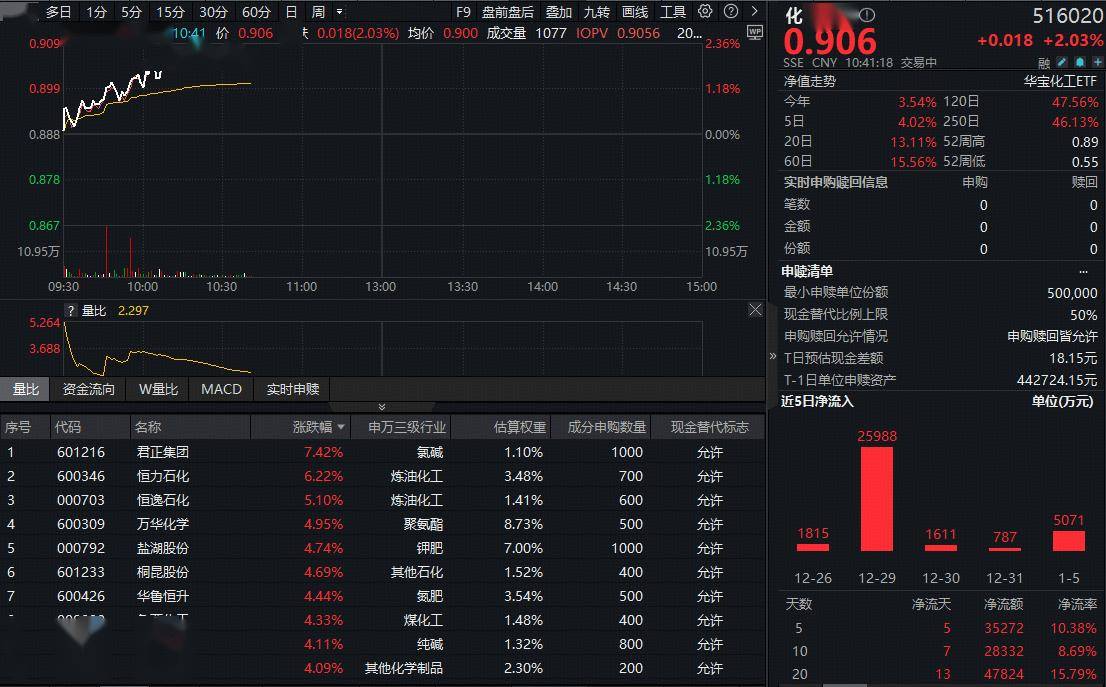
Group 1 - The chemical sector continues to show strong performance, with the chemical ETF (516020) rising by 2.03% as of the latest report, reflecting a robust market trend [1] - Key stocks in the sector include Junzheng Group, which surged over 7%, Hengli Petrochemical up over 6%, and Hengyi Petrochemical increasing by over 5% [1][2] - The overall market sentiment is positive, driven by price increases in core products like MDI/TDI by Wanhua Chemical, which plans to raise prices in line with international giants [1][3] Group 2 - The chemical industry is expected to experience a dual uplift in performance and valuation due to the "anti-involution" policy, with a 10% year-on-year decrease in construction projects among basic chemical companies [3] - Demand is being supported by domestic consumption and resilient exports, indicating a recovery in the supply-demand balance [3] - Analysts predict that the chemical industry may reach a cyclical turning point by 2026, driven by policy expectations and a potential increase in demand as the U.S. enters a rate-cutting phase [3] Group 3 - The chemical ETF (516020) tracks the CSI sub-sector chemical industry index, with nearly 50% of its holdings in large-cap leading stocks like Wanhua Chemical and Salt Lake Shares, providing investors with strong investment opportunities [4] - The ETF also diversifies its holdings across various sub-sectors, including phosphate and nitrogen fertilizers, fluorochemicals, and other chemical leaders [4]

华泰期货:烧碱昨日下跌,后市怎么看?
Xin Lang Cai Jing· 2026-01-06 02:30
Core Viewpoint - The significant decline in caustic soda futures prices is primarily driven by a combination of falling spot market prices, increased inventory levels, and seasonal demand fluctuations in the non-aluminum sector [2][8]. Group 1: Market Dynamics - Caustic soda futures prices dropped sharply, with the main contract SH2603 closing down by 3.82% [2][8]. - The spot market continues to decline, with regional procurement prices being consecutively lowered. In Shandong, the procurement price for 32% caustic soda has fallen to 660 yuan/ton, while in Shanxi, the price for 50% caustic soda was reduced by 100 yuan to 2440 yuan/ton [2][8]. - In Guangxi, the procurement price for 50% caustic soda decreased by 150 yuan to 3100 yuan/ton due to delays in new aluminum oxide production capacity and a lack of concentrated restocking [2][8]. Group 2: Supply and Inventory - Liquid caustic soda prices are also declining, with chlor-alkali companies showing a stronger willingness to maintain liquid chlorine prices. Shandong Xinfan raised its liquid chlorine ex-factory price by 50 yuan to 300 yuan/ton [2][8]. - The high operating rates of chlor-alkali plants are maintaining a high supply of caustic soda, resulting in a loose supply-demand balance [2][8]. - Caustic soda inventories are accumulating again, particularly in Shandong and Jiangsu. The inventory for fixed liquid caustic soda samples from companies with over 200,000 tons reached 48.57 million tons, an increase of 9.83% month-on-month and 72.72% year-on-year [2][8]. Group 3: Future Outlook - In January, there are fewer planned maintenance activities for caustic soda production facilities, which means supply pressure is unlikely to ease [3][9]. - The non-aluminum downstream sector is entering a seasonal decline in production, and medium to long-term demand for caustic soda is expected to contract due to anti-competitive policies affecting aluminum oxide [3][9]. - The current weak supply-demand situation for caustic soda will require close monitoring of production facility maintenance dynamics and liquid chlorine price fluctuations [3][9].