房地产

Search documents
需求依旧偏弱,政策仍需加码
Xiangcai Securities· 2026-01-03 12:04
证券研究报告 2026 年 01 月 03 日 湘财证券研究所 行业研究 房地产行业周报 需求依旧偏弱,政策仍需加码 相关研究: 1.《周度观点:成交下行压力加大, 关注后续政策落地》 2025.12.14 行业评级:买入(维持) 近十二个月行业表现 % 1 个月 3 个月 12 个月 相对收益 -6 -9 -16 -15% -5% 5% 15% 沪深300 房地产(申万) 绝对收益 -4 -9 0 注:相对收益与沪深 300 相比 分析师:张智珑 证书编号:S0500521120002 Tel:(8621) 50295363 Email:zzl6599@xcsc.com 地址:上海市浦东新区银城路88号 中国人寿金融中心10楼 核心要点: ❑ 核心城市:2025 年一线城市二手房成交韧性较强,新房需求仍然较弱 北京:根据 Wind 数据,北京近一周(12.25-12.31)二手房、新房日均成交 套数同比降幅收窄,主要受"12.24"限购放松带动需求短期释放。其中, 二手住宅日均成交 702 套(同比-8%),降幅显著收窄至两位数以内;新房 日均成交 159 套(同比-31%),尽管降幅较前两周收窄,但去年基 ...
浙商宏观:预计流动性驱动下A股将在2026年继续走强,低波红利与科技成长交织的结构化行情
Sou Hu Cai Jing· 2026-01-03 11:56
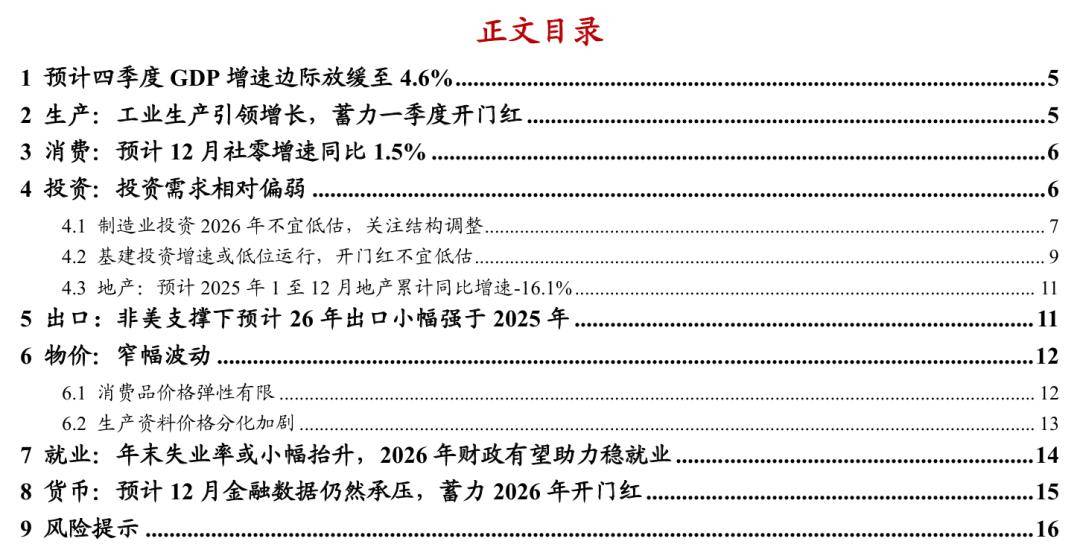
Economic Overview - The GDP growth rate for Q4 2025 is expected to slow to 4.6%, with a strong production sector and moderate demand recovery [1][14] - Industrial production is projected to maintain steady growth, significantly supporting the overall GDP growth target [2][15] - External demand remains resilient, with export growth expected to continue positively [1][5] Production - The industrial added value growth rate for December is estimated at 5.0%, with an annual growth rate of 5.9% for 2025, significantly higher than GDP growth [2][15] - Improvement in demand is noted, driven by pre-holiday inventory buildup and construction progress [2][16] - Manufacturing enterprises are experiencing improved production and market demand, with production growth slightly outpacing demand [2][16] Consumption - The retail sales growth rate for December is expected to be 1.5%, a slight increase from 1.3% [3][19] - Policies supporting the replacement of old products are anticipated to bolster consumer spending, particularly in durable goods [3][19] - The automotive sector continues to face challenges with declining sales and increased discounts, impacting overall retail recovery [3][20] Investment - Fixed asset investment for 2025 is projected to decline by 3.3%, with manufacturing investment showing resilience at 1.2% growth, while infrastructure and real estate investments are under pressure [4][23] - The investment environment has been notably weak since June 2025, with a focus on stabilizing growth in 2026 [4][25] - Manufacturing and broad infrastructure investments are expected to jointly drive growth in early 2026, with a projected increase of 2.5% for the year [4][25][30] Export - December export growth is anticipated at 3.9%, with an annual growth rate of 6.6% for 2026, supported by stable external demand from non-developed countries [5][5] - The stabilization of US-China trade relations and reduced trade friction with Europe and Japan are expected to benefit exports [5][5] Prices - The Consumer Price Index (CPI) growth rate for December is expected to be 0.7%, while the Producer Price Index (PPI) is projected at -1.9% [6][6] - The overall price level is expected to remain stable, with core CPI showing signs of recovery [6][6] Employment - The urban unemployment rate for December is projected to rise slightly to 5.2%, influenced by seasonal factors [7][7] - Continued policy support is expected to help stabilize employment, particularly for vulnerable groups [7][7] Monetary Policy - Financial data for December indicates continued pressure, with new loans and social financing expected to decline [8][8] - The central economic work conference emphasizes the need for flexible monetary policy to support economic stability and reasonable price recovery [8][8]

95岁“股神”巴菲特正式退休!63岁接班人阿贝尔与他性格完全不同,芒格曾称他是“升级版巴菲特”
Sou Hu Cai Jing· 2026-01-03 11:54
据央视新闻消息,当地时间2025年12月31日,著名投资人沃伦·巴菲特正式退休,从知名投资机构伯克希尔-哈撒韦公司的首席执行官岗位上卸任。 沃伦·巴菲特现年95岁,常年担任伯克希尔-哈撒韦公司的首席执行官。他信奉"价值投资法",是价值投资、长期投资的代表人物。 2025年11月,巴菲特在其年度感恩节致股东信中宣布,会在年底辞去相关职务,但将继续担任该公司董事会主席并暂时保留"相当数量"的股份。 巴菲特在信中写道,虽然自己整体感觉良好,但行动迟缓,阅读也越来越吃力。巴菲特表示,他将不再撰写伯克希尔-哈撒韦公司的年度信函,也不会在 公司股东大会上发言。 图片来源:视觉中国 63岁接班人竟与巴菲特性格完全不同 2025年11月,据外媒报道,这位亿万富翁将继续持有伯克希尔-哈撒韦公司的A类股票,直到投资人对将接任首席执行官的该公司副董事长格雷格·阿贝 尔"感到满意"为止。 巴菲特也在致股东信中宣布了最新的慈善捐赠计划,并将加速向其子女管理的基金会捐款以继续支持慈善事业。2025年11月10日,巴菲特向四家家族基金 会捐赠了270万股伯克希尔-哈撒韦公司B类股票,价值约13亿美元。 自1965年掌控伯克希尔公司以来,巴 ...

2026房价若再跌,最惨的不是炒房客,却是这4类人普通人
Sou Hu Cai Jing· 2026-01-03 10:13
晚上十点,李明加完班拖着疲惫的身体回到小区,看到楼下又贴出几张"急售"的红纸,价格比他两年前 买入时低了20万。 他默默上楼,没敢告诉妻子,他们为孩子准备的"学区改善房"计划,可能又要无限期推迟了。 "2026年房价要是还往下走,你觉得谁最惨?"十个路人里有八个会脱口而出:"那还用说,炒房客呗!" 可事实真的如此吗?一位从业多年的房产中介摇着头说出了一个相反的看法:"市场冷了,最先离场 的、损失最小的,往往就是那些'职业选手'。最难受的,是那些把房子和整个生活绑在一起的普通家 庭。" 只要提起房价下跌,人们脑海中总会浮现出炒房客资金链断裂、血本无归的戏剧化场面。 这几乎成了一种思维定式。然而,真实的房产市场逻辑比这复杂得多。 其实真正的职业炒房客或投资机构,在入场时就已经为"退场"做好了预案。 他们的核心逻辑是计算投资回报率,房产对他们而言,是与股票、基金无异的纯粹投资品。 一旦市场风向转变,触发预设的止损线,他们会毫不犹豫地降价抛售、快速变现。 "人家玩的是资本游戏,规则清楚,愿赌服输。"一位资深投资顾问分析,"他们最大的优势是'船小好调 头',资产组合多样,不依赖单一房产。亏了一处,可能别的投资赚了,整体 ...
200万套断供房背后:房贷该取消吗?政策已给减压答案
Sou Hu Cai Jing· 2026-01-03 06:14
Core Viewpoint - The article discusses the rising issue of mortgage defaults in China, highlighting that over 2 million homes are in default, raising questions about the feasibility of canceling mortgages as a solution to alleviate financial pressure on homeowners [1][3]. Group 1: Mortgage Default Data - As of June 2025, over 2 million properties have been reclaimed by banks due to mortgage defaults, with more than 300,000 new defaults recorded in the first half of 2025, representing a 40% year-on-year increase [3]. - The default rate varies significantly by region, with approximately 38% of mortgage-holding families in third and fourth-tier cities classified as "negative equity," while first-tier cities maintain a default rate around 1.5% [3]. Group 2: Financial Pressure on Homeowners - Mortgage payments constitute 75.9% of total household debt in China, with urban residents' debt-to-income ratio slightly exceeding that of the United States [3]. - In major cities like Shenzhen and Beijing, the mortgage-to-income ratio often exceeds 60%, with some areas surpassing 100%, indicating that many families rely on parental support to meet their mortgage obligations [3]. Group 3: Feasibility of Canceling Mortgages - The notion of canceling mortgages is deemed unrealistic as it would disrupt the financial system, given that personal housing loans amount to 37.74 trillion yuan [4]. - Eliminating mortgages would necessitate full cash purchases for homes, which is financially unfeasible for most families, as housing constitutes nearly 70% of their total assets [4]. Group 4: Government Measures - The government has implemented various policies to alleviate mortgage pressure, including reducing the minimum down payment for first-time homebuyers to 15% and lowering interest rates on housing loans [5]. - A 1% interest subsidy policy set to launch at the end of 2025 is expected to save homeowners significant amounts on their monthly payments, with options for repayment extensions available for those in financial distress [5]. Group 5: Future Policy Directions - There is a need for targeted support for low-income families and third and fourth-tier cities, alongside stricter controls on high-leverage speculative buying, to ensure housing remains a means of living rather than a financial burden [6].

国信证券:A股26年牛市的变与不变
智通财经网· 2026-01-03 03:26
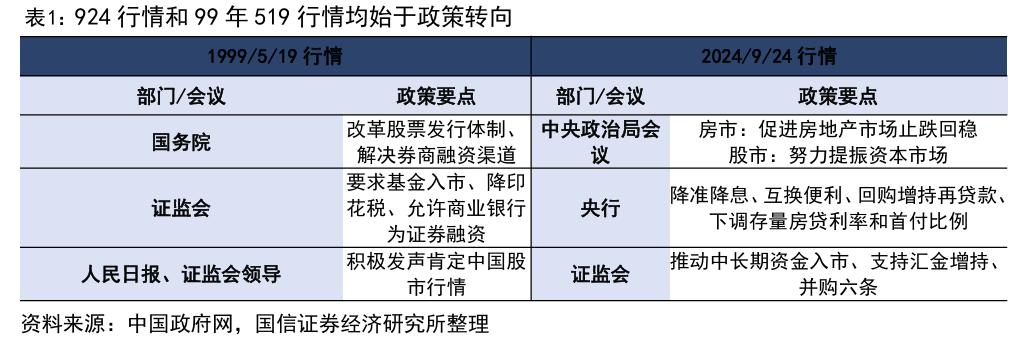
Core Viewpoint - The 26-year bull market is characterized by continued policy easing, an incomplete bull market cycle, and a shift in the market's fundamental recovery and structural dynamics [1][2][20]. Group 1: Unchanging Factors - The policy environment remains accommodative, similar to the 1999 bull market, with a focus on combating deflation through various monetary and fiscal measures [3][4][8]. - Historical patterns of bull and bear market cycles suggest that the current bull market is not yet at its peak, as market sentiment has not reached extreme levels [12][13]. Group 2: Changing Factors - The fundamental recovery is expected to expand from specific sectors to a broader market, supported by increased retail investor participation as the bull market progresses into its later stages [21][22][25]. - The technology sector is anticipated to shift from infrastructure development to application expansion, with traditional assets like liquor and real estate potentially facing revaluation opportunities [42][43].

2026年中国股市十大预言
Xin Lang Cai Jing· 2026-01-03 01:17
Core Viewpoint - The Chinese stock market is undergoing structural adjustments and ecological optimization, with a consensus on improving asset quality, market credibility, and fair competition significantly increasing, leading to greater public confidence in increasing holdings of Chinese assets [2][17]. Group 1: Stock Market Predictions - The Shanghai Composite Index is expected to break through 5200 points, supported by stable long-term capital inflow and improved asset quality, with a current P/E ratio of around 17, indicating further upside potential [3][18]. - Quantitative trading will face significant restrictions, with new regulatory rules likely to limit its scope based on market capitalization and turnover rates, and measures will be taken to combat price manipulation and insider trading [4][18]. - The IPO scale is set for moderate expansion, with a focus on supply-demand balance, expecting 100 new listings in 2024 raising 67.55 billion yuan and 116 listings in 2025 raising 131.77 billion yuan, with a notable increase in high-tech companies [5][19][20]. Group 2: Semiconductor and Military Industry - The semiconductor industry is anticipated to experience significant growth, with investments potentially exceeding 500 billion yuan, driven by capital input, industry expansion, and technological breakthroughs, especially in the context of the "AI+ year" [6][20]. - Military concept stocks are expected to see a phase of growth, with China's defense spending remaining around 1.3% of GDP, which is lower than that of major powers, and a moderate increase in the defense budget is anticipated due to geopolitical changes [9][22]. Group 3: Economic and Trade Dynamics - The Sino-US trade relationship is entering a "dual balance" phase, with both governmental and commercial levels maintaining stability in general trade while facing instability in sectors like semiconductors and renewable energy [10][23]. - New consumer scenarios are emerging as investment opportunities, driven by policy support and the rise of the post-2000 consumer demographic, leading to significant growth in technology, digital, cultural tourism, and health-related consumption [11][23]. Group 4: Inflation and Real Estate Market - CPI growth is expected to exceed 1.5%, approaching 2%, with an overall economic growth target of around 5%, supported by fiscal investments and structural optimization of trade [13][25]. - The real estate market is at a turning point, with policies aimed at stabilizing the market and reducing purchasing costs, while also addressing the debt risks of real estate companies [14][26]. Group 5: Regulatory Environment - The capital market will see new measures and initiatives, with a focus on enhancing governance, optimizing the environment, combating illegal activities, and protecting investors, reflecting a commitment to high-quality economic and financial development [15][14].
花样年控股(01777)与Splendid Fortune订立重组协议,拟452.84万美元出售4.09亿股彩生活股份
智通财经网· 2026-01-02 15:22
TFISF拨用代价(即出售销售股份所得款项);将TFISF股份(占于本公告日期彩生活已发行股份约10.0%)转 让予TFISF指定实体作为对据称担保的有效执行;自据称债务扣除代价及协定股份价值,从而将应付予 TFISF的总债务减至净差额。 智通财经APP讯,花样年控股(01777)发布公告,本公司、TFISF与买方Splendid Fortune Enterprise Limited于2026年1月2日订立重组协议,据此,各订约方有条件同意就纠纷进行一系列平行交易,当中 涉及:买方以每股彩生活(本公司的附属公司)股份0.087港元的价格收购销售股份(4.09亿股彩生活股份, 占于本公告日期彩生活已发行股份约21.97%)。 本公司保留本公司股份(占于本公告日期彩生活已发行股份约9.98%),该等股份不受据称担保或任何其 他申索所限,并已获悉数解除及免除;及(在最后截止日期当日或的前达成或豁免完成重组条件为前提下) 由本公司一间附属公司Sky Ease以对本公司及本集团其他成员公司(股份质押(即与现有担保相同)项下的 质押人及股份将受股份质押所限的公司除外)无追索权为基准进行债务更替及承担相关所产生的新债 务。 ...
求是重磅发声!改善稳定楼市预期,释放三大核心信号
Xin Lang Cai Jing· 2026-01-02 14:20
Core Insights - The article emphasizes the need for a comprehensive approach to stabilize and improve expectations in the real estate market, highlighting the importance of top-level design in ensuring a healthy development trajectory for the sector [1][3]. Group 1: Policy Signals - The first core signal indicates that policies should be implemented in a decisive manner, moving away from incremental approaches to avoid endless market-policy conflicts. This reflects a strong commitment to stabilize the market [5]. - The article suggests that future policies will be more systematic and coherent, ensuring that new and existing policies work together effectively to restore market confidence [5]. - It also highlights the importance of aligning real estate policies with broader macroeconomic strategies to prevent fragmentation [5]. Group 2: Development Model Transformation - The second core signal points to a fundamental shift in the real estate development model from "development and sales" to an integrated approach of "product-service-operation," marking the end of the previous growth cycle focused on scale [7]. - This transformation will change the competitive landscape, with a focus on product quality, operational capabilities, and service excellence rather than land acquisition and financial leverage [7]. - The article notes that policies will encourage real estate companies to hold properties and provide high-quality living services, aligning supply with evolving consumer demands [7]. Group 3: Demand Potential - The third core signal identifies two main areas for demand growth: the housing needs of new urban residents and the renovation of existing housing stock, countering the notion of dwindling demand in the real estate sector [8]. - It provides data indicating that a significant portion of urban households have inadequate living space, suggesting substantial room for improvement in housing quality [8]. - The article estimates that approximately 700 million square meters of housing will require updates annually due to depreciation, indicating a robust market for renovation and improvement [8]. Group 4: Market Outlook - The insights from the article not only clarify the short-term policy path for stabilizing the market but also establish a long-term framework for transformation, guiding various stakeholders in the real estate sector [9]. - The article suggests that while the "era of high profits" in real estate may be over, the sector still holds value as a stable income asset, particularly in areas like urban renewal and housing rentals [9]. - It concludes that the real estate industry will continue to play a crucial role in supporting the national economy and improving living standards, despite potential short-term fluctuations during the transition [10].

断供房已超过200万套?内行人建议:取消房贷,预防压力过大
Sou Hu Cai Jing· 2026-01-02 10:37
Core Insights - The real estate market is experiencing a significant downturn, with a sharp increase in foreclosures and a drastic decline in property values, leading to financial distress for many homeowners [1][2][4][10] Group 1: Market Trends - In the first half of 2025, over 300,000 new mortgage defaults were reported, a 40% increase compared to the same period in 2024, with total foreclosed properties exceeding 2 million [1] - The number of foreclosed properties has surged by 180 times since 2020, with cities like Zhengzhou and Wuhan seeing property prices drop back to 2018 levels, with some areas experiencing declines of over 40% [1] - Nationally, the number of mortgage defaults reached 837,000 in June 2025, marking a 17.2% year-on-year increase and the fourth consecutive year of growth [2] Group 2: Financial Impact on Households - Homeowners are facing severe financial strain, with many properties now valued below the outstanding mortgage balance, leading to a phenomenon of "negative equity" [4][5] - The unemployment rate for the primary working age group (25-59 years) reached 5.3%, while youth unemployment (16-24 years) soared to 18.2%, exacerbating the ability to meet mortgage payments [4] - Over 42% of households reported a decline in income, with 15.3% experiencing a drop of more than 30% [4] Group 3: Banking Sector Response - Banks are adapting to the crisis by offering more flexible repayment options to borrowers, including proposals to allow reduced monthly payments to retain homes [5] - The banking sector is facing increasing non-performing loans as more homeowners opt for default, leading to a potential financial crisis if the trend continues [5][10] Group 4: Changing Attitudes Towards Homeownership - A shift in perception is occurring, with younger generations valuing flexibility and experiences over homeownership, as the financial burden of mortgages becomes more apparent [8][12] - The concept of homeownership as a guaranteed investment is being challenged, with many now viewing it as a liability rather than an asset [10][12] Group 5: Recommendations for Homeowners - Homeowners are advised to assess their financial situations carefully, considering options such as negotiating with banks for payment adjustments or selling properties to mitigate losses [9] - It is crucial to avoid taking on additional debt in the current market, as the risk of further declines in property values remains high [9][10]