
债券

Search documents
STARTRADER:亚市跟随美联储节奏 原油供过于求迫在眉睫 油价挣扎
Sou Hu Cai Jing· 2025-09-04 10:54
Group 1 - Asian stock markets are buoyant following weak U.S. employment data, with expectations of an interest rate cut by the Federal Reserve [1] - The MSCI Asia Index rises, led by Japan, while the S&P 500 and Nasdaq futures also show slight increases due to anticipated Fed actions [1] - Chinese stock markets, however, experience a decline of over 2% due to concerns over a $1.2 trillion margin financing event, prompting potential tightening of monetary policy [1] Group 2 - The bond market remains favorable as traders expect two more interest rate cuts from the Federal Reserve by the end of the year [3] - Global bond yields decline in response to falling U.S. Treasury yields, with non-farm payroll data being a critical indicator for future monetary policy [3] - Gold prices have seen a drop after seven consecutive days of increases, although long-term trends indicate structural support from central banks [3] Group 3 - Brent crude oil prices fall to $67 per barrel, while West Texas Intermediate drops below $64, with discussions of "oversupply" rather than "scarcity" emerging [5] - OPEC+ considers increasing production, which seems counterintuitive given the current market conditions, as supply growth outpaces demand absorption [5] - Geopolitical factors, including U.S. sanctions on Russian oil, complicate the oil market, with traders noting that oil continues to flow to China and India despite sanctions [6] Group 4 - The market shows a divergence: stock markets are buoyed by Fed's accommodative policies, gold receives support from central banks, while oil struggles under supply surplus pressures [6] - Liquidity remains a dominant force in the market, but its distribution is uneven across different asset classes [6]


化债进行时系列:城投化债:两年战果复盘、28年展望
ZHESHANG SECURITIES· 2025-09-04 08:02
1. Report Industry Investment Rating The provided content does not mention the report industry investment rating. 2. Core Viewpoints of the Report - After two years of debt reduction, significant achievements have been made. Local debts are accelerating towards the on - balance - sheet, with fiscal policy taking over from urban investment in 2025. Urban investment focuses on exiting platforms, stabilizing leverage, adjusting structure, and reducing costs to further mitigate risks. After 2028, urban investment bonds are likely to continue to be redeemed at par. Currently, the spread of urban investment bonds is at a low level, and the cost - effectiveness of undifferentiated sinking is not high. It is recommended to select allocation directions based on risk indicators [1]. 3. Summary by Relevant Catalogs 3.1 How Has the Overall Pattern of Local Debt Changed After Two Years of Debt Reduction? - The "front door" is opened wide and the "back door" is blocked, with local debts accelerating towards the on - balance - sheet. Since 2019, the issuance of local government bonds has accelerated, with an annual growth rate of over 15%. The growth rate of urban investment debt has shown a fluctuating downward trend in the past decade, reaching a record low of 3.8% in 2024. By the end of 2024, the proportion of on - balance - sheet government debt had risen to 43.72% [2][15]. - In 2024, the expansion of urban investment slowed down, and in 2025, fiscal policy took over from urban investment. In 2020, the incremental local debt (urban investment + local special bonds) was 10.63 trillion yuan, but the combined increment has not exceeded 10 trillion yuan since then. In 2025, the fiscal deficit increased by 1.6 trillion yuan compared to the previous year. The incremental debt of local governments and urban investment platforms is expected to approach 10 trillion yuan, and the proportion of on - balance - sheet government debt may exceed 45% by the end of the year [3][16]. 3.2 How to View the Urban Investment Risks After 2028? - Risk prevention has become more extensive, evolving from preventing defaults of urban investment bonds to preventing risks of state - owned enterprises. Urban investment is likely to become a state - owned enterprise under the supervision of local state - owned assets supervision and administration commissions, and is unlikely to default on its bonds [20][21]. - From the perspective of assets and liabilities, it is still difficult to completely separate urban investment from local governments. Urban investment still holds a large amount of public - welfare or quasi - public - welfare assets, and the relationship between them remains close [21]. - From the perspective of liquidity, the probability of risk is reduced. After the clearance of hidden debts and the exit from platforms, banks and insurance may open up financing channels for urban investment, and the actual risk may decline [22]. 3.3 What Are the Differences in Urban Investment Financing Among Provinces? 3.3.1 Overall Tightening, with Slight Differences Between Key and Non - key Provinces - The primary issuance review has not been relaxed, and it is difficult for urban investment to increase new financing. Since March 2025, the net financing of urban investment bonds has turned negative. Key provinces have a more significant net outflow, while some non - key provinces such as Shandong and Guangdong still have new increases [23]. 3.3.2 The Proportion of Bank Loans Has Increased, and Some Provinces Are Seeking Increases in Non - standard Financing - As of the end of March 2025, the proportion of bank loans has increased in 18 provinces, with 8 provinces including Ningxia and Hainan having an increase of over 3 percentage points. In non - key provinces, Anhui and Henan have an increase in the proportion of non - standard financing of over 1 percentage point [25]. 3.4 Which Regions Are Facing Increasing Debt Risks? 3.4.1 Macro - level: At the Minsky Moment, the Interest Coverage Ratios of 10 Provinces and Cities Are Less Than 1 - Due to the decline in land sales, although local interest payments have decreased, as of Q1 2025, the government fund revenues of 10 provinces and cities, including Yunnan and Guangxi, have an interest coverage ratio of less than 1 for full - scale debt interest [29][33]. 3.4.2 Micro - level: The Risks in Some Provinces Have Worsened - The debt risks in Henan, Jilin, Anhui, and Hubei have increased compared to before debt reduction. Shandong's overall risk still deserves attention [29]. - In terms of the proportion of risk urban investment platforms, 20 provinces have improved their debt risks, 7 have remained unchanged, and 4 have increased their risks [30]. 3.5 Which Regions Have Achieved Remarkable Results in Debt Reduction? 3.5.1 Debt Reduction Progress - The progress of hidden debt resolution has exceeded half. Jilin, Jiangsu, Shaanxi, Inner Mongolia, and Xinjiang have at least over 10 cities or districts announcing the full clearance of hidden debts [47]. 3.5.2 Stock Bond Scale - As of August 28, 2025, the stock of urban investment bonds was 15.14 trillion yuan, a decrease of 84.321 billion yuan compared to the beginning of the year. Jiangsu, Hunan, Tianjin, and Guizhou have the largest reduction in the stock of urban investment bonds [53]. 3.5.3 Interest Payments - The interest payments of urban investment bonds in some economically strong provinces and provinces receiving more debt reduction support have decreased significantly. Jiangsu, Zhejiang, Tianjin, Hunan, and Shandong have a large decline in interest payments [56]. 3.6 How to View Urban Investment Bonds from the Perspective of Risk Premium? - By constructing a short - term risk indicator (proportion of risk urban investment platforms) and a medium - long - term risk indicator (risk qualification evaluation score), provinces are classified as follows: - Both indicators cross the line (proportion of risk platforms > 20%, risk qualification evaluation score < 40): Guangxi, Tianjin, Gansu, Inner Mongolia, Henan, Jilin, Yunnan, Qinghai, Guizhou. Caution is needed for these regions [59]. - One of the two indicators crosses the line: Shandong, Tibet, Ningxia, Jiangxi, Chongqing, Shaanxi. It is recommended to adopt sinking + duration control when exploring returns in these 6 provinces [59][61]. - Neither indicator crosses the line: Shanghai, Beijing, Shanxi, Hainan, Guangdong, Zhejiang, Fujian, Hebei, Jiangsu, Xinjiang, Anhui, Heilongjiang, Hubei, Hunan, Sichuan, Liaoning. The overall risk in these regions is relatively low, but the spread is generally less than 50bp, with limited room for exploration [61].
大类资产早报-20250904
Yong An Qi Huo· 2025-09-04 07:55
Report Date - The report is dated September 4, 2025 [1] Global Asset Market Performance Bond Yields - On September 3, 2025, the 10 - year bond yields of major economies varied, with the US at 4.218, UK at 4.747, etc. The latest changes, weekly, monthly, and yearly changes also differed across countries. For example, the US 10 - year bond yield had a latest change of - 0.044, a weekly change of - 0.017, a monthly change of - 0.011, and a yearly change of 0.401 [2] - The 2 - year bond yields of some major economies also showed different values and changes on September 3, 2025. For instance, the UK 2 - year bond yield was 3.956, with a latest change of - 0.021, a weekly change of - 0.003, a monthly change of 0.140 [2] Exchange Rates - The exchange rates of the US dollar against major emerging - economy currencies had various changes. For example, against the Brazilian real, the exchange rate on September 3, 2025, was 5.451, with a latest change of - 0.26%, a weekly change of 0.61%, a monthly change of - 0.23%, and a yearly change of - 0.80% [2] - The on - shore and off - shore RMB, RMB mid - price, and 12 - month NDF also had their own changes in rates [2] Stock Indices - Stock indices of major economies had different closing prices and changes on September 3, 2025. The S&P 500 closed at 6448.260, with a latest change of 0.51%, a weekly change of - 0.51%, a monthly change of 1.63%, and a yearly change of 14.80% [2] Credit Bond Indices - Credit bond indices of different regions and types (investment - grade and high - yield) had different changes in the latest, weekly, monthly, and yearly periods. For example, the US investment - grade credit bond index had a latest change of 0.44%, a weekly change of 0.06%, a monthly change of 0.33%, and a yearly change of 3.50% [2][3] Futures Trading Data Stock Index Futures - For A - shares, the closing price was 3813.56 with a decline of 1.16%. The closing prices, changes, valuations, risk premiums, fund flows, trading volumes, and basis spreads of other indices like the CSI 300, SSE 50, ChiNext, and CSI 500 were also presented [4] Treasury Bond Futures - Treasury bond futures T00, TF00, T01, and TF01 had closing prices of 108.290, 105.790, 108.160, and 105.725 respectively, with corresponding changes in percentages [5] Money Market - The capital interest rates of R001, R007, and SHIBOR - 3M were 1.3543%, 1.4644%, and 1.5500% respectively, with daily changes in basis points [5]
中证转债指数收跌0.19%,214只可转债收涨
2 1 Shi Ji Jing Ji Bao Dao· 2025-09-04 07:36
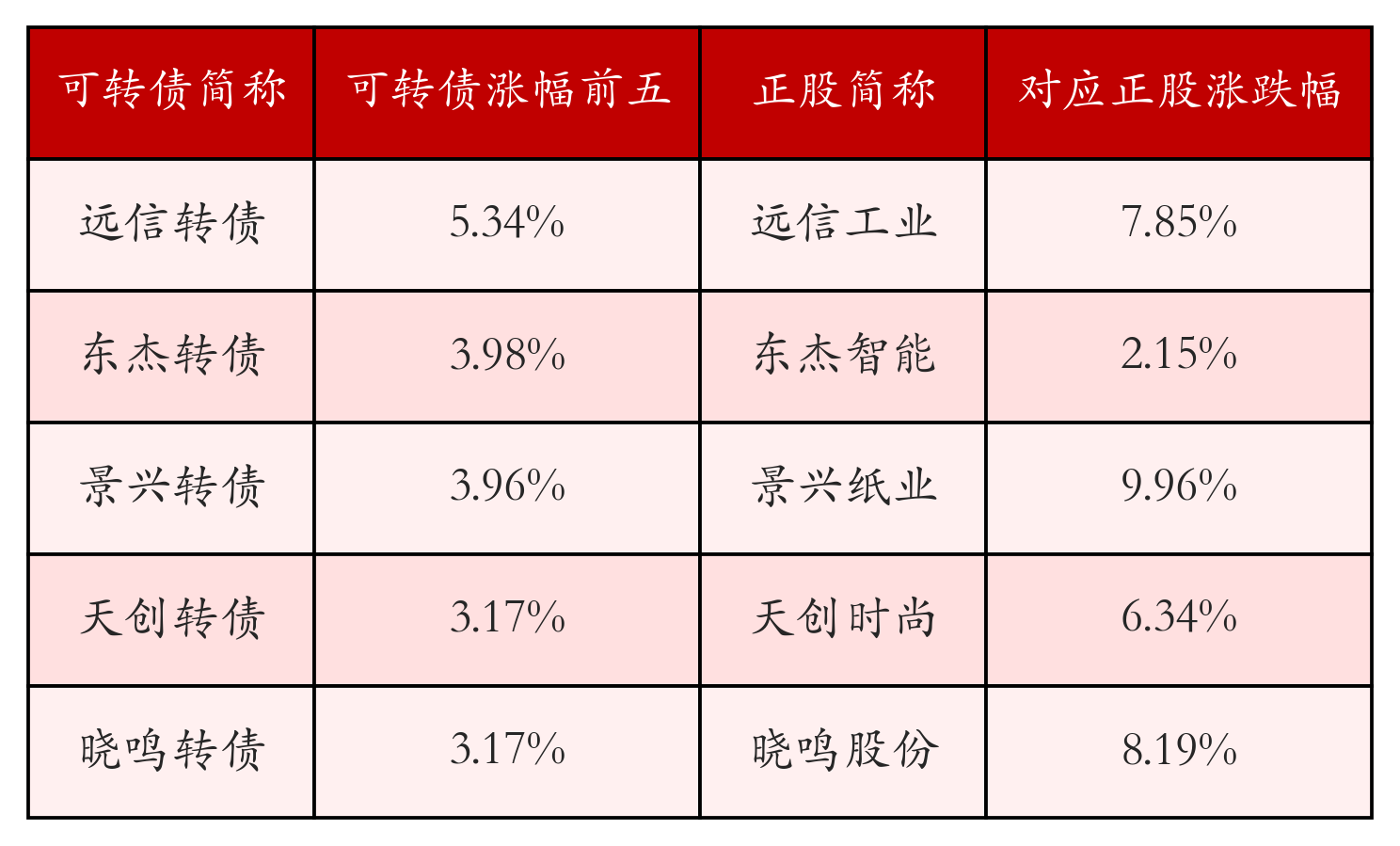
Core Viewpoint - The convertible bond market experienced a slight decline, with the China Convertible Bond Index dropping by 0.19% to 468.84, and a total trading volume of 809.27 billion yuan [1]. Summary by Category Convertible Bonds Performance - A total of 434 convertible bonds were traded, with 214 increasing in value, 0 remaining flat, and 220 decreasing [1]. - Notable gainers included: - Yuanxin Convertible Bond (123246) up by 5.34% - Dongjie Convertible Bond (123162) up by 3.98% - Jingxing Convertible Bond (128130) up by 3.96% [2]. - Significant losers included: - Lushan Convertible Bond (113668) down by 11.22% - Weidao Convertible Bond (118058) down by 9.65% - Zhenhua Convertible Bond (113687) down by 8.56% [2]. Corresponding Stocks Performance - Among the stocks corresponding to the traded convertible bonds, 192 increased, 13 remained flat, and 229 decreased [1]. - Stocks with notable increases included: - Jingxing Paper (002067) hitting the daily limit, up by 9.96%, corresponding to Jingxing Convertible Bond (128130) which rose by 3.96% [1]. - Stocks with significant declines included: - Liyang Chip down by 10.76% - Songsheng Co. down by 9.10% - Zhongtian Rocket down by 9.03% [5].
政府债周报:特殊新增专项债已发行1.1万亿-20250904
Guoxin Securities· 2025-09-04 05:51
1. Report Industry Investment Rating No relevant content provided. 2. Core View No specific core view is clearly presented in the given text other than the title "Core View Economic Research·Macro Weekly" [4]. 3. Summary by Related Catalogs Government Bond Net Financing - Government bond net financing was 6.4 billion yuan in the 35th week (8/25 - 8/31) and 206.5 billion yuan in the 36th week (9/1 - 9/7). As of the 35th week, the cumulative net financing reached 10.3 trillion yuan, exceeding the same period last year by 4.5 trillion yuan [1][6]. Treasury Bond Net Financing - Treasury bond net financing was -237.1 billion yuan in the 35th week (8/25 - 8/31) and 169.8 billion yuan in the 36th week (9/1 - 9/7). As of the 35th week, the cumulative net financing was 4.7 trillion yuan, with a progress of 70.1%, exceeding the average of the past five years [7]. Local Bond Net Financing - Local bond net financing was 243.5 billion yuan in the 35th week (8/25 - 8/31) and 36.7 billion yuan in the 36th week (9/1 - 9/7). As of the 35th week, the cumulative net financing was 5.7 trillion yuan, exceeding the same period last year by 2.8 trillion yuan [9]. New General Bond - New general bond issuance was 35.3 billion yuan in the 35th week (8/25 - 8/31) and 0 yuan in the 36th week (9/1 - 9/7). As of the 35th week, the cumulative issuance was 620.8 billion yuan, with a progress of 77.6%, exceeding the same period last year [9]. New Special Bond - New special bond issuance was 188 billion yuan in the 35th week (8/25 - 8/31) and 17.8 billion yuan in the 36th week (9/1 - 9/7). As of the 35th week, the cumulative issuance was 3.3 trillion yuan, with a progress of 74.2%, exceeding the same period last year. Special new special bonds issued reached 1.0669 trillion yuan, including 99 billion yuan since September. Land reserve special bonds issued were 324 billion yuan [2][13]. Special Refinancing Bond - Special refinancing bond issuance was 29.1 billion yuan in the 35th week (8/25 - 8/31) and 0 yuan in the 36th week (9/1 - 9/7). As of the 35th week, the cumulative issuance was 1.9 trillion yuan, with a progress of 97% [2][27]. Urban Investment Bond - Urban investment bond net financing was -20.9 billion yuan in the 35th week (8/25 - 8/31) and is expected to be -47.7 billion yuan in the 36th week (9/1 - 9/7). As of this week, the balance of urban investment bonds was 10.1 trillion yuan [2][30].
全球债市 “风暴眼”:收益率飙升,危机警钟敲响?
Sou Hu Cai Jing· 2025-09-04 05:41
Core Viewpoint - The global bond market is experiencing unprecedented turmoil, with rising yields in major economies like the US, Japan, Germany, and the UK, raising concerns about future economic stability and potential crises [2][3][11] Group 1: Market Dynamics - Long-term bond yields have surged, with the US 30-year Treasury yield surpassing 5%, reaching levels not seen since 2006, while the UK and Germany also hit historical highs [3][4] - The inverse relationship between bond prices and yields indicates that rising yields lead to significant declines in bond prices, resulting in substantial asset value losses for investors [4][9] - The volatility in bond yields is causing ripple effects across the financial ecosystem, impacting stock, foreign exchange, and commodity markets, thereby threatening overall market stability [4][9] Group 2: Economic Factors - Government debt levels are rising, with the US federal deficit projected at $1.7 trillion, necessitating increased bond issuance to fund operations, amidst persistent inflation concerns [5][9] - High inflation is eroding the real yields of bonds, leading investors to reduce their holdings in favor of assets with better inflation protection, thus increasing bond supply and pushing yields higher [5][9] Group 3: Political Uncertainty - Political events, such as the potential no-confidence vote in France regarding debt reduction plans, are exacerbating market volatility and investor anxiety, leading to increased bond yields [6][9] - In the UK, economic challenges coupled with political instability are putting pressure on the bond market, with rising yields reflecting investor concerns over fiscal health [6][9] Group 4: Market Structure Changes - Central banks and pension funds, traditionally major buyers of long-term bonds, are reducing their participation, leading to decreased demand and increased volatility in the bond market [7][8] - The shift from defined benefit to defined contribution pension plans is reducing the stable demand for long-term bonds, further destabilizing the market [7][8] Group 5: Negative Feedback Loop - The rising yields are creating a vicious cycle where increased borrowing costs worsen fiscal conditions for governments, leading to more bond issuance and further supply concerns [9][11] - This cycle threatens to undermine financial market stability and economic growth, as higher yields increase corporate financing costs and consumer loan rates, dampening investment and consumption [9][11]

2025年8月境外人民币市场综述
Sou Hu Cai Jing· 2025-09-04 03:00
Core Insights - The offshore (CNH) and onshore (CNY) RMB appreciated against the USD in August, with the average daily price difference increasing by 18 basis points (BP) to 80 BP compared to the previous month [1][3] - The CFETS RMB exchange rate index and indices referencing the BIS and SDR currency baskets decreased by 0.20%, 0.13%, and 0.28% respectively from the end of the previous month [1][3] Offshore RMB Foreign Exchange Market - On August 29, the CNH/USD exchange rate closed at 7.1221, appreciating by 1.23% from the end of the previous month, while the CNY/USD exchange rate closed at 7.1330, appreciating by 0.84% [3] - The average daily swap point difference between CNH and CNY increased by 24 BP to 89 BP [4] Offshore RMB Bond Market - In August, 110 offshore RMB bonds were issued, with a total issuance amount of 1640.87 billion, representing an increase of 178.2% from the previous month [5] Offshore RMB Money Market - As of the end of August, the CNH HIBOR rates for overnight, 7-day, 3-month, and 1-year periods rose by 51 BP, 29 BP, 2 BP, and 10 BP respectively compared to the end of the previous month [6] - The average interest rate spread between offshore and onshore borrowing rates remained stable for overnight and 7-day periods, while the 3-month and 1-year periods saw an increase of 1 BP [6] Dynamics of Foreign Institutions in Domestic Interbank Market - As of the end of August, the total number of foreign institutions participating in the domestic interbank foreign exchange market reached 236, an increase of 3 from the previous month [7] - The number of foreign institutions and their products in the domestic interbank currency market increased by 15 to a total of 5755 [7] Trading Volume in Domestic Interbank Market - In August, the total trading volume of foreign institutions in the domestic interbank foreign exchange market was 37336.51 billion, a decrease of 6.9% [8] - The trading volume in the domestic interbank bond market for foreign institutions totaled 11573.91 billion, a decrease of 21.2% [8]

美银:看好欧洲高收益债、中国股市及黄金,建议减持美国科技股
Ge Long Hui A P P· 2025-09-04 02:02
Core Viewpoint - The report from Bank of America highlights significant divergence in asset performance this year, with gold leading precious metals, a resurgence in the Chinese stock market, and U.S. equities at high levels but nearing bubble warning signs [1] Investment Strategy - Bank of America recommends a "three increases and two decreases" risk-averse investment strategy, suggesting investors increase holdings in European high-yield bonds and emerging market sovereign debt, which are expected to benefit from a shift towards looser monetary policy [1] - The report expresses optimism about the Chinese stock market, citing attractive valuations and a gradual inflow of capital [1] - Gold is identified as a key asset for hedging against geopolitical risks and potential depreciation of the U.S. dollar [1] Asset Recommendations - The report advises reducing exposure to U.S. technology stocks, particularly the "big tech" companies, due to their high valuations and associated risks [1] - Additionally, the outlook for the oil market is negative, with the report indicating that the supply-demand imbalance is unlikely to improve in the short term [1]
债市进攻锋利的矛,国债ETF5至10年(511020)成交额超14亿元
Sou Hu Cai Jing· 2025-09-04 01:32
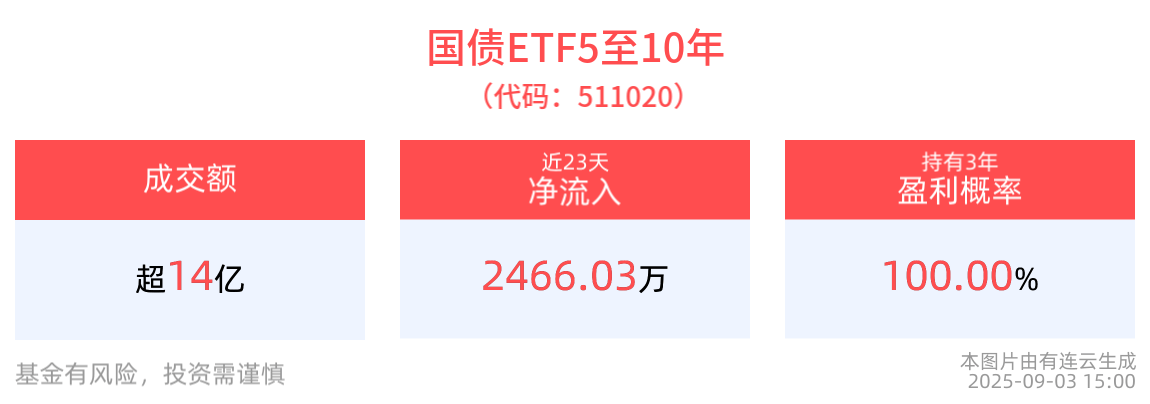
Group 1 - The article discusses the investment strategies regarding government bonds, highlighting that the 10-year government bond 250016 has slightly higher value compared to others, but its cost-effectiveness is relatively average against the National Development and Reform Commission bonds and 30-year government bonds [3] - For the 30-year government bonds, the 25T6 is currently about 4 basis points higher than 25T5 and 8 basis points higher than 25T2, with an expected outstanding scale of 3100-3200 billion yuan, indicating a potential to become the next main bond [3] - The liquidity of 25T6 is gradually improving, and it is anticipated that after the issuance on Friday, it may become the main bond next week, with a potential to continue compressing yield spreads [3] Group 2 - As of September 3, 2025, the active bond index for 5-10 year government bonds (H21018) increased by 0.10%, while the government bond ETF for the same duration rose by 0.12%, with the latest price at 116.99 yuan [4] - Over the past year, the government bond ETF for 5-10 years has accumulated a rise of 3.55% [4] - The trading activity for the government bond ETF was robust, with a turnover rate of 97.8% and a transaction volume of 1.443 billion yuan, indicating active market participation [4] Group 3 - The government bond ETF for 5-10 years has a current scale of 1.477 billion yuan, with a net value increase of 21.65% over the past five years [4] - The fund has shown a maximum monthly return of 2.58% since inception, with a historical profitability rate of 100% over three years [4] - The management fee for the government bond ETF is 0.15%, and the custody fee is 0.05%, with a tracking error of 0.029% over the past month [4][5]
宝城期货资讯早班车-20250904
Bao Cheng Qi Huo· 2025-09-04 01:30
1. Report Industry Investment Rating No relevant content provided. 2. Core Views of the Report - The economy shows mixed trends with some indicators improving and others weakening. Gold prices reach new highs, while oil prices decline due to potential supply increases. The bond market has complex dynamics, and the stock market is segmented. [1][4][9] - The paper industry's prices are rising due to raw material cost increases, and the coal - coking - steel - mining market is expected to have a positive trend in September. [2][7] 3. Summary by Relevant Catalogs Macro Data - GDP in Q2 2025 had a year - on - year growth of 5.2%, slightly lower than the previous quarter's 5.4% but higher than the same period last year's 4.7%. [1] - In August 2025, the manufacturing PMI was 49.4%, up from 49.3% in the previous month and 49.1% last year. The non - manufacturing PMI was 50.3%, up from 50.1% in the previous month and the same as last year. [1] - In July 2025, social financing scale increment was 11320 billion yuan, down from 42251 billion yuan in the previous month but higher than 7707 billion yuan last year. [1] - In July 2025, M0, M1, and M2 year - on - year growth rates were 11.8%, 5.6%, and 8.8% respectively. M1 and M2 growth accelerated compared to the previous month and last year, while M0 growth slowed slightly. [1] - In July 2025, CPI year - on - year was 0.0%, down from 0.1% in the previous month and 0.5% last year. PPI year - on - year was - 3.6%, the same as the previous month but lower than - 0.8% last year. [1] - In July 2025, fixed - asset investment (excluding rural households) cumulative year - on - year growth was 1.6%, down from 2.8% in the previous month and 3.6% last year. Social consumer goods retail cumulative year - on - year growth was 4.8%, down from 5.0% in the previous month but higher than 3.5% last year. [1] - In July 2025, export and import year - on - year growth were 7.2% and 4.1% respectively, both showing an upward trend compared to the previous month. [1] Commodity Investment Comprehensive - From September 5, 2025, the Shanghai Gold Exchange will adjust the margin levels and price limit ranges for multiple gold and silver contracts. [2] - The London Metal Exchange postponed its Asian opening on a Wednesday by 90 minutes without stating a reason. [2] - Major paper mills announced price increases in early September due to rising raw material costs, and the industry's supply - demand situation is expected to improve in the second half of the year. [2] - China imposed anti - dumping duties on certain optical fibers imported from the US, with different tax rates for different companies. [3] - China's August S&P Global services PMI was 53, and the composite PMI was 51.9, both higher than the previous month. [3] Metals - Gold prices reached new highs on September 3, 2025, with London Gold Spot and COMEX Gold hitting record levels, and domestic gold prices also rising. [4] - The World Gold Council is seeking to introduce digital gold, which may transform the London gold market. [5] - Nickel and tin inventories increased on September 2, 2025, while lead and zinc inventories decreased. [6] - Citi adjusted its price forecasts for silver, aluminum, and copper, expressing optimism about copper prices. [6] Coal - Coking - Steel - Mining - Since July 2025, steel prices have recovered, and upstream coking coal and coke prices have risen significantly. The steel market in September may see an upward trend. [7] - Shaanxi has made achievements in mineral exploration during the "14th Five - Year Plan" period, exceeding the national targets. [8] - The EU is working on new steel and aluminum safeguard measures after 2026. [8] Energy and Chemicals - On September 3, 2025, international oil prices declined due to potential OPEC+ production increases, an unexpected increase in US API crude inventories, and reduced geopolitical concerns. [9] - OPEC's August oil production increased by 400,000 barrels per day. [10] - Russia's September oil exports from western ports are expected to decline by 6% compared to August. [10] - Colombia's July oil production decreased by 4.8% year - on - year. [10] - Citi slightly lowered its 2026 Brent crude oil price forecast. [10] Agricultural Products - India's August soybean oil imports decreased by 28% month - on - month, while palm oil imports increased by 16%. [11] - Argentina's August agricultural product export revenue decreased by 25% year - on - year. [11] - Malaysia's August palm oil exports increased by 10.22% month - on - month. [12] Financial News Open Market - On September 3, 2025, the central bank conducted 229.1 billion yuan of 7 - day reverse repurchase operations, resulting in a net withdrawal of 150.8 billion yuan. [13] Key News - The joint working group of the Ministry of Finance and the central bank discussed issues related to the bond market and aims to promote its stable development. [14] - Since the implementation of the "science and technology board" policy in the bond market, the issuance of science and technology innovation bonds has accelerated, with a total issuance scale exceeding 1.02 trillion yuan since May. [14] - Tianjin's first private technology enterprise science and technology innovation bond was successfully issued. [14] - The China - SCO Digital Economy Cooperation Platform was inaugurated in Tianjin. [15] - 12 provinces have raised their minimum wage standards this year, and all 31 provinces' highest - grade monthly minimum wage standards exceed 2000 yuan. [16] - Shanghai's "Six Measures" for the property market have had a positive initial impact, and the market is expected to recover. [16] - In 2024, the total issuance of green and sustainable debt in Hong Kong reached 84.4 billion US dollars, and the HKMA is researching the application of tokenization technology in sustainable finance. [17] - The global long - term treasury bond sell - off intensifies, with yields rising in many countries. [17] - There were corporate events such as leadership changes, name changes, and bond redemptions in the corporate bond market. [18] - Some companies' credit ratings were confirmed or adjusted by international rating agencies. [18] Bond Market Review - The bond market was positive on September 3, 2025, with yields of major interest - rate bonds in the inter - bank market falling, and treasury bond futures rising. [19] - The currency market interest rates showed mixed trends, and some short - term Shibor rates reached new lows. [20] - The winning bid yields and multiples of some financial bonds and treasury bonds were announced. [21] - Repurchase fixed - rate and inter - bank repurchase fixed - rate showed different trends, and European and US bond yields generally declined. [22] Foreign Exchange Market - The on - shore RMB against the US dollar rose on September 3, 2025, while the RMB central parity rate was depreciated. The US dollar index declined, and most non - US currencies rose. [23] Research Report Highlights - Xingzheng Fixed Income believes that the yields and credit spreads of bank secondary and perpetual bonds are at relatively high levels since 2021, and the long - end US bond yields may rise. [24] - Huatai Fixed Income reports that "fixed income +" products have experienced large - scale redemptions, affecting the stock - bond relationship. [25] - Xingzheng Fixed Income also points out that the PMI in August shows some improvements, but the bond market may be affected by the equity market. [25] Stock Market - The A - share market was segmented on September 3, 2025, with the ChiNext Index rising, and the Shanghai Composite Index and Shenzhen Component Index falling. The market turnover decreased. [27] - The Hong Kong stock market declined, with financial and consumer sectors falling and pharmaceutical stocks rising. Southbound funds had a large - scale net inflow, and Alibaba was significantly added. [28] - Southbound funds' net inflow to the Hong Kong stock market reached a record high this year, and most Hong Kong - Stock Connect stocks' shareholdings increased. [28] - 41 brokerages have completed their September golden stock recommendations, and they are generally optimistic about the A - share market. [28] - Since August, institutions have actively investigated North Exchange listed companies. [29]