商贸零售

Search documents
债券日报:转债市场日度跟踪 20251225-20251225
Huachuang Securities· 2025-12-25 15:22
Report Industry Investment Rating No relevant content provided. Core Viewpoints - The convertible bond market generally rose today, with increased valuations, trading sentiment, and a shift towards small - cap value stocks [1]. - The central price of convertible bonds increased, and the proportion of high - price bonds rose [2]. - Most underlying stock industries rose, with different performance in different industries in the convertible bond market [3]. Summaries According to Relevant Catalogs Market Overview - Index performance: The CSI Convertible Bond Index rose 0.38% month - on - month, the Shanghai Composite Index rose 0.36%, the Shenzhen Component Index rose 0.66%, the ChiNext Index rose 0.49%, the SSE 50 Index rose 0.19%, and the CSI 1000 Index rose 0.79% [1]. - Market style: Small - cap value stocks were relatively dominant. Large - cap growth rose 0.40%, large - cap value fell 0.17%, mid - cap growth rose 1.05%, mid - cap value rose 0.91%, small - cap growth rose 0.97%, and small - cap value rose 1.07% [1]. - Fund performance: Trading sentiment in the convertible bond market increased. The trading volume of the convertible bond market was 71.204 billion yuan, a 11.42% month - on - month increase; the total trading volume of the Wind All - A was 1.748742 trillion yuan, a 4.29% month - on - month increase; the net out - flow of main funds in the Shanghai and Shenzhen stock markets was 4.444 billion yuan, and the yield of the 10 - year treasury bond decreased by 0.48bp to 1.83% [1]. Convertible Bond Price - The central price of convertible bonds increased. The weighted average closing price of all convertible bonds was 135.01 yuan, a 0.61% increase from yesterday. Among them, the closing price of equity - biased convertible bonds was 201.30 yuan, a 0.71% increase; the closing price of bond - biased convertible bonds was 119.74 yuan, a 0.37% increase; the closing price of balanced convertible bonds was 130.05 yuan, a 0.17% increase [2]. - The proportion of high - price bonds (above 130 yuan) increased to 60.89%, a 1.84pct increase from yesterday. The largest change in proportion was in the 110 - 120 (including 120) range, with a proportion of 7.61%, a 1.05pct decrease from yesterday. There were 0 bonds with a closing price below 100 yuan. The median price was 133.64 yuan, a 0.48% increase from yesterday [2]. Convertible Bond Valuation - Valuations increased. The fitted conversion premium rate for 100 - yuan par value was 32.51%, a 0.14pct increase from yesterday. The overall weighted par value was 99.53 yuan, a 0.86% increase from yesterday. The premium rate of equity - biased convertible bonds was 15.45%, a 0.27pct decrease; the premium rate of bond - biased convertible bonds was 84.79%, a 0.38pct decrease; the premium rate of balanced convertible bonds was 26.39%, a 0.10pct decrease [2]. Industry Performance - Underlying stock industries: 27 industries rose. The top three rising industries were commerce and retail (+3.66%), light industry manufacturing (+2.17%), and environmental protection (+2.06%); the top three falling industries were banking (-0.44%), electronics (-0.29%), and coal (-0.29%) [3]. - Convertible bond market: 23 industries rose. The top three rising industries were environmental protection (+4.16%), building materials (+2.40%), and building decoration (+1.65%); the top three falling industries were non - bank finance (-1.26%), national defense and military industry (-0.16%), and pharmaceutical biology (-0.15%) [3]. - Different indicators for different sectors: - Closing price: The large - cycle sector rose 1.53%, the manufacturing sector rose 0.49%, the technology sector rose 0.21%, the large - consumption sector rose 0.46%, and the large - finance sector fell 0.68% [3]. - Conversion premium rate: The large - cycle sector decreased 1.5pct, the manufacturing sector decreased 0.33pct, the technology sector decreased 0.96pct, the large - consumption sector decreased 1.8pct, and the large - finance sector decreased 0.86pct [3]. - Conversion value: The large - cycle sector rose 2.65%, the manufacturing sector rose 0.69%, the technology sector rose 0.99%, the large - consumption sector rose 1.19%, and the large - finance sector fell 0.47% [3]. - Pure bond premium rate: The large - cycle sector rose 2.1pct, the manufacturing sector rose 0.75pct, the technology sector rose 0.27pct, the large - consumption sector rose 0.56pct, and the large - finance sector fell 0.79pct [4]. Other Data - Main index performance: Different indices showed different price levels and growth rates, such as the CSI Convertible Bond Index closing at 493.46, with a daily increase of 0.63%, a one - week increase of 2.13%, a one - month increase of 1.96%, and a year - to - date increase of 19.03% [6]. - Style index performance: Small - cap indices generally had better performance than large - cap indices [9]. - Convertible bond valuation: The fitted premium rate for 100 - yuan par value was 33.71%, a 0.08pct increase; the valuation repair index was 3.29%, a 0.13pct decrease; the overall weighted average par value was 101.53, a 0.84% increase; the median price was 133.64, a 0.48% increase [16][17]. - Industry rotation: Industries such as national defense and military industry, light industry manufacturing, and mechanical equipment led the rise, with detailed data on stock price changes, valuation quantiles, etc. [54].
【25日资金路线图】国防军工板块净流入逾61亿元居首 龙虎榜机构抢筹多股
Zheng Quan Shi Bao· 2025-12-25 13:33
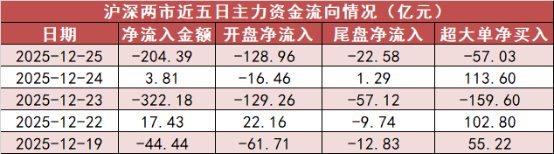
Market Overview - The A-share market experienced an overall increase on December 25, with the Shanghai Composite Index closing at 3959.62 points, up 0.47%, the Shenzhen Component Index at 13531.41 points, up 0.33%, and the ChiNext Index at 3239.34 points, up 0.3% [1] - The total trading volume in the A-share market reached 19440.6 billion yuan, an increase of 466.79 billion yuan compared to the previous trading day [1] Capital Flow - The main capital in the A-share market saw a net outflow of 204.39 billion yuan for the day, with an opening net outflow of 128.96 billion yuan and a closing net outflow of 22.58 billion yuan [2] - The CSI 300 index recorded a net outflow of 79.88 billion yuan, while the ChiNext saw a net outflow of 51.51 billion yuan and the STAR Market a net outflow of 16.01 billion yuan [4] Sector Performance - The defense and military industry led the sectors with a net inflow of 61.72 billion yuan, followed by machinery equipment with 60.79 billion yuan and the automotive sector with 39.51 billion yuan [6][7] - The electronic sector experienced the largest net outflow of 81.47 billion yuan, followed by retail with 50.64 billion yuan and telecommunications with 44.44 billion yuan [7] Individual Stocks - Goldwind Technology saw the highest net inflow of 8.29 billion yuan among individual stocks [8] - Institutions actively participated in several stocks, with Hainan Development showing a net institutional buy of 288.69 million yuan, while Tianji Co. had a net institutional sell of 21.35 million yuan [10][11]

兴业证券:哪些行业股价与人民币汇率相关性较强?
智通财经网· 2025-12-25 12:13
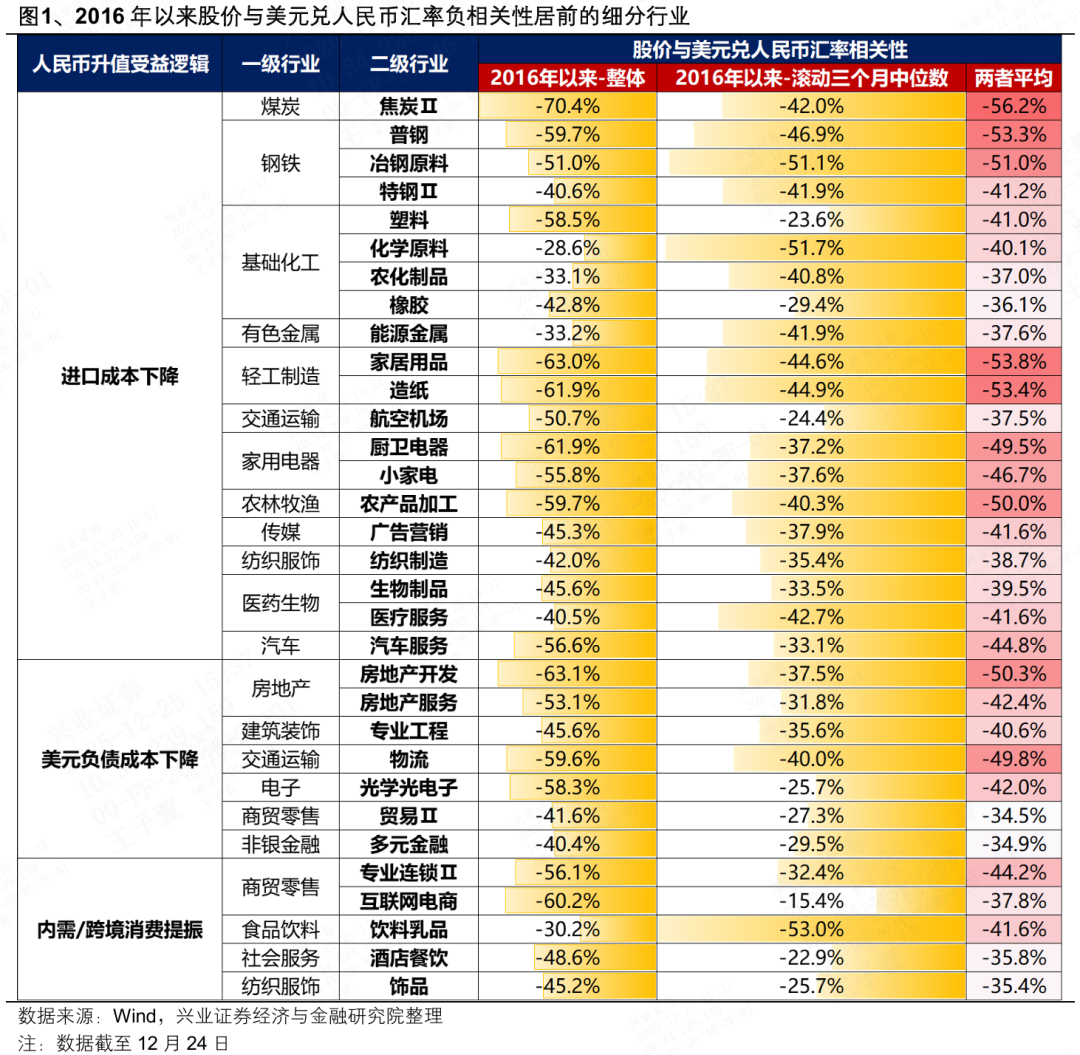
Core Viewpoint - The report from Industrial Securities highlights the negative correlation between stock prices and the USD/CNY exchange rate since 2016, indicating that a stronger RMB tends to drive stock prices higher across various sectors [1] Group 1: Industries Benefiting from RMB Appreciation - Industries with high reliance on imported raw materials benefit from RMB appreciation, leading to reduced import costs. Key sectors include coke, steel, certain chemicals (plastics, chemical raw materials, agricultural chemicals, rubber), energy metals, paper, airport operations, and agricultural product processing [1] - The construction and real estate sectors, which have high USD-denominated debt, see a decrease in financing costs due to RMB appreciation. This includes real estate development, real estate services, and specialized engineering [1] - The service and high-end consumption sectors, such as cross-border e-commerce, hotel and catering services, and jewelry, benefit from increased domestic demand and cross-border consumption driven by enhanced RMB purchasing power [1] Group 2: Correlation Data - The median negative correlation between stock prices and the USD/CNY exchange rate since 2016 shows significant figures for various sectors: - Coke: -70.4% overall, -42.0% rolling three months - Steel: -59.7% overall, -46.9% rolling three months - Basic chemicals: -58.5% overall, -23.6% rolling three months - Transportation (airports): -50.7% overall, -24.4% rolling three months - Real estate development: -63.1% overall, -37.5% rolling three months [2] Group 3: Impact on Financing Costs - Industries with high USD debt benefit from RMB appreciation, leading to lower financing costs. This includes logistics, optical electronics, trade, and diversified finance sectors [1] - Specific correlations include: - Logistics: -59.6% overall, -40.0% rolling three months - Optical electronics: -58.3% overall, -25.7% rolling three months - Trade: -41.6% overall, -27.3% rolling three months [2] Group 4: Domestic Demand and Cross-Border Consumption - The sectors benefiting from increased domestic demand and cross-border consumption include: - Food and beverage (dairy products): -30.2% overall, -53.0% rolling three months - Hospitality (hotels and restaurants): -48.6% overall, -22.9% rolling three months - Textiles (jewelry): -45.2% overall, -25.7% rolling three months [2]

数据复盘丨93股获主力资金净流入超1亿元 龙虎榜机构抢筹12股
Zheng Quan Shi Bao Wang· 2025-12-25 10:45
Market Performance - The Shanghai Composite Index closed at 3959.62 points, up 0.47%, with a trading volume of 785 billion yuan [1] - The Shenzhen Component Index closed at 13531.41 points, up 0.33%, with a trading volume of 1139.5 billion yuan [1] - The ChiNext Index closed at 3239.34 points, up 0.3%, with a trading volume of 532.66 billion yuan [1] - The STAR 50 Index closed at 1349.06 points, down 0.23%, with a trading volume of 44.8 billion yuan [1] - Total trading volume for both markets reached 1924.5 billion yuan, an increase of 44.26 billion yuan from the previous trading day [1] Sector Performance - Strong sectors included defense and military, light industry manufacturing, machinery equipment, insurance, automotive, textiles and apparel, computing, and food and beverage [3] - Active concepts included satellite internet, space stations, commercial aerospace, synchronous reluctance motors, humanoid robots, antibacterial fabrics, industrial mother machines, and PEEK materials [3] - Weak sectors included non-ferrous metals, precious metals, commercial retail, coal, and telecommunications [3] Fund Flow - The net outflow of main funds from the Shanghai and Shenzhen markets was 20.439 billion yuan [4] - The automotive sector saw the highest net inflow of main funds, amounting to 1.158 billion yuan [5] - Other sectors with significant net inflows included machinery equipment and food and beverage, with net inflows of 504 million yuan and 228 million yuan, respectively [5] - The electronics sector experienced the largest net outflow, totaling 5.068 billion yuan [5] Individual Stock Performance - A total of 1969 stocks saw net inflows, with 93 stocks receiving over 100 million yuan in net inflows [6] - Jin Feng Technology had the highest net inflow at 829 million yuan, followed by Yangguang Electric, Sanhua Intelligent Control, and others [7] - Conversely, 3196 stocks experienced net outflows, with 105 stocks seeing over 100 million yuan in net outflows [8] - Shenghong Technology had the largest net outflow at 1.651 billion yuan [9] Institutional Activity - Institutions had a net sell of approximately 108 million yuan, with 12 stocks seeing net purchases and 17 stocks net sold [10] - The stock with the highest net purchase by institutions was Hainan Development, with a net purchase amount of approximately 289 million yuan [10]
商贸零售行业12月25日资金流向日报
Zheng Quan Shi Bao Wang· 2025-12-25 09:10
Market Overview - The Shanghai Composite Index rose by 0.47% on December 25, with 25 out of the 28 sectors experiencing gains, led by defense and military industry (up 2.91%) and light industry manufacturing (up 1.59%) [1] - The sectors that saw declines included comprehensive and non-ferrous metals, down 1.12% and 0.77% respectively [1] Capital Flow - The main capital flow showed a net outflow of 18.129 billion yuan across the two markets, with 8 sectors experiencing net inflows [1] - The automotive sector led the net inflow with 2.747 billion yuan and a daily increase of 1.46%, followed by the machinery equipment sector with a net inflow of 1.862 billion yuan and a daily increase of 1.51% [1] Retail Sector Performance - The retail sector declined by 0.47% with a net outflow of 1.938 billion yuan, comprising 97 stocks, of which 49 rose and 44 fell [2] - Notable stocks with significant net inflows included Kuaijingtong (3.96 billion yuan), Hemei Group (1.28 billion yuan), and Yimin Group (1.24 billion yuan) [2] - Major stocks with net outflows exceeding 1 billion yuan included Dongbai Group (0.673 billion yuan), Yonghui Supermarket (0.555 billion yuan), and China Duty Free (0.473 billion yuan) [2] Notable Stocks in Retail Sector - The top stocks with significant capital outflow included: - Dongbai Group: -2.52% with a capital outflow of 672.60 million yuan - Yonghui Supermarket: -3.65% with a capital outflow of 554.62 million yuan - China Duty Free: -3.02% with a capital outflow of 473.47 million yuan [2][3]



量化观市:外资休整缩量博弈,聚焦政策主线
SINOLINK SECURITIES· 2025-12-24 15:22
- The report discusses a rotation model for micro-cap stocks, which uses the relative net value of micro-cap stocks to the "Mao Index" as a key indicator. If the relative net value is above its 243-day moving average, it suggests investing in micro-cap stocks; otherwise, it suggests investing in the Mao Index. Additionally, the 20-day closing price slope of both indices is used to determine the direction of rotation, favoring the index with a positive slope when the directions differ [19][24][26] - A timing indicator is constructed based on the 10-year government bond yield (threshold: 0.3) and the volatility congestion rate of micro-cap stocks (threshold: 0.55). If either indicator reaches its threshold, a closing signal is triggered to manage risk [19][24][20] - The report evaluates eight major stock selection factors across different stock pools (All A-shares, CSI 300, CSI 500, and CSI 1000). Among these, the value factor (20.46%), volatility factor (16.11%), and technical factor (13.68%) show strong IC mean performance, while the growth factor (-5.65%) and consensus expectation factor (-2.16%) perform relatively weakly [46][47][48] - The report highlights that defensive value factors and volume-price factors (volatility and technical) performed strongly in the past week, reflecting a shift in market style towards low-valuation defensive strategies amid a volatile environment. Growth and consensus expectation factors, which previously performed well, experienced a pullback [46][47][48] - For convertible bonds, the report constructs quantitative bond-picking factors, including equity-related factors and valuation factors such as parity and floor premium rates. Among these, equity consensus expectation, equity value, and convertible bond valuation factors achieved higher IC mean values in the past week [54][55][56]
【24日资金路线图】电子板块净流入202亿元居首 龙虎榜机构抢筹多股
证券时报· 2025-12-24 11:28
12月24日,A股市场整体上涨。 截 至 收 盘 , 上 证 指 数 收 报 3940.95 点 , 上 涨 0.53% , 深 证 成 指 收 报 13486.42 点 , 上 涨 0.88%,创业板指收报3229.58点,上涨0.77%,北证50指数上涨0.39%。A股市场合计成交 18973.81亿元,较上一交易日减少241.46亿元。 | | | 今日资金净流出前五大行业 | | | --- | --- | --- | --- | | 行业 | 涨跌幅 | 净流入资金 (亿元) | 资金流出较多个股 | | 商贸零售 | 0. 05% | -17.63 | 东百集团 | | 银行 | -0. 14% | -17. 27 | 江苏银行 | | 有色金属 | 1. 15% | -13.86 | 中钨高新 | | 食品饮料 | -0. 34% | -13.67 | 山西汾酒 | | 农林牧渔 | 0. 08% | -9.06 | 牧原股份 | 4.德明利主力资金净流入9.55亿元居首 1. A股市场全天主力资金净流入3.81亿元 今日A股市场主力资金开盘净流出16.46亿元,尾盘净流入1.29亿元,全天净流 ...

商社美护行业周报:海南自贸港正式封关,服务零售增速环比提速-20251224
Guoyuan Securities· 2025-12-24 08:16
Investment Rating - The industry maintains a "Recommended" rating, focusing on new consumption sectors such as beauty care, IP derivatives, and gold jewelry [5][28]. Core Insights - The market performance for the week of December 15-20, 2025, showed significant gains in the retail, social services, and beauty care sectors, outperforming the overall market with increases of +6.66%, +2.66%, and +2.87% respectively [2][14]. - The total retail sales of consumer goods from January to November 2025 reached 45.61 trillion yuan, a year-on-year increase of 4%. In November alone, retail sales totaled 4.39 trillion yuan, growing by 1.3% year-on-year, which was below market expectations [3][22]. - The service consumption growth rate outpaced that of goods retail, with service retail sales increasing by 5.4% year-on-year from January to November 2025 [3][22]. Summary by Sections Market Performance - The beauty care, retail, and social services sectors ranked first, fourth, and third among 31 primary industries, respectively, during the week [2][14]. - Specific sub-sectors such as general retail, hotel and catering, and professional chains saw notable increases of +9.67%, +8.40%, and +5.06% [15]. Key Industry Data and News - The retail sales of consumer goods in November 2025 showed a modest increase, with categories like communication equipment and jewelry performing well, while automotive and home appliances faced challenges due to high base effects and subsidy reductions [3][22]. - The Ministry of Commerce initiated a two-year pilot program for new consumption models in 50 cities, aiming to stimulate consumption through various innovative approaches [3][22]. Investment Recommendations - The report suggests focusing on companies in the beauty care and new consumption sectors, recommending specific stocks such as Shangmei Co., Juzhi Biotechnology, and Marubi Biotechnology [5][28].


每日投资策略-20251224
Zhao Yin Guo Ji· 2025-12-24 03:33
Market Performance - Hang Seng Index closed at 25,774, down 0.11% for the day but up 28.49% year-to-date[1] - Shanghai Composite Index closed at 3,920, up 0.07% for the day and 16.95% year-to-date[1] - US Dow Jones closed at 48,442, up 0.16% for the day and 13.86% year-to-date[1] Sector Performance - Hang Seng Financial Index at 49,069, up 0.58% for the day and 39.65% year-to-date[2] - Hang Seng Industrial Index at 13,970, down 0.55% for the day and up 24.18% year-to-date[2] - Hang Seng Real Estate Index at 17,858, up 0.56% for the day and 19.75% year-to-date[2] Capital Flows and Market Trends - Southbound capital net inflow of HKD 611 million, with Alibaba, Meituan, and Zijin Mining as top net buys[3] - A-shares in social services, beauty care, and retail saw the largest declines, while power equipment, building materials, and electronics led gains[3] - Anticipation of a spring market in early 2024, with technology and consumer sectors expected to outperform[3] Economic Indicators - US GDP growth at an annualized rate of 4.3% in Q3, the highest in two years[3] - Core PCE inflation at 2.9%, indicating persistent inflationary pressures[3] - Consumer confidence index declined for the fifth consecutive month, while the job market shows improvement[3]
【金工】金融地产主题基金表现占优,股票ETF资金逆势大幅流入——基金市场与ESG产品周报20251222(祁嫣然/马元心)
光大证券研究· 2025-12-23 23:04
Market Overview - In the week of December 15-19, 2025, gold prices increased while domestic equity market indices experienced fluctuations, with the ChiNext index showing a significant decline [4] - The retail trade, non-bank financial, and beauty care sectors saw the highest gains, while the electronics, power equipment, and machinery sectors faced the largest declines [4] Fund Issuance - A total of 40 new funds were established in the domestic market this week, with a combined issuance of 18.321 billion units. This includes 8 bond funds, 14 equity funds, 11 mixed funds, 3 FOF funds, and 4 money market funds [5] Fund Performance Tracking - The long-term thematic fund indices showed that financial and real estate theme funds performed well, while TMT theme funds experienced a net value decline. As of December 19, 2025, the net value changes for various thematic funds were as follows: financial and real estate (2.17%), national defense and military industry (1.75%), cyclical (1.68%), consumption (0.92%), industry rotation (-0.32%), industry balance (-0.65%), new energy (-1.66%), pharmaceuticals (-1.85%), and TMT (-2.02%) [6] ETF Market Tracking - This week, stock ETFs saw significant inflows, with various broad-based ETFs receiving increased investments. The median return for stock ETFs was -0.33%, with a net inflow of 55.232 billion yuan. Hong Kong stock ETFs had a median return of -2.06% and a net inflow of 12.373 billion yuan [7][8] - Broad-based ETFs experienced a total inflow of 33.739 billion yuan, while TMT theme ETFs saw an inflow of 6.652 billion yuan [8] ESG Financial Products Tracking - This week, 31 new green bonds were issued, totaling 18.530 billion yuan. The cumulative issuance of green bonds in the domestic market reached 5.15 trillion yuan, with 4,427 bonds issued [9] - The domestic market currently has 211 ESG funds with a total scale of 149.677 billion yuan. The median net value changes for various ESG fund types were: active equity (-1.35%), passive equity index (-0.54%), and bond ESG funds (0.06%) [9]