
农产品

Search documents
阿努廷称跟紧美国不吃亏!泰国商品将抢占美国市场份额?
Sou Hu Cai Jing· 2025-11-10 09:49
Core Points - The meeting between Thai Prime Minister Anutin and US President Trump was described as productive, indicating potential tariff reductions on Thai products [1][3] - The discussions focused on three main categories: agricultural products, automotive parts, and electronics, which are crucial for Thailand's export economy [3][5] - The reduction of tariffs could enhance Thailand's competitiveness in agricultural exports and automotive parts, potentially leading to increased orders and profits [5][6] Group 1: Trade Relations - The US remains Thailand's largest export market and second-largest trading partner, with significant foreign investment from US tech companies [4] - The meeting emphasized the importance of trust in negotiations, which is seen as a foundation for reaching agreements [4][6] - Optimism surrounds the potential for a mutually beneficial agreement in the near term, with expectations of increased orders for Thai agricultural products and automotive components [5][6] Group 2: Economic Impact - A successful tariff negotiation could lead to expanded production capacity for large enterprises and new opportunities for SMEs [5] - The Thai government is focused on improving the business environment and simplifying investment processes to attract more foreign investment [4][6] - The potential agreement may also address issues such as customs efficiency and digital trade rules, enhancing the overall investment climate in Thailand [6] Group 3: Diplomatic Strategy - Anutin's approach reflects a new diplomatic strategy for Thailand, characterized by more bilateral meetings and a clear economic agenda [7] - The emphasis on political commitment and market realization is seen as essential for translating agreements into tangible benefits for the public [7] - The ongoing discussions highlight Thailand's intent to strengthen export and investment cooperation with the US while maintaining regional stability [6][7]


瑞达期货玉米系产业日报-20251110
Rui Da Qi Huo· 2025-11-10 09:33
Report Summary 1. Report Industry Investment Rating No relevant content provided. 2. Core Views - For corn, as the US corn harvest progresses, supply pressure will gradually increase, but the recent rise in US soybeans and wheat provides external support. In the domestic market, the main producing areas are still releasing sales pressure, but as multiple market entities build storage and the central reserve increases purchases, the circulation of grain sources slows down, and some deep - processing enterprises have raised purchase prices. The corn market has shown a slightly stronger trend recently, and short - term observation is recommended [2]. - For corn starch, the supply of raw material corn is abundant, and the industry's operating rate is rising due to improved processing profits, increasing supply - side pressure. However, downstream orders and pick - ups have slowed down slightly, and inventory has increased marginally. The corn starch market has oscillated and risen in tandem with the corn market, and short - term observation is recommended [3]. 3. Summary by Relevant Catalogs Futures Market - Corn: The futures closing price of the active contract is 2164 yuan/ton, up 15 yuan; the monthly spread (1 - 5) is - 86 yuan/ton, up 6 yuan; the futures holding volume of the active contract is 966186 hands, down 10833 hands; the net long position of the top 20 futures holders is 0 hands, up 118210 hands; the registered warehouse receipt volume is 66351 hands; the CS - C spread of the main contract is 344 yuan/ton, up 1 yuan [2]. - Corn starch: The futures closing price of the active contract is 2479 yuan/ton, up 17 yuan; the monthly spread (1 - 3) is - 7 yuan/ton, up 3 yuan; the futures holding volume of the active contract is 226343 hands, up 261 hands; the net long position of the top 20 futures holders is 0 hands, up 58773 hands; the registered warehouse receipt volume is 12453 hands [2]. Outer - disk Market - The futures closing price of the active contract of CBOT corn is 426.75 cents/bushel, down 2 cents; the total holding volume is 1543065 contracts, up 13269 contracts; the non - commercial net long position is - 51186 contracts, down 15017 contracts [2]. Spot Market - Corn: The average spot price is 2243.33 yuan/ton, up 4.8 yuan; the flat - hatch price at Jinzhou Port is 2170 yuan/ton, up 10 yuan; the CIF price of imported corn is 2036.72 yuan/ton, up 1.2 yuan; the international freight of imported corn is 42 US dollars/ton; the basis of the main contract is 79.33 yuan/ton, down 10.2 yuan [2]. - Corn starch: The factory - quoted price in Changchun is 2510 yuan/ton; in Weifang is 2750 yuan/ton; in Shijiazhuang is 2680 yuan/ton; the basis of the main contract is 31 yuan/ton, down 17 yuan; the spread between Shandong starch and corn is 524 yuan/ton, down 90 yuan [2]. - Substitute products: The average spot price of wheat is 2485.33 yuan/ton, down 1.5 yuan; the spread between tapioca starch and corn starch is 322 yuan/ton, up 31 yuan; the spread between corn starch and 30 - powder is - 235 yuan/ton, down 3 yuan [2]. Upstream Situation - The predicted annual corn production in the US is 427.11 million tons, up 1.85 million tons; in Brazil is 131 million tons; in Argentina is 53 million tons; in China is 295 million tons; in Ukraine is 32 million tons. The predicted sown areas in the US, Brazil, Argentina, and China are 36.44 million hectares, 22.6 million hectares, 7.5 million hectares, and 44.3 million hectares respectively [2]. Industry Situation - Corn inventory: The inventory at southern ports is 74.2 tons, up 13.5 tons; at northern ports is 122 tons, up 14 tons; the monthly import volume is 6 tons, up 2 tons [2]. - Corn starch: The monthly export volume is 12780 tons, down 2020 tons; the weekly inventory of starch enterprises is 113.8 tons, up 1 ton; the weekly increase rate is 0.89%, the monthly increase rate is 0.89%, and the year - on - year increase rate is 33.26% [2][3]. Downstream Situation - Feed: The monthly output is 3128.7 tons, up 201.5 tons; the sample feed corn inventory days are 24.88 days, up 0.78 days; the weekly consumption of deep - processing corn is 138.18 tons [2]. - Corn starch processing: The processing profit in Shandong is 42 yuan/ton, down 20 yuan; in Hebei is 124 yuan/ton; in Jilin is 94 yuan/ton, down 20 yuan; the alcohol enterprise operating rate is down 1.63%; the starch enterprise operating rate is 62.77%, up 3.91% [2]. Option Market - For corn, the 20 - day historical volatility is 9.88%, up 0.05%; the 60 - day historical volatility is 7.66%, up 0.01%; the implied volatility of at - the - money call options is 8.53%, up 0.58%; the implied volatility of at - the - money put options is 8.52%, up 0.57% [2]. Industry News - The United Nations Food and Agriculture Organization (FAO) predicts that the global grain production in 2025 will reach a record 2.99 billion tons, a 4.4% increase from 2024. All major grain productions will increase, with corn having the largest increase and rice the smallest. Corn and rice production are expected to hit new highs [2]. - As of November 2nd, the US corn harvest is 83% complete, up from 72% a week ago [2].
高频数据跟踪:供地迎季节性高峰,物价整体下行
China Post Securities· 2025-11-10 09:21
Report Information - Report Type: Fixed Income Report - Release Date: November 10, 2025 - Analysts: Liang Weichao (SAC Registration No.: S1340523070001), Cui Chao (SAC Registration No.: S1340523120001) [2] Core Views - High-frequency economic data focuses: Production end overall declined with decreased coke oven, asphalt, and PTA operating rates and reduced rebar output; blast furnace and PX operating rates increased, and automobile tire operating rates remained relatively stable. Second, commercial housing transactions increased slightly, and the land supply area in 100 large and medium-sized cities increased seasonally, with a peak expected at the end of the month. Third, overall prices declined, with oil, coking coal, copper, aluminum, and rebar prices all dropping; agricultural product prices continued to rise but at a slower rate, with vegetable prices rising continuously and pork prices stabilizing and rebounding. Fourth, in terms of shipping prices, the SCFI index rose and then fell, while the BDI rebounded significantly. Short-term focus is on the implementation of incremental policies on the consumption and investment ends and the recovery of the real estate market [2][35] Production - Steel: Coke oven capacity utilization decreased by 0.90 pct, blast furnace operating rate increased by 1.38 pct, and rebar output decreased by 4.05 tons. On the week of November 7, the coke oven capacity utilization of domestic independent coking plants (230 samples) was 71.84%, a 0.9 pct decrease from the previous week; the blast furnace operating rate of steel mills (247 samples) was 83.13%, a 1.38 pct increase from the previous week; the national building materials steel mill rebar output was 208.54 tons, a 4.05 tons decrease from the previous week; inventory was 166.84 tons, a 4.87 tons decrease from the previous week [3][10] - Petroleum Asphalt: Operating rate decreased by 1.8 pct. On the week of November 5, the operating rate of domestic petroleum asphalt plants was 29.7%, a 1.8 pct decrease from the previous week [3][10] - Chemicals: PX operating rate increased by 2.56 pct, and PTA operating rate decreased by 1.19 pct. On November 6, the domestic chemical PX operating rate was 90.49%, a 2.56 pct increase from the previous week; the PTA operating rate was 77.19%, a 1.19 pct decrease from the previous week [3][10] - Automobile Tires: All-steel tire operating rate increased by 0.12 pct, and semi-steel tire operating rate increased by 0.26 pct. On the week of November 6, the all-steel tire operating rate was 65.46%, a 0.12 pct increase from the previous week; the semi-steel tire operating rate was 73.67%, a 0.26 pct increase from the previous week [3][11] Demand - Real Estate: Commercial housing transaction area increased slightly, and the inventory-to-sales ratio decreased; land supply area increased seasonally and significantly, and the residential land transaction premium rate decreased slightly. On the week of November 2, the commercial housing transaction area in 30 large and medium-sized cities was 201.93 million square meters, a 2.01 million square meters increase from the previous week; the inventory-to-sales ratio (area) of commercial housing in 10 large cities was 82.59, an 18.6 decrease from the previous week; the land supply area in 100 large and medium-sized cities was 3749.75 million square meters, a 1761.59 million square meters increase from the previous week; the residential land transaction premium rate in 100 large and medium-sized cities was 4.17%, a 0.04 pct decrease from the previous week [3][15] - Movie Box Office: Increased by 6 million yuan compared to the previous week. On the week of November 2, the total national movie box office revenue was 215 million yuan, a 6 million yuan increase from the previous week [3][15] - Automobiles: On the week of October 31, the daily average retail sales of manufacturers increased by 86,000 vehicles, and the daily average wholesale sales increased by 107,800 vehicles. On the week of October 31, the daily average retail sales volume of national passenger vehicle manufacturers was 154,796 vehicles, an 85,525 vehicles increase from the previous week; the daily average wholesale sales volume was 210,099 vehicles, a 107,782 vehicles increase from the previous week [3][21] - Shipping Index: SCFI decreased by 3.59%, CCFI increased by 3.60%, and BDI rebounded significantly by 7.02%. On the week of November 7, the Shanghai Containerized Freight Index (SCFI) was 1495.1 points, a 55.6 points decrease from the previous week; the China Containerized Freight Index (CCFI) was 1058.17 points, a 36.78 points increase from the previous week. On November 7, the Baltic Dry Index (BDI) was 2104 points, a 138 points increase from the previous week, with a weekly increase of 7.02% [3][23] Prices - Energy: Brent crude oil price decreased by 2.21% to $63.63 per barrel. On November 7, the settlement price of Brent crude oil futures (continuous contract) was $63.63 per barrel, a $1.44 per barrel decrease from the previous week, with a weekly change of -2.21%. Coking coal futures price decreased by 1.31% to 1278.5 yuan per ton. On November 7, the settlement price of coking coal futures (active contract) was 1278.5 yuan per ton, a 17 yuan per ton decrease from the previous week, with a weekly change of -1.31% [4][25] - Metals: LME copper, aluminum, and zinc futures prices changed by -1.80%, -0.90%, and +0.54% respectively, and the domestic rebar futures price decreased by 2.35%. On November 7, the closing price of LME copper futures (active contract) was $10,695 per ton, a $196.5 per ton decrease from the previous week, with a weekly change of -1.8%; the closing price of LME aluminum futures (active contract) was $2862 per ton, a $26 per ton decrease from the previous week, with a weekly change of -0.9%; the closing price of LME zinc futures (active contract) was $3066.5 per ton, a $16.5 per ton increase from the previous week, with a weekly change of 0.54%; the settlement price of domestic rebar futures (active contract) was 3036 yuan per ton, a 73 yuan per ton decrease from the previous week, with a weekly change of -2.35% [4][26] - Agricultural Products: Overall prices continued to rise but at a slower rate. The agricultural product wholesale price 200 index rose by 0.18%. The prices of pork, eggs, vegetables, and fruits changed by +2.42%, -0.14%, +1.58%, and 0 respectively compared to the previous week. On November 7, the agricultural product wholesale price 200 index released by the Ministry of Agriculture and Rural Affairs was 125.24, a 0.22 increase from a week ago, with a weekly change of 0.18%. Among the main agricultural products, the average wholesale price of pork was 18.23 yuan per kilogram, a 0.43 yuan per kilogram increase from a week ago, with a weekly change of 2.42%; the average wholesale price of eggs was 7.35 yuan per kilogram, a 0.01 yuan per kilogram decrease from a week ago, with a weekly change of -0.14%; the average wholesale price of 28 key monitored vegetables was 5.78 yuan per kilogram, a 0.09 yuan per kilogram increase from a week ago, with a weekly change of 1.58%; the average wholesale price of 7 key monitored fruits was 7.04 yuan per kilogram, unchanged from a week ago [4][28] Logistics - Subway Passenger Volume: Beijing slightly increased, and Shanghai slightly decreased. On November 7, the seven-day moving average of Beijing subway passenger volume was 10.4051 million person-times, a 14,900 person-times increase from the previous week, with a weekly change of 0.14%; the seven-day moving average of Shanghai subway passenger volume was 10.6257 million person-times, a 92,900 person-times decrease from the previous week, with a weekly change of -0.87% [4][30] - Flight Operations: Both domestic and international flight operations continued to decrease. On November 8, the seven-day moving average of domestic (excluding Hong Kong, Macao, and Taiwan) flight operations was 12,270.57 flights, a 108.71 flights decrease from the previous week, with a weekly change of -0.88%; the seven-day moving average of domestic (Hong Kong, Macao, and Taiwan) flight operations was 359.86 flights, a 6.43 flights decrease from the previous week, with a weekly change of -1.76%; the seven-day moving average of international flight operations was 1817.43 flights, a 2.57 flights decrease from the previous week, with a weekly change of -0.14% [4][33] - Urban Traffic: The peak congestion index in first-tier cities continued to decline. On November 8, the seven-day moving average of the peak congestion index in first-tier cities was 1.76, a 0.05 decrease from the previous week, with a weekly change of -2.97% [4][33]
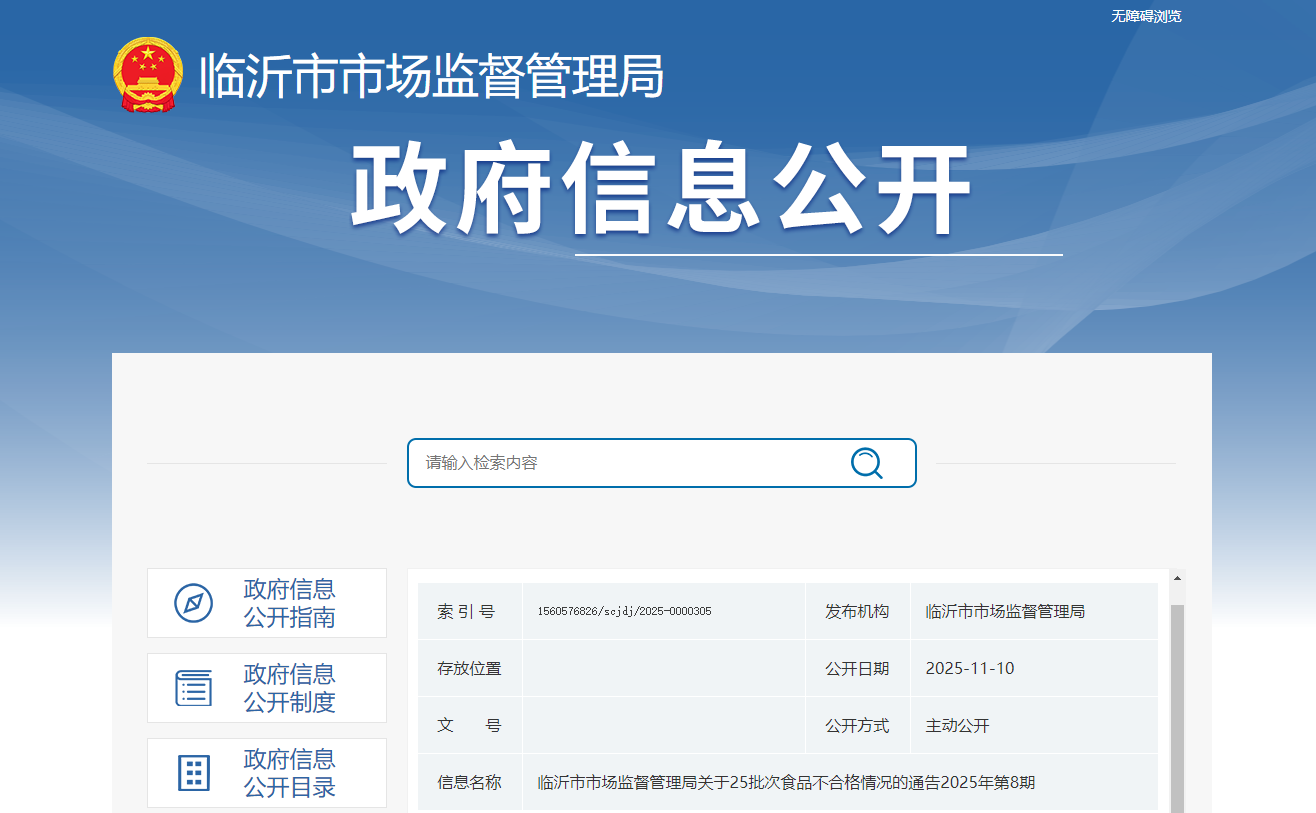
山东省临沂市市场监督管理局关于25批次食品不合格情况的通告2025年第8期
Zhong Guo Zhi Liang Xin Wen Wang· 2025-11-10 08:52
Core Points - The article reports on the results of food safety inspections conducted by the Linyi Municipal Market Supervision Administration, revealing that 25 out of 2172 food samples tested were found to be non-compliant with safety standards [1][2]. Group 1: Inspection Results - A total of 2172 food samples across 21 categories were inspected, including edible agricultural products, catering foods, and grain processing products [1]. - Among the inspected samples, 25 batches were identified as non-compliant, primarily due to pesticide residues, veterinary drug residues, and excessive food additives [1][2]. Group 2: Specific Non-Compliant Products - Specific non-compliant products included: - Chili with pesticide residue (0.21 mg/kg of imidacloprid, exceeding the standard of ≤0.05 mg/kg) [2]. - White fungus with sulfur dioxide residue (0.904 g/kg, where the standard is not to be used) [2]. - Peanut oil containing aflatoxin (106 μg/kg, exceeding the standard of ≤20 μg/kg) [2]. - Other products listed include various agricultural products and seasonings that failed to meet safety standards due to similar issues [3][4].
人民财评:“舌尖上”的进博会魅力独特
Ren Min Wang· 2025-11-10 08:27
Core Insights - The eighth China International Import Expo (CIIE) serves as a platform for showcasing global food products, creating a "global food museum" that enhances trade cooperation and cultural exchange [1][2] - The event facilitates the entry of high-quality agricultural products from various countries into the Chinese market, breaking geographical barriers and trade obstacles [1] - The expo promotes innovation tailored to Chinese consumer preferences, with many companies developing customized products to meet local tastes [1] Group 1 - The CIIE features over 2,000 exhibitors, presenting a wide array of international food flavors, thus enhancing consumer experience and quality [1] - The event acts as a "golden bridge" for trade cooperation, showcasing products like Canadian beer, Malaysian durian, and meats from Brazil, Argentina, and Australia [1] - The expo's focus on food not only enriches the Chinese dining experience but also drives the evolution of consumer quality [1] Group 2 - The CIIE creates a win-win chain benefiting both domestic and international communities, exemplified by Chinese coffee companies establishing processing plants in Yunnan to support local farmers [2] - The event provides practical solutions and pathways for developing countries to overcome agricultural challenges and access international markets [2] - The CIIE is not just a trading platform but also a stage for cultural exchange and a driver of economic development, contributing to job creation and income growth [2]
农业农村部发布11月农产品供需分析 小幅上调2025/26年度玉米、棉花产量预估
Xin Hua Cai Jing· 2025-11-10 08:20
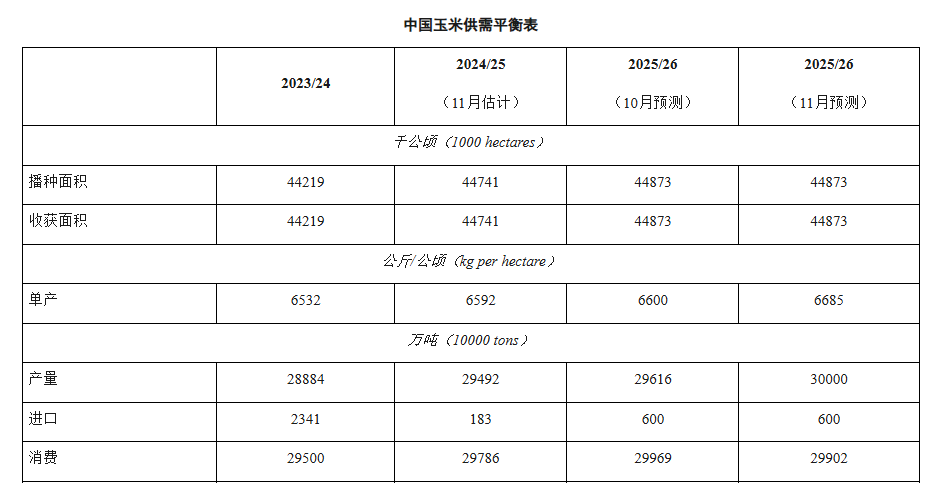
Core Insights - The Ministry of Agriculture and Rural Affairs of China has released an analysis of the supply and demand situation for agricultural products in November 2025, indicating adjustments in production forecasts for corn and cotton while maintaining estimates for edible vegetable oil and sugar [1] Corn - The forecast for China's corn production in the 2025/26 season has been raised to 30 million tons from the previous estimate of 29.616 million tons, with imports for the 2024/25 season reduced to 1.83 million tons [1][2] - Factors contributing to the positive outlook include ample market supply, improved profitability for deep processing enterprises, and strong demand for feed consumption due to high livestock inventory [1] Soybeans - The soybean production forecast for 2025/26 has been slightly adjusted down to 20.9 million tons from 21.09 million tons, with good weather conditions in Northeast China leading to higher yields, while adverse weather in other regions has caused slight declines [2] - The total import of soybeans for the 2024/25 season is estimated at 10.937 million tons, with exports at 80,000 tons [2] Cotton - The cotton production forecast for 2025/26 has been increased to 6.6 million tons from 6.36 million tons, with the yield per hectare raised from 2,211 kg to 2,251 kg, reflecting favorable growing conditions [3] - As of November 6, the cotton picking progress reached 95.3%, up 1.3 percentage points year-on-year, with a sales rate of 18.3%, an increase of 12.2 percentage points [3] Edible Vegetable Oil - The production estimate for edible vegetable oil in 2024/25 is 31.32 million tons, an increase of 560,000 tons from the previous year, primarily due to higher production of soybean and peanut oil [5] - For 2025/26, the production estimate remains stable at 30.69 million tons, with slight reductions in peanut oil production due to lower yield expectations [6] Sugar - The total sugar production for the 2024/25 season is projected at 11.16 million tons, an increase of 1.2 million tons from the previous year, with an average price of 5,993 yuan per ton, reflecting a decrease of 498 yuan or 7.7% year-on-year [6] - The forecast for the sugar supply and demand situation for 2025/26 remains unchanged, with ongoing monitoring of the impact of adverse weather conditions on sugar beet and cane production [6]

粕类周报:震荡偏强,关注USDA供需报告-20251110
Guo Mao Qi Huo· 2025-11-10 08:05
1. Report Industry Investment Rating - The investment view is "oscillating with an upward bias" [5] 2. Core View of the Report - Domestic soybean purchase and crushing margins are poor. With China's expected procurement of US soybeans, the short - term domestic futures market is expected to continue the oscillating and upward - biased trend following the US market. However, the expected global soybean supply surplus is likely to limit the rebound height of the futures market. Future drivers depend on the USDA November supply - demand report and South American weather [5] 3. Summary by Relevant Catalogs 3.1 Main Views and Strategy Overview - **Supply**: The supply factor is bullish. USDA's current estimate of the US soybean stock - to - consumption ratio for the 25/26 season is 6.9%, with potential for a downward adjustment in the expected yield of 53.5 bushels per acre and an upward adjustment in export expectations, indicating a tight supply - demand balance sheet. As of November 1st, Brazil's soybean sowing rate was 47.1%, lower than last year and the five - year average, and attention should be paid to the relatively dry weather in southern Brazil and the impact of the weak La Nina weather pattern. In November, domestic soybean meal inventory is expected to start decreasing, but the supply in the fourth quarter is still expected to be abundant. The progress of vessel bookings for December - January is slow, and the supply gap in the first quarter of next year is uncertain. Under the current China - Canada trade policy, the supply of imported rapeseed meal and rapeseed in China is expected to decrease, while the opening of Australian rapeseed imports is expected to supplement the domestic rapeseed meal supply in the fourth quarter [5] - **Demand**: The demand for soybean meal is neutral, and for rapeseed meal is bearish. Livestock and poultry are expected to maintain high inventory levels in the short term, supporting feed demand, but current breeding profits are in the red, and national policies tend to control pig inventory and weight, which may affect future supply. Soybean meal has a high cost - performance ratio, but recent downstream transactions of soybean meal and rapeseed meal have been cautious, and提货 performance has declined [5] - **Inventory**: The inventory factor is neutral. Domestic soybean and soybean meal inventories are at historically high levels, and are expected to start decreasing in November. Feed enterprises' soybean meal inventory days have dropped to a low level. Domestic rapeseed inventory has declined to a low level, and rapeseed meal inventory has been continuously decreasing [5] - **Basis/Spread**: The basis is neutral [5] - **Profit**: The profit factor is bullish. Domestic soybean purchase and crushing margins are poor, while Canadian rapeseed crushing margins are good [5] - **Valuation**: The valuation is neutral. From the perspective of crushing margins, the soybean meal futures price is at a relatively low valuation; from the perspective of basis, the recent soybean meal futures price is at a relatively high - neutral valuation [5] - **Macro and Policy**: The macro and policy factor is bullish. Since November 10, 2025, the additional tariff measures on US - imported goods have been adjusted, with a 24% additional tariff rate suspended for one year, leaving a 10% additional tariff rate, and the current tariff rate for Chinese imports of US soybeans is 13%. Canada cannot immediately cancel tariffs on China [5] - **Trading Strategy**: For unilateral trading, the trend is oscillating with an upward bias, and risks to watch include policy and weather; for arbitrage, it is recommended to wait and see [5] 3.2 Fundamental Supply - Demand Data of Meal Products - **Inventory - to - Consumption Ratio**: In September, the US soybean inventory - to - consumption ratio for the 25/26 season increased, while the global soybean inventory - to - consumption ratio decreased. The rapeseed inventory - to - consumption ratio also increased [34][40] - **US Soybean Data**: The US soybean sowing rate and good - quality rate data are presented, and the domestic crushing profit has declined. This week, no US soybean export sales data were announced [49][54][67] - **Price and Profit Data**: Data on soybean CNF premiums, import soybean crushing margins, Canadian rapeseed CFR prices, and Canadian rapeseed import crushing margins are provided [74][78] - **Inventory and Consumption Data**: Domestic soybean and soybean meal inventories are at high levels, while feed enterprise inventories are at low levels. Data on domestic rapeseed and rapeseed meal inventories, as well as oil mill opening rates, crushing volumes, and meal product trading and consumption volumes, are also presented [85][98][107] - **Livestock and Poultry Breeding Data**: Data on livestock and poultry breeding profits, pig prices, weights, and poultry breeding inventories are provided, showing that pig prices have slightly declined and weight reduction is not obvious [123][127][131]
玉米周报:现实博弈,低位震荡-20251110
Guo Mao Qi Huo· 2025-11-10 08:05
投资咨询业务资格:证监许可【2012】31号 【玉米周报】 现实博弈,低位震荡 国贸期货 农产品研究中心 2025-11-10 国贸期货研究院 农产品研究中心:黄向岚 从业资格证号:F03110419 投资咨询证号:Z0021658 本报告非期货交易咨询业务项下服务,其中的观点和信息仅供参考,不构成任何投资建议;期市有风险,投资需谨慎 | 影响因素 | 驱动 | 主要逻辑 | | --- | --- | --- | | 供给 | 偏空 | (1)东北产地仍面临集中上量压力,华北质量偏差的潮粮也面临保管压力,建议关注11-12月的产地卖压;(2)25/26年度种植成本继续下降,播种面积稳 中略减,单产表现良好,整体维持丰产预期;(3)进口谷物政策限制持续,进口谷物供应缩量。 | | 需求 | 偏多 | (1)据饲料工业协会数据,2025年9月,全国工业饲料产量3036万吨,环比增长3.4%,同比增长5.0%。饲料企业生产的配合饲料中玉米用量占比为33.6%, 同比下降2.4个百分点。(2)畜禽短期预期维持高存栏,产能去化尚不明显,支撑饲用需求,但目前养殖利润呈现亏损,国家政策倾向于控生猪存栏和体重, | | | ...
广发期货《农产品》日报-20251110
Guang Fa Qi Huo· 2025-11-10 07:47
Report Overview 1. Report Industry Investment Ratings No investment ratings are provided in the reports. 2. Core Views of Each Report - **Fats and Oils Industry**: The market has a bearish outlook on Malaysian palm oil inventory, and there is pressure for further decline in the external palm oil market. The domestic soybean oil supply is abundant, and the basis price may fluctuate within a certain range [1]. - **Sugar Industry**: The global sugar supply is abundant, and the raw sugar price remains weak. The domestic sugar market is affected by import quotas and may experience weak price fluctuations [3]. - **Pig Industry**: The pig price is expected to be moderately strong in November, and the market has entered a range - bound pattern. It is recommended to hold the 3 - 7 reverse spread and be cautiously bullish on single - side operations [5]. - **Cotton Industry**: The short - term cotton price may fluctuate within a range due to cost support and weak downstream demand [7]. - **Corn Industry**: The short - term corn supply is relatively stable, and the price may adjust in a range. It will be weak when the selling pressure emerges [8]. - **Meal Industry**: The domestic soybean and soybean meal inventories are at a high level, but there is strong cost support. The price is expected to fluctuate within a range [12]. - **Egg Industry**: The egg supply pressure remains, and the demand is average. The egg price is expected to fluctuate widely at the bottom [15]. 3. Summary by Related Catalogs Fats and Oils Industry - **Price Changes**: On November 7th, compared with November 6th, soybean oil prices were stable, palm oil prices had minor fluctuations, and rapeseed oil prices increased slightly [1]. - **Market Situation**: Malaysian palm oil production increased in October, and the market has a bearish view on its inventory. The domestic soybean oil supply is under pressure, and the demand is weak [1]. Sugar Industry - **Price Changes**: On November 7th, sugar futures prices increased slightly, and spot prices in some regions changed. The raw sugar price is at a five - year low [3]. - **Industry Situation**: The national sugar production and sales increased year - on - year, and the industrial inventory decreased [3]. Pig Industry - **Price Changes**: On November 7th, compared with November 6th, futures prices decreased slightly, and spot prices in some regions increased [5]. - **Market Situation**: The market's reluctance to sell increased, and the planned November slaughter volume will slow down, which may support the pig price [5]. Cotton Industry - **Price Changes**: On November 7th, compared with November 6th, cotton futures prices decreased slightly, and spot prices increased slightly [7]. - **Industry Situation**: Industrial and commercial inventories increased, and textile exports decreased [7]. Corn Industry - **Price Changes**: On November 7th, compared with November 6th, corn futures prices decreased slightly, and spot prices in some regions increased [8]. - **Market Situation**: The selling pressure of corn is expected to increase, and the demand side is cautious in purchasing [8]. Meal Industry - **Price Changes**: On November 7th, compared with November 6th, soybean meal, rapeseed meal, and soybean prices had minor fluctuations [12]. - **Market Situation**: The demand for US soybeans is not strong, and the domestic soybean and soybean meal inventories are high, but there is cost support [12]. Egg Industry - **Price Changes**: On November 7th, compared with November 6th, egg futures prices changed, and spot prices increased [15]. - **Market Situation**: The supply of eggs is under pressure, and the demand is average [15].
2025年绿色食品宣传月乘“丰”启航,“宁波农好”追溯平台重磅发布
Feng Huang Wang Cai Jing· 2025-11-10 07:36
Core Insights - Ningbo has launched the "Ningbo Nonghao" quality traceability system as part of its Green Food Promotion Month, aiming to enhance the transparency and quality of local agricultural products [1][2] - The initiative is a response to national efforts in promoting green food and signifies a step towards ensuring food safety and increasing the market recognition of high-quality agricultural products [1][2] Group 1: Event Overview - The Green Food Promotion Month will last for two months, featuring the distribution of a guidebook on green quality agricultural products and the launch of the traceability system [1] - Four companies were recognized for their inclusion in the national green food label directory, and 20 agricultural entities showcased their products at the event [1] Group 2: Agricultural Quality and Safety - Ningbo is committed to ensuring food safety by implementing strict standards and regulations, enhancing the supply and quality of green agricultural products [2] - The city has developed a digital traceability system that allows consumers to access detailed information about agricultural products through a unified identification code [2] Group 3: Industry Development - Currently, Ningbo has 257 green food enterprises and 375 certified products, with a total annual output value of nearly 5 billion [3] - The city aims to optimize the structure of green food products and improve the effectiveness of certification processes while enhancing the overall agricultural industry development [3]