
稀土

Search documents
商务部发布公告严控稀土相关技术出口
Zhong Guo Hua Gong Bao· 2025-10-13 02:34
Core Viewpoint - The Chinese government has announced export controls on rare earth-related technologies and items to safeguard national security and fulfill international non-proliferation obligations [1][3]. Group 1: Export Control Measures - The Ministry of Commerce has issued announcements regarding the export control of rare earth technologies, including mining, smelting, metal refining, and recycling technologies, which require permission for export [1][3]. - The export control is a response to the illegal acquisition of rare earth technologies by foreign entities, which poses significant risks to China's national security and international stability [3]. Group 2: International Cooperation and Compliance - China emphasizes its commitment to maintaining global peace and regional stability through responsible export control measures and is open to dialogue with other countries to promote compliant trade [2]. - The scope of the controlled items is limited, and various facilitation measures will be implemented, including exemptions for humanitarian aid and a reasonable transition period for existing commercial contracts [2].
中信建投证券:重视钴和稀土的战略配置机遇
Xin Hua Cai Jing· 2025-10-13 02:32
Group 1: Cobalt Export Quotas - The details of cobalt export quotas from the Democratic Republic of Congo have been finalized, with the top three companies being Luoyang Molybdenum, Jiana Co., and Eurasian Resources, holding shares of 35.9%, 27.3%, and 21.6% respectively [1] - The total quota for 2026 and 2027 is set at 96,600 tons, which includes a basic quota of 87,000 tons allocated to various production companies and a strategic quota of 9,600 tons [1] - Under this quota system, only about 44% of the production can be exported, resulting in a reduction of over 100,000 tons [1] Group 2: Cobalt Market Dynamics - Based on estimates for 2024, with a supply of 270,000 tons and demand of 230,000 tons, the market is expected to shift from a surplus of approximately 70,000 tons to a shortage of about 30,000 tons, potentially driving cobalt prices higher [1] Group 3: Rare Earth Export Controls - The Ministry of Commerce has issued four documents to strengthen export controls on rare earths, adding five categories of medium and heavy rare earths to the export control list [1] - The strategic position of rare earths is further reinforced, with expectations of increased overseas stockpiling actions, which may lead to further price increases for rare earths [1] - China's control over the entire rare earth industry chain, from mining to recycling, is expected to complicate the establishment of independent overseas rare earth supply chains, extending the time required and enhancing China's competitive advantage in rare earths [1]

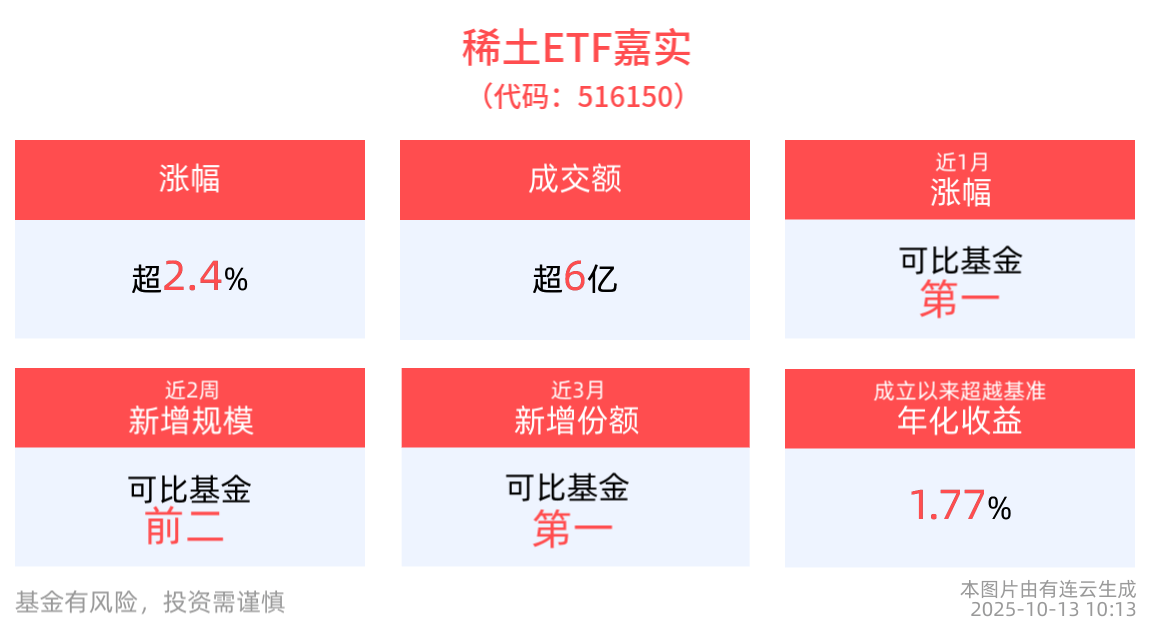
反制利器!稀土ETF嘉实(516150)盘中上涨2.47%,成分股安泰科技10cm涨停
Sou Hu Cai Jing· 2025-10-13 02:30
Group 1: Market Performance - The liquidity of the Rare Earth ETF managed by Jiashi has a turnover rate of 8%, with a transaction volume of 638 million yuan [3] - Over the past week, the average daily transaction volume of the Rare Earth ETF reached 598 million yuan, ranking first among comparable funds [3] - The fund's scale increased by 150 million yuan in the last two weeks, showing significant growth [3] Group 2: Fund Growth Metrics - The Rare Earth ETF saw a share increase of 2.197 billion shares over the past three months, ranking first among comparable funds [3] - As of October 10, the net value of the Rare Earth ETF has risen by 85.56% over the past year, placing it in the top 0.55% among 3,064 index equity funds [3] - The fund has recorded a maximum monthly return of 41.25% since its inception, with the longest consecutive monthly gain being four months and an average monthly return of 10.78% [3] Group 3: Industry Insights - The Ministry of Commerce has announced strengthened export controls on rare earth-related items, highlighting the strategic importance of rare earth resources and increasing market attention on the sector [3] - The rare earth industry is experiencing a supply-demand resonance, with China's quota management and export controls enhancing strategic control over the industry chain [4] - The global green transition and dual carbon goals are driving demand for key elements like praseodymium and neodymium, leading to rapid expansion in new applications such as permanent magnetic materials [4] Group 4: Key Stocks in the Sector - The top ten weighted stocks in the China Rare Earth Industry Index account for 61.96% of the index, with notable performers including Northern Rare Earth (6.90% increase) and China Rare Earth (6.05% increase) [6] - Other significant stocks include Baotou Steel (9.84% increase) and Shenghe Resources (5.01% increase), while some stocks like China Aluminum and Liying Intelligent Manufacturing experienced declines [6]


受美新一轮关税影响,国际金价突破4060美元/盎司,金ETF(518680)、稀土ETF(159713)早盘双双涨逾2%
Mei Ri Jing Ji Xin Wen· 2025-10-13 02:29
Core Viewpoint - The U.S. has announced a 100% tariff increase on Chinese imports, leading to a surge in gold prices and a strong performance in the rare earth sector [1] Group 1: Gold Market - On October 13, gold prices on Comex futures reached a new historical high of $4060 per ounce due to the announcement of tariffs [1] - The gold ETF (518680) opened with over a 2% increase and has seen a year-to-date rise of nearly 55%, ranking first among 14 gold ETFs over the past year [1] - As of October 10, the gold ETF (518680) reached a record share of 452 million, the highest since its listing and the largest among similar ETFs [1] Group 2: Rare Earth Sector - The rare earth ETF (159713) experienced a peak increase of over 3% in early trading, closing with a rise of 2.52% [1] - Notable stocks within the index include Jiuling Technology, which rose over 14%, and AnTai Technology, which hit the daily limit, while Baogang Co. increased by over 9% [1] Group 3: Tariff Impact - President Trump announced that starting November 1, a 100% tariff will be imposed on Chinese imports, which is an additional charge on top of existing tariffs [1] - The U.S. will also implement export controls on "all critical software" on the same date, indicating a significant rise in tariff risks [1] - Recent market sentiment driven by risk aversion is expected to continue supporting the prices of gold and other resource commodities in the medium to long term [1]
商务部新闻发言人就商务部新闻发言人就近期中方相关经贸政策措施情况答记者问近期中方相关经贸政策措施情况答记者问
Xin Hua She· 2025-10-13 02:29
Core Viewpoint - China has implemented export controls on rare earth materials to enhance its export control system, citing the importance of these materials in military applications and the need to maintain global peace and regional stability [2][3]. Group 1: Export Control Measures - The export control measures are a legitimate action by the Chinese government based on laws and regulations, aimed at ensuring national security and international safety [2][4]. - China emphasizes that the export controls are not a ban on exports; applications that meet the criteria will be approved, and the government is open to facilitating compliant trade [3][4]. Group 2: Response to U.S. Actions - The U.S. has announced a 100% tariff on Chinese rare earth exports and additional export controls on key software, which China views as a double standard and a violation of fair trade practices [4][5]. - China has expressed strong opposition to the U.S. actions, which it believes undermine the atmosphere for economic talks and harm mutual interests [5][6]. Group 3: Bilateral Relations and Future Cooperation - China urges the U.S. to correct its erroneous practices and to engage in dialogue based on mutual respect and equality to resolve concerns and manage differences [5][7]. - The Chinese government has indicated that it will take necessary countermeasures to protect its legitimate rights and interests in response to U.S. unilateral actions [6][7].
稀土概念走势活跃,包钢股份涨停,金力永磁等大涨
Zheng Quan Shi Bao Wang· 2025-10-13 02:28
Group 1 - The rare earth sector is experiencing active trading, with significant stock price increases for companies such as Jiuling Technology (up over 17%), Galaxy Magnetics (up over 15%), and Baotou Steel (limit up) [1] - Baotou Steel announced an adjustment to its rare earth concentrate transaction price for Q4 2025 to 26,205 RMB/ton (excluding tax, dry weight, REO=50%), with a price change of 524.1 RMB/ton for each 1% change in REO [1] - Northern Rare Earth also announced a similar adjustment for the same period, indicating a consistent pricing strategy across major players in the sector [1] Group 2 - CITIC Securities stated that the security of rare earth resources has become a core aspect of national security, suggesting a shift towards high-quality development in the rare earth industry [2] - The supply-demand dynamics for rare earths are expected to remain favorable, with performance in the sector likely to improve, driven by industries such as new energy vehicles, wind power, and energy-saving motors [2] - Global demand for neodymium-iron-boron is projected to reach 329,000 tons by 2027, with a CAGR of 13% from 2024 to 2027, indicating strong growth potential in the sector [2]


A股早评:三大指数大幅低开,创业板指低开4.44%,AI硬件板块大跌
Ge Long Hui· 2025-10-13 02:08
Core Viewpoint - Recent escalation of China-US trade tensions has led to significant declines in A-share indices, with the Shanghai Composite Index opening down 2.49%, the Shenzhen Component down 3.88%, and the ChiNext Index down 4.44% [1] Market Performance - The CPO and liquid cooling server concepts experienced the largest declines, with companies such as Tongfu Microelectronics and Digital China hitting the daily limit down, while others like Shokubai and Luxshare Precision fell over 9% [1] - The humanoid robot sector also opened significantly lower, with Haichang New Materials and Sanhua Intelligent Control dropping over 8% [1] - In contrast, the rare earth permanent magnet sector saw initial gains, with companies like Antai Technology, Baogang Group, and Xinlai Fu reaching the daily limit up, following the Ministry of Commerce's announcement of export controls on rare earth-related items [1]

三大指数均大幅低开 沪指低开2.49%
Feng Huang Wang· 2025-10-13 01:48
Market Overview - The Shanghai Composite Index opened down 2.49%, the Shenzhen Component Index down 3.88%, and the ChiNext Index down 4.44%, with nearly 70 stocks falling over 9% [1] - On the previous Friday, the market experienced a full-day adjustment, with all three major indices declining, and the Shanghai Composite Index fell nearly 1% below 3900 points [1] - The trading volume in the Shanghai and Shenzhen markets was 2.52 trillion yuan, a decrease of 137.6 billion yuan compared to the previous trading day [1] - High-position stocks collectively fell, with significant declines in battery and chip concept stocks, including Huahong Semiconductor, Yiwei Lithium Energy, and others [1] - By the end of the trading day, the Shanghai Composite Index fell 0.94%, the Shenzhen Component Index fell 2.70%, and the ChiNext Index fell 4.55% [1] Analyst Insights - Galaxy Securities believes that the market is unlikely to replicate the April 7th trend due to reduced impact from expectations, established policy mechanisms, and a focus on medium to long-term policy expectations [2] - The recent adjustment of Chinese concept stocks is not driven by a single external factor but is a necessary correction after a sustained rise [2] - Short-term market volatility may increase due to rising external uncertainties and profit-taking pressures, but the core driving factors of the current market remain unchanged [2] Sector Analysis - Huatai Securities reports that major overseas storage manufacturers have announced price increases since September, exceeding market expectations, with strong demand for DRAM driven by AI applications [3] - The supply-demand structure for NAND is improving due to strict capacity control and increased enterprise-level SSD demand, leading to further price increases [3] Strategic Insights - CITIC Construction Investment highlights that the Ministry of Commerce has reinforced export controls on rare earths, enhancing the strategic position of rare earths in the industry [4] - New regulations include increased controls on five categories of medium and heavy rare earths and restrictions on the export of equipment, technology, and raw materials across the entire industry chain [4]
中国造出EUV,美国建立起稀土全产业链,谁会更快?
是说芯语· 2025-10-13 01:46
Core Insights - The article emphasizes the critical role of rare earth elements, particularly heavy and medium rare earths, in the AI supply chain, highlighting China's near-total control over this supply chain [3][10][19] - It discusses the asymmetrical leverage that a mere 0.1% content of rare earths can exert on the global AI supply chain, affecting everything from chip production to cooling systems [5][6] - The article warns that the U.S. economy is heavily reliant on AI, and any disruption in the rare earth supply chain could lead to significant economic consequences [6][12] Rare Earths and AI Supply Chain - Rare earths are essential for AI hardware performance, with their unique atomic properties making them irreplaceable in the short term [3][7] - The concentration of rare earth supply in China gives it a strategic advantage in controlling the flow of AI-related technologies globally [4][10] - The U.S. faces challenges in overcoming the "rare earth wall," as its efforts to rebuild a complete supply chain from mining to manufacturing are still in early stages [10][11] Market Dynamics - The direct market size of the rare earth industry is relatively small compared to the massive valuations of AI companies, yet its impact on the AI economy is profound [5][6] - The article notes that the U.S. has been slow to respond to the importance of rare earths, with significant investments and policies only emerging in recent years [11][12] Technological Implications - Rare earths are not only crucial for semiconductor manufacturing but also for enhancing the performance of AI hardware through their unique physical properties [7][8] - The article highlights ongoing research in alternative materials, but current substitutes for rare earths are still in experimental stages and face significant challenges [9][19] Global Supply Chain Challenges - The article outlines the geographical concentration of heavy rare earth resources, primarily in China, which poses a challenge for other countries attempting to establish their own supply chains [10][19] - It emphasizes that the processing of rare earths is more critical than mining, with China's dominance in refining technology making it difficult for other nations to compete [15][19]


券商晨会精华 | 市场大概率不会复制4月7日行情
智通财经网· 2025-10-13 01:45
Market Overview - The market experienced a significant downturn last Friday, with all three major indices declining, and the Shanghai Composite Index falling nearly 1% to below 3900 points. The total trading volume in the Shanghai and Shenzhen markets was 2.52 trillion yuan, a decrease of 137.6 billion yuan compared to the previous trading day. The decline was broad-based, particularly affecting high-priced stocks in sectors such as batteries and semiconductors, with companies like Huahong Semiconductor, Yiwei Lithium Energy, and others experiencing substantial drops. Conversely, sectors like gas and coal saw gains, while semiconductors, batteries, and precious metals faced notable losses. By the end of the trading day, the Shanghai Composite Index fell by 0.94%, the Shenzhen Component Index by 2.70%, and the ChiNext Index by 4.55% [1]. Analyst Insights - **Galaxy Securities**: The firm believes that the market is unlikely to replicate the performance seen on April 7. They attribute this to a significant reduction in the expected impact of recent tariff shocks, the establishment of policy mechanisms to stabilize the market, and a focus on medium to long-term policy expectations. They also note that the recent adjustments in Chinese concept stocks are not indicative of a long-term trend reversal but rather a necessary market correction following previous gains. Short-term uncertainties in the external environment may suppress market risk appetite, leading to increased volatility and divergence among individual stocks. However, the core drivers of the current market trend remain unchanged, with liquidity expected to continue improving [2]. - **Huatai Securities**: The firm highlights that since September, major overseas storage manufacturers like SanDisk, Micron, and Samsung have announced price increases, often exceeding market expectations. In the DRAM segment, demand driven by AI for HBM and high-capacity DDR5 remains strong, leading to a steady increase in mainstream DRAM prices in Q4 2025. Micron's FY25Q4 earnings report indicated that the supply-demand relationship in the DRAM market will remain tight in 2026. In the NAND segment, strict control over production capacity, combined with HDD supply shortages and increasing enterprise-level SSD demand driven by AI applications, is expected to further optimize the supply-demand structure, with price increases in Q4 2025 likely to be greater than in Q3 2025 [3]. - **CITIC Construction Investment**: The firm notes that the Ministry of Commerce has issued multiple documents to strengthen export controls on rare earths, increasing restrictions on five categories of medium and heavy rare earths and on the export of equipment, technology, and raw materials across the entire industry chain. This move further reinforces the strategic importance of rare earths, particularly in relation to overseas military and high-end semiconductor demands [4].

