
新消费

Search documents
苏州高新区冲刺“金秋经贸招商季”
Xin Hua Ri Bao· 2025-11-13 20:49
Group 1 - Suzhou High-tech Zone is launching an investment promotion campaign focusing on the automotive industry, engaging with companies like BYD and NIO for deep cooperation [1] - The region is leveraging the "Golden Autumn Economic and Trade Investment Season" to drive breakthroughs in automotive technology, new consumption, and digital economy sectors [1] - Recent events include a series of targeted investment activities, such as the Nanjing Digital Industry Exchange and Jilin University project matching, aimed at precise investment promotion [1] Group 2 - The "Zhihui Su Gao Xin" innovation and entrepreneurship competition has attracted 21 outstanding projects, focusing on core industries like photonics and integrated circuits [2] - Suzhou High-tech Zone is increasing its outreach efforts, visiting major cities to engage with well-known groups and facilitate project implementation [2] - The region is establishing a global investment network, conducting over 10 high-level "cloud dialogues" with Fortune 500 companies to showcase its industrial advantages and development potential [2] Group 3 - Investment personnel are implementing a "list management, project promotion" strategy to tailor solutions for key projects, aiming for a rolling development model of planning, signing, and landing projects [3] - Future initiatives will focus on optimizing investment strategies and hosting more specialized investment activities in sectors like cross-border e-commerce and biomedicine [3] - The strategy includes leveraging existing enterprises to create application scenarios that facilitate technological innovation and regional high-quality development [3]


从“适配需求”到“创造需求” 机构投资消费逻辑生变
Shang Hai Zheng Quan Bao· 2025-11-13 17:55
Group 1 - The consumer sector is showing signs of stabilization and rebound, with significant capital inflow through ETFs, indicating a potential turning point for the sector [1][2] - Fund companies are shifting their investment logic from "adapting to demand" to "creating demand," focusing on companies that emphasize innovation and consumer experience [1][4] - Several consumer-themed ETFs have reached new highs in terms of shares, reflecting increased investor interest and confidence in the sector [2] Group 2 - The recent performance of the consumer sector is supported by a combination of policy, capital, industry fundamentals, and consumption trends, suggesting a structural recovery after a deep adjustment [1][3] - The third-quarter earnings reports indicate that many segments within the consumer sector are still struggling, with net profits not yet turning positive, highlighting a potential mismatch between valuation and earnings [3] - New consumption trends are emerging, where consumption is seen as a form of self-expression, prompting supply-side upgrades that align with the core demands of the new generation of consumers [4]
港股收评:恒指涨0.85%科指涨0.16%!生物医药股走强百济神州涨7%,沪上阿姨涨28%协鑫科技跌7%,中国石油涨3%
Sou Hu Cai Jing· 2025-11-12 08:43
Market Overview - The Hong Kong stock market indices collectively rose, with the Hang Seng Index increasing by 0.85% to 26,922.73 points, the Hang Seng Tech Index rising by 0.16%, and the National Enterprises Index up by 0.82% [2] Biopharmaceutical Sector - The biopharmaceutical stocks strengthened, with BeiGene rising over 7%. The company reported a total revenue of 27.595 billion yuan for the first three quarters of 2025, marking a year-on-year increase of 44.2%. The net profit attributable to the parent company was 1.139 billion yuan, driven by sales growth of self-developed products and authorized products [1][2] Oil Sector - Oil stocks led the gains, with PetroChina increasing nearly 3%. Geopolitical tensions in South America, particularly regarding Venezuela, may elevate risks in the region, which could support oil prices due to OPEC+ production adjustments [3][4] New Consumption Concept Stocks - New consumption concept stocks saw some increases, with "Hushang Aiyi" rising nearly 29%. The company announced a ten-year H-share incentive plan, aiming to incentivize core talent through restricted stock [4][5] Solar Energy Sector - Solar energy stocks weakened, with GCL-Poly Energy falling over 7%. There were rumors regarding significant changes in the photovoltaic industry, which the China Photovoltaic Industry Association has refuted, emphasizing the need for careful decision-making amidst misinformation [6]


中概股估值模型拆解:如何提升IPO定价与后市表现?
Sou Hu Cai Jing· 2025-11-12 05:48
Core Insights - The valuation logic and IPO pricing of Chinese concept stocks are focal points for issuers, investors, and underwriters, impacting both the success of IPO financing and post-listing stock performance [1] Valuation Models and Application Scenarios - **PE (Price-to-Earnings) Model**: Suitable for traditional industries with stable earnings, such as consumer, manufacturing, and education sectors. Adjustments to standard PE multiples should consider growth potential, industry position, and earnings quality [3] - **PS (Price-to-Sales) Model**: More applicable for high-growth tech companies that are not yet profitable. Evaluation should focus on the specific segment's PS levels and metrics like user scale, revenue growth, and gross margin [4] - **DCF (Discounted Cash Flow) Model**: Best for mature business models with predictable cash flows, such as infrastructure and utility companies. Key factors include setting appropriate discount rates and growth assumptions based on macroeconomic and industry trends in China [5] Strategies for Enhancing IPO Value Realization - **Integration of Valuation Logic and Business Narrative**: Emphasizing core competencies during roadshows can enhance the credibility of valuation models. For instance, tech companies should highlight technological barriers and market penetration, while consumer firms should focus on brand value and supply chain efficiency [7] - **Full-Cycle Performance Management**: Pre-IPO roadshows should build consensus by clearly communicating business certainty and growth logic to attract strategic investors. Post-IPO, transparent information disclosure and regular communication can strengthen trust in the company's strategy and execution [8] - **Flexibility in Responding to Market Fluctuations**: Companies should be prepared to adjust their strategies in response to valuation pressures, such as initiating buybacks during undervaluation or pursuing refinancing or acquisitions when market sentiment improves [9]

港股新消费概念股集体走强,沪上阿姨涨近13%,锅圈涨6%,毛戈平涨超5%,奈雪的茶涨超4%,蜜雪集团、茶百道涨超3%
Ge Long Hui· 2025-11-12 02:42
Group 1 - The Hong Kong stock market saw a strong performance in new consumption concept stocks, with notable gains in several companies [1] - Companies such as "沪上阿姨" increased by nearly 13%, "锅圈" by 6%, "毛戈平" by over 5%, "奈雪的茶" by over 4%, and others like "蜜雪集团" and "茶百道" rising by over 3% [1] Group 2 - "沪上阿姨" (Code: 02589) rose by 12.52% to a latest price of 102.000, with a total market value of 10.731 billion and a year-to-date decline of 9.83% [2] - "锅圈" (Code: 02517) increased by 6.02% to 4.400, with a market cap of 11.61 billion and a year-to-date increase of 147.22% [2] - "毛戈平" (Code: 01318) saw a rise of 5.41% to 95.500, with a market value of 46.813 billion and a year-to-date increase of 66.16% [2] - "奈雪的茶" (Code: 02150) increased by 4.17% to 1.250, with a market cap of 21.31 billion and a year-to-date decline of 8.09% [2] - "蜜雪集团" (Code: 02097) rose by 3.55% to 431.800, with a total market value of 163.919 billion and a year-to-date increase of 113.23% [2] - "茶百道" (Code: 02555) increased by 3.28% to 7.560, with a market cap of 11.171 billion and a year-to-date decline of 27.98% [2]

港股新消费概念股持续活跃 沪上阿姨涨超13%
Mei Ri Jing Ji Xin Wen· 2025-11-12 01:57
Group 1 - The new consumption concept stocks in the Hong Kong market are showing significant activity, with notable price increases for several companies [1] - Specifically, the stock of "沪上阿姨" (Hushang Ayi) has risen by 13.07%, "锅圈" (Guoquan) by 4.82%, "毛戈平" (Mao Geping) by 4.14%, and "奈雪的茶" (Naixue's Tea) by 3.33% [1]
港股收评:探底回升!新消费股涨势继续,半导体股低迷
Ge Long Hui· 2025-11-11 08:45
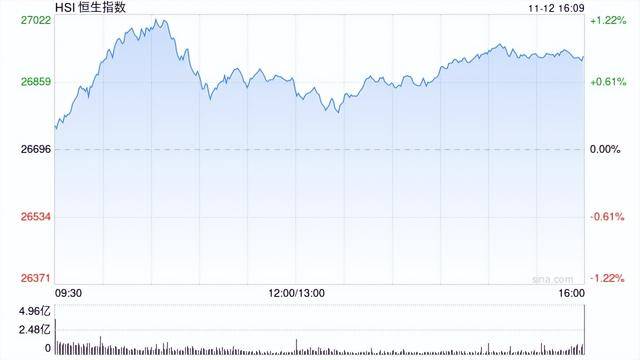
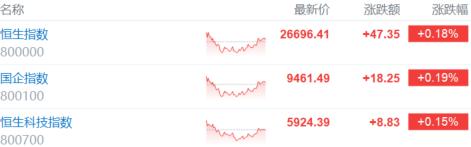
Market Overview - The Hong Kong stock market showed a rebound after hitting a low, with the Hang Seng Index closing up 0.18% at 26,696 points, the Hang Seng China Enterprises Index up 0.19%, and the Hang Seng Tech Index up 0.15% [1][2] - Overall market sentiment remained stable, with various sectors experiencing mixed performances [1] Sector Performance - Large tech stocks had mixed results, with Baidu rising over 2%, while Alibaba, Bilibili, and Meituan fell over 1% [4] - Consumer stocks, including retail, pork, and dining sectors, continued to rise, while semiconductor stocks generally performed weakly [2][4] - The film industry saw significant gains, with Huayi Brothers rising over 16% and Cat's Eye Entertainment up over 5%, driven by upcoming film releases [6][7] Investment Insights - The AI technology investment landscape is growing, with expectations for significant capital expenditure increases among major tech firms [4] - New consumption trends are emerging, focusing on brand expansion, emotional value, functional value, and channel transformation [5] - The aviation sector is expected to enter a super cycle, with high passenger load factors and low ticket prices driving profitability [9] Notable Stock Movements - Xpeng Motors surged over 17%, while other new consumption stocks like Nayuki Tea and Xiaomi also saw gains [6][5] - Property management and real estate stocks strengthened, with Kaisa Group rising over 5% [8] - Semiconductor stocks faced declines, with Huahong Semiconductor down over 3% and SMIC down over 2% [10] Capital Flows - Southbound funds recorded a net inflow of HKD 4.467 billion, indicating strong interest in Hong Kong stocks [12] Future Outlook - Analysts suggest that the Hong Kong market may reach new highs in the medium term, driven by increased capital inflows and the concentration of quality assets [13]
机构称新消费板块回调后基本面与估值匹配度提升,聚焦港股消费ETF(513230)布局机遇
Mei Ri Jing Ji Xin Wen· 2025-11-11 05:51
Group 1 - Southbound capital has accumulated a net inflow exceeding 50 billion HKD, setting a new record, with a net purchase of 6.654 billion HKD on November 10, marking 14 consecutive trading days of net inflow and over 1.3 trillion HKD net purchases year-to-date [1] - China Galaxy Securities suggests that the new consumption sector has improved its fundamental and valuation alignment after a correction, recommending leading companies in the industry. The leading new tea brand's FY25 PE has returned to a reasonable range after Q3 correction, with expectations of high double-digit profit growth for Mixue and Guming in Q3-Q4, aligning with annual performance expectations [1] - The investment focus for 2026 is expected to shift towards market share enhancement, with Mixue and Guming benefiting from stronger brand momentum, anticipating increased market share after the exit of delivery platform subsidies in 2H26, with Guming's FY26 adjusted net profit expected to grow by 25%, corresponding to a PE of approximately 18X [1] - The concert economy and sports event demand remain robust, supported by policy guidance and venue supply optimization, indicating high growth potential for the industry. Damai Entertainment, as a leading live entertainment and IP licensing company, is expected to achieve steady growth in ticketing business, with IP business potentially exceeding expectations driven by Chiikawa [1] Group 2 - The Hong Kong Stock Consumption ETF (513230) tracks the CSI Hong Kong Stock Connect Consumption Theme Index, packaging internet e-commerce leaders and new consumption sectors, including major players like Pop Mart, Laoputang, Miniso, Tencent, Kuaishou, Alibaba, and Xiaomi, highlighting a strong technology and consumption attribute [2]
上海证券交易所国际投资者大会明日开幕
Zheng Quan Ri Bao Wang· 2025-11-11 04:09
Core Points - The Shanghai Stock Exchange International Investor Conference will be held on November 12-13, focusing on "Value Leading Open Empowerment - New Opportunities for International Capital Investment and Mergers and Acquisitions" [1] - This marks the seventh consecutive year the SSE has hosted the conference, providing a platform for foreign institutions to communicate with domestic regulatory bodies, exchanges, listed companies, and financial institutions [1] Group 1 - The opening remarks will be delivered by leaders from the China Securities Regulatory Commission, Shanghai Municipal Government, and the SSE [1] - Discussions will cover topics such as capital market institutional openness, investment and merger opportunities in the Chinese market, and value investing [1] Group 2 - The first afternoon will feature two sub-forums: one focused on investment, discussing topics like asset allocation in China, ESG, new consumption industry development, exchange-traded funds (ETFs), and the bond market, along with the release of cross-border index investment cooperation results [1] - The second sub-forum will focus on mergers and acquisitions, addressing the development and reform of the Chinese M&A market and cross-border M&A [1] Group 3 - The second day will introduce the latest developments in the Sci-Tech Innovation Board, showcasing the investment value of high-quality Chinese assets [1] - Discussions will center around industries such as artificial intelligence, biomedicine, and high-end equipment manufacturing, featuring industry leaders and representatives from Shanghai-listed companies and domestic and foreign financial institutions [1]
进博会开启消费提质新周期,聚焦港股消费ETF(513230)配置窗口
Mei Ri Jing Ji Xin Wen· 2025-11-11 02:17
Group 1 - The Hong Kong stock consumer sector experienced a slight pullback after an initial rise, with the Hong Kong Consumer ETF (513230) declining nearly 0.5% [1] - The eighth China International Import Expo concluded on November 10, highlighting the ongoing momentum of cross-border e-commerce and the influx of quality overseas brands into the Chinese market [1] - The consumer market in China is transitioning from a recovery in quantity to an upgrade in quality, driven by channel innovation, diversified demand, and improved commercial ecosystems [1] Group 2 - The new gold tax policy is expected to drive market share towards leading brands in the medium to long term, as it aims to regulate previous non-compliant tax practices in the industry [1] - Companies with differentiated product offerings and strong operational capabilities, such as Lao Pu Gold and Chow Tai Fook, are likely to benefit from this policy [1] - The Hong Kong Consumer ETF (513230) tracks the CSI Hong Kong Stock Connect Consumer Theme Index, encompassing a wide range of sectors including new consumption leaders and internet e-commerce giants [2]


