金融

Search documents
2025印度工业发展探索:从服务业路径依赖转向路径重塑研究报告
Sou Hu Cai Jing· 2026-02-12 05:51
Core Insights - The report focuses on India's industrial development transition from a service-oriented path dependency to a path reconfiguration, analyzing the causes of deviation from traditional industrialization, the effectiveness and constraints of industrial development, and proposing policy recommendations for industrialization opportunities [1][6]. Group 1: Historical Context of India's Industrialization - India's industrialization has undergone two major phases: the state-led phase (1948-1991) and the market economy phase (1991-present), influenced by global dynamics and domestic strategic shifts [14][23]. - During the state-led phase, India adopted a planned economy model, focusing on heavy industry, which led to an initial industrial growth peak with an average GDP growth rate of 3.6% from 1960-1967 [15]. - The liberalization period starting in 1991 marked a shift towards a more market-oriented economy, with significant reforms in finance, infrastructure, and information technology, resulting in a rise in service sector GDP share from 32% to 42% [22]. Group 2: Drivers of Service-Oriented Path Dependency - The service-oriented growth path in India is driven by institutional, technological, and weak inter-industry linkages [24]. - Institutional factors include a risk-averse regulatory environment and low efficiency in governance, which have constrained industrialization while allowing the service sector to thrive due to lower dependency on traditional institutions [25]. - Technological dependency is characterized by low R&D investment in manufacturing, leading to a reliance on external resources for complex technologies, while the IT sector attracts skilled labor due to higher wages [26]. Group 3: Achievements and Constraints in Industrial Development - India has made progress in manufacturing, becoming the fifth-largest manufacturing economy globally, with a shift from labor-intensive to knowledge-intensive industries, particularly in pharmaceuticals and automotive sectors [2][29]. - Despite these advancements, significant gaps remain compared to leading countries, with manufacturing's GDP contribution stagnating around 15% and foreign investment levels being relatively low [30]. - The manufacturing sector faces challenges such as informal employment issues and limited job creation, with existing competitive advantages in pharmaceuticals and automotive industries hindered by insufficient R&D and a narrow export structure [2][29]. Group 4: Opportunities and Policy Recommendations for Industrialization - Current opportunities for India's industrialization include leveraging digital advancements and diversifying the industrial base to enhance manufacturing growth [7]. - The report suggests six key areas for path reconfiguration: advancing existing competitive industries, fostering high-value emerging sectors like semiconductors and green technologies, empowering manufacturing through digital technologies, restructuring the industrial base for sustainable growth, expanding domestic demand through government procurement and rural infrastructure, and enhancing international cooperation [7][10].


美国2026年1月非农数据:教育医疗支撑美国就业市场保持强劲
Donghai Securities· 2026-02-12 05:34
Employment Data - In January 2026, the U.S. added 130,000 non-farm jobs, significantly exceeding the forecast of 70,000 jobs, with the previous month's figure revised down to 48,000 from 50,000[2] - The unemployment rate fell to 4.3%, better than the expected 4.4% and down from the previous 4.4%[2] - Private sector employment increased by 172,000 jobs, with the production sector adding 36,000 jobs and the service sector contributing 136,000 jobs[2] Wage Growth and Inflation Concerns - Average hourly earnings in the private sector rose by 0.4% month-over-month, up from 0.1% in the previous month, raising concerns about inflation driven by wage growth[2] - The significant increase in wages, particularly in cyclical industries like transportation and finance, is attributed to labor shortages caused by adverse weather conditions[2] Sector-Specific Insights - The construction sector saw a rebound with 33,000 new jobs, primarily due to preemptive hiring, although wage growth in this sector slowed from 0.4% to 0.2%[2] - The healthcare and education sectors added 137,000 jobs, largely influenced by the extension of the Affordable Care Act, while financial activities and leisure sectors faced declines[2] Government Employment Trends - Government employment decreased by 42,000 jobs, with federal jobs down by 34,000 and state jobs down by 18,000, likely due to a temporary government shutdown affecting payroll reporting[2] Market Reactions and Economic Outlook - Following the employment data release, markets expect the Federal Reserve to delay interest rate cuts until July, indicating a tightening labor market[2] - The U.S. economy is projected to continue its recovery, but inflation risks remain, particularly due to wage pressures in the labor market[3]
近五年GDP接近翻番 前海今年瞄准六大方向
2 1 Shi Ji Jing Ji Bao Dao· 2026-02-12 04:29
Core Insights - During the "14th Five-Year Plan" period, Qianhai has achieved significant economic growth, with GDP nearly doubling and modern service industry value increasing over 100% [1][2] - The region's focus on reform, innovation, and deepening cooperation with Hong Kong has led to substantial improvements in key economic indicators [2][3] Economic Growth - Qianhai's GDP is projected to grow from 175.57 billion yuan to 331.81 billion yuan from 2021 to 2025, nearly doubling [2] - The added value of the modern service industry is expected to rise from 96.41 billion yuan to 218.20 billion yuan, representing over 100% growth [2] - The region's import and export volume is anticipated to increase from 378.05 billion yuan to 757.43 billion yuan, achieving a doubling effect [2] Investment and Foreign Capital - Over the past five years, Qianhai has completed fixed asset investments exceeding 700 billion yuan [2] - Actual foreign capital utilization reached 157.52 billion yuan, with 29.32 billion yuan utilized in 2025, accounting for 58.1% of Shenzhen's total [2] Institutional Innovation - Qianhai has replicated and promoted 105 institutional innovation achievements nationwide over the past five years [2] - The region's institutional innovation index has ranked first among national free trade zones for four consecutive years [2] Modern Service Industry Development - Qianhai has established 18 specialized industrial clusters, with ship leasing assets exceeding 20 billion yuan, ranking first in South China and third nationally [3] - The area has attracted 183 Fortune Global 500 companies and 42 regional and functional headquarters of global service providers [3] Deepening Hong Kong Cooperation - There are 11,065 Hong Kong-funded enterprises in Qianhai, with over 10,000 Hong Kong residents employed in the area [3] - 26 categories of Hong Kong and Macau professionals can practice in Qianhai without taking mainland qualification exams, facilitating cross-border professional services [3] Living Standards and Healthcare - The Qianhai Hong Kong-Macau Youth Dream Factory has incubated 1,632 entrepreneurial teams, raising a total of 7.2 billion yuan in financing [4] - The "Hong Kong-Macau Drug and Medical Device Access" initiative has achieved full coverage in local hospitals, benefiting over 1,700 patients [4] Business Environment Optimization - Qianhai has implemented "instant approval" for business establishment and introduced reforms that save companies approximately 38 million yuan annually [5] - The region has launched a provincial-level service platform for enterprises going abroad, offering 70 public services [5] Internationalization and Urban Development - The "Qianhai Land Space Planning (2025-2035)" has been implemented, establishing a spatial pattern that promotes connectivity and urban development [6] - Major infrastructure projects, including the Shenzhen-Zhongshan Corridor and various rail lines, are enhancing transportation networks [6] Future Development Plans - In 2026, Qianhai will focus on six key tasks, including building a modern industrial system and enhancing international competitiveness [7] - The region aims to implement new measures to boost trade and investment, targeting a 6% growth in total imports and exports [8] Regional Cooperation and Talent Attraction - Qianhai plans to enhance cooperation with Hong Kong, including the establishment of a dual-headquarters base and facilitating cross-border logistics [8] - New policies will support Hong Kong youth and provide high-quality services for talent from Hong Kong and Macau [8] Urban Center Development - Qianhai aims to create a future urban center in the Guangdong-Hong Kong-Macau Greater Bay Area, emphasizing internationalization and cultural integration [9] - The region will implement various urban development projects to enhance its appeal as a modern coastal city [9] Political and Organizational Support - Qianhai is committed to strengthening political foundations for development through innovative party-building efforts and governance [10] - The region aims to align its development with national and local policies, ensuring comprehensive and coordinated growth [10]
每日市场观察-20260212
Caida Securities· 2026-02-12 03:03
Market Overview - On February 11, major indices showed mixed results, with the Shanghai Composite Index up 0.09% and the ChiNext Index down 1.08%[2] - The total trading volume was 2 trillion yuan, a decrease of approximately 120 billion yuan from the previous trading day[1] Sector Performance - Over half of the sectors declined, with construction materials, non-ferrous metals, steel, and chemicals showing the most significant gains, while media, telecommunications, electronics, and military industries faced the largest declines[1] - The leading sectors included chemicals, non-ferrous metals, and oil, which outperformed the broader market index during the same period[1] Capital Flow - On February 11, net inflows into the Shanghai Stock Exchange were 15.499 billion yuan, while the Shenzhen Stock Exchange saw net inflows of 2.915 billion yuan[3] - The top three sectors for capital inflow were small metals, batteries, and glass fiber, while the sectors with the highest outflows were communication equipment, advertising, and semiconductors[3] Economic Indicators - January's Consumer Price Index (CPI) saw a year-on-year increase, primarily affected by the timing of the Spring Festival, with energy prices dropping by 5.0%, contributing to a 0.34 percentage point decrease in CPI[7] - The core CPI maintained a moderate upward trend, indicating a recovery in consumer demand[7] Industry Dynamics - In January, China's new energy vehicle production and sales reached 1.041 million and 945,000 units, respectively, marking year-on-year increases of 2.5% and 0.1%[8] - The overall automotive market remained stable, with total production and sales of 2.45 million and 2.346 million vehicles, showing a production increase of 0.01% but a sales decrease of 3.2% year-on-year[9] Investment Sentiment - Over 60% of private equity firms plan to maintain high positions during the holiday, with an average calculated position of 75.68% among surveyed firms, reflecting positive expectations for the A-share market[12][13]
以旧换新、有奖发票、金融支持消费者将迎“乐购新春”春节特别活动三重礼包
Ren Min Ri Bao· 2026-02-12 02:18
Core Viewpoint - The Chinese government is implementing a series of initiatives to boost consumer spending during the 2026 Spring Festival, including promotional activities and enhanced market supply measures [1][2][3][4] Group 1: Government Initiatives - The Ministry of Commerce, in collaboration with nine departments, has planned the "Happy Shopping Spring Festival" special activities, offering consumers incentives such as trade-in programs, prize invoices, and financial support [1] - Financial regulatory authorities are encouraging financial institutions to assist in organizing consumer promotion activities, providing subsidies, and offering value-added services [2] - The State Administration of Radio and Television is promoting the "Happy Shopping Spring Festival" through engaging television and online content to stimulate consumer demand [3] Group 2: Market Supply and Consumer Behavior - Data shows that essential goods supply is robust, with key supermarket inventories of grains, oils, meats, and eggs increasing by over 20% compared to the previous month, and vegetable stocks up by 7.7% [4] - The 2026 online New Year goods festival has seen a total online retail sales of 989.73 billion yuan since its launch in January, highlighting a strong consumer engagement through various promotional activities [2] - The Ministry of Culture and Tourism is launching 22 themed activities to enhance cultural experiences during the Spring Festival, including significant consumer subsidies exceeding 360 million yuan [3][4] Group 3: Consumer Experience Enhancement - The integration of online and offline shopping experiences is being emphasized, with new formats such as cloud exhibitions and live streaming to invigorate consumer activity [2] - The promotion of traditional culture and heritage is being leveraged to create unique consumer experiences, aligning with the festive spirit of the Spring Festival [2] - The sports sector is enhancing public access to sports facilities during the holiday, promoting outdoor activities and fitness opportunities for the public [3]

公子们为什么都喜欢搞金融
Xin Lang Cai Jing· 2026-02-12 02:15
炒股就看金麒麟分析师研报,权威,专业,及时,全面,助您挖掘潜力主题机会! 于此同时,易炼红的儿子易世威也逐渐浮出水面。 媒体报道其曾在湖南一家省属国有控股金融企业工作,被一些圈内人称为湖南官场七公子之一,行事高 调,资源密集。 来源:金融街1号狙击手 管理公司是双方合资成立的私募机构,基金成立、募资、投项目,一路推进得非常顺。 2月10日,中央纪委国家监委官宣,十四届全国人大财经委副主任、浙江省原省委书记易炼红,落马 了。 同一时期,中金资本的董事长单俊葆去湖南交流合作,后来单俊葆也落马了。 易炼红的落马令人联想起同为易姓的易会满,并进行对比,特别是腐败手法和家庭利益链条。 据悉,易会满的儿子易晨阳,其职业生涯轨迹几乎与其父易会满的仕途升迁高度同步。 最关键的一句是,利用父亲影响力拿项目,从项目里拿奖金,动辄上千万。 湖南上市公司拓维信息的公众号里,出现过一张照片易世威,以中金资本副总经理身份出现。 线索开始闭环了,时间再往前,2023年前后,中金资本和湖南财信金控,一起搞了一个60亿的产业基 金,专门投新兴产业。 每一步都踩在父亲权力扩张的节点上,从国际投行到国内龙头券商,迅速跻身高管行列。 易晨阳2014 ...
商务部等九部门派送“乐购新春”大礼包
Huan Qiu Wang· 2026-02-12 02:08
Core Viewpoint - The Chinese government is launching a comprehensive initiative to boost consumer spending during the upcoming 2026 Spring Festival, with a total funding of 20.5 billion yuan allocated for various consumer incentives [1][3]. Group 1: Consumer Incentives - The initiative includes three major policy packages aimed at stimulating consumption: 1. The first package focuses on "trade-in" programs, with 625 billion yuan in national subsidies allocated to support the replacement of durable goods like home appliances and automobiles during the nine-day holiday [3]. 2. The second package involves a "prize invoice" pilot program in 50 cities, with 100 billion yuan in reward funds, including over 10 million yuan specifically for the Spring Festival period, encouraging consumers to participate by shopping and dining [3]. 3. The third package includes support from financial institutions, which will offer various discounts and incentives across high-frequency consumption areas such as travel and dining [3][4]. Group 2: Financial Services - Financial institutions will collaborate with key merchants to create promotional activities such as consumer red envelopes, discounts for minimum payments, and loyalty points redemption [4]. - During the holiday, financial services will remain operational, with banks ensuring adequate branch availability to meet consumer needs [5]. Group 3: Supply and Price Stability - The government is also focusing on ensuring the supply and price stability of essential goods, with significant reserves of meat and vegetables being prepared for the holiday season [6]. - Analysts view the Spring Festival as a critical indicator of economic vitality, noting that the combination of subsidies and financial support is expected to effectively stimulate large-scale and service consumption [6][7].
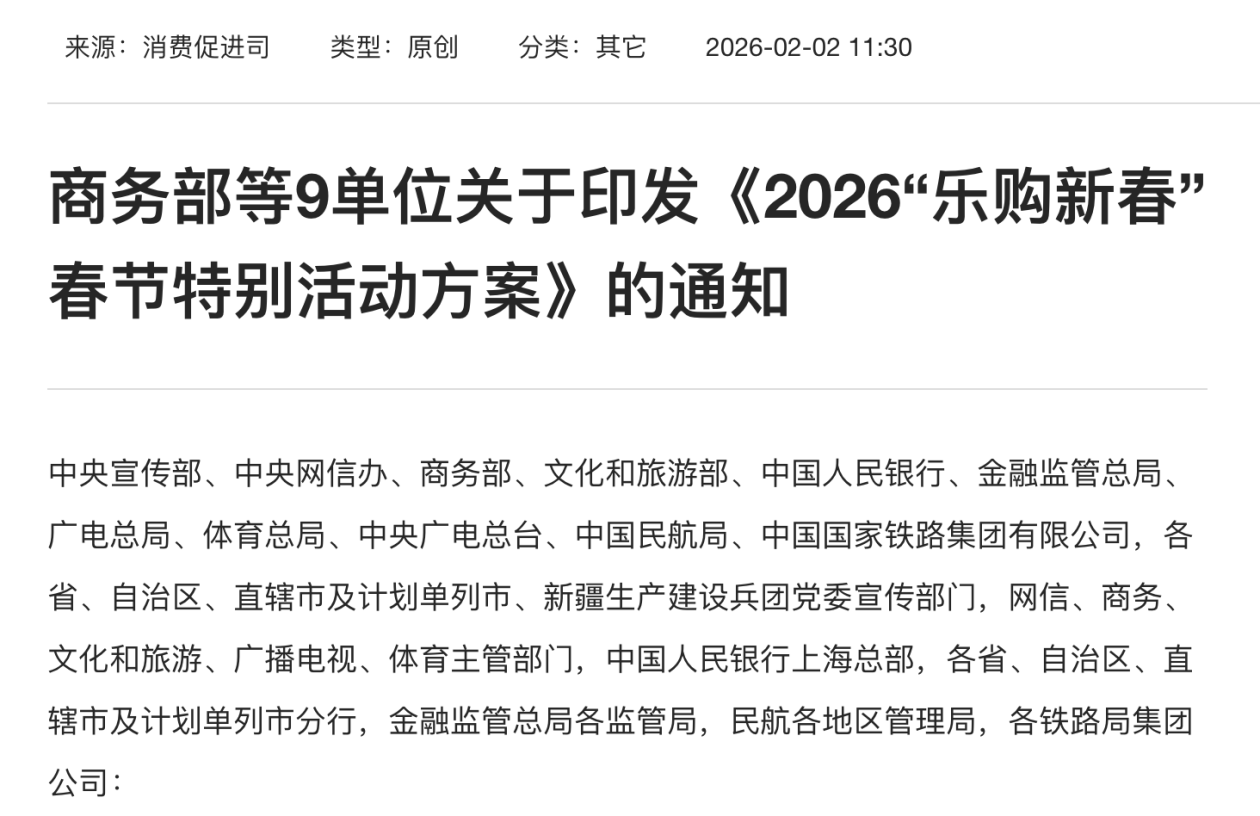
家门口的年货消费“火”起来
Jin Rong Shi Bao· 2026-02-12 02:06
Group 1: Consumer Trends - The approach to purchasing traditional New Year goods has evolved, with community stores and markets providing convenient options for consumers [1][2] - Health-conscious products are gaining popularity, with vendors offering individually packaged and healthier options, such as sugar-free dried fruits and low-sodium products [2][3] - The demand for traditional snacks like dried fruits and preserved meats remains strong, but there is a noticeable shift towards healthier alternatives [2][3] Group 2: Electronics and Home Appliances - 3C home appliances are becoming increasingly popular as New Year gifts, with many families opting to replace old appliances during the festive season [4][5] - The trend of "upgrading" home appliances is supported by government policies encouraging trade-in subsidies for old appliances [6] Group 3: Financial Services - Financial institutions are adapting to the rising demand for consumer goods by providing on-site financial services at markets and stores, including installment payment options [7] - Consumer finance companies are offering zero-interest installment plans to ease the financial burden on consumers during the holiday season [7] - There is a focus on risk management and consumer protection, with institutions implementing measures to prevent over-lending and promote responsible borrowing [7] Group 4: Economic Impact - The vibrant consumer activity during the New Year period reflects a positive economic outlook, contributing to a sense of well-being and consumer confidence [8]
华商基金李卓健:对成长与周期行业继续保持敏锐关注
Xin Lang Cai Jing· 2026-02-12 01:41
Core Viewpoint - The securities market has shown significant structural trends since the beginning of the year, with increasing attention on the economic and industrial development outlook for 2026 and investment opportunities [1][7]. Group 1: Market Outlook - The macroeconomic policy is expected to remain proactive, with growth-stabilizing policies likely to continue, and monetary policy is expected to maintain a steady and loose stance [1][7]. - Despite frequent market concerns regarding the macroeconomic fundamentals, there is a belief in the need for confidence and determination to adapt to potential changes and actively seek allocation opportunities across various industries [1][7]. Group 2: Investment Focus - The company continues to favor growth sectors such as pharmaceuticals and medical devices, defense and military industry, and humanoid robots, while also looking at cyclical industries like non-ferrous metals, steel, and securities for potential returns driven by macroeconomic fluctuations [1][7]. - In the fourth quarter of 2025, the company increased its overall equity position based on a high position from the third quarter, maintaining holdings in sectors like robotics, semiconductors, non-ferrous metals, and finance, while also adding to other cyclical industries [10][11].

美国再加25%关税,特朗普半路开香槟庆祝,中国:抛售700亿美债
Sou Hu Cai Jing· 2026-02-12 01:05
前言 白宫欢庆AI芯片关税大棒落下,以为按下"核按钮"锁死对手未来? 殊不知,大洋彼岸的北京金融街,一场更深远的金融反击已悄然进行:700亿美元美债被静默抛售,这 哪里是贸易战,分明是一场关于美元信用的窒息游戏。 硅谷上空的黑色幽默 让我们先回到那场在华盛顿被视为"胜利"的关税庆典。 现在的硅谷,空气里弥漫的可不是香槟味,而是焦虑烧焦电路板的味道。就在白宫为了"保护本土供应 链"而沾沾自喜时,一张张来自独立机构的财务分析报告,如同冷水泼在了那些科技新贵的脸上。 那个被寄予厚望的25%关税壁垒,在现实的物理世界里撞得粉碎。数据不会撒谎:高达92%的关税成 本,最终并没有像回旋镖一样打在对手身上,而是结结实实地砸在了美国本土进口商的账单里。 你可以想象一下这个画面:一家位于帕洛阿尔托的AI初创公司,原本计划将这季度的预算全部投入大 模型训练,现在却不得不把这笔救命钱划拨给海关账户。对于他们来说,这哪里是保护?这简直是"友 军火力覆盖"。 更讽刺的是物理层面的阻滞。 在这个算力即权力的时代,时间就是一切。但这道行政令,硬生生把原本流畅的物流周期拉长了3-4 周。这三四周的时间,足够竞争对手迭代出一个新的算法版本,而 ...