
生猪养殖

Search documents
生猪:如何理解“不够还有”?
2025-07-02 01:24
Summary of the Conference Call on the Swine Industry Industry Overview - The swine industry has been experiencing a "difficult to drop" trend since May 29, with a need to be cautious of the risks associated with rising stock prices [1][2] - The market sentiment has been overly pessimistic, with expectations that prices will not rise; however, the industry is currently in a phase where prices are "easy to rise but difficult to drop" before August [2] Key Points and Arguments - **Market Performance**: The swine sector's market performance shows uncertainty, particularly regarding the risks of rising stock prices [2] - **Supply-Side Reform**: On May 29, relevant authorities convened discussions with the top 10 enterprises regarding capacity and inventory, with execution results meeting expectations but showing some discounting [3][4] - **Policy Effects**: The overall policy effect is in a neutral state, influenced by the large and dispersed number of farmers, making policy transmission more challenging compared to other industries like solar energy [4] - **Future Market Trends**: The future development of the swine market will depend on the execution strength of policies and market feedback, with a warning about potential risks from rising stock prices [5] Important Data and Trends - **Price Trends**: A significant price change occurred around June 15, with prices dropping in the first half of June and then rebounding to new highs in the second half [6] - **Weight Trends**: Data indicates a continued trend of weight reduction in swine, although there are signs of stockpiling [6] - **Enterprise Responses**: Leading enterprises are actively managing inventory, but responses from breeding sows vary significantly [6] - **Retailer Responses**: Due to difficulties in comprehensive sampling, feedback from small samples shows mixed responses, with both positive and negative behaviors observed [6] Key Factors for Future Market Judgments - The concept of "not enough yet" is crucial for future market judgments, with ongoing discussions among agricultural departments and enterprises focusing on price and capacity [7] - The policy's primary focus is on anti-deflation (80%) and countering internal competition (20%), with pork's significant weight in the Consumer Price Index (CPI) making it a key target for regulation [7] Investment Opportunities - The current environment presents layout opportunities in the swine sector, with a clear positional advantage over the past few years [8] - While caution is advised against excessive optimism, the market requires correction from excessive pessimism, emphasizing the need to be wary of rising risks rather than falling ones [8] Policy Measures - Current policy measures focus on price and capacity, with clear KPIs and monthly data reporting to assess progress [9][10] - Authorities have engaged with both leading and mid-tier enterprises to express regulatory intentions aimed at addressing rising pork CPI pressures while balancing anti-deflation and internal competition goals [10]
上半年生猪养殖端仍存压栏时段 供应压力或再度后置
Qi Huo Ri Bao· 2025-07-02 01:19
Group 1 - Recent fluctuations in live pig futures prices are influenced by the rhythm of livestock sales and market sentiment, with a recent sharp decline following a rebound from low points [2] - The current strong performance of live pig spot prices is attributed to farmers holding back sales and the entry of secondary fattening, while rising temperatures slow weight gain [2][3] - In June, the average trading price of live pigs in China was 14.28 yuan/kg, reflecting a month-on-month decline of 2.16% and a year-on-year decline of 21.81% [2] Group 2 - The overall trend of live pig prices from January to June was characterized by a decline, fluctuation, and subsequent drop, primarily due to abundant supply in the first half of 2025 [3] - Analysts expect a supply lag in the second half of the year, which may impact short-term supply and subsequently depress prices [3] - The current market anticipates price increases ahead of the Mid-Autumn Festival and National Day, providing some support for spot prices [3][4] Group 3 - The increase in pig prices in late June was linked to group enterprises reducing weights and some farmers resuming secondary fattening, despite a generally abundant supply [4] - The demand for pork is expected to decrease as the market enters a consumption lull, limiting the upward momentum for prices [4][5] - In July, there may be a reduction in supply due to some breeding enterprises having room for weight reduction, although most do not plan to reduce weights [5]

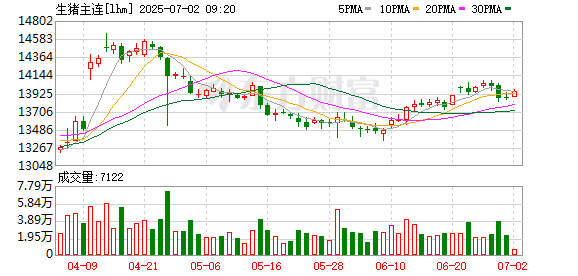
广发证券:优质生猪养殖企业下半年有望继续保持盈利
news flash· 2025-07-02 00:23
智通财经7月2日电,广发证券研报表示,展望下半年,由于前期行业产能回升整体较为温和,估计生猪 出栏量同比小幅增长,预计2025年下半年生猪均价14-16元/公斤,优质养殖企业有望继续保持盈利。 广发证券:优质生猪养殖企业下半年有望继续保持盈利 ...

政策干预催化反转预期,农业板块走强
Mei Ri Jing Ji Xin Wen· 2025-07-01 05:32
Group 1 - The A-share market showed mixed performance with the Shanghai Composite Index up 0.21% at 3451.69 points, while the Shenzhen Component and ChiNext Index fell by 0.32% and 0.58% respectively, with a half-day trading volume of 981.32 billion yuan [1] - The pig price has been declining since Q2 2024, with an increase in both breeding sows and newborn piglets, leading to a potential negative impact on CPI if prices continue to drop, prompting government regulatory concerns [1] - According to Zhongtai Securities, the current market conditions suggest that the stock price of the pig sector is at a bottom level, with low risks of further decline, indicating that any minor positive news could trigger significant price increases [1] Group 2 - Huayuan Securities highlighted that agriculture, as a fundamental sector, is experiencing a rise in investment value due to its unique attributes such as "anti-cyclical asset premium" and "historically low valuations" [2] - The investment approach in the pig sector is shifting from a "cyclical thinking" to a focus on "quality and price," with leading companies expected to have strong profit certainty by 2025 [2] - The Agricultural 50 ETF (516810) closely tracks the CSI Agricultural Theme Index, covering various segments including breeding, agricultural chemicals, and feed, with the top ten weighted stocks accounting for over 60% [2]
东海证券晨会纪要-20250701
Donghai Securities· 2025-07-01 05:25
Group 1 - The report highlights a resilient actual GDP growth forecast of over 5% for Q2 2025, despite nominal GDP pressures due to declining economic data, particularly in real estate investment [6][7] - The report emphasizes the importance of domestic demand and technology as key investment themes, especially in light of the upcoming political bureau meeting that will outline economic policies for the second half of the year [7][8] - The agricultural sector, particularly pig farming, is expected to see a price increase due to reduced supply pressure and improved profitability, with specific companies like Muyuan Foods and Wens Foodstuffs recommended for investment [8][9][10] Group 2 - The pharmaceutical and biotechnology sector is gradually stabilizing, with a reported revenue of CNY 795.03 billion in the first four months of 2025, a year-on-year decline of 2.1% [12][13] - The report notes a significant increase in the number of innovative drug projects and collaborations, with 51 innovative drug projects worth over USD 48 billion completed in the first five months of 2025 [13][14] - Investment recommendations include focusing on innovative drug companies with differentiated products and strong potential for international expansion, such as Kelun Pharmaceutical and Betta Pharmaceuticals [14][27] Group 3 - The basic chemical sector is experiencing a recovery, with the SW basic chemical index outperforming the market, driven by a decrease in raw material costs and potential supply-side reforms [16][17] - Companies with strong cost advantages and those involved in supply-side reforms, such as Hoshine Silicon Industry and Zhejiang Longsheng, are highlighted as potential investment opportunities [18][19] - The report also points to new consumer trends driving demand for health additives and domestic substitutes in the chemical materials sector, with companies like Jinfa Technology and Shengquan Group recommended for investment [19] Group 4 - The electronics sector is witnessing a recovery, with Xiaomi's launch of its first AI glasses and other innovative products expected to strengthen its market position [20][21] - The report indicates a 4.61% increase in the electronic index, outperforming the broader market, with specific focus on AI-driven sectors and semiconductor equipment as key investment areas [22][23] - Recommended companies include companies benefiting from strong domestic and international demand in the AIOT field, such as Espressif Systems and Rockchip Electronics [23] Group 5 - The GLP-1 drug market is gaining attention with the approval of the first dual-target weight loss drug in China, which is expected to drive further interest in the sector [24][26] - The report notes that the pharmaceutical sector's overall performance has been mixed, with a 1.60% increase in the biopharmaceutical index, but specific segments like medical services and devices are performing well [25][27] - Investment suggestions include focusing on companies involved in innovative drug development and medical devices, such as Betta Pharmaceuticals and Yao Ming Pharmaceutical [27][28]
7月1日早间重要公告一览
Xi Niu Cai Jing· 2025-07-01 03:51
Group 1 - Kanghong Pharmaceutical received a drug registration certificate for Lifisig Eye Drops, approved for treating dry eye symptoms [1] - Kanghong Biotech, a wholly-owned subsidiary, received clinical trial approval for KH813 injection for metastatic non-squamous non-small cell lung cancer [1] - Kanghong Pharmaceutical was established in October 1996, focusing on drug and medical device research, production, and sales [1] Group 2 - Guoyuyuan's subsidiary received a government subsidy of 7.5521 million yuan, accounting for 10.14% of the company's audited net profit for 2024 [2] - Guoyuyuan was founded in November 1996, specializing in drug research, production, and sales [3] Group 3 - Haicheng Bonda's subsidiary signed a lease termination agreement, incurring a termination fee of 3.35 million USD [4] - Haicheng Bonda was established in December 2009, providing comprehensive modern logistics services [4] Group 4 - Hongxin Electronics' subsidiary signed contracts totaling 373 million yuan for computing power business [5] - Hongxin Electronics was founded in September 2003, focusing on FPC research, design, manufacturing, and sales [6] Group 5 - Tianbang Food reached a settlement agreement regarding a 1.214 billion yuan lawsuit, agreeing to repay 410 million yuan over 36 months [8] - Tianbang Food was established in September 1996, specializing in pig farming and pork processing [9] Group 6 - Daoshi Technology's controlling shareholder plans to reduce holdings by up to 1.97% of the company's shares [10] - Daoshi Technology was founded in September 2007, focusing on ceramic color glazes and related products [10] Group 7 - Jinpu Titanium is planning a major asset restructuring, leading to a stock suspension [10] - Jinpu Titanium was established in November 1989, specializing in titanium dioxide production and sales [11] Group 8 - Shenzhen Energy plans to invest 6.332 billion yuan in upgrading the Mawan Power Plant [12] - Shenzhen Energy was founded in August 1993, focusing on conventional and renewable energy development [13] Group 9 - Lihua Co. plans to reduce holdings by up to 3% of the company's shares [14] - Lihua Co. was established in June 1997, specializing in the breeding and sales of poultry [15] Group 10 - China Communications Construction Company plans to repurchase shares worth 500 million to 1 billion yuan [16] - China Communications Construction Company was founded in October 2006, focusing on infrastructure design and construction [17] Group 11 - Huatiankeji's subsidiary received a government subsidy of 80.6569 million yuan, accounting for 13.09% of the company's latest audited net profit [20] - Huatiankeji was established in December 2003, specializing in integrated circuit packaging and testing [21] Group 12 - Luxin Chuangtou plans to acquire shares in Hongke Electronics for a total of 9 million yuan [23] - Luxin Chuangtou was founded in November 1993, focusing on venture capital and industrial development [24] Group 13 - Feilong Co.'s controlling shareholder plans to reduce holdings by up to 563,250 shares [25] - Feilong Co. was established in January 2001, specializing in thermal management components for automotive and civil applications [26] Group 14 - Linglong Tire submitted an application for H-share listing on the Hong Kong Stock Exchange [27] - Linglong Tire was founded in June 1994, focusing on tire design, development, manufacturing, and sales [27] Group 15 - Saiwei Electronics plans to acquire 9.5% of its subsidiary's shares for up to 324 million yuan [28] - Saiwei Electronics was established in May 2008, focusing on MEMS chip development and semiconductor equipment [28] Group 16 - Suzhou Bank's major shareholder plans to increase holdings by no less than 400 million yuan [29] - Suzhou Bank was founded in December 2004, focusing on various banking services [29]





农业策略报:?末缩量,?猪期现背离
Zhong Xin Qi Huo· 2025-07-01 03:31
1. Report Industry Investment Ratings - **Oils and Fats**: Weakening with fluctuations [5] - **Protein Meal**: Fluctuating [7] - **Corn and Starch**: Fluctuating [8][9] - **Hogs**: Fluctuating [2][9] - **Natural Rubber**: Fluctuating horizontally [9][10][11] - **Synthetic Rubber**: Maintaining range-bound fluctuations [12] - **Cotton**: Fluctuating in the short term, with a reference range of 13,500 - 14,300 yuan/ton [13] - **Sugar**: Weakening with fluctuations in the long term, rebounding with fluctuations in the short term [14][16] - **Pulp**: Fluctuating, with a weakening bias [17] - **Logs**: Weakening with fluctuations [18] 2. Core Views of the Report - **Overall**: The report analyzes the market conditions of multiple agricultural products, including oils and fats, protein meal, corn, hogs, rubber, cotton, sugar, pulp, and logs. It assesses the supply - demand situation, price trends, and future outlooks for each product [2][5][7][8][9][10][13][14][17][18]. - **Short - term Outlook**: Most products are expected to show a trend of fluctuating, with some having a weakening or strengthening bias. For example, oils and fats are expected to weaken with fluctuations, while protein meal is expected to fluctuate [5][7]. - **Long - term Outlook**: Some products, such as hogs and sugar, are in a downward cycle or face supply - driven downward pressure in the long term [2][16]. 3. Summary by Relevant Catalogs 3.1 Oils and Fats - **Industry Information**: In 2025, Canada's rapeseed planting area decreased by 2.5% year - on - year. The US soybean planting is completed, and its growth is good. CNPE will raise Brazil's biodiesel blending ratio from 14% to 15% on August 1. China's imported soybean arrivals are large, and domestic soybean oil inventory is rising. The expected increase in palm oil production in June is limited, and export expectations are optimistic. Domestic rapeseed oil inventory is slowly declining but remains high [5]. - **Logic**: Due to technical rebounds, last Friday, US soybeans fluctuated strongly, while US soybean oil fluctuated weakly. Yesterday, China's three major oils and fats fluctuated weakly. Considering the macro - environment and industrial factors, oils and fats are expected to continue to weaken with fluctuations [5]. - **Outlook**: Oils and fats may continue to weaken with fluctuations in the near term, but the effectiveness of the lower technical support needs attention [5]. 3.2 Protein Meal - **Industry Information**: On June 30, 2025, international soybean trade premiums and discounts showed different changes. China's imported soybean crushing profit increased week - on - week and year - on - year [6]. - **Logic**: Internationally, US soybeans are in a range - bound fluctuation. Domestically, soybean arrivals are increasing, oil mill inventories are rising, and downstream replenishment is insufficient, leading to supply pressure. In the long term, the consumption demand for soybean meal may increase steadily [7]. - **Outlook**: US soybeans are expected to maintain range - bound fluctuations. Domestic soybean meal inventories continue to accumulate. Oil mills can sell on rallies, and downstream enterprises can buy basis contracts or price at low prices after price drops [7]. 3.3 Corn and Starch - **Industry Information**: According to Mysteel, the FOB price at Jinzhou Port remained unchanged, and the domestic average corn price increased by 4 yuan/ton [8]. - **Logic**: Today, China's corn prices mainly rose. The remaining vehicles at North China's deep - processing enterprises decreased due to continuous rainy weather, and the purchase price increased. The demand for corn is being squeezed by wheat, and there are rumors of policy grain auctions [8][9]. - **Outlook**: Driven by the expected supply - demand gap, the price has an upward trend, but there may be corrections due to potential negative impacts from policy grain auctions [9]. 3.4 Hogs - **Industry Information**: On June 30, the spot price of hogs in Henan increased by 0.6% month - on - month, while the futures closing price decreased by 0.96% month - on - month [9]. - **Logic**: At the end of the month, the slaughter rhythm of farms slowed down, and the spot price rose, but the futures faced high - capacity and high - inventory pressure. In the short term, the average slaughter weight is decreasing, but the utilization rate of fattening pens is increasing. In the long term, the production capacity remains high, and the supply is expected to increase in the second half of the year [2][9]. - **Outlook**: The price is expected to fluctuate. Recently, the average slaughter weight is slowly decreasing, but farmers' fattening profit still attracts them to hold back hogs. Currently in the off - season of consumption, the price mainly fluctuates [2][9]. 3.5 Natural Rubber - **Industry Information**: On June 30, the prices of various rubber products in the Qingdao Free Trade Zone and the Thai raw material market showed different changes [9][10]. - **Logic**: The external environment has changed little, and rubber prices are fluctuating horizontally. The raw material price is relatively firm, providing strong support at the bottom. The supply is expected to increase, while the demand is expected to decrease [10][11]. - **Outlook**: Before the fundamentals provide clear guidance, rubber prices may continue to fluctuate with the overall commodity market [11]. 3.6 Synthetic Rubber - **Industry Information**: The spot prices of butadiene rubber and butadiene in different regions showed different changes [12]. - **Logic**: Recently, the macro - sentiment has been relatively positive, and the BR market has maintained range - bound fluctuations. The overall operating level has dropped to the lowest since May, and inventories have slightly increased [12]. - **Outlook**: The external situation may be temporarily controllable, and the market correction may not be over. Attention should be paid to the previous low support [12]. 3.7 Cotton - **Industry Information**: As of June 30, the number of registered cotton warrants in the 24/25 season was 10,273, and the closing price of Zhengzhou cotton 09 was 13,740 yuan/ton, a decrease of 20 yuan/ton [13]. - **Logic**: In the 25/26 season, cotton production in China and other major producing countries is expected to increase. The downstream is in the off - season, and the demand is weak. The current commercial inventory is at a relatively low level, which provides support for the price [13]. - **Outlook**: In the short term, cotton prices are expected to fluctuate within the range of 13,500 - 14,300 yuan/ton [13]. 3.8 Sugar - **Industry Information**: As of June 30, the closing price of Zhengzhou sugar 09 was 5,807 yuan/ton, an increase of 15 yuan/ton [14]. - **Logic**: Domestically, the 24/25 sugar production season has ended, and the sales rate is high, but there is an expectation of concentrated arrivals of imported sugar. Internationally, the new sugar seasons in Brazil, India, and Thailand are expected to have increased production [14][16]. - **Outlook**: In the long term, due to the expected increase in supply, sugar prices are expected to weaken with fluctuations. In the short term, they are expected to rebound with fluctuations [16]. 3.9 Pulp - **Industry Information**: On the previous trading day, the prices of various pulp products in Shandong showed different changes [17]. - **Logic**: Pulp imports remain high, and prices are in a downward trend. Demand is in the off - season, and downstream paper enterprises' inventories are increasing. The US dollar price is continuously falling, and the pulp market is facing downward pressure [17]. - **Outlook**: Due to weak supply - demand and potential positive impacts from changes in delivery rules, pulp futures are expected to fluctuate [17]. 3.10 Logs - **Industry Information**: The spot prices of logs in Jiangsu and Shandong remained stable, and the futures price of LG2507 decreased [18]. - **Logic**: Yesterday was the last trading day before the first log contract LG2507 entered the delivery month, and the price fluctuated and declined. The total inventory decreased, and the market is in the off - season. In the short term, the fundamentals are in a weak balance [18]. - **Outlook**: In the medium term, the market will gradually return to being dominated by fundamentals, and the far - month prices are expected to be weak [18].
山西证券研究早观点-20250701
Shanxi Securities· 2025-07-01 01:27
Market Trends - The domestic market indices showed positive performance with the Shanghai Composite Index closing at 3,444.43, up by 0.59%, indicating an expected improvement in supply and demand conditions [4] Agricultural Industry - The agricultural sector saw a weekly increase in the Shanghai and Shenzhen 300 Index by 1.95%, with the agriculture, forestry, animal husbandry, and fishery sector rising by 0.80% [9] - Pig prices increased week-on-week, with average prices in key provinces such as Sichuan, Guangdong, and Henan at 13.90, 15.94, and 14.88 CNY/kg respectively, reflecting increases of 1.46%, 2.57%, and 3.48% [9] - The report highlights the potential for Hai Da Group as an investment opportunity due to expected recovery in the feed industry driven by lower raw material prices and improving breeding conditions [7][9] Chemical Pharmaceutical Industry - BGB-43395, a CDK4 inhibitor developed by BeiGene, shows promising initial efficacy and safety in treating previously treated breast cancer and solid tumor patients [10] - The drug exhibits high selectivity for CDK4 and is expected to enter Phase III trials for HR+/HER2- metastatic breast cancer, with the second-line study anticipated to start in Q4 2025 [10][11] - The global market for CDK4/6 inhibitors is projected to reach approximately $13 billion by 2024, indicating significant growth potential for BGB-43395 [10] Textile and Apparel Industry - Bosideng reported a revenue of 25.902 billion CNY for FY2024/25, a year-on-year increase of 11.6%, with a net profit of 3.514 billion CNY, up 14.3% [11][15] - The brand's down jacket business showed steady growth, with revenue from this segment reaching 21.668 billion CNY, a 11.0% increase year-on-year [11] - The company opened 253 new stores, enhancing its operational capabilities and channel management [12][15] Photovoltaic Glass Industry - Major photovoltaic glass manufacturers plan to collectively reduce production by 30% starting in July, which is expected to improve the supply-demand balance in the market [14][16] - The report recommends leading photovoltaic glass companies such as Fuyao Glass and Xinyi Solar as potential investment opportunities due to anticipated improvements in market conditions [14]
大消费行业2025年7月金股推荐
Changjiang Securities· 2025-06-30 14:41
Investment Rating - The report recommends a "Buy" rating for the highlighted stocks in the consumer sector, indicating a positive outlook for their performance in the coming years [8][12][13][14][18][19][20]. Core Insights - The report identifies nine key advantageous industries within the consumer sector, including agriculture, retail, social services, automotive, textiles and apparel, light industry, food, home appliances, and pharmaceuticals, with specific stock recommendations for each [4][8]. - The report emphasizes the potential for growth in the consumer sector, driven by factors such as market recovery, digital transformation, and international expansion strategies [11][12][13][14][17][20]. Summary by Relevant Categories Agriculture - Recommended stock: Muyuan Foods (牧原股份) with a projected net profit of 20.1 billion, 20.3 billion, and 34.1 billion for 2025-2027, respectively [11]. Retail - Recommended stock: Maogeping (毛戈平) with expected adjusted net profits of 1.17 billion, 1.50 billion, and 1.86 billion for 2025-2027, respectively [12]. Social Services - Recommended stock: Xiaocaiyuan (小菜园) with projected net profits of 703 million, 837 million, and 1.01 billion for 2025-2027, respectively [13]. Automotive - Recommended stock: Yutong Bus (宇通客车) with expected net profits of 4.82 billion, 5.60 billion, and 6.23 billion for 2025-2027, respectively [14]. Textiles and Apparel - Recommended stock: HLA (海澜之家) with projected net profits of 4.6 billion, 5.0 billion, and 5.8 billion for 2025-2027, respectively [14]. Light Industry - Recommended stock: Pop Mart (泡泡玛特) with expected net profits of 330 million, 610 million, and 850 million for 2025-2027, respectively [17]. Food - Recommended stock: Kweichow Moutai (会稽山) with projected earnings per share (EPS) of 0.48, 0.58, and 0.67 for 2025-2027, respectively [18]. Home Appliances - Recommended stock: Anker Innovations (安克创新) with expected net profits of 2.506 billion, 3.052 billion, and 3.689 billion for 2025-2027, respectively [19]. Pharmaceuticals - Recommended stock: Innovent Biologics (信达生物) focusing on innovative drug development with significant potential in oncology and autoimmune diseases [20].



农林牧渔行业周报:宠物保持高景气度,生猪板块布局底部-20250630
Guohai Securities· 2025-06-30 13:32
Investment Rating - The report maintains a "Recommended" rating for the agriculture, forestry, animal husbandry, and fishery industry [1][61]. Core Views - The report highlights that the pig price may experience a turning point due to seasonal factors and policy changes, suggesting a bottoming out phase for the sector [2][12]. - The poultry sector is seeing price declines, but there are signs of marginal improvements in the cycle [3][24]. - The animal health sector is expected to see performance recovery, and there are investment opportunities in the pet medical industry [4][35]. - The planting sector is witnessing a week-on-week rebound in grain prices [5][43]. - The feed sector is experiencing price fluctuations, with a general downward trend [6][46]. - The pet economy is thriving, with domestic brands gaining strength [7][51]. Summary by Sections Pig Industry - The average pig price is currently fluctuating between 14-15 CNY/kg, with a notable increase in average weights compared to previous years [11][12]. - The report recommends focusing on companies with low costs and strong financial health, such as Wens Foodstuffs, Muyuan Foods, and Juxing Agriculture [12][61]. Poultry Industry - The poultry prices are declining, with the white feather chicken price at 3.48 CNY/jin, showing a slight decrease [24][25]. - The report recommends companies like San Nong Development and Yisheng Livestock, while suggesting to pay attention to He Feng and Minhe Livestock [25][61]. Animal Health - The animal health sector is expected to recover, supported by the profitability of the pig farming industry [35][36]. - The pet medical market is projected to grow, with a market size of approximately 840 billion CNY, representing 28% of the pet industry [4][35]. Planting Sector - Grain prices are showing a week-on-week increase, with corn priced at 2353 CNY/ton and wheat at 2446 CNY/ton [43][44]. - The report suggests focusing on companies involved in genetically modified seeds, such as Suqian Agricultural Development and Longping High-tech [43][61]. Feed Sector - Feed prices are experiencing a downward trend, with pig feed at 3.36 CNY/kg [46][47]. - The report recommends Hai Da Group and suggests paying attention to He Feng [47][61]. Pet Industry - The pet market is expected to reach a scale of 300.2 billion CNY in 2024, with a growth rate of 7.5% [51][52]. - The report recommends companies in the pet food sector like Guobao Pet and Zhongchong Co., and in the pet medical sector, it recommends Ruipu Biological [55][61].


