食品

Search documents
(进博故事)葡企逐梦进博 叩响“机遇之门”
Zhong Guo Xin Wen Wang· 2025-07-09 17:38
Group 1 - Portuguese products, especially wine and olive oil, are increasingly favored by Chinese consumers, with growing attention year by year [1][2] - The China International Import Expo (CIIE) has proven beneficial for Portuguese companies, facilitating transactions and establishing new relationships [2][5] - The participation of Portuguese companies in CIIE has increased, with many companies expressing high enthusiasm for the event [3][5] Group 2 - The CIIE provides an opportunity for Portuguese companies to understand the Chinese market and consumer trends, making it a strategic first step for market entry [6][10] - Portuguese companies have successfully established business connections and initial cooperation intentions with Chinese e-commerce platforms like Tmall International [5][8] - The event has significantly enhanced the visibility of Portuguese brands in China, with many companies reporting substantial sales growth after participating [8][10] Group 3 - There is a strong desire among Portuguese companies to expand cooperation beyond the food industry, particularly in technology innovation and renewable energy [10][11] - The collaboration potential between China and Portugal in emerging industries such as blue economy and electric vehicles is highlighted, with both countries emphasizing technological innovation and green development [10][11] - The eighth CIIE is expected to attract more Portuguese enterprises, showcasing their products and exploring new market opportunities in China [11]


上市公司“宠股东”动作不断 股东回报机制日趋多元化
Zheng Quan Ri Bao· 2025-07-09 15:48
Group 1 - Companies are increasingly adopting innovative shareholder return methods beyond traditional dividends and buybacks, such as offering tickets, gift boxes, and hotel stays to enhance shareholder engagement [1][2] - Beijing Yingxin Development Co., Ltd. announced a shareholder return activity, allowing eligible shareholders to purchase discounted tickets and hotel stays at its theme park, aiming to express gratitude and promote its main business [1] - Gai Shi Food Co., Ltd. and Shui Yang Group Co., Ltd. also launched similar initiatives, providing summer gift boxes and beauty product gift sets to shareholders, thereby enhancing brand experience and gathering feedback [2] Group 2 - The trend of "scenario-based and brand-oriented" shareholder return models is seen as beneficial for increasing brand recognition and investment loyalty [3] - Experts suggest that more companies may integrate shareholder returns into their market value management systems, fostering a new ecosystem of "interaction, recognition, and win-win" relationships with shareholders [3]


复盘供给侧改革:“反内卷”如何催生产能出清主升浪
Changjiang Securities· 2025-07-09 15:23
Group 1 - The report emphasizes the need to regulate low-price disorderly competition among enterprises and promote the orderly exit of backward production capacity, aiming to address the issue of "involution" in market competition [2][8] - Historical cases show that supply-side clearance driven by policy typically begins with market expectations, while the main upward trend requires improvements in industry structure to support cash flow and balance sheet recovery [8][10] - The current round of overcapacity is primarily concentrated in mid- and downstream industries, unlike the previous cycle which was focused on upstream resource sectors [9][10] Group 2 - The report suggests focusing on two main strategies: industries that have experienced prolonged supply-side clearance and are likely to see improvements in supply-demand dynamics, and industries that may benefit from policy-driven accelerated clearance [10][11] - For natural clearance, the report recommends monitoring demand-side indicators for upstream industries and supply-side indicators for mid- and downstream sectors, highlighting sectors such as agricultural chemicals, general machinery, pharmaceuticals, and components [10] - For policy-driven clearance, attention should be given to industries mentioned in recent policies aimed at addressing "involution," including photovoltaic, lithium batteries, automobiles, and cement [10][17]
通胀数据快评CPI同比转正
Guoxin Securities· 2025-07-09 13:29
Inflation Data Summary - In June, China's CPI turned positive at +0.1% year-on-year, a recovery from -0.1% in May, marking the first positive reading since January 2025[3] - The month-on-month CPI decreased by -0.1%, an improvement from the previous month's decline of -0.2%[3] - Core CPI rose to +0.7% year-on-year in June, up from +0.6% in May, while month-on-month core CPI remained unchanged at 0%[3] PPI Analysis - June's PPI decreased by -3.6% year-on-year, a decline of 0.3 percentage points from the previous month, marking the lowest level since August 2023 and the 33rd consecutive month of negative growth[9] - Month-on-month PPI fell by -0.4%, continuing a trend of negative growth for seven consecutive months, which is weaker than the historical average of -0.1%[9] Key Drivers and Trends - The positive CPI was primarily driven by clothing, household goods, and services, with household goods benefiting from consumption incentives[4] - Food prices decreased by -0.4% month-on-month, with pork prices significantly dropping from +3.1% to -8.5% year-on-year[4] - The international oil price recovery, influenced by geopolitical tensions, supported domestic gasoline prices, which shifted from -3.7% to +0.3% month-on-month[4] Future Outlook - The current inflation rate is still far from the annual target of 2%, indicating a need for further policy support to stabilize domestic demand[12] - The core CPI is expected to remain a key support for prices under existing policies, while industrial product prices may require additional measures to improve[12]
市场监管总局公布十起违法广告典型案例,涉及医美、物流等领域
news flash· 2025-07-09 08:28
Core Viewpoint - The national market regulatory authorities have intensified efforts to combat illegal advertising to prevent unfair competition and maintain an orderly advertising market, resulting in the investigation of 14,315 illegal advertising cases and fines totaling 101 million yuan by May 2025 [1] Group 1: Case Summaries - Chengdu Chenghua Hanhou Medical Beauty Hospital was fined 409,800 yuan for misleading claims about the efficacy of its medical beauty projects during live e-commerce promotions [2] - Shiyie (Zhengzhou) Network Technology Co., Ltd. was fined 200,000 yuan for false advertising regarding its medical device, claiming it could eliminate pain for three years [3] - Anhui Quankang Pharmaceutical Co., Ltd. was fined 210,000 yuan for misleading advertising about its health food products, claiming production capabilities and experience that were not accurate [4] - Hangzhou Xunyou Trading Co., Ltd. was fined 175,500 yuan for advertising a cosmetic product with misleading claims about its effectiveness in treating skin allergies [5] - Guangzhou Qihuang Medical Culture Media Co., Ltd. was fined 135,000 yuan for promoting ordinary food products with claims of treating various medical conditions [6] - Shanghai Yimo Health Management Co., Ltd. was fined 100,000 yuan for advertising ordinary food products with misleading health claims [7][8] - Qingdao Kemanqi Trading Co., Ltd. was fined 100,000 yuan for fabricating consumer testimonials regarding the effectiveness of its product in treating ailments [9] - Haikou Huaxiatong Logistics Service Co., Ltd. was fined 200,000 yuan for spreading false information about the transportation of new energy vehicles [10] - Jiangxi Tongchuang Xinxin Marketing Planning Co., Ltd. was fined 100,000 yuan for misleading advertising related to a real estate project that was not yet operational [11] - Zhongzhi Wireless (Beijing) Technology Co., Ltd. was fined 100,000 yuan for false advertising regarding mobile data plans [12]
CPI边际改善,PPI持续承压
Cai Jing Wang· 2025-07-09 06:08
Group 1: CPI Marginal Improvement - In June, the CPI showed a marginal improvement with a year-on-year increase of 0.1%, reversing a three-month trend of -0.1%, primarily driven by rising domestic fuel prices and a rebound in durable goods prices [2] - Food prices performed better than seasonal averages, with fresh vegetable prices increasing by 0.7% month-on-month, compared to a historical average decline of -3.9% [2] - Energy prices saw a month-on-month increase of 0.1% in June, recovering from a previous decline of -1.7%, influenced by rising international oil prices due to geopolitical tensions [2][3] Group 2: PPI Continued Pressure - The PPI decreased by 0.4% month-on-month in June, marking the seventh consecutive month of negative growth, with a year-on-year decline of 3.6%, the largest drop since August 2023 [4] - The decline in production material prices was a significant factor, with a month-on-month decrease of 0.6%, compared to a historical average of -0.1% [4] - Life goods prices remained sluggish, with a month-on-month decrease of 0.1%, reflecting weak seasonal performance [4] Group 3: Future Price Outlook - CPI is expected to show a mild recovery, with an annual increase projected around 0%, higher than the first half's average of -0.1% [5] - Core CPI is anticipated to rise by approximately 0.6% for the year, supported by policies aimed at improving supply-demand structures [6] - PPI is expected to remain under pressure, with an annual decline projected at around -2.3%, an improvement from the first half's -2.8% [6] Group 4: International and Domestic Commodity Trends - Internationally, commodity prices are expected to show increased divergence and reduced volatility, with oil prices likely to continue declining due to OPEC+ production increases and weakening global demand [7] - Domestically, weak internal demand persists, particularly in real estate and infrastructure investments, which are not expected to drive resource prices upward [7] - The manufacturing sector is facing challenges with low capacity utilization, indicating a phase of oversupply in certain industries [7]
从“大美丽法案”到关税新信函,海外变局下的应对与思考
Sou Hu Cai Jing· 2025-07-09 01:02
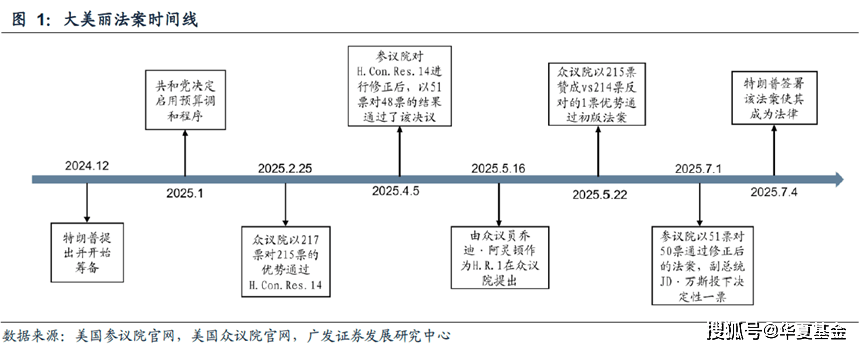
Group 1 - The "One Big Beautiful Bill Act" (OBBB) was signed by Trump on July 4, 2025, marking a significant legislative change in the U.S. [1][2] - The OBBB focuses on three main areas: large-scale tax cuts, adjustments to government spending, and an increase in the debt ceiling to $5 trillion, which is the largest adjustment in U.S. history [4][8] - The act has a dual impact on various industries, providing significant tax benefits to traditional energy, manufacturing, real estate, defense, agriculture, and semiconductors, while reducing incentives for clean energy, electric vehicles, healthcare, and food sectors [4][5] Group 2 - The Federal Reserve has paused interest rate cuts four times, with market expectations leaning towards two rate cuts by the end of the year, likely starting in September [10][12] - Trump's administration is advocating for immediate rate cuts to manage the increased debt from the OBBB and to counter potential economic stagnation due to tariffs and immigration policies [12][16] - The current economic environment presents challenges for the Fed, including fiscal expansion, changing economic fundamentals, and uncertainties from tariffs, which complicate the decision-making process [16] Group 3 - The expiration of tariff exemptions on July 9, 2025, has led to renewed concerns about global trade dynamics, with Trump announcing new tariffs on imports from 14 countries starting August 1 [17][19] - The ongoing trade negotiations, particularly between the U.S. and China, are expected to continue until August 12, 2025, amidst fluctuating market reactions to Trump's tariff strategies [20][21] Group 4 - The investment landscape is undergoing a profound transformation, with a shift from "American exceptionalism" to a more regionalized global economy, necessitating a reevaluation of asset allocation strategies [22][24] - Investors are encouraged to adopt a diversified approach to mitigate uncertainty, focusing on sectors aligned with emerging trends such as AI and high-end manufacturing [25][26] - Maintaining liquidity and a long-term investment perspective is crucial for navigating the current market volatility and capitalizing on future opportunities [27][28][30]
2025年上半年德国初创企业数量增长9%
Zhong Guo Xin Wen Wang· 2025-07-08 21:16
Group 1 - The report indicates that the number of newly established startups in Germany is projected to reach 1,500 by the first half of 2025, representing a 9% increase compared to the second half of 2024, continuing a steady growth trend [1] - Berlin and Munich remain leading international entrepreneurial hotspots in terms of per capita startup activity, while cities like Heidelberg, Darmstadt, and Aachen contribute significantly to the startup ecosystem [1] - Saxony leads the country with a 71% increase in startup growth, followed by Bavaria (23%) and North Rhine-Westphalia (16%), highlighting these regions as key drivers of Germany's overall entrepreneurial ecosystem [1] Group 2 - The software industry dominates with 368 startups, showing a 16% growth compared to the previous half-year, while industrial solutions, particularly AI-driven automation technologies, exhibit strong growth at 29% [1] - The previously challenged B2C sector is recovering, with the food industry seeing a 44% increase in startup numbers and the e-commerce sector growing by 14% [1] - Germany's solid innovation foundation and robust entrepreneurial ecosystem are reaffirmed, with high-quality talent, strong R&D capabilities, and a favorable attitude towards new technologies making it an ideal location for tech startups [2]
食品饮料行业双周报:食饮板块分化,关注阿洛酮糖新机遇-20250708
Guoyuan Securities· 2025-07-08 13:31
Investment Rating - The report maintains a "Recommended" rating for the food and beverage industry [5] Core Insights - The food and beverage sector in A-shares has underperformed compared to major indices, with a decline of 0.27% over the past two weeks, lagging behind the Shanghai Composite Index by 3.62 percentage points [2][13] - The approval of D-Tagatose by the National Health Commission presents a new opportunity in the sugar substitute market, as it is a natural sweetener with lower calories compared to sucrose [4][62] - The dairy industry is showing signs of stabilization, with efforts to alleviate challenges and improve quality [4][62] Summary by Sections Market Review - The A-share food and beverage industry fell by 0.27% from June 23 to July 4, underperforming the Shanghai Composite Index by 3.62 percentage points and the Shenzhen Component Index by 5.30 percentage points [2][13] - Within the sector, baking products (+3.67%), health products (+3.50%), and meat products (+1.54%) saw the highest gains, while soft drinks (-2.21%), beer (-2.10%), and snacks (-1.84%) experienced the largest declines [2][13] Key Data Tracking - As of July 4, the price of Feitian Moutai was 1,955 RMB for original boxes and 1,865 RMB for bulk, showing a decrease of 35 RMB and 65 RMB respectively from two weeks prior [3][29] - The average price of fresh milk in major production areas was 3.04 RMB/kg, down 7.0% year-on-year [40][43] Key Events Tracking - The approval of D-Tagatose as a new food ingredient opens up opportunities in the sugar substitute market, with its sweetness being about 70% that of sucrose but with only 10% of the calories [4][62] - The Ministry of Agriculture emphasized the need to support the dairy industry, indicating a positive trend towards recovery [4][62] Investment Recommendations - In the white liquor segment, it is advised to focus on high-end brands with strong market positions such as Kweichow Moutai and Wuliangye, as well as regional leaders with favorable competitive dynamics [9][64] - For consumer goods, there is a growing interest in yellow wine, and beer consumption is entering its peak season, with high demand in snack foods and energy drinks [9][64]
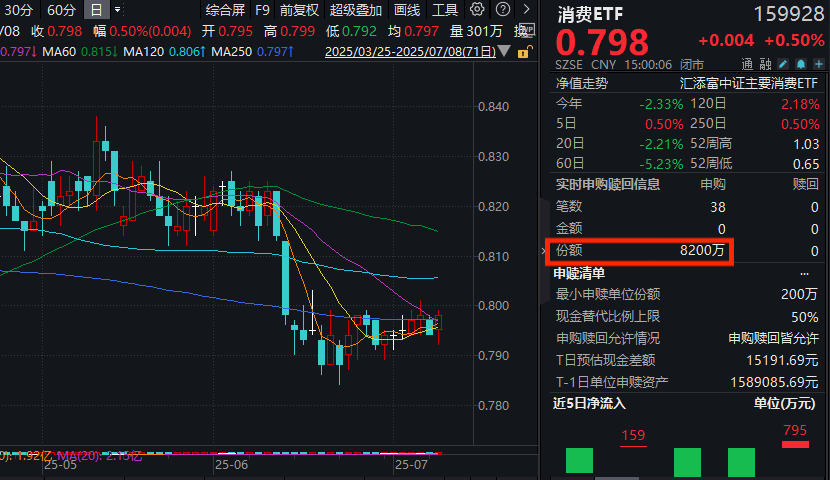
燕京啤酒绩后涨超2%,持续看好国内消费复苏潜力!消费ETF(159928)收涨0.5%,连续两日吸金!机构:新消费短期回调不改长期趋势!
Xin Lang Cai Jing· 2025-07-08 09:49
Core Viewpoint - The A-share market is experiencing a collective rise, with the Shanghai Composite Index nearing a new high for the year, driven by strong performance in the consumption sector, particularly the Consumption ETF (159928) which has seen significant inflows and positive stock performance among its constituent companies [1][3]. Group 1: Market Performance - The Shanghai Composite Index is close to reaching 3500 points, marking a new high for the year [1]. - The Consumption ETF (159928) recorded a 0.5% increase with a total trading volume of 239 million yuan, and it has seen a net subscription of 82 million units over two consecutive days, bringing its total size to over 11.9 billion yuan [1][3]. Group 2: Company Performance - Yanjing Beer reported a strong first-half earnings forecast, projecting a net profit of 1.062 to 1.137 billion yuan for the first half of 2025, representing a year-on-year growth of 40% to 50% [3]. - In the second quarter of 2025, Yanjing Beer expects a net profit of 896 million to 972 million yuan, reflecting a year-on-year increase of 37% to 48% [3]. Group 3: Consumer Trends - The "618" shopping festival demonstrated significant growth in domestic consumption, with platforms like JD and Tmall leading in various categories, indicating a robust recovery in consumer spending [4]. - The promotion of "old-for-new" policies in the home appliance and 3C sectors has driven increased foot traffic in stores, with a year-on-year increase of 105% [4]. Group 4: Industry Insights - The new consumption trend is expected to continue despite short-term adjustments, with a focus on low-valuation stocks that have potential catalysts [7]. - The food and beverage sector is highlighted as a key area for investment, with ongoing structural adjustments providing opportunities for growth [8].