科技

Search documents
第四届数贸会AI展区裂变升级,智能体专区首秀
2 1 Shi Ji Jing Ji Bao Dao· 2025-08-25 11:34
Core Insights - The Fourth Global Digital Trade Expo will be held in Hangzhou from September 25 to 29, focusing on innovation in digital trade with guest countries including the UAE and Indonesia [1][4] - The expo will feature an expanded AI exhibition area, showcasing over 300 companies and introducing a new "Intelligent Agent Zone" for consumer-grade AI products [3][4] - The event aims to enhance industry connections and promote digital trade through a comprehensive activity system, including a new "Digital Trade Investment Day" [4][5] Group 1: Event Overview - The total exhibition area for this year's expo is 155,000 square meters, with 1,671 exhibitors, a 21.5% share of international exhibitors [1][4] - An estimated 40,000 professional buyers are expected to attend, including over 10,000 international buyers [1] - The exhibition structure includes one main theme area and five subfields of digital trade, covering seven specialized industry zones [1] Group 2: Focus on AI and Technology - The expo will highlight cutting-edge technologies such as generative AI and embodied intelligent robots, aiming to integrate digital technology with the real economy [3][4] - The AI exhibition area will focus on practical applications of AI across various sectors, including agriculture, finance, and emergency management [3][4] - The event will also feature a variety of activities aimed at promoting industry connections and digital trade reforms [4] Group 3: Economic Impact and Future Goals - Zhejiang's digital trade volume is projected to exceed 800 billion yuan in 2024, continuing a trend of double-digit growth for six consecutive years [6] - The provincial government has introduced a development plan to establish a "1+3+N" layout for digital trade, encouraging the creation of distinctive projects in various cities [6] - Hangzhou aims to achieve a digital trade volume of 440 billion yuan by 2027, supported by the establishment of key digital trade bases [7]


美股投资需了解哪些关键信息?
Jin Rong Jie· 2025-08-25 11:28
Group 1 - The U.S. stock market is characterized by high openness and diversity, encompassing various industries and companies of different sizes, providing a wide range of investment targets from tech giants to traditional manufacturing firms [1] - The trading mechanism in the U.S. stock market is flexible, with long trading hours and unique rules such as the market maker system, which helps maintain market liquidity and stability [1] - Strict market regulation ensures a fair, just, and transparent trading environment for investors [1] Group 2 - Investors need to have a deep understanding of listed companies, as the U.S. market includes a wide range of sectors, each affected differently by macroeconomic conditions, industry cycles, and technological changes [2] - Financial health, operational strategies, and governance quality are key factors determining a company's investment value, with strong financial statements and effective strategies supporting sustainable growth [1][2] Group 3 - Macroeconomic and policy environments significantly impact the U.S. stock market, with indicators like economic growth, inflation, and employment data influencing corporate performance and profitability [2] - Changes in monetary and fiscal policies directly affect market liquidity and funding costs, while tax adjustments and government spending can either support or constrain different industries [2] - Currency exchange rates are crucial for non-U.S. dollar investors, as fluctuations can affect investment returns when converting to local currencies [2] Group 4 - Risk awareness is essential in U.S. stock investment, as market, industry, and company-specific risks can affect returns [3] - Market risks arise from macroeconomic fluctuations and geopolitical tensions, while industry risks stem from competition and technological advancements [3] - Company-specific risks focus on internal management and operational issues, and diversifying investment portfolios through asset allocation is an effective way to mitigate risks [3]
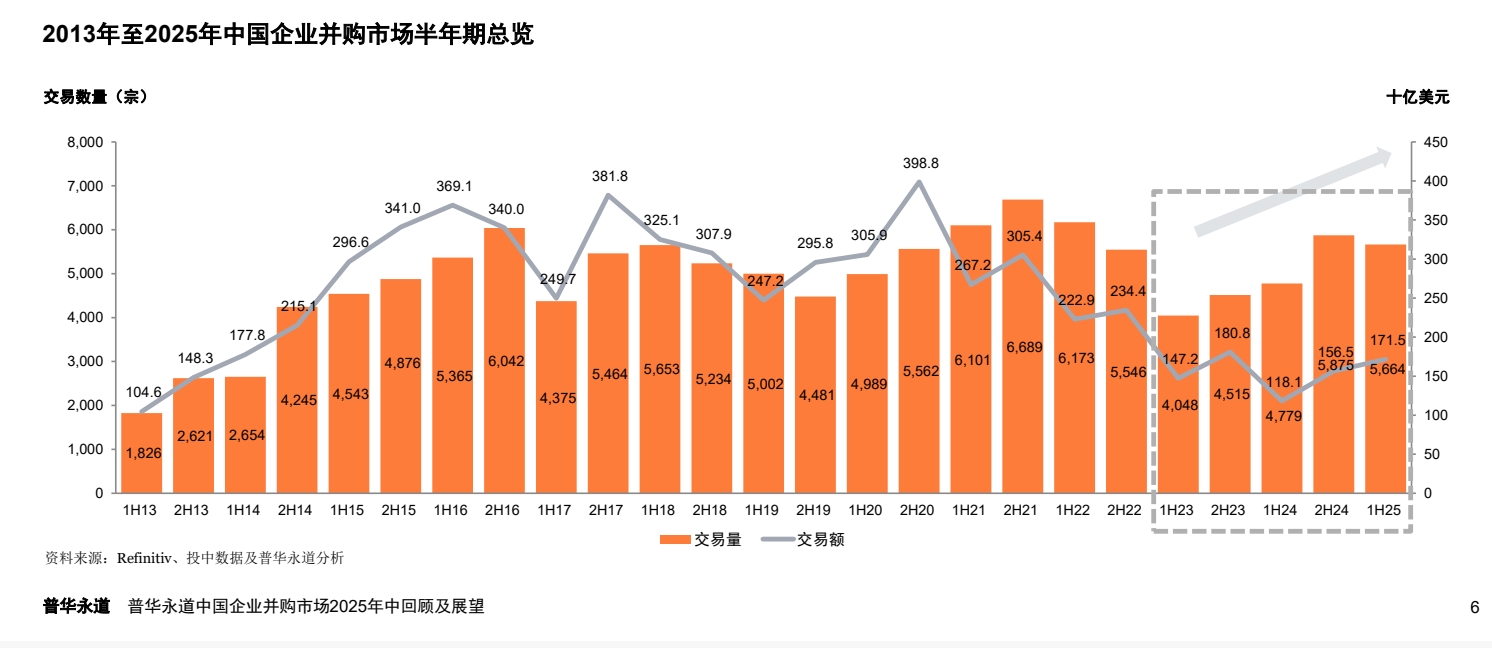
国内并购市场火热,上半年交易额同比大增45%,超大型并购成增长主力
Di Yi Cai Jing· 2025-08-25 11:11
Group 1 - The core viewpoint of the article highlights the acceleration of the domestic M&A market in China, with a significant increase in transaction value driven by large-scale mergers, particularly in high-tech, healthcare, and industrial sectors [1][3] - In the first half of 2025, the total disclosed transaction value in China's M&A market exceeded $170 billion, representing a substantial 45% increase compared to the same period last year [1] - There were 29 mega-mergers (transactions over $1 billion) completed in the first half of 2025, with 20 of these being domestic strategic investments, nearly half of which were led by state-owned enterprises [1][3] Group 2 - Domestic strategic investments and venture capital transactions saw year-on-year increases of 17% and 2%, respectively, while private equity fund transactions declined by 3% [3] - The number of overseas mergers by Chinese companies decreased by 6%, with only 133 transactions recorded [3] - The recovery of the IPO market in Hong Kong has provided private equity with diverse exit options, contributing to a significant increase in exit transactions through mergers and acquisitions [3][4] Group 3 - The venture capital sector, despite a modest overall increase of 2% in transaction volume, remains strong in emerging technology fields such as artificial intelligence and robotics, maintaining high transaction levels [4] - There is an anticipated increase in M&A activity in the second half of 2025, driven by accumulated demand and improved market sentiment, with expectations of a high double-digit growth in total transaction value for the year [4]
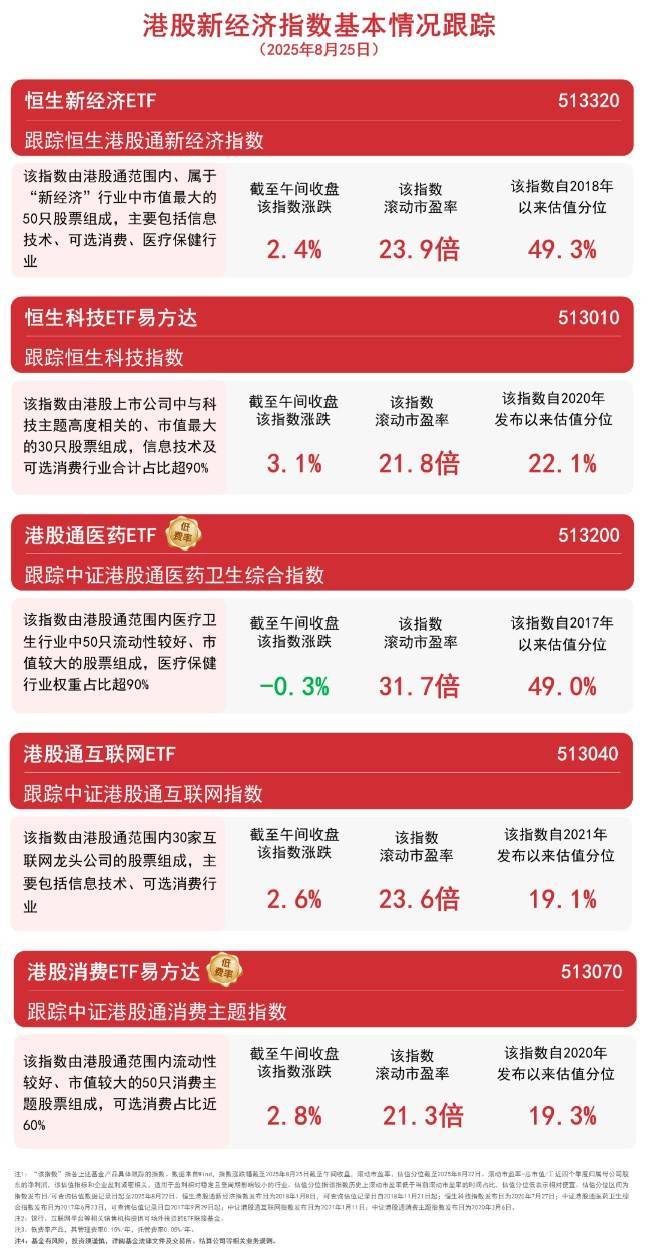
恒生科技指数涨超3%,恒生科技ETF易方达(513010)盘中成交额超10亿元,近日连获资金净流入
Sou Hu Cai Jing· 2025-08-25 04:54
Group 1 - The Hang Seng Technology Index increased by 3.1%, while the CSI Hong Kong Stock Connect Consumer Theme Index rose by 2.8%, and the CSI Hong Kong Stock Connect Internet Index gained 2.6% [1] - The Hang Seng Hong Kong Stock Connect New Economy Index saw an increase of 2.4%, whereas the CSI Hong Kong Stock Connect Medical and Health Comprehensive Index decreased by 0.3% [1] - The E Fund Hang Seng Technology ETF (513010) recorded a trading volume exceeding 1 billion yuan, with a net inflow of 2.39 billion yuan over the past month, bringing its total size to over 15 billion yuan [1] Group 2 - The Hang Seng New Economy ETF (513320) tracks the Hang Seng Hong Kong Stock Connect New Economy Index, which consists of the 50 largest stocks in "new economy" sectors within the Hong Kong Stock Connect range [2] - The index has a rolling price-to-earnings ratio of 23.9 times and has a valuation percentile of 49.3% since its inception in 2018 [2] - The E Fund Hang Seng Technology ETF (513010) tracks the Hang Seng Technology Index, composed of the 30 largest stocks related to technology listed in Hong Kong, with over 90% of its composition in information technology and consumer discretionary sectors [2] Group 3 - The CSI Hong Kong Stock Connect Medical and Health Comprehensive Index (513200) includes 50 liquid and large-cap stocks in the healthcare sector, with a weight of over 90% in the healthcare industry [2] - This index has a rolling price-to-earnings ratio of 31.7 times and a valuation percentile of 49.0% since its inception in 2017 [2] - The CSI Hong Kong Stock Connect Internet Index (513040) consists of 30 leading internet companies, primarily in information technology and consumer discretionary sectors, with a rolling price-to-earnings ratio of 23.6 times and a valuation percentile of 19.1% since its inception in 2021 [2] Group 4 - The E Fund Hong Kong Consumption ETF (513070) tracks the CSI Hong Kong Stock Connect Consumer Theme Index, which includes 50 large-cap consumer stocks with good liquidity, where consumer discretionary accounts for nearly 70% [3] - This index has increased by 2.8% and has a rolling price-to-earnings ratio of 21.3 times, with a valuation percentile of 19.3% since its inception in 2020 [3]
上周国际油价金价均上涨,美国将公布关键通胀指标引关注
Sou Hu Cai Jing· 2025-08-25 04:39
Market Overview - The US stock market experienced a rebound on Friday (August 22) after Federal Reserve Chairman Powell indicated an openness to interest rate cuts, leading to increased expectations for a September rate cut [1] - For the week, the Dow Jones increased by 1.53%, the S&P 500 rose by 0.26%, while the Nasdaq fell by 0.58% [1] Oil Market - International oil prices saw a significant increase due to the lack of progress in peace negotiations between Russia and Ukraine, which suggests that US sanctions on the Russian oil industry will continue [4] - US crude oil inventories showed a substantial decrease, contributing to oil prices rising for the first time in three weeks, with West Texas Intermediate (WTI) oil up by 1.37% and Brent crude up by 2.85% [4] Gold Market - International gold prices rose by over 1% as some investors bought on dips following a period of decline, supported by expectations of a Fed rate cut and a weaker dollar [5] Economic Indicators - The market is closely watching the US July Personal Consumption Expenditures (PCE) price index, a key inflation indicator for the Federal Reserve [6] - Economists expect the core PCE index to remain unchanged at a month-on-month increase of 0.3%, with a slight year-on-year rebound to 2.9% [8] - Analysts believe that the upcoming inflation data may not hinder the Fed's rate cut in September, but higher-than-expected inflation could dampen rate cut expectations beyond September [9] Earnings Reports - Several technology companies are set to release their latest earnings reports this week, which will be closely monitored by the market [10]

意外吗?无论是公募还是对冲基金,美国机构普遍“低配”科技股
Hua Er Jie Jian Wen· 2025-08-25 03:41
Core Insights - Despite the strong performance of technology stocks in the market this year, mainstream institutional investors in the U.S. are generally avoiding them [1][2] - Public funds have reached a historic low in their allocation to the information technology sector, while hedge funds are also at their lowest allocation level for tech stocks since 2024 [1][2] Institutional Investor Strategies - Both public funds and hedge funds are significantly underweight in the TMT (Technology, Media, Telecom) sector, while they are overweight in healthcare and industrial sectors [1] - In Q2, both types of institutional investors increased their holdings in the financial sector, with Capital One being a standout stock for both public and hedge funds [1][5] Technology Sector Analysis - The cautious stance towards technology stocks indicates that institutional investors believe these stocks face valuation pressures or growth slowdown risks [3] - Alphabet, the parent company of Google, is notably among the most reduced stocks in public funds and has seen significant declines in hedge fund holdings [3] Magnificent 7 Holdings - There is a divergence in strategies regarding the "Magnificent 7" tech stocks between public funds and hedge funds [4] - Public funds have increased their underweight position on the "Magnificent 7" from 723 basis points in Q1 to 819 basis points, reducing holdings in all seven stocks [4] - Conversely, hedge funds have increased their overall exposure to the "Magnificent 7," raising their weight from 11.8% to 12.8% in their long positions [4] - Hedge funds have shown mixed actions at the individual stock level, reducing holdings in Meta and Alphabet while increasing positions in Nvidia, Amazon, and Apple [4] Financial Sector Preference - The financial sector has garnered significant interest from both public and hedge funds, indicating a positive outlook from institutional investors [5] - Capital One has emerged as the most popular stock among fund managers based on net holding changes, alongside other financial stocks like Fidelity National Information Services and Nu Holdings [5] Common Stock Preferences - Currently, there are only seven stocks that are favored by both public and hedge funds, including AppLovin, CRH, Mastercard, Charles Schwab, Spotify, Visa, and Vertiv [6] - This common stock portfolio has outperformed the S&P 500 index by 11 percentage points year-to-date [6]
鲍威尔“放鸽”点燃降息预期!机构称海外流动性宽松等共振下,恒生科技或是弹性品种
Sou Hu Cai Jing· 2025-08-25 03:10
Group 1 - The Hong Kong stock market, particularly the Hang Seng Tech Index, experienced a significant upward movement, with the index rising nearly 3.5% and the Hang Seng Tech Index ETF (513180) increasing over 4% [1][2] - Key stocks driving this rally included NIO, ASMPT, Alibaba, Baidu, NetEase, and Horizon Robotics, with NIO seeing a rise of over 13% [1] - The market sentiment was influenced by Federal Reserve Chair Jerome Powell's dovish remarks at the Jackson Hole conference, indicating potential interest rate cuts in September due to risks in the employment market [1][2] Group 2 - The CME FedWatch Tool indicated an over 85% probability of a 25 basis point rate cut in the upcoming September meeting, suggesting a favorable environment for the Hong Kong stock market, especially the tech sector [2] - The Hang Seng Tech Index is currently viewed as undervalued and is highly sensitive to changes in the US-China interest rate differential, positioning it to benefit significantly from the easing of overseas liquidity [2] - The index is characterized by high elasticity and growth potential, indicating that improvements in market conditions could lead to stronger upward momentum [2]
债市何时回调到位
2025-08-24 14:47
Summary of Key Points from Conference Call Records Industry Overview - The conference call discusses the convertible bond market and the broader equity market in China, particularly focusing on the A-share market and its dynamics influenced by global liquidity and economic factors [1][3][4]. Core Insights and Arguments 1. **Positive Factors for Equity Market**: The A-share market is supported by multiple favorable factors, including global liquidity easing expectations, performance risk release, alleviation of external pressures, technological industry catalysts, and a positive cycle of capital inflow [1][3]. 2. **Convertible Bond Market Dynamics**: The convertible bond market is experiencing a tight supply-demand balance, with accelerated redemptions of existing bonds and insufficient new issuance. Institutional investors show strong demand for convertible bonds, leading to significant growth in convertible bond ETFs [1][4][5]. 3. **Price and Valuation Trends**: The median price of convertible bonds has surpassed 135 yuan, indicating high historical valuations. Despite this, there is still potential for upward movement due to the anticipated slow bull market in equities and the rising proportion of professional institutional investors [1][6]. 4. **Investment Strategy Recommendation**: A "barbell" investment strategy is suggested, focusing on high-quality equity-oriented targets in technology sectors (e.g., AI computing, semiconductors) while also selecting low-priced bonds with potential for price adjustments [1][7]. 5. **Market Correction Indicators**: The current bond market correction is attributed to changes in market expectations rather than economic data improvement. Key indicators to assess whether the correction has stabilized include the narrowing of the 30-year to 10-year treasury yield spread and increased trading activity in local and long-term bonds [1][8]. Additional Important Content 1. **Recent Market Performance**: In the past week, the equity market saw significant gains, with the Shanghai Composite Index rising from 3,700 to 3,800 points, marking a ten-year high. The convertible bond index outperformed the underlying stocks, reflecting strong market sentiment [2]. 2. **Convertible Bond Supply and Demand**: Since July, 37 convertible bonds have been announced for forced redemption, totaling 34.5 billion yuan, while only six new bonds have been issued, amounting to 8.78 billion yuan, indicating a constrained supply environment [4][5]. 3. **Institutional Investor Behavior**: The growth of convertible bond ETFs, with a 48.3% increase in total shares since July, highlights the strong willingness of institutional investors to increase their positions in this asset class [5]. 4. **Global Economic Influences**: The Chinese dollar bond market is showing signs of recovery and differentiation, with a rebound in issuance but still facing negative net financing. The market is primarily driven by financial and industrial entities, with a low proportion of real estate dollar bonds [3][19]. 5. **Future Focus Areas**: Investment focus should be on investment-grade and mid-to-high-grade entities, including local government financing vehicles and central state-owned enterprises in sectors like energy and public utilities [22]. This summary encapsulates the key points discussed in the conference call, providing insights into the convertible bond market, equity market dynamics, and strategic investment recommendations.
这轮牛市跟哪一轮比较像?|投资小知识
银行螺丝钉· 2025-08-24 13:53
Core Viewpoint - The article discusses the cyclical nature of the A-share market, highlighting the similarities and differences between past market conditions (2013-2017) and the current situation (2023-2024), emphasizing the importance of fundamental recovery for future market performance [2][6][9]. Group 1: Market Trends and Historical Context - In 2015, the A-share market experienced a significant rise due to loose control over leveraged investments, with the index soaring from around 2000 points to over 8000 points, followed by a sharp decline in the second half of the year [2]. - The period from 2016 to 2017 saw a recovery in the fundamentals of A-share listed companies, leading to a slow bull market for value stocks, which outperformed after a period of underperformance [3][4]. - The market dynamics from 2013 to 2017 included phases where large-cap, small-cap, growth, and value stocks all had their moments, but many investors suffered losses due to chasing trends [5]. Group 2: Current Market Conditions and Future Outlook - The current market environment in 2023-2024 is characterized by low fundamentals and declining corporate profits, similar to the conditions seen in 2015-2016 [6][9]. - With the Federal Reserve's first interest rate cut in September 2024, and corresponding domestic policies, the market is expected to see an initial rise, particularly in sectors like securities and insurance [8]. - By 2025, growth sectors such as small-cap, technology, and pharmaceuticals are anticipated to lead the market, while value and consumer sectors may remain subdued [8]. - The potential for a market uptrend hinges on the recovery of corporate fundamentals, with historical precedents suggesting that economic recovery can lead to significant market rallies [9].

A股3800点,绩优基金经理最新发声
中国基金报· 2025-08-24 13:25
Core Viewpoint - The A-share market is expected to enter a sustainable "slow bull" phase, driven by multiple factors including policy support, capital structure optimization, and industrial trends [20][21][22]. Group 1: Market Drivers - The recent rise in the Shanghai Composite Index above 3800 points is attributed to a combination of policy measures, technological advancements, and improved market sentiment [15][16][18]. - The current market differs from previous peaks, as it is characterized by a shift towards technology and cyclical sectors, rather than a concentration in a few leading industries [18][19]. - The economic cycle is now driven by new productive forces, particularly in technology and manufacturing, which are expected to enhance competitiveness on a global scale [24][25]. Group 2: Investment Strategies - Investment strategies are shifting towards a balanced approach, focusing on sectors benefiting from national development strategies and clear industrial trends, such as AI and high-end manufacturing [30][31]. - There is an emphasis on maintaining a diversified portfolio that includes both growth sectors and value stocks, with a focus on companies with strong fundamentals and earnings potential [31][32]. - The investment outlook suggests a cautious yet optimistic stance, with a preference for sectors that are likely to benefit from ongoing policy support and economic recovery [33][34]. Group 3: Sector Opportunities - Key sectors identified for investment include new productive forces and high-end manufacturing, AI applications, and industries benefiting from the "anti-involution" policy [34][35]. - The technology sector, particularly AI and innovative pharmaceuticals, is seen as having significant growth potential, with a focus on companies that can effectively monetize their technological advancements [35][36]. - Traditional sectors are also viewed as having opportunities, especially those that can adapt to changing market conditions and benefit from macroeconomic policies [36][37]. Group 4: Market Risks and Uncertainties - Current market conditions exhibit signs of exuberance, with trading volumes high and some sectors potentially overheating, necessitating caution [39][40]. - Key uncertainties include the pace of corporate earnings recovery, the effectiveness of policy implementation, and external factors such as global economic fluctuations and geopolitical tensions [39][40]. - Investors are advised to align their equity exposure with their risk tolerance, focusing on sectors with strong fundamentals while being mindful of market volatility [41][42].