
中游制造业

Search documents
创业板营收净利增速领跑A股
第一财经· 2025-11-06 11:21
Core Viewpoint - The article highlights the strong performance of companies listed on the ChiNext board in the third quarter of 2025, with significant growth in both revenue and net profit, indicating a continuation of the positive trend observed in the first half of the year [3][5]. Financial Performance - As of October 31, 2025, 1,388 ChiNext companies reported a total revenue of 3.25 trillion yuan, a year-on-year increase of 10.69%, and a net profit of 244.66 billion yuan, up 18.69% year-on-year [5][6]. - In Q3 2025, ChiNext companies achieved a total revenue of 1.18 trillion yuan, a quarter-on-quarter increase of 7.13%, and a net profit of 932.61 billion yuan, up 18.32% quarter-on-quarter [6]. - Among the reported companies, 1,034 were profitable, representing 74.5%, and 737 companies saw net profit growth, accounting for 53.1%, an increase of 8.31 percentage points compared to the previous year [6]. Industry Performance - The electronic and communication sectors showed remarkable growth, with the "Yizhongtian" combination achieving a total net profit of 14.92 billion yuan in the first three quarters, 2.34 times that of the same period last year [3][7]. - The power equipment industry benefited from explosive growth in energy storage, with revenue increasing by 12.90% year-on-year and net profit rising by 28.61% [7][9]. - The machinery equipment sector experienced a revenue growth of 10.15% and a net profit increase of 8.26% due to recovering demand in engineering machinery and policy support [7][9]. Sector Highlights - The electronic industry reported a revenue growth of 21.65% year-on-year and a net profit increase of 36.29% [8][9]. - The communication sector saw a revenue increase of 24.82% and a net profit surge of 94.10% [8][9]. - The semiconductor and components sectors benefited from high demand, with net profits growing by 54.09% and 91.07%, respectively [9]. Overall Market Trends - The ChiNext board demonstrated a "three increases and one decrease" trend, indicating an overall increase in gross profit margin, growth in long-term asset investments, and an increase in R&D spending, while the expense ratio decreased [6][7]. - Traditional industries are recovering from cyclical lows, with the basic chemical industry and non-ferrous metals sector showing net profit increases of 28.86% and 15.94%, respectively [9].


景气正在扩散
SINOLINK SECURITIES· 2025-11-03 01:28
Group 1 - The core viewpoint of the report indicates a reversal in the relationship between GDP, revenue, and profit growth, with A-share revenue growth surpassing nominal GDP for the first time since 2023, showing a year-on-year growth rate of 3.8% in Q3 2025 [1][10] - The net profit growth rate for all A-shares (excluding financial and real estate sectors) improved by 0.9 percentage points to 3.8% in Q3 2025, indicating a marginal recovery in profitability [1][19] - The net asset return (TTM) rose to 7.5%, marking two consecutive quarters of improvement, driven primarily by profit margin recovery [1][19] Group 2 - The midstream manufacturing sector showed significant improvement, with revenue and profit growth rates of 2.1% and 18.1% respectively in Q3 2025, reflecting a marginal increase compared to Q2 [2][39] - The TMT sector continued to outperform, with profit share rising to 16.0%, while the downstream consumer sector saw a decline in profit share to 25.1%, the lowest since Q3 2024 [2][39] - The non-bank financial sector recorded nearly 40% profit growth, indicating a strong performance relative to other sectors [2][39] Group 3 - The report highlights that the recovery in upstream profit share often requires a return to price advantages, which was observed in September 2025, suggesting a potential easing of performance pressures in the upstream sectors [3][29] - The energy metals and fiberglass manufacturing sectors achieved simultaneous volume and price increases, indicating effective outcomes from anti-involution policies [3][29] - The report notes that while the technology sector's absolute growth rates are high, the degree of expectation fulfillment is not particularly strong, suggesting potential risks if larger-scale industry catalysts do not emerge [3][29] Group 4 - The report indicates that the overall revenue growth for all A-shares was 1.36% year-on-year as of Q3 2025, with a notable improvement of 1.2 percentage points compared to Q2 [10][14] - Capital expenditure growth for all A-shares (excluding financial and real estate) recorded a decline of 1.91%, indicating limited new capital investment and a focus on updates and renovations [10][15] - The inventory growth rate for all A-shares (excluding financial and real estate) rebounded to 4.5%, reflecting a recovery in demand and improved operational expectations [10][15]
招商基金李湛:当前宏观经济形势下股市资金的流入分析 三个因素有望继续支撑A股
Xin Lang Ji Jin· 2025-09-26 05:24
Macroeconomic Analysis - The GDP growth rate for Q3 is estimated at around 4.8%, down from approximately 5% in July, indicating a noticeable slowdown in economic data [1] - The "trade-in" policy's marginal effectiveness has weakened, with retail sales in August increasing by only 3.4%, a decline of 0.3 percentage points from the previous month [1] - Fixed asset investment growth has decreased, with August's cumulative year-on-year growth at 0.5%, down 1.1 percentage points from the previous month [2] - Exports maintained a relatively high level, with August exports growing by 4.4%, although this is a decline from 7.2% in July [2] - Borrowing willingness among enterprises and households remains weak, with social financing stock growth at 8.8%, down 0.2 percentage points from the previous month [2] Economic and Financial Concerns for Q4 - Limited consumer recovery and urgent need for additional government subsidies, as consumer employment indices are low, affecting income and spending [3] - Investment faces downward pressure, particularly in manufacturing and real estate, with no signs of stabilization in the real estate market [3] - Low inflation persists, with core CPI remaining below 1%, influenced by weak domestic demand and external supply pressures [3] Capital Market Trends - Market liquidity is overall abundant, with non-bank financial institutions' deposits increasing, suggesting a positive feedback loop for stock market inflows [4] - External risks are easing, with successful tariff negotiations and signals of potential interest rate cuts from the Federal Reserve [5] - Macro policy expectations have risen, with initiatives to address "involution" in competition and promote the AI industry [5] Market Funding Structure Changes - Current market funding primarily comes from private equity, speculative funds, and leveraged capital, with significant growth in private equity fund registrations [6] - There has been no significant increase in new individual accounts on the Shanghai Stock Exchange, indicating a lack of strong retail investor interest [6] - Residents' funds may be entering the stock market through bank wealth management products, despite a rising savings inclination [7] Current Market Focus - Key issues include the progress of US-China tariff negotiations and potential changes in Trump's policies towards China [8] - The effectiveness of measures to address "involution" in competition and policies to stabilize growth in service consumption and real estate are under scrutiny [8] Policy Recommendations - Further guidance is needed to attract long-term funds into the market, optimizing mechanisms for social security and pension investments [9] - Strengthening policy coordination and expectations management is essential to stabilize market confidence amid external uncertainties [9] - Enhanced regulation and risk prevention measures are necessary to monitor leveraged funds and prevent excessive speculation [9]
如何走出PPI负增长?
Sou Hu Cai Jing· 2025-09-05 15:20
Core Viewpoint - The article discusses the necessity of regulating industrial policies and controlling local governments' enthusiasm for industrial investment while emphasizing the need for further efforts to stimulate consumption [3][22]. Group 1: PPI Trends - Since October 2022, China's PPI has entered a continuous negative growth phase, experiencing 34 months of decline, which has pressured industrial profits and suppressed consumer spending [3][4]. - The current PPI negative growth is compared to a previous cycle from March 2012 to August 2016, which lasted 54 months, highlighting similarities in duration and abrupt declines [4][5]. - The current PPI decline is driven by two main factors: overcapacity in industries like photovoltaics and lithium batteries due to rapid demand growth, and significant adjustments in the real estate market since the second half of 2021 [5][6]. Group 2: Demand and Supply Dynamics - Both rounds of PPI decline are characterized by rapid capacity expansion exceeding demand growth, leading to oversupply, but the causes of demand insufficiency differ [6][11]. - The current round of PPI decline has seen a more significant impact from weak consumer demand, particularly in the context of the real estate market's deep adjustments, which have led to substantial wealth evaporation for residents [6][12]. Group 3: Industry Contributions to PPI Decline - The mining and upstream raw materials sectors contributed significantly to PPI declines in both periods, but their contribution decreased from 85.2% to 61.7% in the current cycle [11]. - The midstream manufacturing sector's contribution to PPI decline increased to 9.0% due to the overcapacity in the new energy sector, while the downstream manufacturing sector's contribution rose to 26.0%, particularly from essential consumer goods [11][12]. Group 4: Consumer Demand Analysis - The current cycle's core CPI has averaged around 0.3%, significantly lower than the previous cycle's average of 2.1%, indicating a substantial drop in consumer demand [13][14]. - Factors contributing to weak consumer demand include declining disposable income growth, increased savings tendencies, and unstable income expectations, leading to reduced consumption even with unchanged income levels [17][19]. Group 5: Policy Recommendations - To reverse the PPI negative growth, stronger counter-cyclical adjustment policies are needed, including lowering policy interest rates and expanding public investment [21][23]. - Enhancing consumer confidence through effective policies can lead to increased consumption, which is crucial for reversing the downward trend in downstream manufacturing prices and ultimately improving PPI [23][24].

中信建投:A股盈利确认拐点,新动能主导结构性行情
Zheng Quan Shi Bao Wang· 2025-09-02 23:53
Core Viewpoint - The A-share market is entering a mild recovery phase, with a significant structural divergence that highlights the accelerated shift between old and new driving forces [1] Group 1: Market Trends - The market style is shifting towards growth, with technology manufacturing being a core engine driven by the AI cycle and domestic substitution, resulting in high performance growth [1] - Midstream manufacturing is benefiting from cost recovery, demonstrating resilient profitability [1] Group 2: Recovery Dynamics - The current recovery is characterized by price restoration being more favorable than volume expansion [1] - In emerging sectors, the AI industry chain has shown strong performance, while robotics and innovative pharmaceuticals face opportunities for mass production and reversal of difficulties [1] - New consumption sectors require attention on the transmission from revenue to profitability [1] Group 3: Policy and Selection - Overall economic recovery still requires policy reinforcement, indicating that the market will experience structural trends, necessitating the selection of high-prosperity sectors [1]

又见基金经理道歉,“有些难熬”
Zhong Guo Ji Jin Bao· 2025-08-30 14:49
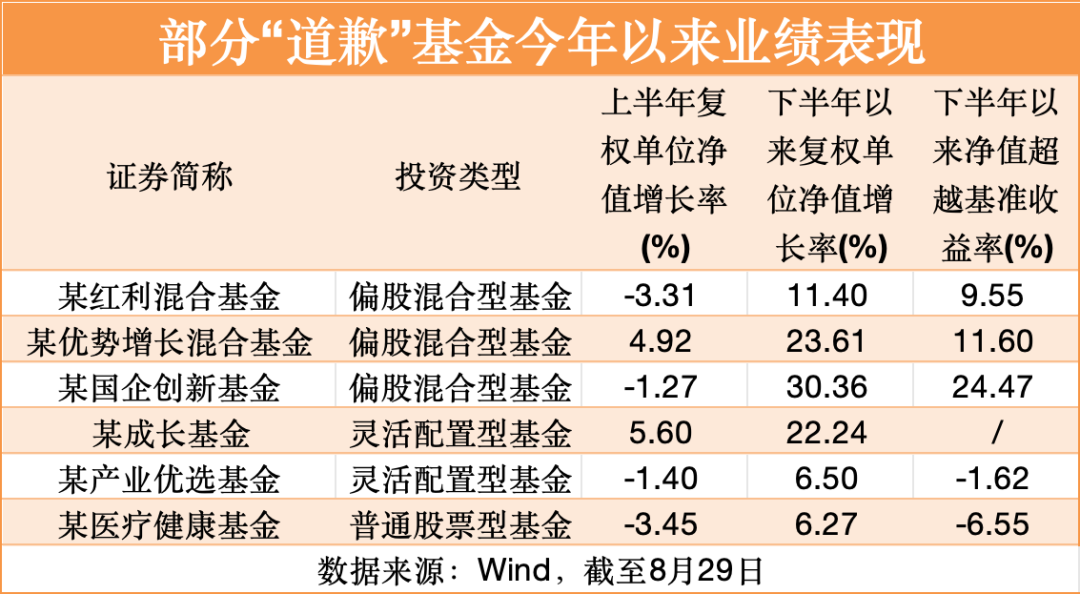
Core Viewpoint - The A-share market has shown signs of recovery this year, leading to improved performance for many actively managed equity funds, although some funds have lagged due to structural market conditions, prompting fund managers to express apologies in their semi-annual reports [1][2]. Fund Performance and Apologies - Fund types expressing apologies include underperforming pharmaceutical funds, dividend funds, and growth funds, indicating a need for fund managers to reassess their investment frameworks and for investors to discern between short-term market style mismatches and long-term managerial capabilities [2][5]. - A pharmaceutical fund manager acknowledged underperformance relative to industry indices and expressed regret for not achieving absolute returns, attributing the poor performance to premature shifts in investment strategy and missed opportunities in the "new drug + new consumption" sector [4][5]. - A dividend fund manager reported negative returns in the first half of 2025, citing both objective market conditions and subjective misjudgments as reasons for underperformance, particularly in avoiding high-recognition sectors while focusing on low-recognition ones [7][8]. Market Trends and Future Outlook - The pharmaceutical sector has seen significant activity, particularly in innovative drug companies, with some funds achieving substantial gains, while others have struggled due to conservative positioning [4][5]. - Fund managers are optimistic about future performance, highlighting potential in low-positioned sectors within the pharmaceutical industry, such as AI healthcare and medical devices, and committing to a more proactive investment approach [5][10]. - Some fund managers reflected on missed opportunities due to early profit-taking and emphasized the importance of maintaining a long-term investment perspective despite short-term challenges [10][11]. Performance Data - Data from Wind indicates that several funds that apologized for their performance have rebounded in the second half of the year, with some achieving net value growth rates of 20% to 30%, significantly outperforming their benchmarks [14][15]. - Specific fund performance metrics show that a dividend mixed fund had a net value growth rate of -3.31% in the first half but rebounded to 11.40% in the second half, while other funds also demonstrated similar recovery trends [14].
红利国企ETF(510720)收红,定价逻辑转向基本面改善
Sou Hu Cai Jing· 2025-08-20 09:02
Group 1 - The core viewpoint is that the pricing drivers for dividend sectors are shifting from low volatility attributes to improvements in fundamental expectations, particularly benefiting consumer dividends such as food and beverages, home appliances, and textiles and apparel [1] - The current macroeconomic environment is in a "de-involution" transition phase, indicating that corporate profit bottoms have been reached, and the continuous decline in PPIRM-PPI suggests a recovery in midstream manufacturing profits, which will gradually restore overall demand [1] - In this context, the price elasticity of dividend assets may strengthen as fundamental expectations improve, especially in sectors with profit improvement potential in the consumer domain [1] Group 2 - The Dividend State-Owned Enterprise ETF (510720) tracks the State-Owned Dividend Index (000151), which selects 50 stocks from the Shanghai market that have high cash dividend yields, stable dividends, and certain scale and liquidity [1] - The index constituents mainly cover traditional high-dividend sectors such as finance, energy, and industry, reflecting the investment characteristics of seeking stable returns [1] - Investors without stock accounts can consider the GT Fund's Shanghai Stock Exchange State-Owned Enterprise Dividend ETF Initiated Link A (021701) and Link C (021702) [1]
国金证券:当前的“双弱”、反内卷的过渡与年底前A股最大的认知差
Xuan Gu Bao· 2025-08-17 09:37
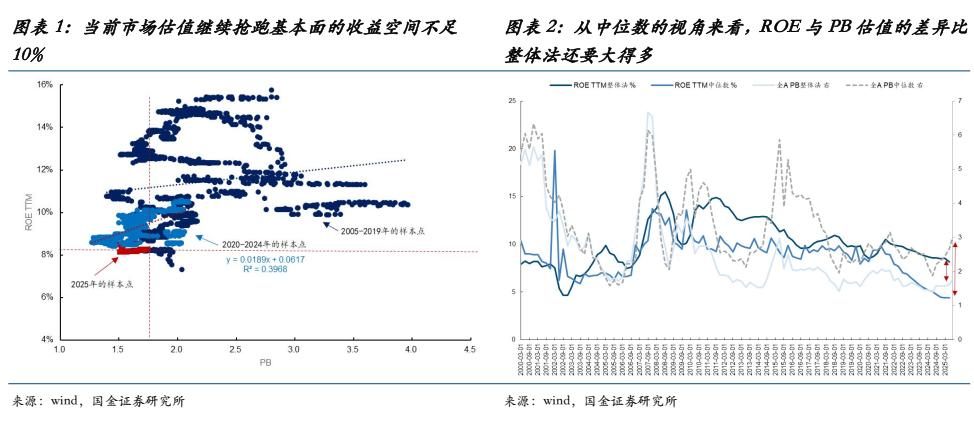
Group 1 - The market is currently experiencing a shift from a focus on banks and low-volatility stocks to a pricing strategy that emphasizes fundamental trends, particularly in growth sectors driven by industrial trends [1][9][28] - The valuation of the market, as indicated by the PB ratio of 1.74, is approaching historical highs, suggesting limited room for further price increases based on fundamentals alone [1][6][28] - There is a notable transition from small-cap growth represented by the National Securities 2000 index to large-cap growth represented by the ChiNext index, driven by valuation differences and investor focus on profitability [2][11][28] Group 2 - Domestic economic indicators show a "double weakness" in both reality and expectations, with financial data indicating weak credit growth and economic data reflecting declining investment and consumption [3][14][20] - The manufacturing sector is experiencing a decline in investment growth and industrial output, which is seen as a normal phenomenon during the transition from an inward-focused economy to a more balanced one [3][16][20] - Historical trends suggest that corporate earnings typically bottom out before PPI, indicating potential recovery in profitability for midstream manufacturing as raw material costs decline faster than factory prices [3][20][28] Group 3 - Inflationary pressures from overseas tariffs are becoming evident, impacting U.S. PPI and altering interest rate expectations, which may accelerate manufacturing investment [4][22][26] - Despite a lower-than-expected CPI, the core CPI has slightly exceeded expectations, indicating persistent inflationary pressures from tariffs [4][22][26] - Global manufacturing investment is on the rise, as evidenced by Japan's machine tool orders increasing by 3.6% year-on-year, primarily driven by overseas demand [4][26][28] Group 4 - The market's focus is shifting towards fundamental pricing, particularly in growth sectors, while large-cap blue-chip stocks continue to underperform [5][28][29] - The recovery of midstream manufacturing profits is expected to take time, but the overall trend towards improving fundamentals is anticipated [5][28][29] - Investment strategies are recommended to focus on upstream resource products and capital goods, as well as consumer-oriented dividend stocks, while monitoring large-cap growth opportunities [5][29]

永赢基金王乾:下半年重点关注“反内卷”政策效应、内需复苏、新质生产力等投资线索与方向
Zhong Guo Jing Ji Wang· 2025-07-24 01:41
Group 1 - The A-share market has shown good performance in 2023, with the Shanghai Composite Index rising by 6.88%, the ChiNext Index by 7.89%, and the CSI 300 by 4.7% from the beginning of the year to July 23 [1] - The market experienced significant fluctuations due to factors such as "reciprocal tariffs" and has gradually moved upward since mid-April, supported by proactive domestic policies and a temporary easing of Sino-U.S. trade tensions [1] - There is a clear divergence in sector performance, with non-ferrous metals, non-bank financials, and banks leading in gains, while coal, food and beverage, and real estate sectors remain in negative returns [1] Group 2 - The "anti-involution" policy aims to shift industry competition from low-level price wars to high-quality competition, which could improve the profitability of listed companies and enhance the long-term capacity for technological advancement [2] - Midstream manufacturing and upstream raw materials sectors, which are currently facing supply-demand imbalances, are expected to benefit significantly from the gradual implementation of the "anti-involution" policy [2] Group 3 - Domestic demand has shown resilience in the first half of the year, supported by policies such as "trade-in" for durable goods and equipment upgrades, which bolster manufacturing investment [3] - The stabilization of the real estate market is seen as a crucial factor for the recovery of domestic demand, with ongoing supportive policies expected to contribute to this trend [3] - New productive forces, particularly in artificial intelligence and innovative pharmaceuticals, are anticipated to represent significant investment opportunities in the future [3]