
原材料业

Search documents
利润修复来自何处?——12月工业企业利润数据解读【陈兴团队·华福宏观】
陈兴宏观研究· 2026-01-27 09:45
Core Viewpoint - December saw a decline in revenue for industrial enterprises, with a year-on-year decrease of 3.2%, while profits improved with a year-on-year growth of 5.3%, marking a significant turnaround from the previous month's -13.1% [2][11] Group 1: Profit and Revenue Analysis - The profit margin growth in December was a key support for the overall profit improvement, with a notable recovery in profit rates [11][16] - The revenue decline was slightly offset by a narrowing of price drag, but overall revenue contraction still impacted profitability [11][16] - The year-on-year profit growth of 5.3% in December was a significant increase of 18.4 percentage points from the previous month, marking the first year-end profit increase since 2018 [11][14] Group 2: Currency Impact - The appreciation of the RMB since late 2025 has led to a return of overseas profits, with the bank's foreign exchange settlement and sales differences indicating a trend towards repatriating profits [5][11] - The expectation of RMB appreciation has historically been associated with an increase in the ratio of bank foreign exchange settlement differences to trade balances, reaching 25.9% in 2025, the second-highest since 2015 [5] Group 3: Industry Performance - The equipment manufacturing and high-tech manufacturing sectors showed strong profit growth, significantly outpacing the overall profit growth of large-scale industrial enterprises [6][14] - In December, the mining, raw materials, and processing assembly industries saw improvements in profit, while the consumer goods manufacturing sector continued to face pressure [14][16] - The high-tech manufacturing sector reported a profit growth of 13.3% year-on-year, exceeding the average growth rate of large-scale industrial enterprises by 12.7 percentage points [14] Group 4: Inventory and Demand - The nominal inventory growth rate declined to 3.9% in December, with actual inventory growth also falling, indicating weak domestic demand [9][17] - The consumer goods manufacturing sector is actively reducing inventory, while the equipment manufacturing sector is primarily focused on replenishing stock, reflecting the contrasting performance of these industries [9][17] - The production turnover days for industrial enterprises decreased to 19.9 days, suggesting ongoing operational pressures despite seasonal improvements in sales rates [17]


——12月工业企业利润数据解读:利润修复来自何处?
Huafu Securities· 2026-01-27 09:29
Group 1: Profit and Revenue Trends - In December, the revenue of industrial enterprises above designated size decreased by 3.2% year-on-year, with the decline expanding by 3.0 percentage points compared to the previous month[3] - Industrial enterprise profits increased by 5.3% year-on-year in December, reversing from a -13.1% decline in the previous month, marking the first year-end profit increase since 2018[3] - The profit margin growth in December was a significant support for profit improvement, while the price drag slightly narrowed, contributing to the overall profit recovery[3] Group 2: Currency and Economic Factors - The appreciation of the RMB since late November has led to a repatriation of overseas profits, with the bank's foreign exchange settlement and sales difference reaching 25.9% of the trade surplus for the year, the second-highest since 2015[4] - Weak domestic demand continues to constrain revenue and profit improvements for enterprises, although the RMB appreciation may temporarily support profit growth by encouraging the repatriation of overseas profits[3][4] - In the long term, the RMB appreciation could help curb excessive reliance on price competition among export enterprises, promoting a shift towards quality development driven by technology upgrades and brand building[3] Group 3: Industry Performance - The equipment manufacturing and high-tech manufacturing sectors showed strong profit growth, significantly outpacing the overall profit growth of industrial enterprises[4][5] - For the year 2025, the profit of the equipment manufacturing sector increased by 7.7%, contributing 2.8 percentage points to the overall profit growth of industrial enterprises[5] - High-tech manufacturing profits grew by 13.3% year-on-year, exceeding the average growth rate of all industrial enterprises by 12.7 percentage points, with notable performance in smart consumer devices, semiconductors, and medical-related manufacturing[5]
AH股市场周度观察(1月第1周)-20260110
ZHONGTAI SECURITIES· 2026-01-10 13:10
Group 1: A-Share Market - The A-share market showed strong performance this week, with significant increases in trading activity. The CSI 500, CSI 1000, and CSI 2000 indices rose by 7.92%, 7.03%, and 6.54% respectively, indicating a strong performance of small-cap stocks [3][7] - The market's upward trend was driven by increased risk appetite, with technology innovation sectors such as brain-computer interfaces, commercial aerospace, and AI applications becoming the main focus. Industries like electronics, computers, and defense received substantial capital inflows [5][7] - The average daily trading volume reached 2.85 trillion, a significant increase of 35.68% compared to the previous period [3][7] - The outlook for the A-share market remains positive, with expectations of continued upward momentum in the short term, particularly in the first quarter, driven by macroeconomic improvements and favorable policies [8] Group 2: Hong Kong Market - The Hong Kong market exhibited a weaker overall performance this week, with major indices such as the Hang Seng China Enterprises Index, Hang Seng Technology Index, and Hang Seng Index declining by 1.31%, 0.86%, and 0.41% respectively [9] - Despite the overall decline, there was structural differentiation within the market, with the healthcare sector leading gains at 10.06%, while telecommunications, information technology, and energy sectors underperformed [9] - The geopolitical situation, particularly U.S.-China relations, has influenced market sentiment, with recent announcements regarding increased U.S. defense spending impacting risk appetite [9] - Future expectations for the Hong Kong market suggest a potential recovery in the technology sector, influenced by the rising sentiment in the A-share technology sector and domestic economic recovery [9]
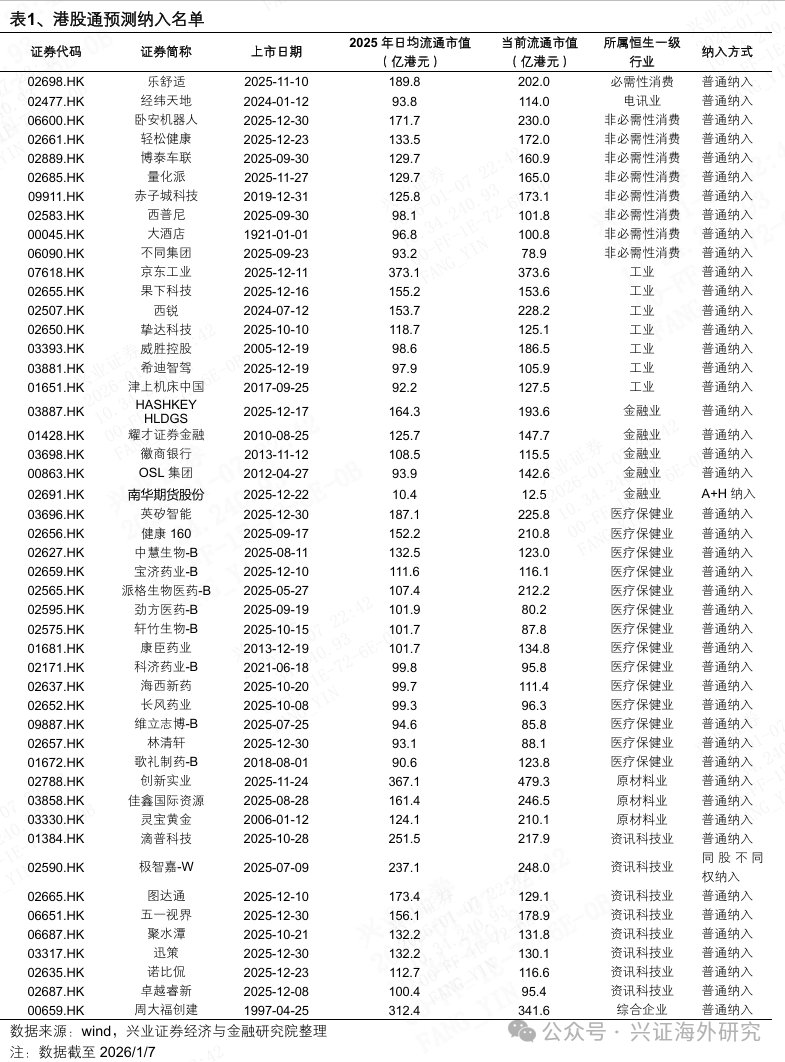
兴业证券:港股通新一轮调整在即 48只港股标的或入围
Zhi Tong Cai Jing· 2026-01-09 07:33
Core Viewpoint - The semi-annual review of the Hang Seng Composite Index has concluded, and a new round of adjustments to the Hong Kong Stock Connect eligible stocks is imminent, with results expected to be announced on February 20 and effective from March 9, 2025 [1][2]. Group 1: Adjustments and Market Impact - A total of 48 Hong Kong stocks are expected to be included in the Hong Kong Stock Connect eligible list based on simulated calculations [2][3]. - The market capitalization threshold for new eligible stocks has been raised to HKD 9 billion as of December 31, 2025 [3]. Group 2: Industry Distribution of New Eligible Stocks - The new eligible stocks are primarily concentrated in the following sectors: - Healthcare: 14 companies, including names like 英矽智能 and 健康160 [3]. - Information Technology: 8 companies, including 滴普科技 and 极智嘉-W [3]. - Consumer Discretionary: 8 companies, including 卧安机器人 and 轻松健康 [3]. - Industrial: 7 companies, including 京东工业 and 果下科技 [3]. - Financials: 5 companies, including HASHKEY HLDGS and 徽商银行 [3]. - Materials: 3 companies, including 创新实业 and 佳鑫国际资源 [3]. - Consumer Staples: 1 company, 乐舒适 [3]. - Telecommunications: 1 company, 经纬天地 [3]. - Conglomerates: 1 company, 周大福创建 [3]. Group 3: Detailed List of New Eligible Stocks - A detailed list of stocks expected to be included includes: - 乐舒适 (2025-11-10, average daily market cap: HKD 1.898 billion) [4]. - 经纬天地 (2024-01-12, average daily market cap: HKD 0.938 billion) [4]. - 卧安机器人 (2025-12-30, average daily market cap: HKD 1.717 billion) [4]. - 轻松健康 (2025-12-23, average daily market cap: HKD 1.335 billion) [4]. - 博泰车联 (2025-09-30, average daily market cap: HKD 1.297 billion) [4]. - 京东工业 (2025-12-11, average daily market cap: HKD 37.31 billion) [4]. - HASHKEY HLDGS (2025-12-17, average daily market cap: HKD 1.643 billion) [4].

资本市场月报2026年1月-20260105
Ping An Securities Hongkong· 2026-01-05 06:31
Group 1: Global Stock Market Performance - The global stock indices in 2025 exhibited a clear "divergent upward" trend, with the South Korean Composite Index leading at 75.6% growth, significantly higher than other markets[4] - The second tier of performance was concentrated in Hong Kong and Northeast Asian markets, including the Hang Seng Index and Nikkei 225, with growth rates ranging from 23.0% to 31.1%[4] - European markets showed moderate performance, while global benchmarks and U.S. tech-related indices remained relatively strong[4] Group 2: Hong Kong Stock Market Insights - The Hong Kong Hang Seng Industry Index displayed a "strong structure, weak diffusion" characteristic, with materials leading at 161.3% growth, while defensive sectors like utilities and telecommunications lagged[6] - In 2025, the Hong Kong IPO market welcomed 117 new listings, raising approximately HKD 285.7 billion, with notable first-day performance from Nobikang (2635.HK) at 363.75%[9] - The largest fundraising project was CATL (3750.HK), which raised around HKD 41 billion, while 685 companies announced additional share placements, expected to raise about HKD 361.8 billion, mainly in TMT and financial sectors[9] Group 3: U.S. Economic Overview - In Q3 2025, the U.S. GDP growth rate was 4.3%, exceeding expectations of 3.3%, driven by resilient private consumption and improved net exports[10] - Personal consumption expenditures contributed 2.4 percentage points to GDP growth, indicating strong consumer resilience despite tariff impacts[10] - Market expectations for interest rate cuts have shifted to April and July 2026, with anticipated reductions of 25 basis points each[10] Group 4: Chinese Economic Trends - Industrial profits in China showed a slight year-on-year increase of 0.1% from January to November 2025, with notable growth in high-tech manufacturing sectors[11] - The solar and semiconductor industries are experiencing a new wave of growth, supported by policy adjustments and rising prices in key materials[11] - The government initiated a venture capital fund of HKD 100 billion to stimulate investment in high-tech sectors, including AI and quantum technology[11]
恒指公司:2025年恒指上升27.8% 为2017年以来最佳表现
智通财经网· 2025-12-31 12:07
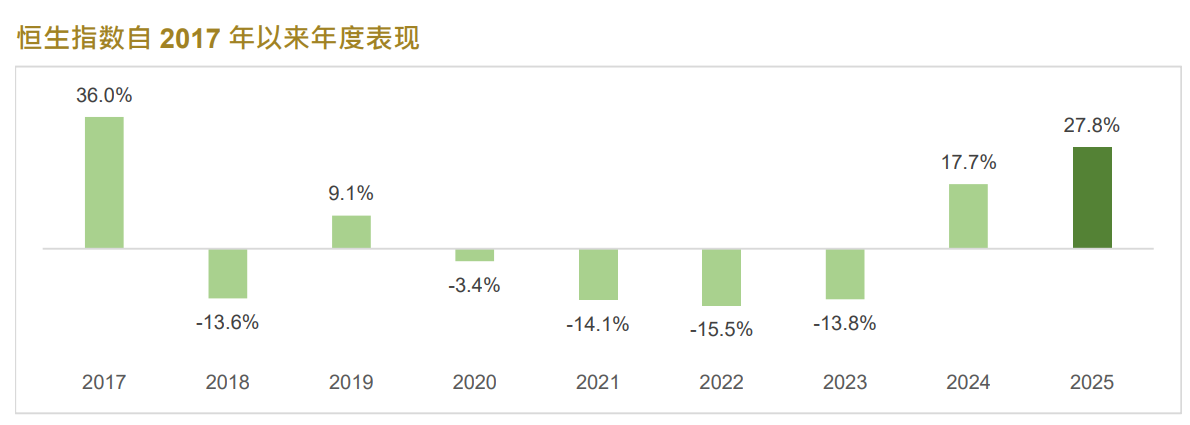
Group 1 - The Hang Seng Index (HSI) rose by 27.8% in 2025, marking its best performance since 2017, following a 17.7% increase in 2024 [1] - The rise in the HSI was driven by record capital inflows from the Hong Kong Stock Connect, optimism about the future of artificial intelligence, and interest rate cuts [1] - The HSI outperformed two other flagship indices: the Hang Seng China Enterprises Index (up 22.3%) and the Hang Seng Tech Index (up 23.5%) [1] Group 2 - The Hang Seng Composite Index (HSCI) increased by 31.0% in 2025, with mid-cap stocks leading the gains at 31.6%, followed by large-cap stocks at 30.8% and small-cap stocks at 28.8% [2] - Among industry indices in the HSCI, the materials sector had the best performance, rising by 161.3%, while utilities had the worst performance with a 5.7% increase [2] - The Hang Seng High Dividend Yield 30 Index led the high dividend indices with a rise of 38.1% in 2025 [2] Group 3 - The Hang Seng Climate Change 1.5°C Target Index performed well, with an annual increase of 31.2% [3]
港股投资周报:材料行业领涨,港股精选组合年内上涨57.14%-20251227
Guoxin Securities· 2025-12-27 07:58
- The "Hong Kong Stock Selection Portfolio" strategy is constructed based on a dual-layer selection process that combines fundamental and technical analysis. The initial stock pool is built using analyst recommendation events, such as upward earnings revisions, first-time coverage, and unexpected positive research report titles. From this pool, stocks with both fundamental support and technical resonance are selected to form the portfolio. The backtesting period is from January 1, 2010, to June 30, 2025, with an annualized return of 19.11% and an excess return of 18.48% relative to the Hang Seng Index after considering transaction costs in a fully invested state [14][16] - The "Stable New High Stock Screening" factor is constructed to identify stocks that have recently reached a 250-day high and exhibit stable price paths. The 250-day new high distance is calculated as follows: $ 250\text{-day new high distance} = 1 - \frac{Close_t}{ts\_max(Close, 250)} $ Where $ Close_t $ is the latest closing price, and $ ts\_max(Close, 250) $ is the maximum closing price over the past 250 trading days. A value of 0 indicates a new high, while positive values indicate a decline from the peak. Stocks are further filtered based on analyst attention (at least five buy or overweight ratings in the past six months), relative strength (top 20% in 250-day returns), price stability (evaluated using price path smoothness and 250-day new high distance averages over 120 days), and trend continuation (average 250-day new high distance over the past five days). The top 50 stocks are selected based on these criteria [23][24] - The backtesting results for the "Hong Kong Stock Selection Portfolio" show an annualized return of 19.11%, an excess return of 18.48% relative to the Hang Seng Index, and a maximum drawdown of 23.73% over the entire sample period. The information ratio (IR) is 1.22, with a tracking error of 14.55% and a return-to-drawdown ratio of 0.78 [20] - The "Stable New High Stock Screening" factor identified stocks primarily in the cyclical sector (9 stocks), followed by financials (4 stocks), technology (3 stocks), manufacturing (3 stocks), and consumer sectors (3 stocks) during the recent period. Specific stocks include Global New Material International and others [23][24]
哈焊华通:12月12日召开董事会会议
Mei Ri Jing Ji Xin Wen· 2025-12-12 13:16
每经AI快讯,哈焊华通(SZ 301137,收盘价:54元)12月12日晚间发布公告称,公司第五届第四次董 事会会议于2025年12月12日在公司六楼会议室召开。会议审议了《关于修订 <董事会审计委员会议事规 则> 的议案》等文件。 2024年1至12月份,哈焊华通的营业收入构成为:原材料业占比99.29%,其他业务占比0.71%。 截至发稿,哈焊华通市值为98亿元。 每经头条(nbdtoutiao)——实施城乡居民增收计划、降准降息等工具灵活高效运用、增加普通高中学 位……深度解读中央经济工作会议 (记者 曾健辉) ...
美元退潮,资产大变局!美联储降息后,留学生、股民和黄金投资者必须看清的三个真相
Sou Hu Cai Jing· 2025-12-12 04:29
Group 1 - The Federal Reserve's decision to cut interest rates from a target range of 4.25-4.5% to 4.0-4.25% is a "risk management" move focused on the employment market [1] - The shift in U.S. monetary policy from aggressive anti-inflation measures to a more cautious approach aimed at preventing recession is evident [3] - Global market reactions to the rate cut were mixed, with U.S. stock indices showing varied performance and concerns about the pace of future rate cuts [3] Group 2 - The rate cut has opened the channel for global financial conditions to ease, leading to a decrease in borrowing costs for the U.S. dollar, which is the primary global financing currency [5] - Japanese and South Korean stock indices rose over 1% on the day of the rate cut, indicating early positive effects on these markets [5] Group 3 - For China, the external changes present more opportunities than challenges, particularly in reducing depreciation pressure on the yuan against the dollar [7] - The stabilization and appreciation of the yuan provide cost relief for Chinese importers, especially in energy and raw materials [7] - The People's Bank of China gains more monetary policy flexibility, allowing for potential rate cuts or reserve requirement reductions to support economic growth [7] Group 4 - China's capital markets are expected to benefit directly from increased global risk appetite and capital inflows into emerging markets [9] - Historical data suggests that during the Fed's preemptive rate cuts, growth sectors in A-shares and Hong Kong stocks tend to perform well [9] - However, a weaker dollar may increase input inflation pressures for China, and rapid yuan appreciation could challenge the competitiveness of export-oriented industries [9] Group 5 - China's response strategy is clear, focusing on a self-directed regulatory approach rather than simply following the Fed's lead [11] - Monetary policy will remain flexible and appropriate, directing financial resources towards key areas such as technological innovation, green transformation, and small and medium enterprises [11]

港股策略周报-20251211
Shanghai Securities· 2025-12-11 14:30
Market Overview - The Hong Kong stock market indices showed a mixed performance with the Hang Seng Index rising by 0.87%, the Hang Seng China Enterprises Index increasing by 0.75%, and the Hang Seng Technology Index up by 1.13% during the week of December 1 to December 5, 2025 [4][9] - The Hang Seng Index's current Price-to-Earnings (PE) ratio is 11.87, which is around the 70th percentile since January 1, 2007, while the Price-to-Book (PB) ratio stands at 1.28, approximately at the 58th percentile during the same period [6][11] Key Economic Indicators - The U.S. PCE price index increased by 0.3% month-on-month in September, with the core PCE price index rising by 0.2%, aligning with expectations [4] - The probability of a 25 basis point rate cut by the Federal Reserve in December has risen to 86.2%, which is expected to positively impact liquidity in the Hong Kong stock market [4] Investment Recommendations - The report suggests focusing on sectors such as non-ferrous metals, price-increasing chemical products, and AI infrastructure due to favorable market conditions [4] Capital Flow Analysis - Net inflow of southbound funds amounted to HKD 11.349 billion last week, a decrease of HKD 8.491 billion compared to the previous week [6][13] - The top five net purchases by southbound funds included Xiaomi Group (HKD 4.596 billion), Tracker Fund of Hong Kong (HKD 2.606 billion), Meituan (HKD 2.100 billion), ZTE Corporation (HKD 0.641 billion), and Li Auto (HKD 0.392 billion) [6][17] - The top five net sales were Tencent Holdings (HKD 3.811 billion), SMIC (HKD 1.376 billion), ASMPT (HKD 0.439 billion), Kuaishou Technology (HKD 0.285 billion), and China Pacific Insurance (HKD 0.129 billion) [6][17]



