
外卖平台服务

Search documents
反垄断重拳接连落下,“携程们”面临重新洗牌
财富FORTUNE· 2026-01-15 13:07
Core Viewpoint - The article highlights the tension between high profits in the platform economy and regulatory risks, particularly focusing on Ctrip's recent antitrust investigation, which underscores the increasing scrutiny of platform companies in China [1][3]. Group 1: Ctrip's Financial Performance and Regulatory Challenges - Ctrip's net profit for the first three quarters of 2025 reached 29.1 billion yuan, nearly doubling year-on-year, which translates to approximately 1 billion yuan in daily earnings, surpassing the total profits of the A-share tourism sector [1]. - The State Administration for Market Regulation (SAMR) has initiated an investigation into Ctrip for alleged abuse of market dominance, with potential fines reaching up to 10% of the previous year's sales if violations are confirmed [1][6]. - Ctrip holds a dominant market share of 56% in China's domestic travel market, significantly higher than competitors such as Tongcheng Travel (15%), Meituan (13%), and Fliggy (8%) [3]. Group 2: Broader Regulatory Landscape - The recent antitrust investigations reflect a systemic approach to regulating the platform economy, moving from case-specific actions to a comprehensive industry assessment [3][4]. - The SAMR has released guidelines to address antitrust compliance in the platform economy, identifying typical risk scenarios such as below-cost sales and "choose one from two" practices [4]. - The regulatory focus aims to shift platform companies from zero-sum competition to a healthier ecosystem that benefits merchants, workers, and consumers [4]. Group 3: Market Reactions and Strategic Adjustments - Following the announcement of the investigation, Ctrip's stock price fell approximately 7% on the day of the news and further declined nearly 20% the next day, resulting in a market value loss exceeding 70 billion HKD [3][6]. - Other platform giants are adjusting their strategies in response to the tightening regulatory environment, with companies like Alibaba, Meituan, and JD.com exploring differentiated competition in the food delivery sector [5]. - Ctrip's challenges may create opportunities for competitors such as Meituan and Tongcheng Travel to capture market share from Ctrip as it navigates regulatory scrutiny [7]. Group 4: Long-term Implications for the Industry - The ongoing regulatory actions are expected to reshape the competitive landscape, providing more space for innovators and new entrants while promoting healthier market dynamics [8]. - Investors are advised to shift their focus from user growth and market share to compliance capabilities, profit quality, and ecosystem health in evaluating platform companies [8]. - The regulatory journey for platform economies is anticipated to continue, with further actions likely against other companies, prompting a reevaluation of core competitive strengths in a more equitable market environment [8].

下游持续回暖,关注外贸政策调整
Hua Tai Qi Huo· 2026-01-13 05:17
Group 1: Industry Investment Rating - No information provided Group 2: Core Views - The downstream industry is showing signs of recovery, and attention should be paid to foreign trade policy adjustments [1] - The upstream energy prices have slightly corrected, agricultural egg prices have rebounded significantly, and non - ferrous metal prices of aluminum and nickel have continued to rise [3] - In the midstream, PX prices are at a high level while polyester operating rates are low, and power plant coal consumption has decreased [4] - Downstream, the sales of commercial housing in first - and second - tier cities have rebounded beyond seasonality, and the number of domestic flights has continued to increase [5] Group 3: Summary of Related Catalogs 1. Middle - view Event Overview Production Industry - On January 12, regarding China's export of rare earths to Japan, the Chinese Foreign Ministry stated that relevant measures are taken in accordance with laws and regulations [1] - Also on January 12, the China Chamber of Commerce for Import and Export of Machinery and Electronic Products believes that the "soft landing" of the EU's anti - subsidy case on Chinese electric vehicles is conducive to the stability of the industrial chain and supply chain [1] Service Industry - The State Administration for Market Regulation will conduct an investigation and evaluation on the market competition of the food delivery platform service industry due to issues such as subsidy and price competition [2] 2. Industry Overview Upstream - Energy: International crude oil and liquefied natural gas prices have slightly corrected [3] - Agriculture: Egg prices have rebounded significantly [3] - Non - ferrous metals: Aluminum and nickel prices have continued to rise [3] Midstream - Chemical industry: PX prices are high, and polyester operating rates are low [4] - Energy: Power plant coal consumption has decreased [4] Downstream - Real estate: The sales of commercial housing in first - and second - tier cities have rebounded beyond seasonality [5] - Service: The number of domestic flights has continued to increase [5] 3. Key Industry Price Indicators - On January 12, prices of various products showed different trends, such as a 7.20% year - on - year increase in egg prices, a 4.49% increase in aluminum prices, and a 3.14% increase in WTI crude oil prices [38]
营造公平有序的竞争环境
Di Yi Cai Jing Zi Xun· 2026-01-12 15:33
Core Viewpoint - The Chinese government is intensifying its efforts to combat unfair competition and monopolistic practices in the food delivery platform industry, aiming to create a fair market environment and protect consumer rights [2][3]. Group 1: Government Actions - The State Council's Anti-Monopoly and Anti-Unfair Competition Committee has announced an investigation into the competitive conditions of the food delivery platform service industry due to issues like excessive subsidies and price wars [2][3]. - The government emphasizes the need to eliminate monopolistic behaviors in the livelihood sector, reflecting a commitment to maintaining fair competition [2]. Group 2: Market Concerns - There are significant concerns regarding the current practices in the food delivery market, including the use of algorithms to manipulate competition and the blending of platform and merchant subsidies, which distorts market preferences [3]. - The expectation is that the investigation will address these competitive irregularities and help establish a fair competition order in the market [3]. Group 3: Enforcement and Governance - There is a need for transparent administrative enforcement processes to minimize misunderstandings and concerns among market participants, ensuring that legitimate rights are protected without infringing on others [4]. - The enforcement of anti-unfair competition and anti-monopoly laws should be regulatory rather than intrusive, maintaining a balance between protecting market transactions and respecting individual rights [4]. Group 4: Market Autonomy - Strengthening market autonomy is essential, with suggestions to introduce collective litigation and other mechanisms to empower consumers in defending their rights at lower costs [5]. - The investigation into the food delivery industry is seen as a careful and data-driven approach to understanding competitive dynamics and informing future policy and enforcement actions [5].

前瞻全球产业早报:国家开展外卖平台垄断调查
Qian Zhan Wang· 2026-01-12 00:59
Group 1 - The State Council is conducting an investigation and assessment of the market competition status in the food delivery platform service industry, emphasizing the need for platforms to comply with antitrust regulations and promote healthy competition [2] - Five departments, including the Ministry of Industry and Information Technology, have issued guidelines requiring new renewable energy generation projects to achieve a self-consumption ratio of at least 60% [3] - Kuaishou announced a crackdown on AI-modified classic films and animations, starting from January 1, 2026, to maintain content integrity [4] Group 2 - TSMC reported a 31.6% year-on-year increase in consolidated revenue for 2025, with total revenue for the year reaching approximately NT$3.81 trillion [7] - The China Passenger Car Association reported that retail sales of new energy passenger vehicles reached 12.809 million units in 2025, a year-on-year increase of 17.6% [8] - The global humanoid robot market is expected to see exponential growth, with AGIBOT leading in shipments and market share [9] Group 3 - The Hong Kong Stock Exchange will launch six new stock option categories on January 19, expanding the stock options market [10] - Cainiao has become the first logistics company to provide G2G services across three continents, launching cross-border logistics services between the U.S. and Mexico [11] - Hainan Airlines addressed an issue regarding abnormal ticket prices due to a temporary system failure, assuring that all sold tickets remain valid [12] Group 4 - Elon Musk's xAI plans to invest over $20 billion in building a data center in Mississippi, highlighting the growing interest in data center infrastructure [13] - NVIDIA has appointed a Google Cloud executive as Chief Marketing Officer to enhance its brand influence [14] - Hyundai has begun mass production of an AI chip for autonomous robots, enabling them to operate without external network connections [15] Group 5 - Li Auto is deepening its overseas collaboration with Alibaba Cloud, focusing on global expansion in Central Asia, the Middle East, Europe, and Asia-Pacific [16] - Volvo is recalling over 413,000 vehicles in the U.S. due to rearview camera issues, marking the second recall for the same problem [17] - Apple is accelerating the selection process for a new CEO, with John Ternus emerging as the leading candidate [18] Group 6 - Glencore has confirmed that it is in preliminary talks with Rio Tinto regarding a potential business merger, which may involve a full stock merger [19] - A report from the Halle Institute indicates that the number of bankruptcy applications by German companies reached a 20-year high in 2025, reflecting ongoing structural pressures in the economy [20] Group 7 - The China Securities Regulatory Commission has approved Shenglong Mining's application for an initial public offering on the Shenzhen Stock Exchange [21] - PhotonPay has completed a multi-million dollar Series B financing round led by IDG Capital [22]

牛市早报|证监会:合力推动各类中长期资金进一步提高入市规模比例
Xin Lang Cai Jing· 2026-01-12 00:49
Market Data - As of January 9, the Shanghai Composite Index rose by 0.92% to 4120.43 points, the Shenzhen Component Index increased by 1.15% to 14120.15 points, and the ChiNext Index gained 0.77% to 3327.81 points, with total trading volume in the Shanghai and Shenzhen markets reaching 31,227 billion yuan [1] - In the US market on January 9, the Dow Jones Industrial Average rose by 0.48% to 49,504.07 points, the S&P 500 increased by 0.65% to 6,966.28 points, and the Nasdaq Composite gained 0.81% to 23,671.35 points [1] Regulatory Updates - The State Administration for Market Regulation announced a revised "Complaint Handling Measures" effective April 15, which clarifies the jurisdiction for complaints against online store operators and live streaming platforms [2] - The National Development and Reform Commission emphasized eight key areas for the national business system to focus on by 2026, including boosting consumption and developing digital, green, and health consumption [2] - The National Health Insurance Administration is launching a pilot program for "Personal Medical Insurance Cloud" from February to December, aiming to create a smart healthcare management model [3] - The China Securities Regulatory Commission is committed to deepening investment and financing reforms to enhance the capital market's quality and growth [2] Fund Management - New regulations on fund sales fees will take effect on January 1, 2027, prohibiting fund managers from charging subscription fees and requiring a "pay first, refund later" model for sales service fees [4] - Fund managers must complete adjustments to ensure fair treatment of investors by merging fund shares and standardizing fee rates by the deadline [4] Market Investigations - The State Council's Anti-Monopoly and Anti-Unfair Competition Committee is investigating the competitive landscape of the food delivery platform industry due to issues like price wars and market saturation [5] - The China Securities Regulatory Commission is investigating abnormal stock price fluctuations of Ningbo Tianpu Rubber Technology Co., Ltd., which has raised market concerns [7] New Stock Offerings - Two new stocks are scheduled for subscription this week: Aisheren (920050.BJ) on Monday and Hengyun Chang (688785.SH) on Friday [8][9]
告别内卷,外卖要竞争也要健康
Bei Jing Shang Bao· 2026-01-11 15:21
Core Viewpoint - The State Council's Anti-Monopoly and Anti-Unfair Competition Committee has initiated an investigation into the competitive landscape of the food delivery platform service industry, highlighting issues of excessive subsidies, price wars, and traffic control that have led to "involution" in competition [1][2]. Group 1: Industry Competition - The food delivery industry has seen intense competition, initially sparked by JD.com, followed by fierce battles between Alibaba's Taobao and Meituan, escalating further amid multi-format e-commerce conflicts [1]. - Regulatory scrutiny has been ongoing, with the government previously engaging with major platforms like JD.com, Meituan, and Alibaba to ensure fair competition [1]. - The ongoing price wars have resulted in significant financial burdens for platforms, which have not translated into sustainable business improvements [1]. Group 2: Impact on Stakeholders - Many small and medium-sized businesses are experiencing a situation where increased order volume does not equate to increased revenue, reflecting a broader issue of financial strain across the industry [2]. - Delivery riders are also facing challenges, as the influx of orders does not lead to proportional income, indicating a disconnect between consumer subsidies and worker compensation [2]. - Consumers may benefit from low prices in the short term, but this comes with hidden risks, such as the potential for lower quality and service standards [2]. Group 3: Regulatory and Market Implications - The government has emphasized the need to address "involution" in competition, particularly in e-commerce, where low prices and low quality dominate, leading to inefficiencies and resource wastage [2][3]. - Healthy competition is essential for industry growth, and the current state of "involution" hinders innovation and value creation, necessitating a shift towards differentiated, high-quality competition [3]. - The regulatory intervention signals a commitment to fostering fair competition and improving overall market health, moving from mere market share battles to enhancing supply chain efficiency and innovation [3].

【西街观察】告别内卷,外卖要竞争也要健康
Bei Jing Shang Bao· 2026-01-11 13:54
Core Viewpoint - The State Council's Anti-Monopoly and Anti-Unfair Competition Committee has initiated an investigation into the competitive landscape of the food delivery platform industry, highlighting issues of excessive subsidies, price wars, and traffic control that have led to "involution" and negatively impacted the real economy [1][2]. Group 1: Industry Competition - The food delivery industry has seen intense competition, initially sparked by JD.com, followed by fierce battles between Alibaba's Taobao and Meituan, escalating amidst a multi-format e-commerce environment [1]. - Regulatory scrutiny has been ongoing, with the government previously engaging with major platforms like JD, Meituan, and Alibaba to ensure fair competition [1]. - The current competition is characterized by a focus on market share acquisition through heavy spending, which has not translated into sustainable business improvements, resulting in significant financial burdens for the platforms [1]. Group 2: Impact on Stakeholders - Many small and medium-sized businesses are experiencing a situation where increased order volume does not equate to increased revenue, leading to a cycle of burdens without corresponding financial benefits [2]. - Delivery riders are also facing challenges, as the influx of orders does not lead to proportional earnings, and consumer subsidies are not effectively reaching the labor force [2]. - Consumers may benefit from low prices in the short term, but this comes with hidden risks, such as the potential for lower quality products and services due to aggressive pricing strategies [2]. Group 3: Regulatory Response and Future Directions - The government has emphasized the need to address "involution" in competition, particularly in the e-commerce sector, which is marked by low prices and low quality, lacking innovation [2]. - A healthy industry requires new entrants and should focus on creating value rather than engaging in destructive competition that leads to resource waste and declining profits [3]. - The regulatory intervention signals a push towards fostering fair and orderly competition, aiming to shift from mere market share battles to enhancing supply chain efficiency and promoting high-quality, differentiated competition [3].
传媒行业周报系列 2026 年第 2 周:腾讯推出AI小程序成长计划,监管启动外卖反垄断调查-20260111
HUAXI Securities· 2026-01-11 12:52
Investment Rating - Industry rating: Recommended [4] Core Insights & Investment Recommendations - Tencent launched an AI mini-program growth plan to accelerate the implementation of AI applications within its ecosystem, providing developers with a year-long cloud development resource, free AI computing power, data analysis, traffic incentives, and better commercialization support [2][22] - The initiative aims to lower development barriers and encourage developers to quickly create and operate AI mini-programs within the WeChat ecosystem, enhancing user experience and driving growth in advertising, cloud services, and payment sectors [2][22] - Regulatory authorities have initiated an antitrust investigation into the food delivery industry, addressing issues of intense competition characterized by subsidies and traffic control, which have negatively impacted profits and merchant operations [3][23] - The intervention is expected to alleviate short-term profit pressures on platforms and shift competition focus towards delivery efficiency, merchant empowerment, and user experience, fostering a healthier industry development [3][23] - Current investment opportunities include leading internet companies in Hong Kong, the gaming industry benefiting from policy incentives, and the film and cultural tourism sectors supported by consumer policies [6][23] Sub-industry Data Film Industry - The top three films by box office for the week are "The Hidden Kill" with 54.525 million yuan (23.90% market share), "Avatar 3" with 47.237 million yuan (20.70%), and "The Legend of the Qin" with 45.543 million yuan (20.00%) [25][26] Gaming Industry - The top three iOS games by revenue are "Honor of Kings," "Peacekeeper Elite," and "Delta Force," while the top three Android games by popularity are "Heart Town," "Duck Duck Goose," and "Ghost Valley" [28][29] TV Series Industry - The top three TV series by broadcast index are "The Sun is Like Me" (82.9), "Carefree" (82.3), and "Tea Bone" (80.6) [31][32] Variety and Animation - The top variety show is "Now Departing Season 3" with a broadcast index of 75.7, followed by "Cosmic Sparkle Please Note" and "Voice of the Flowing Season" [33][34] - The top animation series is "Immortal Reversal" with a viewership index of 225.6, followed by "The Mortal Cultivation" and "Perfect World Animation" [35][36]

美团、淘宝闪购、京东外卖,集体表态
Sou Hu Cai Jing· 2026-01-11 03:12
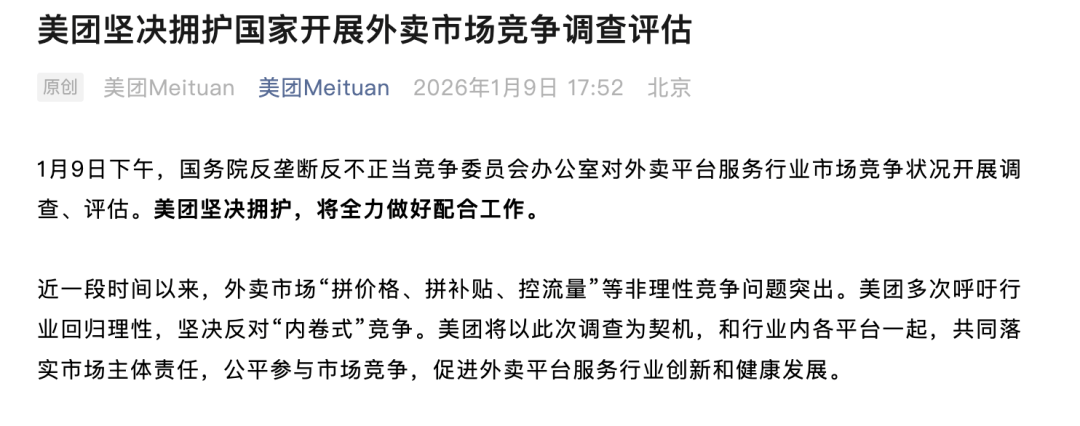
Core Viewpoint - The State Council's Anti-Monopoly and Anti-Unfair Competition Committee announced an investigation into the competitive status of the food delivery platform service industry, with major players like Meituan, Taobao Flash, and JD Delivery expressing their willingness to cooperate [1][3][5]. Group 1: Industry Response - Meituan highlighted the prevalence of irrational competition characterized by price wars, subsidies, and traffic control, urging the industry to return to rational competition and opposing "involution" [1]. - Taobao Flash emphasized the importance of fair competition as a core principle of market economy, committing to compliance with relevant laws and regulations while supporting the investigation [3]. - JD Delivery expressed strong support for the investigation, advocating for the maintenance of fair competition and the protection of consumer and operator rights, while promoting high-quality development through supply chain innovation [5][6]. Group 2: Commitment to Healthy Development - Meituan aims to use the investigation as an opportunity to collaborate with other platforms to fulfill market responsibilities and foster innovation and healthy development in the food delivery service industry [1]. - Taobao Flash reiterated its commitment to providing diverse and high-quality services in collaboration with merchants and partners, contributing to a fair and orderly market environment [3]. - JD Delivery plans to resist harmful competition and focus on quality delivery services, enhancing its offerings for consumers, merchants, and delivery personnel [5][6].
多部门部署 “反内卷”整治行动向纵深推进
Yang Guang Wang· 2026-01-11 02:02
Group 1 - The central economic work conference has identified the "in-depth rectification of 'involutionary' competition" as a key task for economic work in 2026, continuing the "anti-involution" actions into the new year [1] - The Ministry of Industry and Information Technology, along with three other departments, held a meeting targeting irrational behaviors such as blind construction and low-price competition in the power and energy battery industry, aiming to regulate industry competition order [1] - "Involutionary" competition is characterized by low price, low quality, and low-level competition, which disrupts market signals, reduces resource allocation efficiency, and erodes long-term competitiveness of enterprises, ultimately hindering high-quality development [1] Group 2 - Since the 2024 central economic work conference proposed "comprehensive rectification of 'involutionary' competition," China has implemented a series of institutional constructions to guide key industries like steel, photovoltaics, and electric vehicles from low-quality involution to innovation and efficiency [2] - The National Development and Reform Commission plans to research and formulate regulations for the construction of a unified national market, while the State Administration for Market Regulation aims to promote amendments to foundational laws such as the pricing law to enhance the legal and policy tools against "involutionary" competition [2] - To effectively address "involutionary" competition, industries and enterprises must accelerate reforms, eliminate outdated momentum, and shift towards efficiency and innovation, thereby creating a true "moat" for their development through technology, branding, and service upgrades [2]