
智能产品

Search documents
出政策办活动优场景,促消费今年继续加力
Ren Min Ri Bao· 2026-01-27 09:01
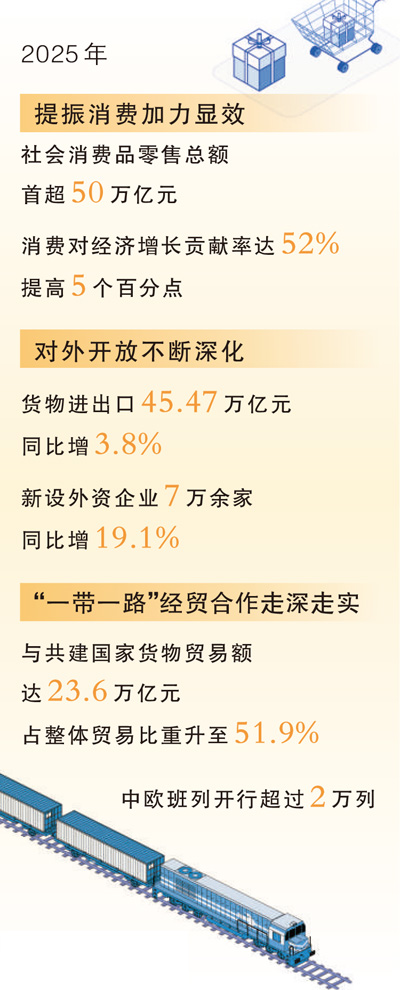
Core Insights - In 2025, China's total retail sales of consumer goods exceeded 50 trillion yuan for the first time, reaching 50.1 trillion yuan, with a year-on-year growth of 3.7% and a contribution rate to economic growth increasing by 5 percentage points to 52% [3][4] - The foreign trade maintained resilience, with total imports and exports reaching 45.47 trillion yuan, a year-on-year increase of 3.8%, and the number of newly established foreign-funded enterprises exceeding 70,000, up 19.1% [5][6] Economic Performance - The retail sales of consumer goods surpassed 50 trillion yuan, driven by policies and activities aimed at boosting consumption, with significant growth in both goods and service consumption [3][4] - The service retail sector saw a year-on-year growth of 5.5%, with specific services like cultural entertainment and tourism experiencing double-digit growth [3][4] Foreign Trade and Investment - The total value of goods traded with Belt and Road Initiative countries reached 23.6 trillion yuan, growing by 6.3%, which is 2.5 percentage points faster than overall trade growth [8] - The number of active trading entities exceeded 780,000, with private enterprises accounting for 57.3% of total foreign trade [5][6] Policy Initiatives - The Ministry of Commerce plans to enhance consumer support through policies, activities, and improved consumption environments, including trials for automobile circulation reforms and international consumption environment construction [4][5] - The government aims to attract foreign investment by optimizing support policies and ensuring equal participation of foreign enterprises in domestic consumption and procurement activities [6][7] International Cooperation - China signed 24 free trade agreements with 31 countries and regions, covering 45% of total goods trade, and actively participated in global trade discussions [8][10] - The "Belt and Road" initiative continues to deepen economic cooperation, with significant investments in infrastructure and trade facilitation projects [8][10]

今年将优化实施消费品以旧换新 全力稳住外贸基本盘
Xin Lang Cai Jing· 2026-01-26 22:42
Core Viewpoint - The Ministry of Commerce of China is committed to implementing the decisions of the Central Committee and the State Council, focusing on high-quality business development to contribute positively to the economic recovery by 2025 [1][5]. Group 1: Domestic Circulation and Consumption Promotion - The Ministry will enhance domestic circulation, facilitate both domestic and international circulation, and expand international circulation to promote high-quality business development [1][5]. - To boost consumption in 2026, the Ministry will focus on three areas: policy issuance, event organization, and scenario optimization [2][5]. - Specific policies will include promoting the replacement of old consumer goods, reforming automobile circulation, and implementing reward invoice trials to stimulate consumption [2][5]. Group 2: Consumption Environment and Activities - The Ministry plans to organize over 20 "Buy in China" themed events and support local activities to create a vibrant consumption atmosphere [2][6]. - Efforts will be made to improve the consumption environment by accelerating the development of international consumption center cities and creating new consumption scenarios [6]. Group 3: Foreign Trade and Investment - The Ministry acknowledges the complex external environment affecting foreign trade, emphasizing the resilience and potential of the Chinese economy [6][7]. - In 2026, the Ministry aims to stabilize foreign trade and promote service market openness, including improving the management of cross-border service trade [6][7]. - The Ministry will also enhance policies to attract foreign investment, ensuring equal support for foreign enterprises participating in various economic activities [7].
出台扩大入境消费的政策措施!商务部最新发声
Zhong Guo Zheng Quan Bao· 2026-01-26 12:06
1月26日,国新办举行新闻发布会。商务部相关负责人表示,下一步,商务部将围绕做强国内大循环、 畅通国内国际双循环、拓展国际循环,着力推动商务高质量发展,为"十五五"开好局、起好步作出新贡 献。 要点概览: 出台扩大入境消费的政策措施。 国家层面的海外综合服务大平台近期将上线。 以服务业为重点扩大市场准入和开放领域。有序扩大电信、医疗、教育等领域自主开放。 优化实施消费品以旧换新,促进汽车、家电、数码和智能产品等大宗耐用商品消费。 开展汽车流通消费改革试点。 出台扩大入境消费的政策措施 在外贸工作方面,商务部对外贸易司司长王志华表示,2026年,商务部将强化政策抓手。形成外贸政 策"组合拳",精心服务好外贸企业,助力企业降本增效。加强政策宣传解读,稳住预期、提振信心,央 地联动,适时研究出台新的政策,创新支持举措。 拓展多元市场。加大对企业赴境外参展力度,举办系列贸易促进活动,办好第139届、140届广交会,鼓 励企业用好国别贸易指南和外贸促进信息,帮助企业更好对接市场。 加快创新赋能。指导跨境电商综试区大力发展跨境电商赋能产业带。着力拓展绿色贸易,提升绿色低碳 产品国际竞争力。推动人工智能赋能外贸发展,提升贸 ...
我省今年扩围支持设备更新 优化实施消费品以旧换新
Xin Lang Cai Jing· 2026-01-24 21:42
Group 1 - The provincial development and reform commission and finance department have announced a policy to promote large-scale equipment updates and a trade-in program for consumer goods in 2026 [1] - The policy will expand support for equipment updates across various sectors, including the addition of new areas such as old community elevator installations, elderly care facilities, and fire rescue equipment [1] - There will be increased support for the replacement of old operational trucks and the update of new energy city buses, as well as the scrapping and updating of old agricultural machinery [1] Group 2 - The policy includes a unified subsidy standard for the trade-in of cars, six categories of home appliances, and four categories of digital and smart products, with specific provisions for smart home products [1] - The province aims to enhance recycling and circular economy efforts by improving the recycling network and encouraging the development of "Internet + second-hand" models [2] - The policy emphasizes the need to strengthen standards and accelerate the development of a standard system, with plans to revise or participate in the creation of 20 national and industry standards and implement 50 local and group standards [2]
坚持政策支持和改革创新并举
Qi Huo Ri Bao Wang· 2026-01-21 03:06
Core Viewpoint - The National Development and Reform Commission (NDRC) emphasizes the importance of macroeconomic policies aimed at strengthening domestic circulation and expanding domestic demand, while also focusing on the development of the real economy and the construction of a unified national market [1][2][5]. Group 1: Macroeconomic Policies - The NDRC plans to formulate a strategic implementation plan for expanding domestic demand from 2026 to 2030, aligning with the trends of demand upgrades and technological revolutions [1]. - The focus will be on enhancing the quality of key industries and fostering emerging and future industries, particularly through initiatives like "Artificial Intelligence+" [1]. - The NDRC aims to implement a more proactive fiscal policy and moderately loose monetary policy, with a key goal of promoting reasonable price recovery [2]. Group 2: Market Regulation and Competition - The NDRC intends to address "involution" competition by shifting from price competition to value competition, improving market access, and enhancing fair competition mechanisms [2]. - There will be a focus on regulating key industry prices and ensuring a healthy market order through the implementation of quality brand strategies [2]. - The NDRC plans to establish a national unified market construction regulation to standardize behaviors of local governments and enterprises [3]. Group 3: Energy Transition and Carbon Neutrality - The NDRC emphasizes the acceleration of energy transition by increasing the development of non-fossil energy and enhancing the capacity of the power grid [4]. - There will be a strong push for industrial upgrades towards green and low-carbon industries, including the promotion of zero-carbon parks and factories [4]. - The NDRC will implement comprehensive resource management and promote a circular economy to support carbon peak and neutrality goals [4]. Group 4: Economic Outlook - The NDRC forecasts a continuous improvement in economic structure and development momentum, with significant potential in consumption, investment, technology, and regional development [5]. - The focus will be on combining policy support with reform and innovation to transform development potential into new economic growth [5].
一图解码:港股IPO一周回顾 29家公司递表 兆易创新首挂涨45%
Sou Hu Cai Jing· 2026-01-19 12:13
Group 1: IPO Market Overview - In the past week (January 12-18, 2026), a total of 29 companies submitted IPO applications in the Hong Kong market, including Qian Dama, Yuanji Food, and others [5][6] - Three companies passed the hearing at the Hong Kong Stock Exchange: Guoen Co., Dongpeng Beverage, and Muyuan Foods, all of which are already listed on A-shares [5][10] - Only one company, Longqi Technology, initiated its IPO process, with a global offering of 52.2591 million shares at a maximum price of HKD 31 per share [5][13] Group 2: Companies Going Public - Four companies officially listed on the Hong Kong Stock Exchange: Haowei Group, BBSB International, Zhaoyi Innovation, and Hongxing Cold Chain [5][14] - Yuanji Food is the largest Chinese and global Chinese fast-food enterprise, with a revenue of RMB 1.982 billion, up 11.0% year-on-year, and a net profit of RMB 142 million, up 18.8% [8][9] - Estun, a leading industrial robot company, reported a revenue of RMB 3.804 billion, up 12.9% year-on-year, and a net profit of RMB 25.372 million, recovering from a loss in the previous year [10][11] Group 3: Company Highlights - Guoen Co. focuses on chemical new materials and reported a revenue of RMB 17.444 billion, up 10.0% year-on-year, with a net profit of RMB 713 million, up 40.2% [11] - Muyuan Foods, a leader in the pork industry, achieved a revenue of RMB 111.79 billion, up 15.5% year-on-year, and a net profit of RMB 15.112 billion, up 34.4% [12] - Longqi Technology is a global leader in smart products and services, with its IPO set to launch on January 14, 2026, and expected to list on January 22, 2026 [13][14]

开启消费市场新图景
Jing Ji Ri Bao· 2026-01-08 21:46
Group 1 - The core viewpoint of the articles emphasizes that the vitality of the consumer market is driven by "quality," with a shift from merely purchasing expensive items to seeking better products [1][3] - Government policies are crucial in optimizing the consumption environment, which is essential for boosting consumer confidence and stimulating economic vitality. Various measures have been implemented to enhance the consumption environment, including the expansion of no-reason return policies to over 1.5 million businesses [1] - The collaboration among government, production enterprises, and sales platforms is creating a new landscape for quality-driven consumption upgrades, showcasing a multi-faceted approach to improving the consumer experience [1] Group 2 - Product iteration is essential for aligning with upgraded consumer demands, particularly in the silver economy sector, where the transaction volume for pickleball has increased by 9.4 times year-on-year, and smart beds have seen over a 10-fold increase [2] - The IP consumption sector is evolving, with IP collaborations shifting from low-frequency luxury items to high-frequency daily necessities, fulfilling both practical needs and emotional value for consumers [2] - Innovative consumption scenarios are expanding the boundaries of quality consumption, as seen in the cultural tourism sector where technologies like VR are enhancing experiences, and community consumption models are integrating health services for improved convenience [2] Group 3 - The essence of quality-driven consumption upgrades is to meet people's aspirations for a better life, creating a virtuous cycle where demand drives supply and supply generates demand [3] - When consumers experience improvements in quality and service in their daily purchases, the vitality of the consumer market is naturally stimulated, reflecting the true meaning of quality consumption [3]
新闻1+1丨2026首批“国补”落地,新政“新”在哪儿?
Yang Shi Wang· 2026-01-06 23:06
Core Insights - The "National Subsidy" policy has significantly boosted consumer spending, with an expected sales increase of 3.92 trillion yuan and benefiting 494 million consumers from 2024 to 2025 [1] Group 1: Adjustments to the "National Subsidy" Policy - The 2026 "National Subsidy" policy will focus on a broader coverage of consumers and stronger product promotion capabilities, particularly for green, low-carbon, and smart digital products [4] - Subsidies will be concentrated on six categories of home appliances, emphasizing energy-efficient products, as 90% of consumers are purchasing first-level energy efficiency products [4] - The scope of smart products has been expanded to include smart glasses, promoting the application of national smart technology products [4] Group 2: Expected Impact of the "National Subsidy" Policy - The 2026 policy will ensure a more balanced and stable distribution of subsidy funds throughout the year, addressing previous issues where funds were depleted by the third and fourth quarters [5] - This approach aims to stabilize market operations and consumer expectations, enhancing the effectiveness of the policy in driving and guiding consumption [5] Group 3: Beneficiaries of the "National Subsidy" - The emphasis on promoting green, low-carbon, and smart digital products will enhance technological competitiveness and product quality in these sectors [8] - The policy encourages companies to innovate and improve their products, expanding the market for advanced technology and fostering continuous growth for innovative enterprises [8] Group 4: Future of Service Consumption and "National Subsidy" - The "National Subsidy" policy is being explored for potential support of service consumption, which currently accounts for 47% of household spending and is expected to grow [10] - Various policies have been introduced to promote service consumption, including support for elderly care and other service sectors, indicating a shift towards integrating subsidies into service consumption [10][11]
2026年国补下达首批625亿元,外媒分析该如何提高消费
Huan Qiu Wang· 2025-12-31 00:52
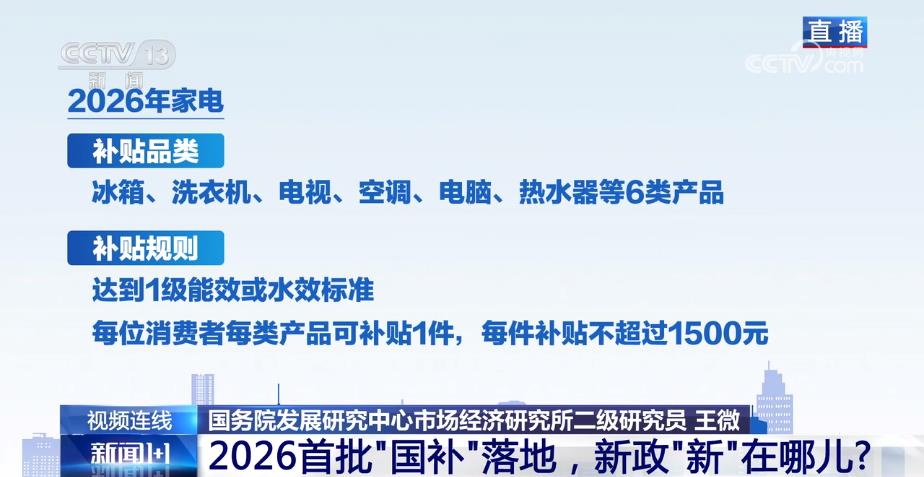
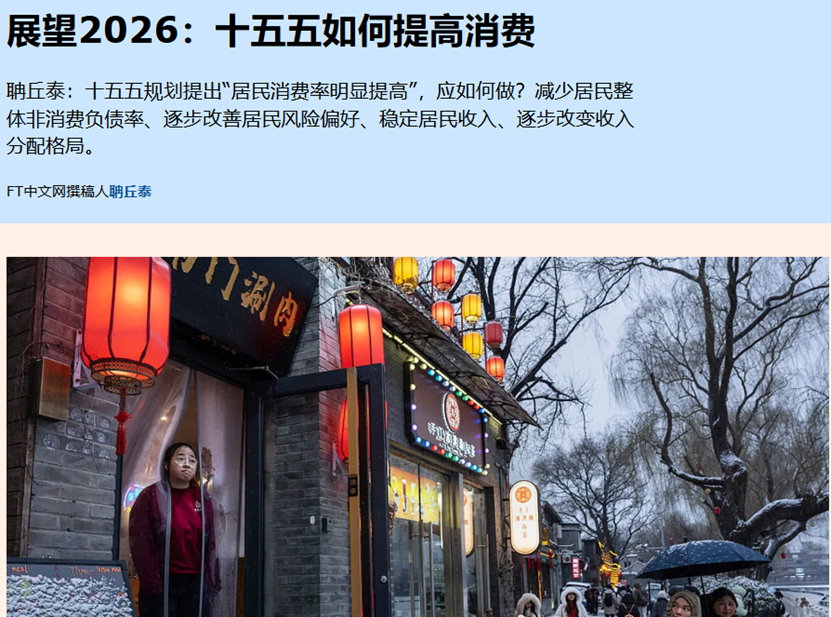
Group 1 - The National Development and Reform Commission and the Ministry of Finance have issued a notice regarding the implementation of a large-scale equipment update and consumer goods replacement policy in 2026, with an initial funding of 62.5 billion yuan to support the replacement of consumer goods [1] - The scope of national subsidies for home appliances has been narrowed to six categories: refrigerators, washing machines, televisions, air conditioners, computers, and water heaters, with the subsidy rate for first-level energy-efficient appliances reduced from 20% to 15%, and the maximum subsidy per appliance decreased from 2,000 yuan to 1,500 yuan [1] - New smart products such as smart glasses and smart home devices will be included in the subsidy program, while categories like home decoration and electric bicycles have been excluded [1] Group 2 - The article emphasizes the need to encourage wealthy individuals to spend more and save less, while also increasing consumer loan availability to support lower-income groups in making significant purchases based on life and career cycles [4] - It suggests that improving consumption hinges on optimizing income distribution, expanding the middle-income group, and enhancing social security, alongside implementing credit policies to reduce debt constraints [4] - Recommendations include reducing non-consumption debt, increasing credit accessibility, stabilizing income, and adjusting income distribution structures to achieve a steady increase in the consumption rate [4]
华勤技术:3+N+3业务布局和客户结构均呈现稳健发展态势
Zheng Quan Ri Bao Wang· 2025-12-04 11:10
Group 1 - The company, Huqin Technology, is focusing on smart products and has a robust development trend in its 3+N+3 business layout and customer structure [1] - The core business strategy of the company is steadily advancing and aligns deeply with industry development trends [1]
