硬件制造

Search documents
5000亿芯片巨头,终止重大资产重组,明天开说明会
2 1 Shi Ji Jing Ji Bao Dao· 2025-12-09 14:47
Core Viewpoint - The companies Haiguang Information and Zhongke Shuguang announced the termination of a major asset restructuring plan due to changes in market conditions and the complexity of the transaction, which was initially proposed to involve a transaction amount of 1159.67 billion yuan [1][2]. Group 1: Termination of Restructuring - On December 9, Haiguang Information and Zhongke Shuguang's boards approved the termination of the asset restructuring plan, which involved a share swap to absorb Zhongke Shuguang [1]. - The termination was attributed to the large scale of the transaction and the involvement of multiple parties, leading to prolonged discussions and unfavorable market conditions [1]. - The companies stated that the termination would not have a significant adverse impact on their operational and financial status [1]. Group 2: Market Performance and Valuation - Following the announcement of the restructuring plan on June 9, Haiguang Information's stock price increased by 58.5% over the past 120 trading days, with a year-to-date increase of 46.6%, bringing its market capitalization to 509.7 billion yuan [2]. - Zhongke Shuguang's stock also saw a cumulative increase of 45.5% over the same period, with a year-to-date rise of 39%, resulting in a market capitalization of 146.5 billion yuan [2]. - The valuation difference between the two companies was highlighted, with Haiguang Information enjoying a price-to-earnings ratio of 147 times, while Zhongke Shuguang had a ratio of 46 times [2]. Group 3: Future Plans - Haiguang Information committed to not planning any major asset restructuring for at least one month following the termination [1]. - An investor briefing is scheduled for December 10, 2025, to discuss the termination and address investor questions [1].
光大期货金融期货日报-20251209
Guang Da Qi Huo· 2025-12-09 06:33
1. Report Industry Investment Rating - Not provided in the given content 2. Core Views of the Report - The stock market opened higher and closed higher, with the ChiNext Index rising over 3% during the session and the turnover exceeding 2 trillion yuan. The market has shifted its focus to fundamental logic after the liquidity-driven market since June. New productivity themes led by AI have optimistic growth expectations, especially in the upstream hardware manufacturing of the technology sector, but they have entered a volatile phase since November. Traditional economic sectors are in a slow recovery and are unlikely to enter a fundamental bull market in the short term. Overseas tech stocks also face expectation divergence. The market volume and volatility are decreasing, and the index is expected to fluctuate in the short term [1]. - For treasury bonds, the 30 - year main - contract futures fell 0.29%, the 10 - year rose 0.02%, the 5 - year fell 0.01%, and the 2 - year remained stable. The central bank conducted 1223 billion yuan of 7 - day reverse repurchase operations, resulting in a net injection of 147 billion yuan. The money market rates have increased slightly. The bond market shows a "good news exhausted" situation, with treasury bond yields rising slightly and the yield curve steepening. It is expected to continue narrow - range fluctuations within the year [1][2]. 3. Summary by Relevant Catalogs 3.1 Research Views - **Stock Index Futures**: The market opened higher and closed higher, with over 3400 stocks rising in the Shanghai, Shenzhen, and Beijing markets. The Shanghai Composite Index rose 0.54%, the Shenzhen Component Index rose 1.39%, and the ChiNext Index rose 2.6%. After the end of the liquidity market since June, the market focuses on fundamentals. AI - related new productivity themes have optimistic growth expectations but are in a volatile phase. Traditional economic sectors are in a slow recovery. Overseas tech stocks have expectation divergence. The market volume and volatility are decreasing, and the index is expected to fluctuate in the short term [1]. - **Treasury Bond Futures**: The 30 - year main - contract futures fell 0.29%, the 10 - year rose 0.02%, the 5 - year fell 0.01%, and the 2 - year remained stable. The central bank conducted 1223 billion yuan of 7 - day reverse repurchase operations, with a net injection of 147 billion yuan. The money market rates DR001 and DR007 increased by 0.19BP and 0.79BP respectively. The bond market shows a "good news exhausted" situation, with yields rising slightly and the curve steepening. It is expected to have narrow - range fluctuations within the year [1][2]. 3.2 Daily Price Changes - **Stock Index Futures**: IH rose 0.59% from 2997.4 to 3015.0; IF rose 0.85% from 4574.4 to 4613.2; IC rose 0.86% from 7083.2 to 7144.0; IM rose 0.83% from 7319.8 to 7380.4 [3]. - **Stock Indexes**: The Shanghai Composite 50 rose 0.58% from 3002.0 to 3019.4; the CSI 300 rose 0.81% from 4584.5 to 4621.8; the CSI 500 rose 1.05% from 7097.8 to 7172.4; the CSI 1000 rose 1.10% from 7342.5 to 7423.0 [3]. - **Treasury Bond Futures**: TS fell 0.01% from 102.42 to 102.41; TF fell 0.01% from 105.76 to 105.75; T rose 0.04% from 107.87 to 107.91; TL fell 0.24% from 112.51 to 112.24 [3]. 3.3 Market News - The overall market opened higher and closed higher, with the ChiNext Index rising 2.6% and the turnover exceeding 2 trillion yuan. Fujian local stocks and commercial aerospace concepts strengthened, and computing power hardware stocks had a collective surge [4][5]. 3.4 Chart Analysis - **Stock Index Futures**: Charts show the historical trends of IH, IF, IM, IC main - contract futures, and their corresponding basis trends [7][9][11]. - **Treasury Bond Futures**: Charts display the trends of treasury bond futures main - contracts, treasury bond spot yields, basis, inter - delivery spreads, cross - variety spreads, and money market rates [14][17][19]. - **Exchange Rates**: Charts present the trends of the US dollar - RMB central parity rate, euro - RMB central parity rate, forward exchange rates, US dollar index, euro - US dollar, pound - US dollar, and US dollar - yen exchange rates [22][26][28]
光大期货:12月9日金融日报
Sou Hu Cai Jing· 2025-12-09 01:17
Market Overview - The market opened higher and saw the ChiNext Index rise over 3% during the day, closing with a gain of 2.6% [1] - The total trading volume exceeded 2 trillion, with over 3,400 stocks in the Shanghai, Shenzhen, and Beijing markets showing gains [1] - The Shanghai Composite Index rose by 0.54% and the Shenzhen Component Index increased by 1.39% [1] Economic and Sector Insights - The market is refocusing on fundamental logic as liquidity conditions since June have stabilized, with optimistic growth expectations for AI and technology sectors [1] - Hardware manufacturing in the tech sector is experiencing significant price increase expectations due to supply-demand mismatches, indicating strong mid-term profitability [1] - Traditional economic sectors, particularly consumption and cyclical themes, are still in a recovery phase, making it difficult for them to enter a bull market in the short term [1] International Market Dynamics - Overseas tech stocks show mixed expectations, with Nvidia providing strong earnings guidance while Google's upgraded model raises questions about the profitability of AI applications [1] - The upcoming change in the Federal Reserve chairmanship and potential unexpected interest rate cuts in 2026 could continue to support the tech sector [1] Bond Market Analysis - The 30-year bond futures contract fell by 0.29%, while the 10-year contract rose by 0.02% [2] - The People's Bank of China conducted a 122.3 billion yuan reverse repurchase operation with a stable interest rate of 1.4% [2] - The overall funding environment remains loose, but expectations for interest rate cuts are low, leading to a slight upward trend in bond yields [2] Precious Metals Market - Gold and silver prices in London showed weak fluctuations, with the gold-silver ratio around 72.2 [3] - The market is cautious ahead of the Federal Reserve's meeting, with a consensus forming around a potential rate cut in December [3] - There are concerns about technical pullback risks in silver, platinum, and palladium due to crowded long positions, which may lead to larger price adjustments compared to gold [3]
存储“超级周期”下的首批输家! 端侧AI红利未至 存储成本已然冲击惠普(HPQ.US)
智通财经网· 2025-11-26 14:24
Core Viewpoint - Wall Street analysts express concerns over HP Inc.'s weak earnings report, attributing the disappointing guidance to a lack of a PC upgrade cycle driven by AI devices and rising storage costs due to increased demand for AI computing power [1][3][6] Financial Performance - In Q4, HP's revenue grew by 4.2% to $14.6 billion, slightly above the analyst consensus of $14.5 billion, while adjusted earnings per share (EPS) fell by 3% year-over-year to $0.93, aligning with analyst expectations [1] - For FY2026, HP's profit guidance is projected at $2.90 to $3.20 per share, below the analyst average of $3.32 per share [2] Market Dynamics - A "super cycle" in storage chips is negatively impacting PC and server manufacturers' profit outlooks, with NAND and DRAM prices significantly affecting OEM margins [3][4] - The cost of storage chips can account for 10% to 70% of the bill of materials (BOM) for high-end products, and a 10% increase in storage prices could lead to a 45 to 150 basis point decline in OEM gross margins [3] Competitive Landscape - Major storage companies like Western Digital, Seagate, and SanDisk are benefiting from the AI data center boom, which is driving demand for high-bandwidth memory (HBM) and other storage solutions [4][6] - Analysts have downgraded ratings for several hardware manufacturers, including HP, due to anticipated profit and valuation pressures from rising storage costs [4][5] Analyst Sentiment - Analysts from Evercore ISI and Morgan Stanley have expressed skepticism about HP's fundamentals and stock price outlook, with target prices being lowered significantly [5][6] - Concerns are raised that HP may struggle to pass on rising costs to consumers without negatively impacting demand [7]

谷歌强势崛起,英伟达是机遇OR风险?
格隆汇APP· 2025-11-26 10:54
Core Viewpoint - The AI industry is experiencing rapid developments, with Google and Nvidia emerging as key players. The competition is characterized by differentiation and collaboration rather than a zero-sum game [2][4][14]. Group 1: Nvidia's Competitive Advantages - Nvidia holds a dominant position in the AI computing market due to its GPU technology, which is preferred for AI training and inference due to its parallel computing efficiency [5]. - The company has established a comprehensive AI ecosystem, integrating hardware, software, and applications, with its CUDA platform becoming the standard for AI development [6]. - Nvidia's diverse revenue streams, including data centers and gaming, provide it with a robust risk management capability compared to Google's current focus on capital expenditures for AI [8]. Group 2: Google's Strategic Positioning - Google's AI strategy focuses on building an AI infrastructure that supports its core business areas, such as search and cloud services, rather than competing for the global general-purpose computing market [7]. - The TPU technology developed by Google is tailored for specific applications, limiting its compatibility and general applicability compared to Nvidia's GPUs [7]. - Google's approach is more about creating a closed ecosystem, while Nvidia adopts an open ecosystem strategy, allowing for broader market coverage and collaboration [7]. Group 3: Market Trends and Investment Opportunities - The AI industry is expected to see a surge in computing power demand, with both general-purpose and specialized computing coexisting in the market [8][14]. - Investment opportunities in the AI sector are identified in areas such as Nvidia's supply chain, liquid cooling technology, and AI application software [9][11]. - The growth of Google's OCS (Optical Circuit Switching) industry chain is anticipated to create significant opportunities for related vendors, particularly in optical modules [10].



港股科技ETF(513020)涨超1.2%,市场关注流动性改善与科技板块结构性机会
Mei Ri Jing Ji Xin Wen· 2025-11-26 07:31
Core Insights - The report from China Merchants Hong Kong indicates that marginal benefits for Hong Kong stocks are accumulating, with the technology sector and non-ferrous metals sector showing active trends [1] - Despite market consolidation, Hong Kong stocks have reached an upward turning point, with a focus on the development prospects of AI and other technology fields [1] - Overall, the technology sector in Hong Kong stocks is viewed as one of the important growth areas in the fourth quarter strategy [1] Sector Analysis - The Hong Kong Technology ETF (513020) tracks the Hong Kong Stock Connect Technology Index (931573), which focuses on technology-themed companies that are tradable through the Hong Kong Stock Connect [1] - This index includes 30 constituent stocks, emphasizing high R&D investment and growth potential, with a focus on hardware manufacturing and electronic communication industries, while also covering software services and internet applications [1] - The index aims to comprehensively reflect the overall performance of the entire technology industry chain in the Hong Kong stock market [1]
净值回撤20%,希瓦资产CEO梁宏致歉:过度追求宏大叙事,高位贪婪付出代价
Sou Hu Cai Jing· 2025-11-25 05:35
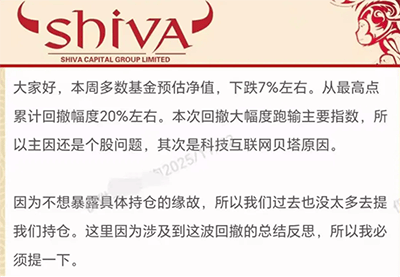
Core Insights - The report from Xiwa Asset indicates a significant decline in the estimated net value of most funds, with an approximate drop of 7% and a cumulative drawdown of about 20% from the peak [1][2] - CEO Liang Hong publicly apologized for the poor performance, attributing the primary reasons to individual stock issues and volatility in the technology and internet sectors [1][2] Group 1: Reasons for Drawdown - The drawdown is primarily attributed to three factors: a decline in the innovation drug sector where the company failed to realize gains at high valuations, a drop of over 37% in a leading hardware company, and significant losses from investments in the stablecoin sector amid a bear market in cryptocurrencies [2][6] - Liang did not disclose the specific hardware company but speculation suggests it could be Xiaomi, which has seen its stock price drop from a high of 61.45 HKD to 38.66 HKD, a decrease of 37% [2][4] Group 2: Company Actions and Future Strategy - Xiaomi's founder and CEO Lei Jun invested over 100 million HKD to purchase 2.6 million shares, increasing his ownership stake to 23.26% [4] - The company has been actively repurchasing its shares, with a total buyback amount exceeding 2.3 billion HKD this year [4] - Liang emphasized the need for a strategic adjustment in response to the significant drawdown, indicating a shift towards absolute return considerations while maintaining value investment principles [7][9]
高盛闭门会-亚洲首席策略师展望,2026年亚洲五大投资主题
Goldman Sachs· 2025-11-24 01:46
Investment Rating - The report upgrades the investment rating for the Indian market, indicating a more attractive position compared to other regional markets [6][4]. Core Insights - The global economic growth forecast has been raised, with expectations of nearly 3% growth in 2025-2026, benefiting from policy easing and potential interest rate cuts by the Federal Reserve [1][2]. - Northeast Asian stock markets have shown strong performance, with South Korea, China, and Japan rising by 80%, 35%, and 25% respectively, driven primarily by the technology sector [1][3]. - The technology sector is crucial in Northeast Asia, with approximately 80% of market capitalization linked to AI-related revenues, contributing over 90% of index gains this year [1][7][8]. - The semiconductor industry is expected to see significant profit improvements due to supply-demand imbalances in DRAM and NAND sectors [9][21]. Summary by Sections Macroeconomic Environment - The macroeconomic environment is favorable for stock markets, with good economic growth, declining interest rates, and a weakening dollar [2]. - Global GDP growth is projected to be close to 3% in 2025 and 2026, supported by widespread policy easing [2]. Market Performance - Northeast Asia has outperformed, with notable gains in South Korea, China, and Japan, primarily driven by the technology sector [3][4]. - The Indian market is viewed positively despite high valuations, with a significant growth gap compared to other regions [6]. Currency and Investment Strategies - The Chinese yuan is expected to appreciate by about 3% over the next 12 months, suggesting a favorable environment for stock investments [5]. - Investors are advised to consider down protection strategies in light of potential market corrections [18][19]. Technology Sector Outlook - The global technology sector outlook remains optimistic, particularly in cloud computing and large-scale capital investments, which will benefit the Asian supply chain [9]. - Demand for smartphones, servers, and AI PCs is strong, with significant growth expected in these markets [10]. Geopolitical and Industrial Trends - The U.S. re-industrialization process presents investment opportunities in Asia, particularly in key markets like China, Japan, and Australia [17]. - China is increasing investments in advanced manufacturing to enhance its position in the global supply chain [15][16]. Future Investment Themes - The report highlights the importance of diversification in investment strategies, with a shift in focus from the U.S. to other regions offering attractive opportunities [23].
存储芯片疯狂涨价,PC与服务器厂商受伤!大摩:每涨10%,OEM毛利率就下降45-150个基点
美股IPO· 2025-11-17 09:54
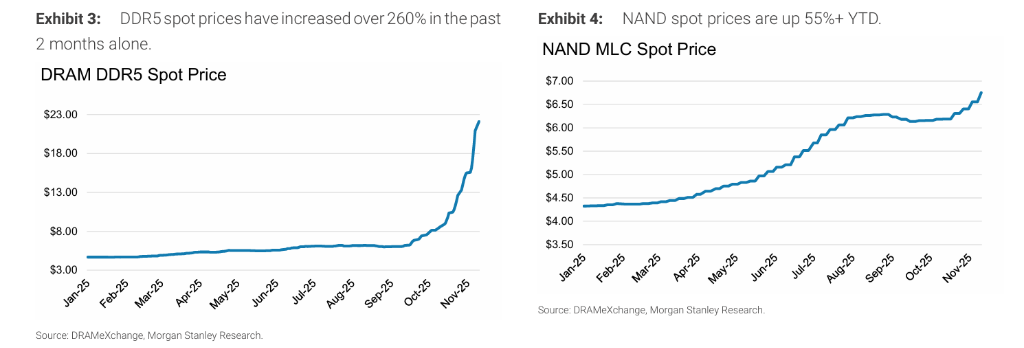
Core Viewpoint - The storage chip market is experiencing an unprecedented "super cycle" driven by AI demand and supply shortages, significantly impacting the profit outlook for PC and server manufacturers [1][3][4]. Group 1: Price Surge and Impact - Morgan Stanley warns that storage chip prices are skyrocketing due to AI demand and supply constraints, with DRAM spot prices soaring over 260% in just two months [1][5]. - The report indicates that the cost of storage chips (NAND and DRAM) constitutes 10%-70% of the BOM for high-end products, leading to a potential decline in hardware OEM gross margins by 45 to 150 basis points for every 10% increase in storage chip prices [3][6]. - The current price surge is unprecedented, with NAND flash prices rising over 50% since the beginning of the year [5][6]. Group 2: Drivers of Price Increase - The price surge is primarily driven by accelerated procurement from large cloud service providers for AI infrastructure, a spike in demand for high-bandwidth memory (HBM) for AI accelerators, and insufficient investment in NAND capacity over the past few years [6][10]. - Morgan Stanley predicts that contract prices for both NAND and DRAM could see double-digit percentage increases each quarter until 2026, far exceeding the previous cycle from 2016-2018 [6][10]. Group 3: Historical Context and Comparison - The previous storage super cycle from 2016 to 2018 serves as a reference point, where OEM margins and stock valuations began to decline 6 to 12 months after prices started to rise [8][10]. - Key differences in the current cycle include a more rapid price increase and a weaker demand environment for non-AI hardware compared to the previous cycle [10][11]. Group 4: Company Ratings and Vulnerabilities - Morgan Stanley has downgraded ratings for several major hardware companies, citing dual pressures on profits and valuations [12][13][14]. - Dell Technologies was downgraded from "Overweight" to "Underweight," with a target price cut from $144 to $110, due to significant impacts from rising storage costs [13]. - HP's rating was lowered from "Market Perform" to "Underweight," with a target price adjustment from $26 to $24, as profit margin pressures overshadow market recovery [14]. - Lenovo's rating was adjusted from "Overweight" to "Market Perform," as over 60% of its PC business targets the enterprise market, which is better positioned to pass on cost increases [17]. Group 5: Market Segmentation and Resilience - Different hardware manufacturers face varying levels of risk, with PC and server manufacturers more exposed due to their reliance on DRAM [18][20]. - Companies like Apple and Pure Storage are viewed as more resilient due to strong supply chain negotiation power and better pricing capabilities [20]. - Memory chip manufacturers such as Micron Technology, SK Hynix, and Samsung Electronics are expected to be direct beneficiaries of this super cycle [20].



存储芯片疯狂涨价,PC与服务器厂商受伤!大摩:每涨10%,OEM毛利率就下降45-150个基点
Hua Er Jie Jian Wen· 2025-11-17 09:01
Core Insights - A significant "super cycle" in storage chips is impacting the profit outlook for PC and server manufacturers, with Morgan Stanley warning of severe profit margin erosion due to skyrocketing storage chip prices [1][2][3] Price Surge and Market Dynamics - The current price surge in storage chips is driven by increased demand from AI infrastructure, a shift towards high bandwidth memory (HBM), and insufficient investment in NAND flash memory [2][7] - DRAM spot prices have surged over 260% in the past two months, while NAND flash prices have increased by over 50% since the beginning of the year [3][7] Historical Context and Comparison - The previous storage super cycle from 2016 to 2018 serves as a reference point, where OEM profit margins and stock valuations faced pressure after a similar price increase [9][11] - Key differences in the current cycle include a more rapid price increase and a weaker demand environment for non-AI hardware compared to the previous cycle [11][13] Impact on Hardware Manufacturers - Morgan Stanley has downgraded ratings for several global hardware giants, predicting dual pressure on profits and valuations [14] - PC and server manufacturers, particularly those heavily reliant on DRAM, are identified as the most vulnerable, with Dell, HP, Asus, and Acer being the most affected [15][17] Company-Specific Ratings Changes - Dell Technologies: Downgraded from "Overweight" to "Underweight," target price reduced from $144 to $110 due to severe impact from rising storage costs [17] - HP Inc.: Downgraded from "Market Perform" to "Underweight," target price lowered from $26 to $24 as profit margin pressures offset market recovery [17] - Asus: Downgraded from "Market Perform" to "Underweight," target price cut from NT$625 to NT$500 due to reliance on price-sensitive consumer markets [17] - Lenovo Group: Downgraded from "Overweight" to "Market Perform," with over 60% of its PC business targeting the enterprise market, which is better positioned to absorb cost increases [17]