
零售消费

Search documents
为何“笨人”常胜?在4300股下跌的行情里,重新思考投资的本源
Sou Hu Cai Jing· 2025-12-16 11:55
Market Overview - The A-share market experienced a significant decline, with the Shanghai Composite Index down 1.11%, the Shenzhen Component down 1.51%, and the ChiNext Index dropping over 2%, resulting in more than 4,300 stocks declining [1] - Despite the overall downturn, two sectors, intelligent driving and retail consumption, showed resilience and growth, indicating a shift in market dynamics [1][8] Intelligent Driving Sector - The most notable development was the issuance of the first batch of L3-level autonomous driving permits by the Ministry of Industry and Information Technology, marking a transition from conceptual discussions to practical applications [2] - This regulatory approval is expected to accelerate the performance of companies across the entire supply chain, from vehicles to radar and algorithms, as the industry moves from "0 to 1" to "1 to N" growth phases [2] Retail Consumption Sector - The retail sector emerged as a safe haven for investors, supported by recent government policies aimed at boosting consumer spending through financial support, including consumption vouchers and credit incentives [3] - The retail sector has been under pressure for a while, leading to historically low valuations, which creates a demand for valuation recovery, making it an attractive option for defensive capital [3] Future Market Outlook - The recent market decline is viewed as a collective "cooling-off period" following rapid rotations, suggesting that broad market rallies may be less likely, while structural opportunities will become more pronounced [4] - The focus will likely remain on "earnings certainty" and "industry authenticity," with continued attention on sectors like intelligent driving that show tangible progress, and retail, which offers a policy safety net [4]
中国家庭财富与消费报告
Sou Hu Cai Jing· 2025-11-30 16:08
Group 1: Income and Asset Allocation - The average annual income per household in China reached 55,500 yuan in Q3 2025, with wage income accounting for 62.1% of total income, indicating its core role in household finances [1][10][27]. - Middle-aged groups in first-tier cities exhibit strong income growth, with their average annual income being 2.05 times that of their counterparts in non-first-tier cities, reflecting the advantages of urban employment quality and salary levels [1][10][29]. - The proportion of families without mortgage loans reached 56.1%, indicating reduced financial pressure from housing assets, while the overall household debt ratio shows a "U-shaped" distribution, with 49.2% of families being debt-free [1][11][46]. Group 2: Consumption Expenditure and Consumer Groups - The average monthly consumption expenditure per household reached 3,004 yuan, with first-tier city households spending an average of 4,442 yuan, significantly higher than other city tiers [2][11][12]. - Young consumers are active in entertainment and dining, focusing on quality and personalized experiences, while middle-aged consumers prioritize education and healthcare due to family responsibilities [2][12]. - Households with housing assets show higher consumption capabilities across all age groups, particularly in first-tier cities, where homeownership correlates with increased spending in various categories [12][13]. Group 3: Consumer Expectations and Influencing Factors - Consumer expectations improved in Q3, with about 69% of households planning to maintain their consumption levels, and 11% intending to increase spending [3][14]. - Employment stability is a key factor influencing consumer confidence, with those unemployed for over three months planning to cut back on discretionary spending [3][14]. - Households with annual incomes below 50,000 yuan show a higher tendency to reduce flexible spending, highlighting the impact of income levels on consumption plans [3][15]. Group 4: Recommendations and Policy Suggestions - To enhance consumer confidence, policies should focus on supporting employment and income for youth and low-income groups, guiding rational financial asset allocation, and improving housing security [16][17]. - Introducing inclusive financial products and optimizing housing finance structures can alleviate the pressure of housing costs on other consumption categories [16][17]. - Establishing a consumption support system tailored to different life stages can stimulate demand across all age groups, particularly for youth and middle-aged consumers [17].


新力量NewForce总第4912期
First Shanghai Securities· 2025-11-27 11:48
Revenue Growth - Total revenue increased by 30% year-on-year to $1.756 billion[7] - Revenue growth in Greater China reached 47%, while Asia-Pacific saw a 54% increase[7] - Functional apparel revenue grew by 31% to $683 million, and outdoor sports revenue increased by 36% to $724 million[7] Store Expansion - Total store count increased by 85 to 631, with a year-on-year increase of 178 stores[7] - Same-store sales growth for functional apparel improved from 15% to 27%[5] Profitability Metrics - Gross margin improved by 1.6 percentage points to 56.8%[7] - Operating profit margin was reported at 12.3%, with an adjusted operating profit margin of 15.7%[7] Strategic Outlook - The company expects full-year revenue growth of 23-24% and a gross margin of 58.0%[8] - Projected earnings per share for 2025 is between $0.88 and $0.92[8] Valuation and Rating - Target price set at $43.80, representing a 20% upside from the current stock price of $36.60[9] - The stock is rated as "Buy" based on a 27x price-to-earnings ratio[9] Risks - Increased competition in the mature outdoor market in Europe and the U.S. poses a risk to performance[10] - High dependency on single brands and markets could impact stability[10]

美国9月非农就业人口增长11.9万人,是预期的两倍多,但7月和8月非农就业人数合计下修3.3万人。
Sou Hu Cai Jing· 2025-11-21 07:34
Core Insights - The U.S. non-farm payrolls increased by 119,000 in September, more than double the expectations, but revisions for July and August showed a combined decrease of 33,000 [1] - The unemployment rate unexpectedly rose to 4.4%, the highest since October 2021 [1] - Initial jobless claims fell by 8,000 to 220,000, while continuing claims reached a four-year high [1] Impact on Federal Reserve Policy - The report reinforces the Federal Reserve's stance of maintaining current interest rates, as the data does not strongly indicate a need for rate hikes or cuts [5] - Market expectations for a rate cut in December are low, with the first potential cut now anticipated in Q1 2025 [5] Financial Market Reactions - Positive signals include strong job growth and a decrease in initial jobless claims, indicating robust hiring demand [7] - Negative signals arise from downward revisions of previous months' data and an increase in the unemployment rate, suggesting challenges in the labor market [7] - The stock market may experience volatility, with strong job growth supporting corporate earnings but high rates pressuring growth and tech stocks [8] - Bond yields are expected to remain elevated due to strong non-farm data, but concerns over economic slowdown may temper upward pressure [8] - The dollar is likely to strengthen as high rate expectations attract international capital [8] Economic Implications - Job growth supports consumer spending, which is crucial for the U.S. economy to avoid deep recession [9] - The report suggests a "Goldilocks" scenario for the labor market, avoiding overheating and severe cooling [9] - The dual nature of the data indicates a complex economic environment, with both positive and negative signals [9] Global Economic Spillover Effects - High U.S. interest rates may maintain elevated global financing costs, impacting emerging markets [10] - A stable U.S. job market and consumer demand could support imports, benefiting export-oriented economies [10]

港股恒指午间收涨0.61% 三桶油继续上涨 消费类股走势活跃
Ge Long Hui· 2025-11-10 04:11
Core Viewpoint - The Hong Kong stock market opened higher but experienced fluctuations, with the Hang Seng Technology Index initially dropping before closing slightly up by 0.12% [1]. Group 1: Market Indices - The Hang Seng Index and the Hang Seng China Enterprises Index rose by 0.61% and 0.84% respectively [1]. Group 2: Sector Performance - Large technology stocks showed mixed performance, with Tencent increasing by 1.66%, while Alibaba and Meituan saw slight gains; however, JD.com, Baidu, and Xiaomi declined [1]. - Domestic oil prices are expected to rise for the seventh time this year, leading to continued gains for the three major oil companies, with China Petroleum rising by 3% to reach a new high [1]. - Airline stocks performed strongly, and consumer stocks were active, with Pop Mart and Gu Ming both rising [1]. - Semiconductor stocks experienced significant declines, with leading company SMIC dropping over 3%, while Apple-related stocks, lithium battery stocks, and military stocks mostly remained sluggish [1].
27位深圳青年才俊上榜!《胡润U40中国创业先锋》出炉
Nan Fang Du Shi Bao· 2025-11-09 11:13
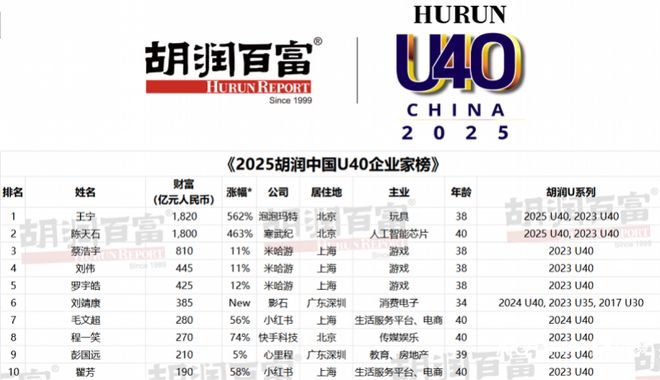
Core Insights - The "2025 Hurun U40 China Entrepreneur Pioneers" list features 195 entrepreneurs under 40 years old, with a significant concentration in the entertainment and new consumption sectors, particularly in software and services [1][3] - Major cities attracting these U40 entrepreneurs include Shanghai, Beijing, and Shenzhen, with Shenzhen having 27 representatives on the list [1][3] - The report also highlights 39 U40 entrepreneurs with personal wealth exceeding 5 billion RMB, with a notable presence in the Greater Bay Area [1][4] Group 1: Entrepreneur Demographics - The list includes entrepreneurs from 53 cities, with a gender distribution of 85% male and 15% female [3] - The average age of these entrepreneurs is 37, and they founded their companies at an average age of 28, with an average of 420 employees per company [3] - 34% of these entrepreneurs have successfully listed their companies, and the average total financing is 100 million RMB [3] Group 2: Industry Focus - The highest representation among the entrepreneurs is in the software and services sector, accounting for 28%, while 72% are involved in selling physical products [3] - B2B companies make up 82% of the list, while B2C companies account for 18% [3] - The life and health sector ranks second with a 14% representation among the entrepreneurs [3] Group 3: Notable Entrepreneurs - The top-ranked entrepreneur is Wang Zhong, with a wealth of 1,820 million RMB, followed by Chen Tianshi at 1,800 million RMB, both from Beijing [2] - Liu Jingkang, founder of Ying Shi, is the highest-ranked entrepreneur from Shenzhen, with a wealth of 385 million RMB [4][5] - Other notable entrepreneurs from Shenzhen include Cheng Guoyuan, with a wealth of 210 million RMB, involved in education and high-precision manufacturing [5]

MetLife's Drew Matus: We're seeing a deceleration in services spending, leading indicator of trouble
Youtube· 2025-10-23 18:20
Core Insights - The consumer sector has shown surprising resilience over the past five years, but recent data indicates potential cracks in consumer spending behavior, particularly among higher-income groups [2][4][11] Consumer Behavior - The New York Fed survey indicates that expectations regarding income after inflation are deteriorating most significantly among high-income consumers, while lower-income consumers are already under stress [3][4] - Spending on services, which typically remains stable, is beginning to decline, suggesting that consumers are becoming more cautious in their spending habits [8][10] - Despite the cautious sentiment, higher-income consumers have been sustaining their spending, but they are starting to notice economic changes and adjust their behaviors accordingly [11][12] Investment Recommendations - Given the current consumer sentiment and spending trends, the outlook for consumer discretionary investments appears less bullish, prompting a reevaluation of investment strategies [13][14] - Financials may benefit from a potential economic downturn or interest rate cuts, as they typically perform well in volatile market conditions [14][18] - Caution is advised in sectors like housing, where buying activity is low despite ongoing discussions about housing shortages [15]
上海黄浦:深化“三生融合”理念,探索“双碳”实践的黄浦模式
Hua Xia Shi Bao· 2025-10-15 01:19
Core Insights - The 2025 Sustainable Global Leaders Conference will be held in Shanghai from October 16 to 18, 2025, as approved by the State Council [1] - Huangpu District has made significant progress in promoting green and low-carbon transformation across various sectors, consistently achieving leading energy efficiency levels in the country [1][2] Group 1: Huangpu's "Dual Carbon" Practices - Huangpu District has introduced initiatives such as the "Dual Carbon" platform and carbon efficiency codes, focusing on building energy consumption, which accounts for over 70% of total energy use [2][3] - The district has implemented refined and intelligent management practices, emphasizing technological innovation and green finance to support economic and social green transformation [2] - Huangpu has pioneered projects like the first "carbon-neutral" themed bond and the first "carbon-neutral" bond index in the country [2] Group 2: Corporate Participation and Community Engagement - A number of high-energy enterprises in the low-carbon sector, including Ainu Power and Budweiser, are actively participating in Huangpu's green initiatives [3] - Financial institutions such as Pacific Insurance and Shanghai Bank are expanding their green finance services to support low-carbon technology innovation [3] - Huangpu promotes green consumption through various community activities and initiatives, such as the "Old Shoes New Life" project, which recycles old shoes into materials for sports tracks [4] Group 3: Ecological Development and Urban Planning - Huangpu District emphasizes the integration of ecological concepts into urban planning, with 40% of its area meeting sponge city requirements [4] - The district is developing a green network system that connects waterfront areas and urban spaces, enhancing the harmony between nature and urban life [4] Group 4: Global Sustainable Governance - The Sustainable Global Leaders Conference aims to foster global dialogue and collaboration on sustainable development, involving government, enterprises, academia, and social organizations [6] - The conference will feature prominent figures, including Nobel laureates and leaders from Fortune 500 companies, discussing topics related to energy, green finance, and sustainable consumption [5][6] - Huangpu District aims to leverage the conference to further explore the synergy between green low-carbon initiatives and high-quality development [6]

2025年上半年中国零售地产与消费市场年度研究报告
Sou Hu Cai Jing· 2025-08-25 02:04
Core Insights - The report focuses on the retail real estate and consumer market in China for the first half of 2025, highlighting market dynamics and trends compared to the same period in 2024 [1] Group 1: Macroeconomic Consumption - The total retail sales of consumer goods in China reached 24,545.8 billion yuan, with a year-on-year growth of 5.0%, accelerating by 0.4 percentage points compared to the first quarter [6] - Retail sales of goods grew by 5.1%, while catering revenue increased by 4.3%, marking the first time in recent years that retail sales surpassed catering revenue [6] - The online retail sales growth rate rebounded to 8.5%, with physical goods online retail accounting for 24.9% of total retail sales [6] Group 2: Retail Real Estate Overview - New supply in 21 key cities totaled 2.069 million square meters, a year-on-year decline of 27.5%, indicating a slowdown in the supply side of the retail real estate market [7] - The average vacancy rate in the retail real estate market across 21 cities rose to 10.5%, increasing by 0.3 percentage points in the first half of the year [8] - The average rent in the retail real estate market fell by 2.8% in the first half of the year, with the decline more pronounced in the second quarter compared to the first [8] Group 3: Consumer Trends - There is a rising demand for experiential consumption, with increased shares in fitness venues, beauty services, and pet-related services, reflecting consumers' pursuit of quality and personalized services [3] - The children's sector has become more segmented, covering various fields such as services, entertainment, and fashion, catering to family consumption needs [3] - The entertainment sector has seen an increase in technology-driven gaming and cultural arts, enriching the consumption landscape [3] Group 4: Changes in Retail Dynamics - The structure of consumer demographics is changing, with the rise of the "single economy" and a shift towards pet-related consumption as family consumption contracts [10] - The value proposition of products is shifting from brand value to emotional and functional value, with luxury brands maintaining high-value customer bases [10] - Commercial spaces are evolving from mere transaction venues to social spaces, emphasizing consumer interaction and socialization [10][11] Group 5: Future Outlook - The retail real estate supply in 21 major cities is expected to reach approximately 8 million square meters in 2025, remaining stable compared to the previous year [11] - The market is anticipated to enter a "tide retreat" phase by 2026, with vacancy rates expected to peak by the end of 2025 and gradually decline thereafter [11]

今年最赚钱的三家消费公司,大基金们押错了两个|深氪
3 6 Ke· 2025-08-21 11:47
Core Insights - The article discusses the surprising rise of Lao Pu Gold, which saw its stock price increase by 12 times since its IPO, despite being overlooked in the primary market [1][4] - The company transitioned from seeking an A-share listing to pursuing a Hong Kong IPO, attracting significant investment from Black Ant and Yu Garden [1][3] - A key turning point was the release of a mid-year report showing a nearly 200% year-on-year profit increase, which led to a surge in investor interest [3][4] Investment Dynamics - Initial interest in Lao Pu Gold was low, with only a few investors participating in the Pre-IPO round, highlighting a lack of understanding of the company's potential [1][2] - The IPO saw overwhelming demand, with retail subscriptions oversubscribed by over 580 times and institutional subscriptions nearly 12 times, indicating a shift in market sentiment [4][15] - The company's market capitalization reached HKD 11.3 billion on its listing day, doubling its valuation from the Pre-IPO round in just six months [4][18] Market Trends - The article notes a broader trend in the Hong Kong market, where consumer stocks have become increasingly popular, with significant inflows from foreign capital [12][16] - The sentiment shift is attributed to a combination of factors, including expectations of U.S. interest rate cuts and a growing confidence in Chinese assets [12][13] - The consumer sector, particularly non-essential goods, has seen a surge in interest, with companies like Bubble Mart and Honey Snow Ice City also experiencing significant market success [17][18] Investment Reflections - Many investors expressed regret over missing opportunities in companies like Lao Pu Gold, indicating a broader issue of understanding emerging consumer brands [5][6][9] - The article highlights a pattern where successful consumer companies were often overlooked in the primary market, leading to missed investment opportunities [9][19] - The narrative emphasizes the importance of recognizing and adapting to changing market dynamics, particularly in the consumer sector [30][32]