
科技

Search documents
精准务实绘就北京高质量发展新图景
Xin Lang Cai Jing· 2026-02-10 21:07
Core Insights - Beijing is committed to achieving decisive progress in the modernization of socialism, balancing opportunities and challenges in its development strategy [1][3] - The city is focusing on a pragmatic approach to economic and social development, emphasizing long-term efforts rather than short-term gains [1][3] Group 1: Economic Development - Beijing is the first mega-city in China to implement a reduction-focused development strategy, moving away from extensive expansion to enhance quality and efficiency in economic growth [2] - The city has achieved a dual leap in economic development quality and efficiency through systematic optimization of spatial layout and the alleviation of non-capital functions [2] - The ongoing transformation is supported by precise top-level design and strategic planning, ensuring that the development remains people-centered [2][3] Group 2: Social Welfare - Continuous improvements in social welfare are being made, focusing on education, healthcare, housing, and support for vulnerable groups, thereby enhancing the quality of life for citizens [2][3] - The city aims to address pressing public concerns and improve living conditions through meticulous governance and resource allocation [3][4] Group 3: Governance and Innovation - Beijing is enhancing its international innovation capabilities, with a focus on technology sectors such as artificial intelligence and biotechnology, in collaboration with neighboring regions [4] - The city is committed to modernizing urban governance by implementing precise financial support and improving public service efficiency [4] - A significant portion of the city's budget, over 80%, is allocated to improving public welfare, demonstrating a strong commitment to social investment [4]
美股开启“资金大轮动”:AI概念波动引焦虑,“非科技”板块受青睐
Zhi Tong Cai Jing· 2026-02-10 13:57
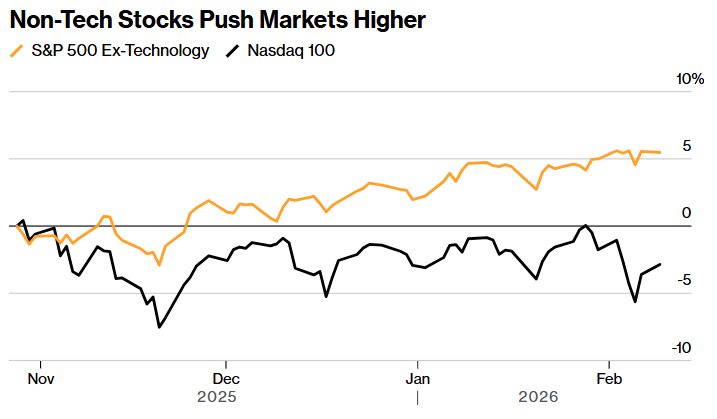
Group 1 - The technology sector's previous strong upward momentum in the US stock market has turned into a volatile journey, prompting investors to seek stability in traditional economic companies, leading to a shift of funds from the AI industry to materials, energy producers, and consumer goods manufacturers [1] - Since late October, non-tech stocks have driven gains in their respective sectors, including Southwest Airlines (LUV.US) up 72%, lithium producer Albemarle (ALB.US) up 71%, Moderna (MRNA.US) up 65%, and logistics giant C.H. Robinson (CHRW.US) up 56% [1] - Roth's Chief Technical Strategist JC O'Hara noted that excluding tech stocks, the S&P 500 index is expected to rise by 6% by May, indicating a positive outlook for sectors outside technology [1] Group 2 - Wall Street has generally accepted the view of diversifying investments, but last week's tech stock sell-off raised questions about this perspective, although computer and software companies led a rebound [3] - Bank of America’s Savita Subramanian highlighted that the average holding of S&P 500 constituents, excluding the seven major tech giants, is 20% lower than their index weight, with only 10% of funds holding these stocks [3] - The trend is shifting from selling tech stocks to diversifying portfolios that are overly weighted in tech, with a focus on traditional economic stocks [4] Group 3 - Morgan Stanley's data indicates that the median earnings growth for Russell 3000 constituents is expected to be 11% this year, the strongest growth in four years, with the S&P 500 information technology sector down 6.7% since October 28, while energy and materials sectors have risen 23% and 17%, respectively [4] - O'Hara emphasized that the current trend is not merely about selling tech stocks but addressing how to diversify portfolios that are heavily weighted in tech [4] - Concerns remain about the tech sector's struggles, as declines in major tech companies like Amazon, Microsoft, Alphabet, and Meta Platforms have negatively impacted the Nasdaq 100 index [4] Group 4 - 22V Research's Jeffrey Jacobson expects the Nasdaq 100 ETF to continue underperforming compared to other sectors, as funds continue to withdraw from these crowded stocks after years of excess returns [5] - Jacobson noted that aggressive capital expenditure plans from Alphabet and Microsoft have pressured their stock prices, suggesting investors consider hedging strategies against large-cap stock risks [5] - O'Hara stated that while holding tech products remains beneficial, other sectors are also benefiting from a strong industrial revival [5]

每日钉一下(为啥这轮牛市,A股医药比较低迷,港股医药比较强势?)
银行螺丝钉· 2026-02-10 13:53
Group 1 - Fund investment plans are suitable for lazy investors, and it is essential to prepare and formulate a good investment plan before starting [2][3] - There are four methods of fund investment, and it is important to determine which one is most suitable for individual needs [2] - A free course is available to help understand fund investment strategies, including course notes and mind maps for efficient learning [2][3] Group 2 - The A-share pharmaceutical index has shown limited growth, underperforming compared to the China Securities North Pharmaceutical Index during the period from September 2024 to January 2026 [4] - The performance disparity between A-share and Hong Kong pharmaceutical stocks is attributed to differences in fundamental strengths, which affect index growth [5] - Currently, Hong Kong pharmaceuticals are in a prosperity cycle, with profit growth recovering and driving valuation increases [7] - A-share pharmaceuticals are in a recovery cycle, with profit growth showing some recovery since 2025, but not yet reaching significant growth levels [8] - Economic cycles are inherent characteristics, where downturns can lead to simultaneous declines in valuation and profits [9]

减持英伟达加码谷歌!20年创造超1300%回报!全球知名“成长股捕手”近万亿持仓披露!
私募排排网· 2026-02-10 10:30
Core Insights - Baillie Gifford, a century-old UK asset management giant, has disclosed its latest US stock holdings report, showcasing its successful investment strategy in growth stocks like Tesla, Nvidia, Google, Amazon, and Alibaba [2] - The flagship product, Scottish Mortgage Investment Trust (SMT), has achieved a total return of 13.64 times from 2004 to 2024, with an annualized return rate of approximately 13.88%, significantly outperforming the S&P 500 (6.98%), Nasdaq (10.87%), and Berkshire Hathaway (10.02%) [2] Holdings Overview - As of the end of Q4 2025, Baillie Gifford's total holdings are valued at approximately $120.34 billion, a decrease of 10.86% from Q3's $134.99 billion [3] - The top twenty holdings account for about $74.09 billion, representing over 60% of the total portfolio [3] - Nvidia is the largest holding with approximately 43.87 million shares valued at $8.18 billion, making up 6.80% of the portfolio [4] Adjustments in Holdings - In Q4, Baillie Gifford reduced its positions in key tech stocks: Nvidia by 5.76%, Amazon by 7.18%, and Microsoft by 5.39% [5] - Conversely, the firm significantly increased its stake in Google, with an increase of 166%, while Google-A shares rose over 28% in Q4 [5]



非农前,黄金上演拉锯战!
Sou Hu Cai Jing· 2026-02-10 09:36
Group 1: Gold and Silver Market - Spot gold surged by $91.82, an increase of 1.85%, closing at $5057.89, while currently trading around $5051 [1] - Spot silver experienced a daily increase of over 7%, reaching a high of $83.414 before closing at $83.341, and is now trading around $82.51 [1] Group 2: U.S. Stock Market - U.S. stock indices closed higher, with the Dow Jones Industrial Average up 0.04%, marking a historical high, while the Nasdaq and S&P 500 rose by 0.9% and 0.47% respectively [2] - The rebound in U.S. stocks is viewed as a "super dip repair," with future performance dependent on key economic data [10] Group 3: Federal Reserve Insights - Federal Reserve Governor Stephen Milan stated that the impact of Trump's tariff policy on the economy is "quite limited," countering the view that tariffs are ultimately borne by U.S. consumers [5] - The probability of a 25 basis point rate cut by the Fed by March is 17.7%, with an 82.3% chance of maintaining current rates [5] Group 4: Japanese Stock Market - The Nikkei 225 index reached a historical high, up 2.77% to 57926.07 points, following a significant rise of over 2000 points in the previous trading session [7] - The surge in Japanese stocks is attributed to the ruling coalition's victory in the House of Representatives elections, which is expected to lead to continued market momentum [8] Group 5: Geopolitical Tensions - The U.S. has issued warnings for ships to stay clear of Iranian waters amid rising tensions in the region, particularly concerning the Strait of Hormuz [11] - A joint statement from eight countries condemned Israel's recent policies in the West Bank, indicating escalating geopolitical tensions [16]
美元指数大跌0.84%破97 贵金属全线大涨 美联储官员重磅发声
Jin Rong Jie· 2026-02-10 08:13
Group 1 - The core viewpoint of the articles highlights significant fluctuations in global asset prices, driven by a substantial decline in the US dollar index, which fell by 0.84% and dropped below the 97 mark, leading to gains in risk assets and precious metals [1] - The US stock market showed positive performance with the Dow Jones Industrial Average reaching a new historical high, closing up by 0.04%, while the S&P 500 and Nasdaq increased by 0.47% and 0.90% respectively, with notable gains in large tech stocks such as Oracle, Microsoft, Broadcom, AMD, Nvidia, Meta, and Tesla [1] - In the precious metals market, COMEX gold futures rose by over 2%, and COMEX silver futures surged by 8%, indicating a strong market response to the weakening dollar [1] Group 2 - Atlanta Fed President Bostic noted signs of market skepticism regarding the dollar's strength, while Fed Governor Milan stated that the current decline in the dollar has not yet had a substantial impact on monetary policy or consumer inflation [1] - Milan previously mentioned that the US economy is not experiencing strong price pressures and anticipates that the Fed may need to cut rates by more than 100 basis points by 2026, especially under the leadership of Walsh as Fed Chair [1] - US Treasury Secretary Basant indicated that even with Walsh potentially becoming Fed Chair, there would not be a rapid initiation of balance sheet reduction, suggesting it may take up to a year for the Fed to make clear decisions regarding asset balance adjustments [2]
美股财报季过半:75%标普500成分股披露业绩 美银梳理四大核心亮点
Jin Rong Jie· 2026-02-10 07:28
Group 1 - The core viewpoint of the article highlights that approximately 75% of S&P 500 companies have reported their Q4 2025 earnings, with overall performance meeting expectations despite some investor concerns related to the AI race [1] - A primary highlight of this earnings season is that earnings and revenue performance have exceeded historical averages, with nearly 70% of reporting companies achieving earnings per share above market expectations, surpassing the historical average of 60% [1] - Optimism among companies has increased, with sentiment slightly above pre-"liberation day" levels, despite a rise in mentions of "weak demand," which remains lower than levels seen in 2023-2024 [1] Group 2 - AI investments have become a focal point this earnings season, with major tech companies projecting AI spending for 2026 to exceed Wall Street expectations by 35%, including Amazon's planned $200 billion investment [2] - The job market shows mixed signals, with layoffs at their highest level since 2009 in January, yet the overall layoff rate remains low, indicating a stable state of "reduced hiring, reduced layoffs" [2] - Despite increased mentions of layoffs in earnings calls, there is no clear evidence that AI is significantly weakening labor demand [2]
德银:软件、科技板块对投机级信贷市场构成重大集中风险
Ge Long Hui A P P· 2026-02-10 07:21
格隆汇2月10日|德银分析师指出,软件及科技行业对投机级信贷市场构成历来最重大的集中风险之 一。软件及科技行业在投机级信贷市场中的规模分别达5970亿美元及6810亿美元,占整体比重约14%及 16%。投机级债务涵盖高收益债券、杠杆贷款及美国私募信贷。分析师指出,相关规模属相当可观的未 偿还债务,一旦软件行业违约情况上升,或会拖累整体市场情绪,其潜在影响可与2016年能源行业危机 相提并论。 ...

金融“活水”精准滴灌 营口银行以“伙伴式”服务助力实体经济高质量发展
Sou Hu Cai Jing· 2026-02-10 06:35
Core Viewpoint - Yingkou Bank is committed to optimizing the business environment by focusing on the financing challenges faced by small and medium-sized enterprises (SMEs) and enhancing its financial services to support their growth [1][2][3] Group 1: Financial Support for SMEs - Yingkou Bank has established a specialized service team to address the liquidity needs of local enterprises, such as Liaoning Sanhua Refractory Group, providing customized credit solutions within a week [1] - The bank has approved a credit limit of 45 million yuan for Liaoning Hongfeng Technology Co., effectively filling the funding gap and ensuring smooth production operations [2] - The total loan balance for supporting technology enterprises in the city has reached nearly 7 billion yuan [2] Group 2: Service Efficiency and Innovation - Yingkou Bank leverages its advantages as a local bank, including a short decision-making chain and high service efficiency, to meet the needs of SMEs [2] - The bank has implemented various initiatives, such as "Financial Assistance to Enterprises" and "Financial Services in Parks," to enhance its service quality and effectiveness [3] - The total loan balance for enterprises has exceeded 60 billion yuan, reflecting the bank's ongoing commitment to supporting the local economy [3] Group 3: Commitment to Local Development - Yingkou Bank aims to build a "partner-style" financial service system with SMEs, continuously improving its financing coordination mechanisms [2] - The bank emphasizes the importance of maintaining its original mission to serve the local economy and support high-quality development [3]
硅谷“科技投行教父”Grimes重返摩根士丹利 或准备参与SpaceX上市项目
Zhi Tong Cai Jing· 2026-02-10 06:16
顶级投行家、硅谷"科技投行教父"Michael Grimes,重返摩根士丹利、将出任投行业务主席。媒体指 出,他的回归使摩根士丹利在SpaceX的1.5万亿美元的IPO中占据了有利地位。摩根士丹利、美国银行、 摩根大通和高盛预计将担任SpaceX的主承销商。 摩根士丹利表示,Grimes将在新职位上运用其专业知识,负责"整个银行和机构证券业务,尤其是在科 技变革生产力并影响全球产业政策的背景下"。 他领导或参与的一些重要项目包括以下几个著名案例:IPO项目包括Google(GOOG.US)、 Facebook(META.US)、Airbnb、LinkedIn、Uber、Snowflake等,并购项目包括Facebook收购Instagram、 Microsoft收购LinkedIn、SoftBank投资Uber、Google收购Motorola Mobility、NVIDIA收购Arm、eBay收 购PayPal、马斯克收购推特等。 此外,他与马斯克建立了深厚联系。Grimes曾在2010年帮助马斯克的特斯拉(TSLA.US)上市,并在2022 年协助完成收购推特的交易。据一位同时认识两人的SpaceX投资者 ...
