
啤酒

Search documents
重整中的泰山啤酒拟融资3000万,用于日常生产及发工资
Nan Fang Du Shi Bao· 2026-02-26 09:09
Core Viewpoint - Taishan Beer is currently undergoing bankruptcy reorganization and has quietly announced a recruitment for investors in "beneficial debt" to raise 30 million yuan, with an annual borrowing rate not exceeding 7% [1][2]. Group 1: Financial Situation - Taishan Beer has total assets of approximately 622 million yuan and total liabilities of about 663 million yuan, resulting in a debt-to-asset ratio of 106.63%, indicating insolvency [1]. - The company is facing significant financial difficulties due to major fixed asset investments, including expansion projects that have severely strained its liquidity [2]. Group 2: Purpose of Fundraising - The 30 million yuan raised through beneficial debt is intended to cover employee salaries, production operations, and ensure the continuation of the reorganization process, with a repayment period of approximately six months [1]. - Beneficial debt is defined as loans provided to a company in bankruptcy reorganization to maintain operations, recognized legally as "beneficial debt" aimed at enhancing asset value for eventual debt repayment [1]. Group 3: Management and Future Outlook - The company’s management asserts that operations are normal and views the bankruptcy reorganization as a necessary step for long-term development, supported by government and legal protections [2]. - Industry analysts believe that the recruitment of beneficial debt investors is a critical phase for Taishan Beer, although challenges remain regarding the effectiveness of the 30 million yuan in ensuring operational continuity and balancing the interests of original shareholders and investors [2]. Group 4: Sales Projections - It is projected that Taishan Beer will achieve a sales volume of 80,000 tons and revenue of approximately 500 million yuan by 2025, remaining nearly unchanged from 2024 [3].
珠江啤酒:去年净利润增长11.42%,产品结构优化升级
Cai Jing Wang· 2026-02-26 08:36
Core Viewpoint - Zhujiang Beer reported its 2025 annual performance, showing steady growth in sales and profits, indicating a positive trajectory for the company's operations and market presence [1] Financial Performance - The company achieved beer sales of 146.24 million tons, a year-on-year increase of 1.58% [1] - Total operating revenue reached 5.878 billion yuan, reflecting a year-on-year growth of 2.56% [1] - Total profit, net profit attributable to shareholders, and net profit excluding non-recurring items were 1.057 billion yuan, 903 million yuan, and 832 million yuan, respectively, with year-on-year growth rates of 10.98%, 11.42%, and 9.25% [1] Strategic Developments - The company emphasized product structure optimization and upgrades during the reporting period [1] - Market expansion efforts showed steady progress, with innovative channel development [1] - Brand visibility continued to increase, and management efficiency improved, contributing to the company's high-quality development [1]

国联民生食饮:精酿啤酒行业专题报告:金星啤酒招股书梳理-20260226
Guolian Minsheng Securities· 2026-02-26 07:50
Investment Rating - The report indicates a positive investment outlook for the craft beer industry, highlighting its structural prosperity and growth potential [3]. Core Insights - The craft beer sector in China is experiencing significant growth, with a projected market size increase from 125 billion yuan in 2019 to 632 billion yuan by 2024, reflecting a CAGR of 38.3%, which is substantially higher than the 2.6% growth of industrial beer [3][10]. - The report emphasizes that craft beer represents a high-end direction in the industry, catering to the diverse and personalized consumption trends in the Chinese market [3][11]. - The company, Jinxing Beer, is positioned as a leading player in the craft beer segment, ranking as the third largest craft beer producer in China with a market share of 14.6% as of Q3 2025 [3][31]. Summary by Sections 1. Craft Beer Industry Overview - The craft beer market in China is projected to grow from 632 billion yuan in 2024 to 1,821 billion yuan by 2029, maintaining a CAGR of 23.6% [3][10]. - By 2024, craft beer is expected to account for 9% of the total beer market by retail value, increasing to 20% by 2029 [3][10]. 2. Jinxing Beer: A New Force in Craft Beer - Jinxing Beer is the eighth largest beer company in China and the largest flavored craft beer producer, focusing on innovation within the craft segment [3][31]. - The company has seen rapid revenue growth, with projected revenues of 3.6 billion yuan in 2023, 7.3 billion yuan in 2024, and 11.1 billion yuan in Q1-Q3 2025, reflecting year-on-year growth rates of 105% and 191% respectively [3][39]. 3. Revenue Growth and Profitability - The company's revenue from craft beer reached 8.7 billion yuan in Q1-Q3 2025, accounting for 78% of total revenue, with a staggering year-on-year growth of 2,332% [3][39]. - The net profit margin has improved significantly, with net profit margins of 3.4%, 17.2%, and 27.5% for 2023, 2024, and Q1-Q3 2025 respectively [3][48]. 4. Competitive Landscape - The craft beer market is characterized by a fragmented competitive landscape, with a CR5 of only 22%, indicating significant opportunities for growth and market entry [3][18]. - Jinxing Beer leads the flavored craft beer segment with a market share of 15% [3][18]. 5. Product and Market Strategy - Jinxing Beer has developed a diverse product matrix, including innovative craft beers that incorporate traditional Chinese elements, such as tea flavors [3][31]. - The company has adopted a dual-channel strategy, enhancing both online and offline sales, with significant growth in online sales following the launch of its craft beer products [3][40]. 6. Financial Analysis - The report highlights a strong improvement in gross margins, driven by a shift in product mix towards higher-margin craft beers, with gross margins increasing from 27.3% in 2023 to 47.0% in Q1-Q3 2025 [3][48]. - The company plans to utilize raised funds for production capacity expansion, brand enhancement, and product innovation to sustain growth [3][59].
大华继显:新春长假消费动能向好 首选安踏体育等
Zhi Tong Cai Jing· 2026-02-26 05:45
Group 1 - The core viewpoint of the article indicates that the domestic consumption market in China is showing signs of recovery, particularly during the Spring Festival holiday from February 15 to 23, with notable performance in tourism, culture, and dining sectors [1] - The company is optimistic about industries that are experiencing initial recovery, driven by structural consumption growth, potential policy support, and overseas growth opportunities, including dining, services, and experiential consumption [1] - The company has assigned a "buy" rating to several stocks, including Anta Sports (02020), China Resources Beer (00291), China Duty Free Group (601888.SH), Haidilao (06862), Midea Group (000333.SZ), and Yum China (09987), while maintaining an "overweight" rating for the domestic consumption sector [1] Group 2 - Based on consumption and travel data during the Spring Festival holiday, the company has adjusted target prices for certain stocks, raising Haidilao's target price to HKD 19.7, Li Ning (02331) to HKD 21.6, Kweichow Moutai (600519.SH) to RMB 1,682, and Wuliangye (000858.SZ) to RMB 115.1 [1]





每日投资策略:港股反复回升,恒指收涨175点
Guodu Securities Hongkong· 2026-02-26 02:50
Market Performance - The Hang Seng Index closed at 26,765.72, up 175 points or 0.66%[2] - The Shanghai Composite Index rose to 4,147.23, an increase of 0.72%[2] - The Shenzhen Component Index increased by 1.29%, closing at 14,475.87[2] Economic Indicators - Hong Kong's inflation rate slowed to 1.1% in January, down from 1.4% in December[6] - The basic inflation rate, excluding one-off government relief measures, was 1%[6] - The year-on-year price increases for various categories included electricity, gas, and water at 3%[6] Corporate Earnings - Hong Kong's San Miguel Brewery reported a profit of HKD 76.12 million for the year, compared to a loss of HKD 20.10 million the previous year[11] - New World Development's rental income from office spaces is expected to decline at a slower rate, with occupancy rates stabilizing at 81.6%[12] - Neway Data's net profit for the six months ending December rose by 9.72% to HKD 531 million[13] Government Fiscal Policy - The government plans to increase tax allowances for dependents, estimating a reduction in tax revenue by HKD 5 billion this fiscal year[7] - The Financial Secretary proposed transferring HKD 150 billion from the Exchange Fund to support infrastructure projects[8] - The Exchange Fund recorded an investment income of over HKD 330 billion in 2025, with total reserves exceeding HKD 780 billion[8] Industry Developments - Steel mills in northern China are required to reduce production by at least 30% to improve air quality during the upcoming National People's Congress[9]
国联民生证券:大众品预计2026年价格开启向上周期 重点推荐餐饮供应链和乳业产业链
智通财经网· 2026-02-26 02:36
Core Viewpoint - The report from Guolian Minsheng Securities indicates that due to weak demand and rapid capacity expansion, the supply of consumer goods will exceed demand, leading to a continuous decline in prices from 2021 to 2025, negatively impacting prices, profits, and valuations. It is expected that some consumer goods prices may have bottomed out by 2025, with a potential upward trend starting in 2026 if demand improves. The report recommends focusing on the catering supply chain and the dairy industry chain [1][2]. Supply and Demand Analysis - The period from 2017 to 2022 saw rapid capital expenditure growth in consumer goods, with a compound annual growth rate (CAGR) of 14%. The years 2020 to 2025 are expected to be peak years for capacity expansion, resulting in significant supply increases. Demand has been weak since 2021, with restaurant demand growth slowing from double digits before 2020 to low single digits in recent years [2]. - The frozen food sector has seen slight volume growth but significant price declines. Despite a weak restaurant market, there is still potential for penetration growth in the frozen segment due to standardization and cost reduction. Major companies are experiencing a decline in net profit margins [2]. - In the seasoning sector, basic seasoning volumes have decreased slightly, while prices have also dropped. The demand for basic seasonings is under pressure due to weak restaurant performance, but the competitive landscape remains stable. The revenue of leading companies has also declined [3]. Price Trends and Future Outlook - By 2025, some consumer goods prices may have reached a temporary bottom, driven by supply-side improvements and terminal price dysfunction. An upward price cycle is anticipated to begin in 2026, with stronger price elasticity and sustainability if demand improves. The catering supply chain and dairy industry chain are highlighted for potential growth [4]. - In the catering supply chain, the "price" logic is beginning to play out, which may lead to simultaneous improvements in price, profit, and valuation. The frozen food industry is expected to see a bottoming out of supply, while the seasoning sector is projected to stabilize in terms of price and profit by 2025 [4]. - The dairy industry chain is characterized by the beef cycle and raw milk cycle, with a strong certainty of growth. It is expected that beef prices will continue to rise in 2026, improving profit margins, while raw milk prices may start to reflect upward trends in the second half of 2026 [5]. Investment Recommendations - For the catering supply chain, the report recommends focusing on frozen food companies like Anjijia, seasoning companies like Yihai International, and companies undergoing turnaround like Qianhe Flavor and Zhongju Gaoxin. Attention is also drawn to Baoli Food [6]. - In the dairy industry chain, the report suggests monitoring Youran Agriculture and recommends companies like Modern Farming, New Dairy, Yili, and Mengniu [6].

每日投资策略:港股反复回升,恒指收涨175点-20260226
Guodu Securities Hongkong· 2026-02-26 02:24
Group 1: Market Overview - The Hang Seng Index closed at 26,765.72, up 175 points or 0.66%, after fluctuating throughout the day, with a high of 26,870 and a low of 26,632 [2][3] - The total market turnover was 236.765 billion, with a net outflow of 4.057 billion from northbound trading [2] Group 2: Economic Indicators - Hong Kong's inflation rate slowed to 1.1% in January, down from 1.4% in December, with the basic inflation rate at 1% [6] - The year-on-year price increases in January were noted in categories such as electricity, gas, and water (3%), miscellaneous services (2.9%), and transportation (1.3%) [6] Group 3: Company News - Hong Kong Sheng Li Beer reported a profit of 76.119 million, with a revenue increase of 3.68% to 737 million [11] - Crown Property Trust's CEO indicated a narrowing decline in office rental income, with a stable occupancy rate of 81.6% and a positive outlook for retail due to increased consumer spending [12] - Neway Group reported a 9.72% increase in shareholder profit to 531 million, attributed to lower borrowing costs and growth in data center revenue [13] - Sinopharm's expected profit for the year is projected to be between 1.3 billion to 1.4 billion, reflecting a growth of approximately 80.1% to 93.9% [14]
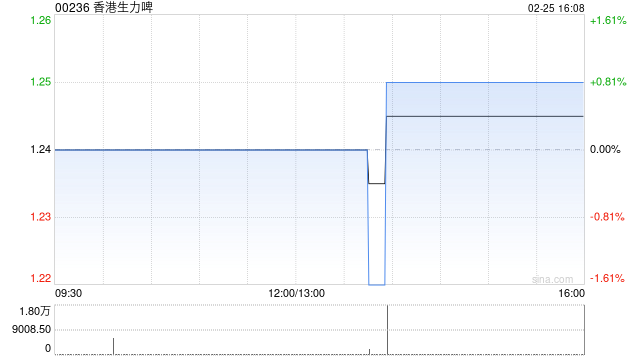
香港生力啤公布2025年业绩 权益持有人应占溢利7611.9万港元同比扭亏为盈
Xin Lang Cai Jing· 2026-02-26 00:05
Core Viewpoint - Hong Kong San Miguel Brewery (00236) reported a revenue of approximately HKD 737 million for the year 2025, reflecting a year-on-year growth of 3.68% [1] - The company achieved a profit attributable to equity holders of HKD 76.12 million, marking a turnaround from a loss in the previous year [1] - Basic earnings per share were reported at HKD 0.20, with a proposed final dividend of HKD 0.06 [1] Financial Performance - Revenue for 2025 was approximately HKD 737 million, representing a 3.68% increase compared to the previous year [1] - Profit attributable to equity holders was HKD 76.12 million, indicating a recovery from prior losses [1] - Basic earnings per share stood at HKD 0.20, with a final dividend proposal of HKD 0.06 [1]

两家公司,筹划易主,周四停牌
Shang Hai Zheng Quan Bao· 2026-02-25 23:26
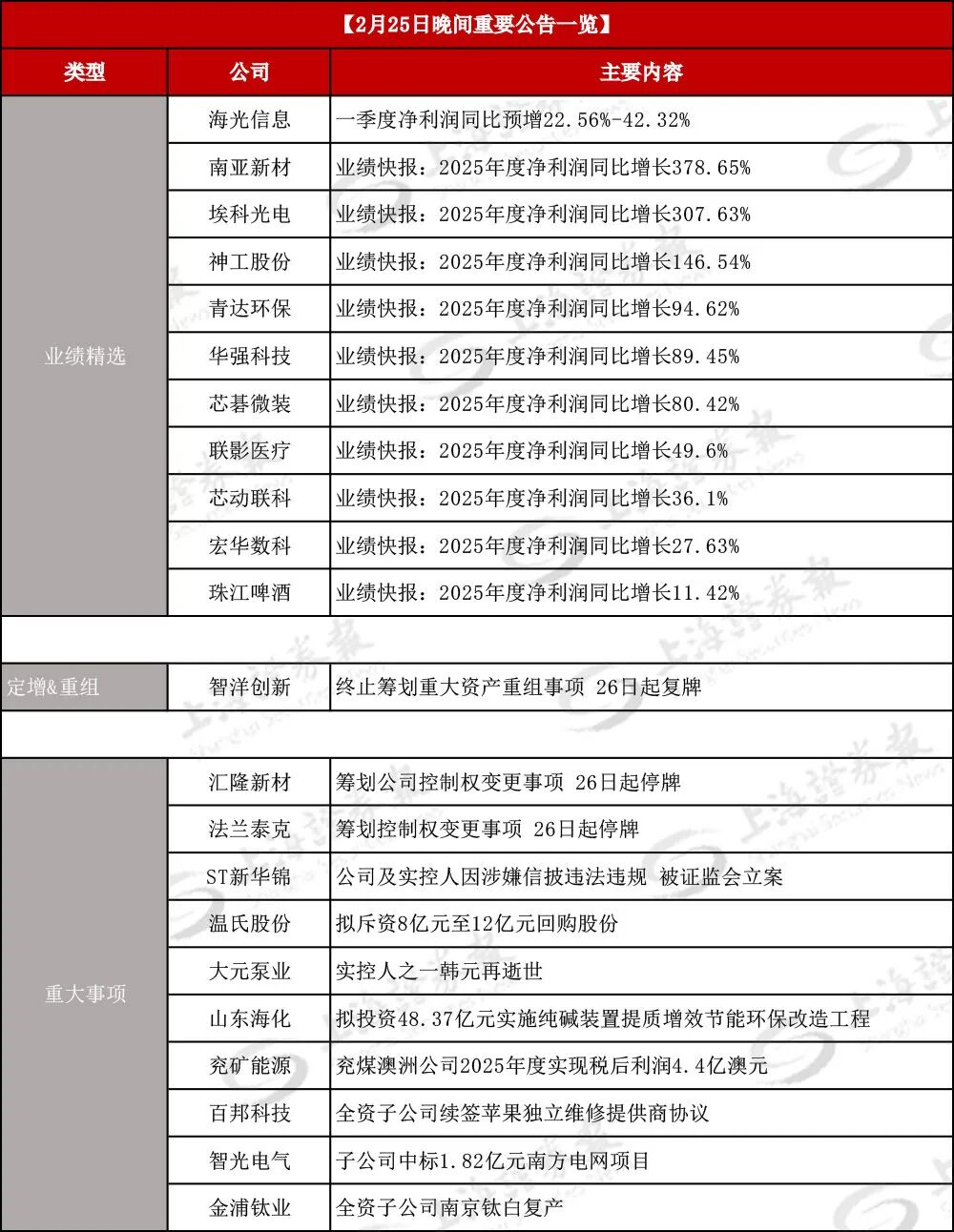
Core Viewpoint - The news highlights significant earnings growth for various companies in 2025, alongside notable corporate actions such as stock repurchases and control changes [1][2][3]. Earnings Highlights - Haiguang Information expects a net profit increase of 22.56% to 42.32% year-on-year for Q1 2026, with projected revenues between 39.1 billion to 42.2 billion yuan, reflecting a growth of 62.91% to 75.82% [3][23]. - Nanya New Materials reported a staggering net profit growth of 378.65% in 2025, with total revenues of 52.28 billion yuan, up 55.52% [5][25]. - Eco-Optoelectronics achieved a net profit increase of 307.63% in 2025, with revenues of 4.4 billion yuan, marking a 77.36% growth [5][25]. - Shengen Co. saw a net profit rise of 146.54% in 2025, with revenues of 4.43 billion yuan, up 46.26% [6][26]. - Qingda Environmental reported a net profit growth of 94.62% in 2025, with revenues of 20.42 billion yuan, reflecting a 55.42% increase [6][26]. - Huachuang Technology's net profit grew by 89.45% in 2025, with revenues of 6.28 billion yuan, up 2.78% [7][27]. - Xinchun Micro-Assembly reported a net profit increase of 80.42% in 2025, with revenues of 14.08 billion yuan, up 47.61% [7][27]. - Union Medical's net profit grew by 49.6% in 2025, with revenues of 138.21 billion yuan, up 34.18% [8][28]. - Xindong Link's net profit increased by 36.1% in 2025, with revenues of 5.24 billion yuan, up 29.48% [8][28]. - Honghua Digital Science reported a net profit growth of 27.63% in 2025, with revenues of 23.08 billion yuan, up 28.9% [9][29]. - Zhujiang Beer achieved a net profit increase of 11.42% in 2025, with revenues of 58.78 billion yuan, up 2.56% [9][29]. Corporate Actions - Wens Foodstuff Group plans to repurchase shares worth between 8 billion to 12 billion yuan, with a maximum price of 24 yuan per share [4][24]. - Zhiyang Innovation terminated its major asset restructuring plans and will resume trading on February 26, 2026 [10][30]. - Huylong New Materials and Falan Technology are planning control changes, leading to a trading suspension starting February 26, 2026 [2][22]. - ST Xinhuajin is under investigation by the China Securities Regulatory Commission for information disclosure violations, leading to a trading suspension [12][32]. - Da Yuan Pump Industry announced the passing of one of its actual controllers, which may affect the company's ownership structure [14][34]. - Shandong Haohua plans to invest 48.37 billion yuan in a soda ash facility upgrade for energy efficiency and environmental protection [14][34]. - Yancoal Australia reported a tax profit of 4.4 million AUD for 2025, with total revenues of 59.49 billion AUD [15][35]. - Baibang Technology renewed its independent repair provider agreement with Apple, extending the contract to June 30, 2030 [15][35]. - Zhiguang Electric's subsidiary won a bid for a 1.82 billion yuan project with the Southern Power Grid [16][36]. - Jinpu Titanium's subsidiary resumed production after a temporary halt due to market conditions [16][36].


广州珠江啤酒股份有限公司2025年度业绩快报
Zhong Guo Zheng Quan Bao - Zhong Zheng Wang· 2026-02-25 22:45
特别提示: 本公告所载2025年度的财务数据仅为初步核算数据,已经公司内部审计部门审计,未经会计师事务所审 计,与年度报告中披露的最终数据可能存在差异,请投资者注意投资风险。 一、2025年度主要财务数据和指标 单位:万元 登录新浪财经APP 搜索【信披】查看更多考评等级 本公司及董事会全体成员保证信息披露的内容真实、准确、完整,没有虚假记载、误导性陈述或重大遗 漏。 二、经营业绩和财务状况情况说明 报告期内,公司产品结构优化升级,市场开拓稳中有进,渠道建设创新发力,品牌声量持续放大,管理 效能不断提升,持续推动企业高质量发展走深走实。2025年,公司实现啤酒销量146.24万吨,同比增长 1.58%;实现营业总收入58.78亿元,同比增长2.56%;利润总额、归属于上市公司股东的净利润、扣除 非经常性损益后的归属上市公司股东的净利润分别为10.57亿元、9.03亿元和8.32亿元,分别同比增长 10.98%、11.42%和9.25%,基本每股收益同比增长10.81%。本报告期末资产总额、归属于上市公司股东 的所有者权益分别为160.66亿元、110.36亿元,分别比本报告期初增长1.00%、5.00%。 三 ...