
交通运输

Search documents
2025 以实干镌刻新荣光
Xin Lang Cai Jing· 2026-01-21 22:36
Core Viewpoint - The government work report of Harbin City emphasizes the commitment to high-quality revitalization and development by 2025, focusing on industrial upgrades, improved public welfare, and enhanced urban vitality [7]. Group 1: Economic Development - The construction of "three bases, one barrier, and one highland" has made significant progress, with grain production reaching 25.775 billion jin, an increase of 753 million jin [9]. - The added value of large-scale equipment manufacturing increased by 19.6%, and the installed capacity of renewable energy reached 5.338 million kilowatts, accounting for 52.9% of the total installed capacity [9]. - Actual foreign investment grew by 18.1%, and total import and export volume increased by 4.1% [9]. Group 2: Policy Implementation - Major policies such as "two heavies" and "two new" have shown effectiveness, with 581 major construction projects and 56 equipment upgrade projects supported [9]. - Consumer incentives included 3.76 billion yuan in subsidies for replacing old consumer goods and 190 million yuan in consumer vouchers, stimulating consumption by 38.89 billion yuan [9]. - Industrial technology investment increased by 36.3%, and high-tech manufacturing investment grew by 10.8% [9]. Group 3: Tourism and Culture - Harbin successfully hosted events like the Harbin Summer Music Festival and the International Ice and Snow Festival, attracting 200 million tourists and generating a total tourism expenditure of 281.84 billion yuan, representing growth of 12.7% and 21.8% respectively [10]. - The city was awarded the title of "World Ice and Snow Tourism Excellence City" by the United Nations World Tourism Organization [10]. Group 4: Innovation and Industry Upgrade - The acceleration of industrial upgrades is evident with 733 projects underway and an investment of 50.1 billion yuan, with significant growth in aerospace, computer, and automotive engine manufacturing [11]. - The number of technology-based enterprises reached 182, with a loan balance growth of 18.7% [11]. - The employment rate of graduates from local universities is 18.3%, with 38.1% for doctoral graduates [11]. Group 5: Urban Development - High-quality urban construction is progressing, with the completion of major infrastructure projects like the expansion of Taiping International Airport [13]. - The city has implemented 32 road and bridge projects and constructed 26,600 new parking spaces [13]. - Historical and cultural preservation efforts include the restoration of 33 heritage sites and the enhancement of urban green spaces [13]. Group 6: Social Welfare - Urban employment increased by 98,900, with 2,000 affordable housing units under construction [15]. - Public services improved with the addition of 38 vocational education programs and 38,300 new quality school places [15]. - Safety and stability in the social environment were maintained, with a decrease in debt rates and criminal cases [15].

2025年杭州经济成绩单“出炉”
Mei Ri Shang Bao· 2026-01-21 22:31
Economic Overview - In 2025, Hangzhou's GDP reached 23,011 billion yuan, growing by 5.2% year-on-year, surpassing the national average by 0.2% [1] Agriculture - The total output value of agriculture, forestry, animal husbandry, and fishery in Hangzhou was 569 billion yuan, with growth rates of 3.8% for planting, 5.3% for forestry, 0.2% for animal husbandry, and 4.2% for fishery [2] - Major agricultural products included a total grain output of 599,000 tons (up 3.9%), vegetable output of 3,860,000 tons (up 3.6%), and fruit output of 900,000 tons (up 3.9%) [2] Industrial Growth - The added value of industrial enterprises above designated size was 4,624 billion yuan, with significant growth in the computer, communication, and other electronic equipment manufacturing (up 13.4%) and automotive manufacturing (up 36.7%) [3] - New quality productivity showed remarkable results, with high-tech industries, strategic emerging industries, and high-end equipment manufacturing growing by 7.5%, 10.0%, and 9.5% respectively [3] - Production of new energy vehicles, industrial robots, and 3D printing equipment saw explosive growth rates of 383.0%, 38.6%, and 15.1% respectively [3] Service Sector - The added value of the service industry was 16,997 billion yuan, with the profit-making service sector growing by 7.0% and financial services by 6.4% [4] - From January to November, the revenue of the service industry above designated size reached 21,168 billion yuan, growing by 8.1%, with the information transmission, software, and IT services sector growing by 13.4% [4] Consumer Market - The total retail sales of consumer goods in Hangzhou reached 9,499 billion yuan, indicating a stable and upgrading consumption pattern [5] - The "8+4" economic policy led to significant growth in retail sales of household appliances (up 42.8%) and communication equipment (up 31.4%) [5] - Upgrading consumption demands were strong, with sports and entertainment goods growing by 45.3% and cosmetics by 12.3% [5] Foreign Trade - The total import and export value was 9,072 billion yuan, with exports at 6,469 billion yuan and imports at 2,603 billion yuan [6] - The export of electromechanical products reached 3,107 billion yuan (up 10.9%), and high-tech products reached 1,001 billion yuan (up 9.9%) [6] - The private economy accounted for 77.0% of total exports, with exports to Belt and Road countries growing by 14.1% [6] Living Standards - The per capita disposable income of residents was 80,017 yuan, with balanced growth across four income sources [7] - Urban residents had a per capita disposable income of 86,640 yuan (up 3.9%), while rural residents had 53,565 yuan (up 5.4%), narrowing the income gap to 1.62 [7] Price Stability - In 2025, the consumer price index remained stable compared to the previous year, with six categories of goods experiencing price increases and two categories seeing declines [8] - Hangzhou aims to achieve a GDP of 30 trillion yuan and a per capita GDP of over 30,000 USD by 2030, focusing on policy coordination and market demand stimulation [8]
上海去年增速超预期:工业投资为何激增20%?高出口能否延续?
2 1 Shi Ji Jing Ji Bao Dao· 2026-01-21 14:44
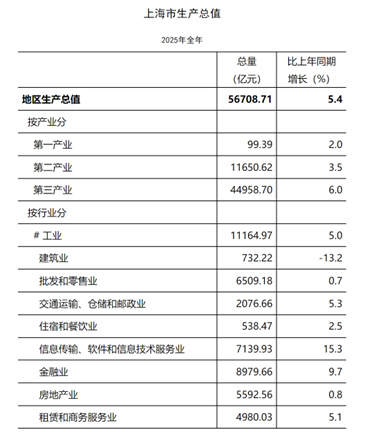
Economic Overview - In 2025, Shanghai's GDP reached 5.67 trillion yuan, growing by 5.4% year-on-year, surpassing the initial target of 5% and the national average growth rate of 5.0% [1][2] - The primary industry added value was 99.39 billion yuan (2.0% growth), the secondary industry was 11,650.62 billion yuan (3.5% growth), and the tertiary industry was 44,958.70 billion yuan (6.0% growth) [1][3] Income and Employment - The per capita disposable income in Shanghai was 91,987 yuan, a 4.1% increase from the previous year, which is lower than the GDP growth rate [1] - The average urban unemployment rate was 4.2%, better than the national average of 5.2% [1] Key Economic Drivers - Shanghai's economic growth is primarily supported by advanced manufacturing, new foreign trade products, and modern service industries [1][2] - The three leading manufacturing sectors (integrated circuits, biomedicine, and artificial intelligence) saw a 9.6% increase in output, while the new energy sector grew by 12.9% [6] Investment Trends - Fixed asset investment in Shanghai grew by 4.6%, which is below the GDP growth rate [7] - Industrial investment surged by 20.0%, the highest in over a decade, while real estate investment declined by 3.1% [10] - Urban infrastructure investment increased by 11.2%, indicating a structural optimization in investment [10] Consumption Patterns - The total retail sales of consumer goods reached 1.66 trillion yuan, growing by 4.6% year-on-year, reversing a decline from the previous year [11] - The increase in inbound tourism, with 9.36 million visitors, contributed significantly to the consumption market [12] Trade Performance - Shanghai's total import and export volume reached 4.51 trillion yuan, a 5.6% increase, with exports growing by 10.8% [13] - The export of "new three samples" products increased by 17.4%, with electric vehicle exports rising by 13.8% [6][13] Future Outlook - For 2026, Shanghai aims for a GDP growth target of around 5%, considering external uncertainties and internal structural adjustments [16] - Key factors influencing future economic performance include exports, investments, and consumption [17] - The "14th Five-Year Plan" emphasizes synchronized growth of resident income and economic growth, along with improving labor remuneration and productivity [20]
*ST交投:撤销因重整而被叠加实施的退市风险警示暨继续被实施退市风险警示和其他风险警示
Ge Long Hui· 2026-01-21 10:47
因公司2024年度末经审计的归母净资产为负值,同时因连续三年实现的扣除非经常性损益后归属于母公 司股东的净利润为负,年审机构对公司2024年度财务报表出具带持续经营重大不确定性段落的无保留意 见《审计报告》,根据《深圳证券交易所股票上市规则》的相关规定,公司股票交易将继续被实施"退 市风险警示"和"其他风险警示"。股票简称仍为"*ST交投",股票代码仍为"002200",股票交易日涨跌幅 限制仍为5%。 格隆汇1月21日丨*ST交投(002200.SZ)公布,鉴于《云南交投生态科技股份有限公司重整计划》已执行 完毕,根据《深圳证券交易所股票上市规则》相关规定,云南交投生态科技股份有限公司向深圳证券交 易所提交了撤销因"被法院裁定受理重整"而被叠加实施的"退市风险警示"申请。2026年1月21日,经深 圳证券交易所审核同意,公司股票交易将自2026年1月22日开市起撤销因重整而被叠加实施的"退市风险 警示"。 ...

直通部委|住建部:今年将着力稳定房地产市场 能源局:电动汽车充电设施突破2000万个
Xin Lang Cai Jing· 2026-01-21 10:20
生态环境部:第一批23个美丽乡村先行区名单公布 生态环境部1月21日公布第一批美丽乡村先行区名单,浙江安吉等23个县(市、区)入选。首批名单公 布,有破解山区乡村建设难题,协调生态保护与民生发展的10个重点体现农村生态功能的涉农县(市、 区);也有统筹城乡发展,扭转二元结构,摸索"生态保护+特色产业"的7个重点体现城乡融合发展的涉 农县(市、区);还有保障生态底色、实现产业兴农的6个重点体现农业生产功能的涉农县(市、 区)。2025年,我国农村生态环境质量不断改善,新增环境整治行政村2.4万余个,农村生活污水治理 率达到55%,较"十三五"末翻了一番多,全国5042个房前屋后较大面积农村黑臭水体基本消除,美丽乡 村整县建成比例达到20%,各美其美、美美与共的美丽乡村建设格局初步显现。到2027年,我国将重点 支持100个左右县开展美丽乡村先行区建设,梯次推进美丽乡村整县建成比例达到40%。 交通运输部:寒潮影响国省干线共有161个路段封闭 住建部:今年将着力稳定房地产市场,继续因城施策 据央视新闻1月21日消息,住房和城乡建设部部长倪虹接受采访时表示,今年将着力稳定房地产市场, 继续因城施策、精准施策,发挥好 ...
FICC日报:指数震荡调整-20260121
Hua Tai Qi Huo· 2026-01-21 05:21
Report Summary 1. Report Industry Investment Rating There is no information provided regarding the report's industry investment rating. 2. Core Viewpoints - Overseas factors such as Trump's remarks and concerns about Japan's fiscal deterioration have led to a decline in major global indexes. Domestically, market enthusiasm has cooled under policy guidance, with a decrease in trading volume and index levels. Currently, investors can focus on the entry opportunities for IC [1][3]. 3. Summary by Directory Macro - economic Charts - The report presents charts showing the relationships between the US dollar index, US Treasury yields, RMB exchange rate, and A - share trends, as well as the relationship between US Treasury yields and A - share styles [6][8][10]. Spot Market Tracking Charts - A - share indexes showed mixed performance. The Shanghai Composite Index closed at 4113.65 points, down 0.01%; the ChiNext Index fell 1.79%. Industries such as petroleum and petrochemicals, building materials, real estate, and transportation led the gains, while communications, national defense and military industry, and computer industries led the losses. The trading volume of the Shanghai and Shenzhen stock markets was 2.8 trillion yuan. Overseas, the three major US stock indexes all closed down, with the Nasdaq falling 2.39% to 22954.32 points [1]. - The daily performance table of major domestic stock indexes shows the closing prices and daily changes on January 20, 2026, and January 19, 2026 [13]. Stock Index Futures Tracking Charts - In the futures market, the current - month contracts of IH and IC were at a premium. The trading volume and open interest of stock index futures increased simultaneously [2]. - The table of stock index futures trading volume and open interest shows the current values and changes of IF, IH, IC, and IM contracts [15]. - The table of stock index futures basis shows the current values and changes of the basis of IF, IH, IC, and IM contracts for the current - month, next - month, current - quarter, and next - quarter contracts [38]. - The table of stock index futures inter - period spreads shows the current values and changes of inter - period spreads for different contract combinations of IF, IH, IC, and IM [43][44].
甘肃开展大规模职业技能提升培训
Ren Min Ri Bao· 2026-01-21 04:40
方案提出,培训将围绕甘肃产业发展需要,聚焦先进制造、数字经济、低空经济、交通运输、农业农 村、生活服务等重点领域市场需求,围绕企业职工、高校毕业生、农民工等重点群体,兼顾加强新兴行 业技能人才培养和提高普通劳动者技能水平。方案明确,甘肃将加强产业链技能人才培育,聚焦现代寒 旱特色农业产业集群,打造以行业企业为主体,普通高等学校、职业院校、行业协会等共同参与的"产 教评"技能人才培育生态链。(记者曾亦辰) 人民日报兰州1月20日电 甘肃省政府办公厅日前印发《甘肃省开展大规模职业技能提升培训实施方案 (2025—2027年)》,明确以深入实施"技能照亮前程"培训行动为牵引,开展大规模职业技能提升培 训,推行"岗位需求+技能培训+技能评价+就业服务"的项目化培训模式。 ...
2025年北京打通53项“断头路”
Bei Jing Shang Bao· 2026-01-21 03:39
值得关注的是,交通、发改、规划、交管、重点站区等部门深入研究,"一区一策"完成怀柔科学城、两 园一河等20余处重点区域交通优化,区域缓堵成效显著;推广"一街一策"区域治理经验,涌现出西城区 大栅栏街道、房山区西潞街道等9个治理范例,构建起"市区街三级联动+政企民共同参与"治理格局。持 续推进火车站优化提升,实现北京站20路公交场站综合利用,拆除北京南站违建、恢复封闭路段道路通 行;新增中心城区停车设施供给5万余个,打造核心区70 条不停车胡同,完成90个轨道站点和学医景商 非机动车停放秩序治理,形成协和医院"开门进车"等成功案例。 同时,打通道路瓶颈,"断点"变"畅点"。攻坚打通53项"断头路",通州区春明西路北段打通后有效服务 中国人民大学通州校区师生出行;昌平区七北路开通后惠及周边9个社区、上万居民日常出行;完成东 四环和西北四环焕新工程,实现"交通提效、生态提质、城市提能"多重效益。推动老旧信号灯升级和联 网改造,实现7000处信号灯联网联控,五环内和城市副中心联网率达100%。 北京商报讯(记者 卓洋)1月21日,记者从北京市交通委获悉,2025年,北京交通强化堵点治理,"堵 点"变"通点"。据介绍, ...
红利国企ETF(510720)近5日涨超2.4亿元,红利风格在2026年表现可期
Sou Hu Cai Jing· 2026-01-21 03:36
开源证券指出,红利风格在2026年的表现或优于2025年,主要基于三大维度:一是赔率层面,红利与成 长的相对估值已处于2016年以来28.2%分位数的较低水平,具备吸引力;二是盈利层面,预计A股盈利 底将在2025年底或2026年初到达,周期品盈利压制有望缓和;三是资金维度,增量资金如保险、固收 +及银行理财等对权益配置比例提升,且偏好绝对收益属性强的高股息资产。但受科技主线中长期占优 条件未破坏影响,红利风格预计不会重现2022~2023年的极致表现。此外,PPI边际修复信号显现,M1 同比回升及CRB指数与PPI的结构性补涨逻辑,或为周期品盈利修复提供支撑,进一步强化红利资产配 置价值。 资金面看,红利国企ETF(510720)近5日涨超2.4亿元,红利风格在2026年表现可期。 注:分红情况具体详见基金分红公告,基金分红规则以基金法律文件为准,鉴于本基金的特点,本基金 分红不一定来自基金盈利,基金分红并不代表总投资的正回报。提及个股仅用于行业事件分析,不构成 任何个股推荐或投资建议。指数等短期涨跌仅供参考,不代表其未来表现,亦不构成对基金业绩的承诺 或保证。观点可能随市场环境变化而调整,不构成投资建议或 ...
2025年北京市第三产业增加值同比增长5.8%
Bei Jing Shang Bao· 2026-01-21 02:27
Economic Overview - In 2025, Beijing's tertiary industry added value, calculated at constant prices, grew by 5.8% compared to the previous year [1] - The information transmission, software, and information technology service industry achieved an added value of 1,219.24 billion yuan, with a growth rate of 11% [1] - The financial industry realized an added value of 866.82 billion yuan, growing by 8.7% [1] Contribution to Economic Growth - The combined contribution rate of the information technology and financial sectors to the overall economic growth of the city exceeded 70% [1] - The leasing and business services industry recorded an added value of 317.14 billion yuan, with a growth of 4.7% [1] - The transportation, warehousing, and postal industry achieved an added value of 134.31 billion yuan, growing by 8.9% [1]