建材

Search documents
涨价预期提升,建材ETF(159745)涨超2%,连续10日吸金超10亿元
Mei Ri Jing Ji Xin Wen· 2026-02-03 03:13
Group 1 - The building materials sector has shown a strong rebound, with the building materials ETF (159745) rising over 2%, and continuous capital inflow exceeding 1 billion yuan over the past 10 days, bringing its total scale to over 1.6 billion yuan, ranking first among its peers [1] - Shanghai has initiated a program to acquire second-hand housing for the purpose of providing affordable rental housing, with pilot districts including Pudong New Area, Jing'an District, and Xuhui District. The first batch of targeted acquisitions will focus on housing types that match, reasonable layouts, mature supporting facilities, and convenient transportation to meet the "work-life balance" needs of various talents [1] - According to Guosheng Securities, since 2026, the real estate market in first-tier cities has maintained high transaction levels, particularly in the second-hand housing market. Second-tier cities such as Hangzhou, Nanjing, Chengdu, and Tianjin have also performed well. The increased debt resolution policies are expected to alleviate government financial pressure and provide room for corporate balance sheet recovery, accelerating municipal engineering projects [1] Group 2 - Zhongyou Securities indicates that in the consumer building materials sector, industry profitability has bottomed out, with frequent price increase notices being issued. Leading companies are expected to benefit from anti-competition policies and improved downstream demand [1]
建材行业报告(2026.01.26-2026.02.01):涨价预期提升,关注节后需求复苏落地情况
China Post Securities· 2026-02-03 01:23
Investment Rating - The industry investment rating is "Outperform the Market" and is maintained [1] Core Views - The cyclical sector performed well recently, with price increase expectations rising. The construction materials sector is expected to see significant valuation elasticity in 2026, with waterproofing, coatings, and cement entering a phase of improved prosperity. Various categories such as gypsum boards, pipes, and glass are anticipated to reach price turning points in 2026, supported by expectations of recovery in real estate and the economy. Short-term demand is currently weak, with a focus on post-Spring Festival demand and price increases [4][5] - Cement demand is entering a seasonal downturn, with overall demand still declining. The housing market remains weak, while infrastructure demand shows significant regional differentiation driven by policy. The civil market exhibits relatively rigid demand. In the medium term, cement production capacity is expected to decline under policies limiting overproduction, leading to a significant increase in capacity utilization and profit elasticity [4][5] - The glass industry is experiencing sustained demand pressure due to real estate impacts, with traditional peak season orders showing limited improvement. Supply-side adjustments, including cold repairs of production lines, have occurred, but overall supply-demand pressures remain, leading to expectations of price stability at low levels [5][16] Summary by Sections Cement - National cement demand is gradually entering a seasonal downturn, with a 6.6% year-on-year decline in December 2025 production, totaling 144 million tons. The housing market remains weak, and infrastructure demand is regionally differentiated, with civil market demand being relatively rigid [9] Glass - The glass industry is under pressure, with traditional peak season orders showing limited improvement and high inventory levels among intermediaries. Despite recent cold repairs of production lines, supply-demand pressures persist, leading to expectations of continued low price fluctuations [5][16] Fiberglass - The fiberglass sector is seeing weak demand as manufacturers focus on cash flow. However, the electronic yarn segment is experiencing growth driven by AI industry demand, with expectations for a significant increase in both volume and price [5] Consumer Building Materials - The industry has reached a profitability bottom, with no further downward price space. The sector is strongly advocating for price increases, with waterproofing, coatings, and gypsum boards issuing price increase notices. Profitability improvements are expected for leading companies in 2026 [5]
中金:调整即序章
中金点睛· 2026-02-02 23:55
Core Viewpoint - The A-share market is experiencing a phase of adjustment after a rapid rise, with potential for a slow bull market supported by favorable factors. The current market favors growth styles, with emerging opportunities in low-priced stocks [2]. Group 1: Energy and Basic Materials - Coal prices are in a state of fluctuation, with January prices for thermal coal, coking coal, and coke rising by 2%, 4%, and 2% respectively. The coal industry maintains stable profitability and cash flow, with a current dividend yield of 5.3% [9]. - Oil prices have shown a 14% increase month-on-month in January, but a year-on-year decrease of 11%. Geopolitical risks are rising, impacting oil supply and prices [10]. - The prices of non-ferrous metals have seen significant increases, with lithium carbonate prices rising by 35% in January. The demand is supported by AI applications and the proliferation of new energy [11]. Group 2: Industrial Products - The AI industry chain remains highly prosperous, with strong domestic demand for engineering machinery and a projected 18% increase in domestic excavator sales by 2025. The photovoltaic industry is also seeing price recoveries [3]. - The automotive sector is facing a projected 6% decline in sales by November 2025, with a focus on opportunities related to overseas markets and smart driving [3]. Group 3: Consumer Products - Traditional consumer sectors are experiencing a decline, with sales of washing machines, refrigerators, and air conditioners dropping by 27%, 37%, and 36% year-on-year in December 2025. The effectiveness of consumption support policies is under observation [4]. - The average purchase price of live pigs remains stable at 14 yuan/kg, with a total pig stock of 429.67 million heads by the end of 2025, indicating a relatively abundant supply [4]. Group 4: Technology - The domestic AI application landscape is seeing significant developments, with multiple domestic large models being released. The semiconductor industry remains robust, with global sales increasing by 30% year-on-year in November [5]. - The gaming industry is recovering, with 1,771 game licenses issued in 2025, indicating a positive trend [5]. Group 5: Financials - The stock market sentiment has improved significantly, with insurance premium income rising by 7% year-on-year in December 2025. The average daily trading volume of A-shares exceeded 30 trillion yuan in January [5].


【光大研究每日速递】20260203
光大证券研究· 2026-02-02 23:08
Group 1: Copper Industry - The market believes that the probability of the Federal Reserve lowering interest rates in March 2026 is low; short-term declines in gold and silver may negatively impact overall commodity sentiment [5] - Cable companies' operating rates have rebounded week-on-week, but demand may weaken as the Spring Festival approaches; copper prices are expected to fluctuate in the short term [5] - The supply-demand tightness in 2026 remains unchanged, and there is continued optimism for copper price increases [5] Group 2: Commercial Aerospace - SpaceX plans to deploy one million computing power satellites, further expanding the commercial aerospace demand space [5] - The manufacturing and launch capabilities of reusable rockets are fundamental for large-scale constellation construction [5] - Laser communication networks are key to achieving large-scale inter-satellite communication [5] Group 3: Jiuri New Materials (688199.SH) - Jiuri New Materials expects to achieve a net profit attributable to shareholders of 21 to 31.5 million yuan in 2025, turning from loss to profit year-on-year [5] - The company anticipates a net profit of 14.4 to 21.6 million yuan after deducting non-recurring gains and losses, also turning from loss to profit year-on-year [5] - The recovery in the price of photoinitiators and the gradual production of new projects are solidifying the company's leading position in the industry [5] Group 4: Keda Manufacturing (600499.SH) - Keda Manufacturing is planning a major asset restructuring to acquire 51.55% of the shares of Tef International, aiming to hold 100% of the shares post-transaction [7] - The transaction is expected to significantly enhance the company's net profit attributable to shareholders [7] Group 5: Tesla (TSLA.O) - Tesla's total revenue for 2025 decreased by 2.9% year-on-year to $94.83 billion, while the Non-GAAP net profit fell by 26.4% to $5.86 billion [8] - In Q4 2025, Tesla's total revenue decreased by 3.1% year-on-year and 11.4% quarter-on-quarter to $24.9 billion, with a Non-GAAP net profit decline of 16.4% year-on-year to $1.76 billion [8] Group 6: Apple (AAPL.O) - Apple's FY1Q26 performance exceeded expectations, driven by strong demand for the iPhone 17 series and the continued penetration of AI features [8] - Despite rising storage costs, Apple managed to maintain and even increase its gross margin through product mix optimization and high-margin service business [8] Group 7: Ausnutria (1717.HK) - Ausnutria is expected to see a 1.1% year-on-year revenue growth in 2025, with a slowdown in growth primarily due to domestic milk powder business challenges [9] - The company's net profit attributable to shareholders is expected to remain flat year-on-year, with a decline in H2 2025 profits due to slower internal code adjustment progress and intensified industry competition [9]

显微镜下的中国经济(2026年第4期):2025年周平均工作时间有所下降
CMS· 2026-02-02 15:07
Group 1: Employment and Work Hours - The average weekly working hours for employees in enterprises is 48.43 hours, lower than in 2023 and 2024, but still significantly higher than pre-pandemic levels[3] - The reduction in working hours has led to an increase in leisure time, with employees averaging over 54.5 hours of leisure time per week after accounting for work, rest, and commuting[3] - The "14th Five-Year Plan" aims to increase the consumption rate by enhancing residents' income and reducing their burdens, thereby improving consumption capacity[3] Group 2: Consumption and Economic Impact - More leisure time provides additional consumption scenarios, primarily reflected in the recovery of service consumption demand[3] - One of the constraints on expanding service consumption is the concentration of consumption scenarios, leading to poor consumer experiences[3] - Measures to protect workers' rights to rest and vacation, and to prevent illegal extensions of working hours, are beneficial for improving consumption demand[3] Group 3: Risks and Economic Indicators - Risks include geopolitical tensions, domestic policy implementation falling short of expectations, global recession, and unexpected monetary policy changes in major economies[3] - The proportion of enterprise employees in employment types has reached 60%, with the remaining 40% also significantly impacting leisure time and consumption rates[3]
【两会】政府工作报告图解丨“十五五”开局 山西这样干!
Xin Lang Cai Jing· 2026-02-02 12:51
Group 1 - The core viewpoint emphasizes the importance of adhering to Marxism, Mao Zedong Thought, Deng Xiaoping Theory, and Xi Jinping's thoughts to promote high-quality development and ecological protection in Shanxi [2][3] - The overall strategy includes promoting the transformation of resource-based economies, deepening energy reforms, and establishing new high grounds for opening up inland areas [2][3] Group 2 - The focus is on achieving significant results in high-quality development by expanding domestic demand, improving consumption mechanisms, and increasing effective investment in key projects [7] - The development of new productive forces and the modernization of the economic system are prioritized to maintain reasonable economic growth [7] Group 3 - Major progress has been made in the transformation of the resource-based economy, with significant achievements in energy transition and industrial upgrading [9] - The establishment of a new energy system is underway, with a goal to increase renewable energy capacity by 100 million kilowatts [9] Group 4 - The strategy includes enhancing industrial upgrading, promoting traditional industries, and fostering emerging industries to achieve annual growth rates of over 5% in manufacturing and 8% in the digital economy [10] - Agricultural strategies aim for high-standard farmland to reach 30.5 million acres and grain production capacity to hit 30.5 billion jin by 2030 [10] Group 5 - The innovation system is being enhanced through the implementation of education and talent strategies, aiming for a 10% annual increase in R&D funding and the establishment of additional national laboratories [12] - A talent policy framework is being developed to create a unique talent center in Shanxi [12] Group 6 - The focus on social and cultural development includes promoting core socialist values and enhancing public cultural services to enrich the cultural life of the people [16][17] Group 7 - The quality of life for residents is being improved through employment initiatives, income growth plans, and the establishment of a comprehensive social security system [19] - Urbanization efforts aim for a population urbanization rate of around 71% and the modernization of rural areas [21] Group 8 - Significant achievements in ecological protection are noted, with an increase in non-fossil energy consumption and a reduction in major pollutants, alongside improved resource utilization [23] Group 9 - Safety development capabilities are being enhanced through a shift towards preventive public safety governance and improved disaster prevention measures [25]

风暴“缺席”成利空、政府停摆再添堵 美国建材供应商盈利增长恐戛然而止
Zhi Tong Cai Jing· 2026-02-02 12:00
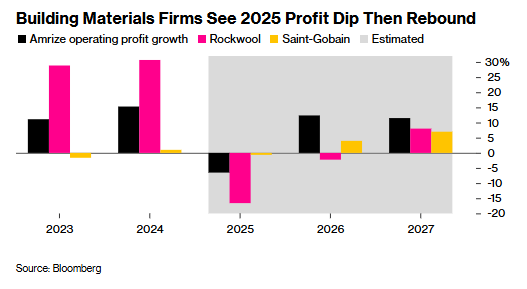
由于美国政府停摆风波叠加极端风暴天气缺席共同压制了市场需求,建材供应商此前强劲的盈利势头或 在第四季度遭遇挫折。 市场普遍预计,多家深耕美国市场的建材企业——包括总部位于芝加哥的Amrize Ltd.(AMRZ.US)、丹麦 的Rockwool A/S(RCWBY.US)以及法国的圣戈班集团——第四季度盈利将面临下滑,从而终结此前稳定 的增长态势。 摩根士丹利分析师Cedar Ekblom测算,受益于疫情后翻新热潮与强对流天气频发带来的价格走高和需求 激增,规模达400亿美元的美国屋面材料市场在2019年至2024年间实现了10%的名义复合增长率,但在 2025年,该市场规模下滑了8%。 去年是美国大陆自2015年以来首次没有飓风登陆的一年。这对房主而言是个好消息,但对建筑公司来说 却意味着需求显著放缓。 Ekblom表示,天气因素对屋面材料销量的影响占比最高可达35%,风暴催生的需求锐减,叠加新房建设 活动放缓,整个建材行业均受到了连锁冲击。 美国建材市场另一龙头企业欧文斯科宁(OC.US)首席执行官Brian D.Chambers在去年11月的分析师电话 会议中透露,公司预计四季度屋面材料销量将跌至"近十 ...
贝莱德增持中国建材(03323)约1254.45万股 每股作价约5.37港元
Zhi Tong Cai Jing· 2026-02-02 11:44
智通财经APP获悉,香港联交所最新数据显示,1月27日,贝莱德增持中国建材(03323)1254.4535万股, 每股作价5.3728港元,总金额约为6739.93万港元。增持后最新持股数目约为3.07亿股,最新持股比例为 8.26%。 (原标题:贝莱德增持中国建材(03323)约1254.45万股 每股作价约5.37港元) ...
宝通证券港股每日策略-20260202
宝通证券· 2026-02-02 05:48
Market Performance - The Hang Seng Index (HSI) fell by 580 points or 2.08%, closing at 27,387 points[1] - The National Index dropped by 235 points or 2.5%, closing at 9,317 points[1] - The Hang Seng Tech Index decreased by 122 points or 2.1%, closing at 5,718 points[1] - Total market turnover was 301.612 billion HKD[1] Currency and Economic Indicators - The RMB/USD central parity rate was adjusted up by 93 pips to 6.9678, the highest since May 16, 2023[1] - The People's Bank of China conducted a 477.5 billion RMB reverse repo operation at a rate of 1.4%[1] - The manufacturing PMI for January 2026 fell to 49.3, below the market expectation of 50, indicating a decline of 0.8 percentage points from the previous month[2] Sector Performance - The Shanghai Composite Index closed down 40 points or 1%, at 4,117 points, with a turnover of 1.27 trillion RMB[2] - The Shenzhen Component Index fell by 94 points or 0.7%, closing at 14,205 points, with a turnover of 1.57 trillion RMB[2] - The ChiNext Index rose by 41 points or 1.3%, closing at 3,346 points, with a turnover of 726.1 billion RMB[2] Corporate Earnings Forecasts - China National Building Material (03323.HK) expects a loss of 2.3 to 4 billion RMB for the year ending December 31, 2025, compared to a profit of 2.387 billion RMB in 2024[4] - China Shenhua Energy (01088.HK) anticipates a net profit of 50.8 to 55.8 billion RMB for 2025, a decrease of 10.6% to 18.6% year-on-year[4] - CICC (03908.HK) projects a net profit of 8.542 to 10.535 billion RMB for 2025, representing a year-on-year increase of 50% to 85%[6]
众赢财富通:市场修复窗口期消费与地产链增配预期升温
Cai Fu Zai Xian· 2026-02-02 05:01
Core Viewpoint - The A-share market is gradually stabilizing after previous adjustments, with opportunities for structural recovery in sectors that are relatively undervalued and have clear fundamentals or expectations [1][6] Group 1: Market Sentiment and Fund Behavior - The wide-based ETF is facing redemption pressure, indicating that institutional funds have not significantly increased their allocation to index-weighted sectors [3] - Market risk appetite has not broadly increased but shows clear structural differentiation, with funds favoring sectors with valuation recovery potential rather than simply returning to blue-chip stocks [3][4] - The consumption chain is identified as a clear allocation direction, with the period leading up to the "Two Sessions" being a critical window for increasing exposure to this sector [4][5] Group 2: Sector Analysis - The consumption chain's performance is not a broad-based rally but exhibits structural characteristics, with some sectors having already recovered valuations and being sensitive to short-term data [4] - The real estate chain is also gaining attention, with some sectors becoming desensitized to new construction data, shifting focus to policy support and industry clearing processes [4][5] - Historical trends suggest that the recovery in the real estate chain typically progresses from downstream to upstream, with current strength in building materials driven by valuation recovery and expectation improvement rather than a comprehensive demand rebound [4][6] Group 3: Strategic Insights - Current market conditions present opportunities, particularly in sectors that are relatively undervalued and have clear logic, which are more likely to achieve excess returns during fund rotation [5] - The period around the "Two Sessions" remains a significant window for policy and expectation, with active trading around macro goals and industry policy directions [5][6] - The transition from "emotional recovery" to "structural validation" is crucial, with the consumption and building materials sectors forming key components of the current market narrative [6]