
非银金融

Search documents
负债行为跟踪:预防式降温:两融、北向和股指期货的分歧
ZHONGTAI SECURITIES· 2026-01-18 07:26
1. Report Industry Investment Rating - Not provided in the content 2. Core Viewpoints of the Report - The market cooled slightly in the second week of the new year. The margin trading and short - selling (MTS) new rules achieved a "preventive" cooling effect before the market overheated, and the slow - bull trend was established. MTS funds showed differentiation rather than a retreat, and northbound funds had a strong willingness to flow in, although the net outflow of broad - based ETFs accelerated [5][11]. - Institutions took a left - hand approach, while MTS and northbound funds served as accelerators for the incremental funds since the beginning of the year. Northbound funds became an incremental force for short - term market activity [9]. - The performance of broad - based indexes was differentiated. Large - cap and dividend indexes declined, while technology stocks and micro - cap stocks performed well [10][13]. 3. Summary by Relevant Catalogs Market Performance - This week, broad - based indexes showed differentiated performance. Large - cap indexes such as the CSI 300 and the Shanghai Composite Index fell by 0.6% and 0.4% respectively, and the dividend index dropped by 1.8%. Technology stocks and micro - cap stocks performed well, with the ChiNext and the STAR 50 rising by 1.0% and 2.6% respectively, and micro - cap stocks increasing by 1.7% [10][13]. Leveraged Funds - Since the spring rally, the MTS balance has rapidly recovered. As of January 15, the MTS balance reached 2.69 trillion yuan, exceeding the highs in 2015 and 2021. The proportion of MTS balance to the market value of tradable shares reached 2.59%, slightly exceeding the high in March 2022 [21]. - The proportion of MTS trading volume to A - share trading volume rose in the first week of the new year and touched the "mean + 2 standard deviations". This week, it rebounded slightly, with the average rising from 11.27% to 11.33%, slightly lower than the "mean + 2 standard deviations" [21]. - Since the beginning of the year, leveraged funds have flowed into major broad - based indexes significantly. In the first week, the average daily net purchase of margin trading in the Shanghai Composite Index, the CSI 500, and the CSI 1000 exceeded 3 billion yuan. This week, the net inflow of MTS in the CSI 500 and the CSI 1000 decreased significantly on Wednesday and Thursday, while the MTS funds in the STAR 50 continued to flow in at an accelerated pace [26]. - From Monday to Tuesday this week, industries such as household appliances, non - banking, media, pharmaceutical biology, computers, and non - ferrous metals had a relatively large proportion of MTS net purchases to trading volume. From Wednesday to Thursday, industries such as national defense and military industry, agriculture, forestry, animal husbandry, coal, and building materials shifted from adding leverage to de - leveraging. The proportion of MTS net purchases to trading volume in industries such as media, household appliances, pharmaceuticals, computers, and non - ferrous metals decreased significantly. After January 13, the proportion of MTS net purchases to trading volume in industries such as banks, public utilities, food and beverages, non - banking, and electronics increased [6][27]. - This week, stocks of all market - value gradients added leverage. After the MTS new rules, stocks of different market values showed differentiation. Since Wednesday, the proportion of MTS net purchases to trading volume of stocks with a market value of over 100 billion yuan increased, while that of stocks with a market value of less than 100 billion yuan decreased [35]. - The proportion of MTS net purchases to trading volume of popular stocks increased. The average proportion of leveraged funds in the trading volume of the top 35 popular stocks rose to 6.30% this week, still lower than the 9.42% in the last week of August. On Wednesday, popular stocks such as Cambricon, Goldwind Science & Technology, and Kunlun Tech de - leveraged. From Thursday to Friday, popular stocks such as Zhongji Innolight, Kweichow Moutai, and Luxshare Precision added leverage [42][44]. ETF Funds - From Wednesday to Friday, the net outflow of broad - based ETFs was relatively large. The average daily net outflow of the CSI 300 ETF reached 14.7 billion yuan, and the average daily net outflow of the SSE 50, ChiNext, and CSI 500 ETFs exceeded 5 billion yuan [48]. Quantitative Funds - This week, the premium of the near - term stock index futures basis widened, and the discount of the far - term futures narrowed. The discount deepened only on Wednesday and then recovered. Overall, the demand for hedging decreased [52]. Northbound Funds - Since Q4 2025, due to the relaxation of US monetary policy, the increasing expectation of US dollar depreciation, and the narrowing of the Sino - US interest rate spread, net foreign exchange settlement has increased, leading to the passive release of RMB and the return of RMB [59]. - Foreign capital actively participated as a right - hand force in the market rally at the beginning of the year, with a higher degree of participation than MTS funds. Comparing the trading volume proportions in the nine trading days before and after New Year's Day, the trading volume proportion of northbound funds increased from 10.2% to 11.6%, a rise of 1.4 percentage points, while that of MTS funds only increased from 11.0% to 11.4%, a rise of 0.4 percentage points [61]. - This week, the total trading volume of northbound funds rebounded. The average daily trading volume increased from 327.2 billion yuan to 401.1 billion yuan, and the proportion in A - share trading volume rose from 11.47% to 11.61%. Since late December 2025, the trading volume of northbound funds has rebounded significantly [67].
华金证券:春季行情未完 继续聚焦成长
Xin Lang Cai Jing· 2026-01-18 06:33
Group 1 - The core viewpoint is that the A-share market may continue to strengthen after a volume increase in the spring market, influenced by policies, external events, liquidity, and sentiment [1][8] - Historical data shows that in the past 16 spring markets since 2010, there were 11 instances where the total A-share trading volume increased by over 100% from the low to the high, and in 9 of those instances, the Shanghai Composite Index continued to rise [1][8] - Key factors affecting whether A-shares can continue to rise after a volume increase include policies and external events, liquidity, and sentiment of leading sectors prior to the volume increase [1][8] Group 2 - Currently, the A-share market is expected to continue a strong but volatile trend, with the spring market not yet over [2][9] - Short-term policies remain positive, with a dual easing of fiscal and monetary policies, and external risks are relatively limited, particularly in US-China relations and Middle Eastern geopolitical risks [2][9] - Short-term liquidity expectations are still loose, with the macro liquidity likely to remain accommodative, and the central bank has already implemented structural interest rate cuts [2][9] Group 3 - In the spring market, sectors that are likely to outperform include technology growth and certain cyclical industries, with historical trends indicating that sectors with low valuation sentiment may experience a rebound after a volume increase [3][10] - Current sectors expected to perform well include pharmaceuticals, machinery, and new energy, while media, military, and electronics may experience slight corrections before continuing to rise [3][10] - The ongoing trends in AI and commercial aerospace are expected to support the upward movement of related sectors such as TMT and military [3][10] Group 4 - Short-term recommendations suggest accumulating positions in technology growth and certain cyclical sectors that are currently undervalued [4][11] - Sectors such as machinery (robots), electronics (semiconductors, AI hardware), and pharmaceuticals (innovative drugs) are highlighted for their positive policy and industry trends [4][11] - Non-bank financials and consumer sectors (food, retail, and services) are also suggested for potential rebound and marginal improvement in fundamentals [4][11]
策略周报:涨价或是重要的景气主线-20260118
Xinda Securities· 2026-01-18 05:52
Group 1 - The core conclusion indicates that the market's upward momentum has slowed, with trading funds remaining active, leading to a significant increase in turnover rates, surpassing the high point from August 2025 [3][9] - The report suggests that the spring market is still in progress, and a period of sideways consolidation following excessive short-term trading is normal, with policies indicating a temporary cooling but maintaining an overall loose tone [9][10] - The report emphasizes that in the liquidity bull market phase, price increases may be a significant theme, driven by the narrative of re-pricing key resources under the backdrop of de-globalization and supply chain restructuring [4][10] Group 2 - The report highlights that the long-term view remains optimistic about the potential for a new super cycle in commodity prices, despite short-term fluctuations [4][24] - It identifies that the current price cycle is primarily driven by supply chain security, with geopolitical tensions and trade conflicts enhancing the strategic value of resource commodities [10][24] - The report notes that both supply and demand sides benefit from the expansion of new energy vehicles, photovoltaic, and other emerging sectors, while traditional demand is recovering [24][25] Group 3 - The report outlines that the main drivers of the current price increase are supply constraints combined with demand shifts, with a focus on the elasticity of supply [24][32] - It mentions that the supply constraints include capacity limitations in key resources like copper and rare earths, as well as policies aimed at reducing excess capacity [24][32] - The report also points out that the demand side should focus on the expansion opportunities in new energy sectors, which are expected to drive growth [24][32] Group 4 - The report indicates that the market may continue to show strength in the near term, with potential volatility in January, but the overall downward risk is manageable [32][35] - It suggests that the liquidity environment is likely to remain favorable leading up to the Spring Festival, with the possibility of further capital inflows supporting market stability [32][35] - The report emphasizes the importance of monitoring regulatory changes and the speed of supply release as potential sources of market volatility [32][35]
A股市场交投活跃 周成交额超17万亿元
Zheng Quan Shi Bao· 2026-01-16 17:44
Market Overview - The A-share market experienced a high and then a pullback, with the Shanghai Composite Index barely holding above 4100 points, while major indices like the Shenzhen Component and Northbound 50 closed with small gains but long upper shadows [1] - The market saw active trading, with daily trading volumes frequently hitting historical highs, and weekly trading volume reaching a record 17 trillion yuan [1] Fund Flows - Significant inflows of leveraged funds continued despite market adjustments, with net financing purchases exceeding 91.3 billion yuan for the week, marking a five-month high, and the financing balance reaching 2.7 trillion yuan, setting a new record for nine consecutive days [2] - The computer industry attracted over 12.3 billion yuan in net financing purchases, while electronics and telecommunications received 10.3 billion yuan and over 9 billion yuan, respectively [2] - Major sectors like defense and non-bank financials saw net outflows of over 24.3 billion yuan and 10.8 billion yuan, respectively [2] Chip Sector - The chip sector saw multiple instances of end-of-day buying, with the sector index hitting historical highs in 7 out of the last 10 trading days [3] - Companies like *ST Chengchang and Liou Co. experienced significant price increases, with *ST Chengchang hitting 128.98 yuan per share, the highest price for any ST stock [3] - Reports indicate that major chip manufacturers AMD and Intel have sold out their server CPU production for the year, leading to planned price increases of 10%-15% [3] Power Industry Outlook - The power equipment sector has shown strong performance, with indices for ultra-high voltage, grid equipment, smart grids, and energy storage reaching historical highs [4] - The State Grid announced a fixed asset investment of 4 trillion yuan for the 14th Five-Year Plan, a 40% increase from the previous plan, focusing on technological innovation and new power system construction [4] - Goldman Sachs predicts that investments in global digital infrastructure and energy systems driven by AI could reach 5 trillion dollars over the next decade, with power grid equipment being a primary beneficiary [4]


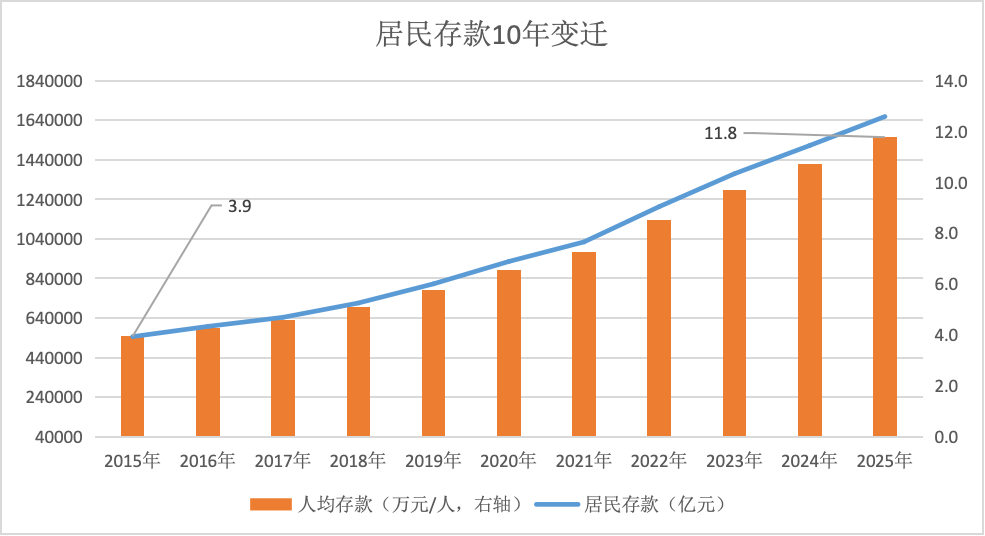
最新金融数据看“钱袋子”:去年人均存款11.8万,居民多存少贷,超七成存定期
Xin Lang Cai Jing· 2026-01-16 11:24
Group 1 - The core point of the article highlights significant trends in China's financial landscape as reported by the People's Bank of China, including a doubling of per capita deposits over the past decade, reaching 118,000 yuan by the end of last year [1][2][21] - Total household deposits in China reached 166 trillion yuan by the end of last year, marking a historical high and reflecting a notable acceleration in wealth accumulation [2][21] - The actual per capita deposit figure may be underestimated due to a shift of funds from traditional savings to wealth management products, which are not fully captured in household deposit statistics [3][22] Group 2 - Households are exhibiting a "save more, borrow less" behavior, with new loan additions dropping to 4,417 billion yuan, the lowest level since 2007, indicating a return to loan levels seen 20 years ago [6][25] - In contrast, household deposits increased by 14.6 trillion yuan, demonstrating a strong saving inclination and a conservative approach to financial risk [8][27] Group 3 - The structure of household deposits is changing, with the proportion of fixed-term deposits rising to a record high of 73.4%, indicating a shift towards longer-term savings strategies [9][28] - This shift reflects a cautious public sentiment, as individuals prefer to lock in higher interest rates through long-term deposits rather than maintaining liquidity for immediate spending [11][30] Group 4 - The phenomenon of "deposit migration" is evident, with non-bank deposits increasing by 6.4 trillion yuan, the highest on record, as households move funds into non-bank financial products [12][31] - This trend is driven by lower deposit rates, prompting a portion of household savings to flow into the stock market and other investment vehicles [12][33] Group 5 - Banks are increasingly front-loading credit issuance, with the first quarter of 2025 accounting for over 60% of the year's total credit, a significant shift from historical patterns [15][34] - This change is attributed to a combination of banks seeking to secure returns in a low-interest environment and weak demand for loans from households [17][36] Group 6 - For the first time, the proportion of credit in the total social financing (TSF) has fallen below 50%, with government bonds now accounting for a significant share of TSF growth, reaching 38.9% [18][37] - This shift indicates a growing reliance on government bonds as a stabilizing force in the economy, as fiscal policies aim to maintain necessary spending levels [20][39]
【16日资金路线图】两市主力资金净流出近240亿元 电子等行业实现净流入
Zheng Quan Shi Bao· 2026-01-16 10:38
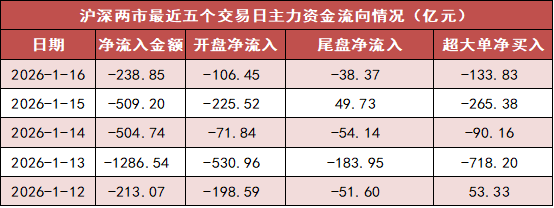
1月16日,A股市场整体下跌。截至收盘,上证指数收报4101.91点,下跌0.26%;深证成指收报14281.08点,下跌 0.18%;创业板指收报3361.02点,下跌0.2%。两市合计成交30262.32亿元,较上一交易日增加1207.36亿元。 1.两市主力资金净流出近240亿元 今日沪深两市主力资金开盘净流出106.45亿元,尾盘净流出38.37亿元,全天净流出238.85亿元。 | | | 沪深两市最近五个交易日主力资金流向情况(亿元) | | | | --- | --- | --- | --- | --- | | 日期 | | 净流入金额 开盘净流入 | 尾盘净流入 | 超大单净买入 | | 2026-1-16 | -238.85 | -106. 45 | -38. 37 | -133. 83 | | 2026-1-15 | -509.20 | -225.52 | 49.73 | -265. 38 | | 2026-1-14 | -504.74 | -71.84 | -54. 14 | -90. 16 | | 2026-1-13 | -1286.54 | -530. 96 | -183. 95 | ...
【16日资金路线图】两市主力资金净流出近240亿元 电子等行业实现净流入
证券时报· 2026-01-16 10:33
1月16日,A股市场整体下跌。截至收盘,上证指数收报4101.91点,下跌0.26%;深证成指收报14281.08 点,下跌0.18%;创业板指收报3361.02点,下跌0.2%。两市合计成交30262.32亿元,较上一交易日增加 1207.36亿元。 1. 两市主力资金净流出近240亿元 今日沪深两市主力资金开盘净流出106.45亿元,尾盘净流出38.37亿元,全天净流出238.85亿元。 | | | 沪深两市最近五个交易日主力资金流向情况(亿元) | | | | --- | --- | --- | --- | --- | | 日期 | | 净流入金额 开盘净流入 | 尾盘净流入 | 超大单净买入 | | 2026-1-16 | -238.85 | -106. 45 | -38. 37 | -133. 83 | | 2026-1-15 | -509.20 | -225. 52 | 49.73 | -265. 38 | | 2026-1-14 | -504.74 | -71.84 | -54. 14 | -90. 16 | | 2026-1-13 | -1286.54 | -530. 96 | -183. 9 ...

爆量第三日:巨额资金,甩卖?
Ge Long Hui A P P· 2026-01-16 09:10
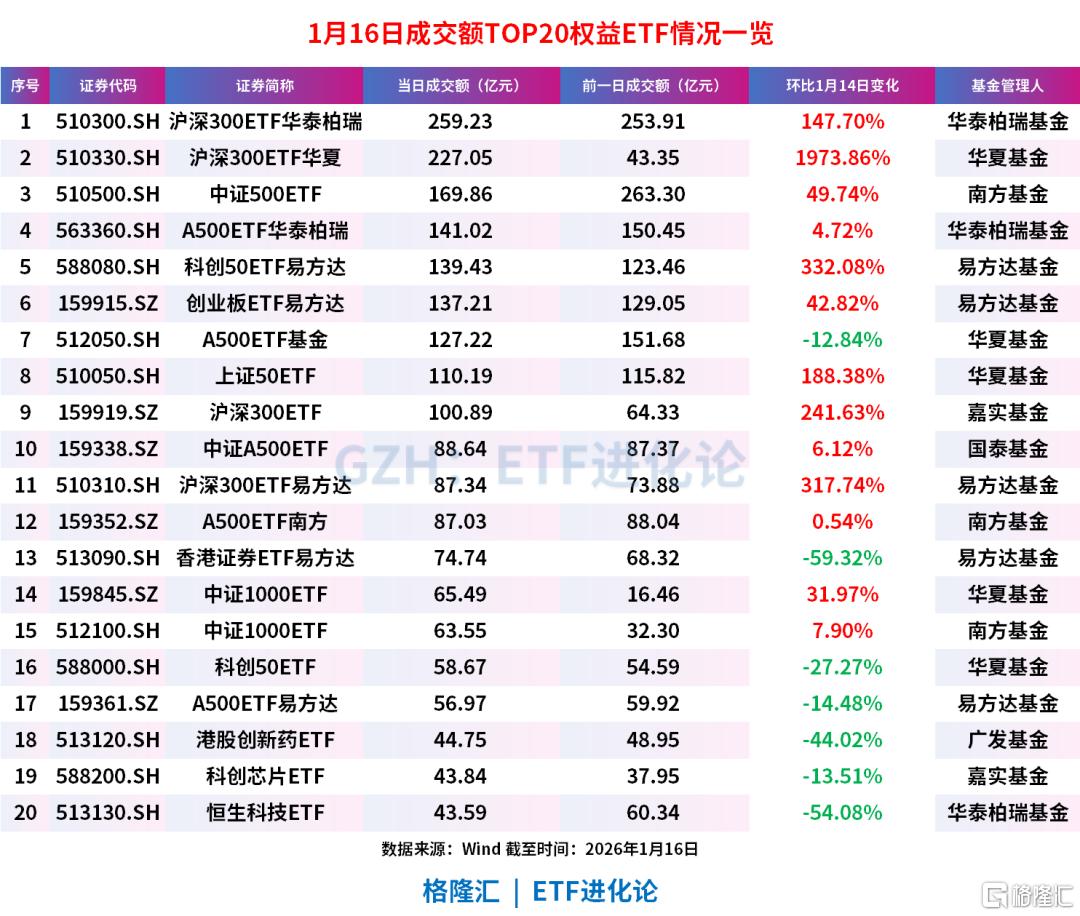
Core Viewpoint - The A-share market is experiencing an unprecedented tug-of-war between bulls and bears, highlighted by significant net outflows from major ETFs and a surge in leveraged funds [1][9][11]. Group 1: ETF Market Activity - Major broad-based ETFs saw a net outflow of 700 billion, with the total margin balance exceeding 2.7 trillion for the first time in history [1]. - The trading volume of ETFs reached a record high of 752.25 billion, marking the third consecutive day of record-breaking activity [1]. - Multiple broad-based ETFs, including the Huatai-PineBridge CSI 300 ETF and the Huaxia CSI 300 ETF, recorded transaction volumes exceeding 20 billion, with the latter seeing a nearly 20-fold increase compared to January 14 [2][4]. Group 2: Institutional Fund Flows - The top ten ETFs with the highest net outflows were all broad-based ETFs, totaling 715 billion in outflows, with the Huatai-PineBridge CSI 300 ETF alone experiencing a net outflow of 200 billion [9][10]. - Institutional funds showed a net outflow across nearly all major ETFs, indicating a trend of selling pressure despite high trading volumes [4][5]. Group 3: Leverage and Margin Trading - Leveraged funds have been aggressively buying, with net purchases of 206 billion on January 15, contributing to a total of 1.77 trillion in net purchases over the first nine trading days of the year [13][15]. - The current pace of leveraged fund inflows suggests that they could match last year's total net purchases in just over 25 trading days [15]. Group 4: Market Sentiment and Regulatory Environment - The market is showing signs of cooling, with regulatory measures aimed at tempering excessive speculation following a period of high trading volumes and bullish sentiment [11][19]. - The shift in regulatory stance is seen as a response to the rapid increase in trading activity, particularly after three consecutive days of trading volumes exceeding 3 trillion [19][20]. Group 5: Wealth Transfer and Investment Trends - A significant portion of the 160 trillion in household savings is being reallocated, which could have profound implications for the capital markets [21][30]. - The upcoming maturity of long-term deposits, estimated at 32 trillion, coincides with a bullish market environment, potentially leading to increased equity market participation [25][26].
存款,开始“搬家”了?
Sou Hu Cai Jing· 2026-01-16 08:29
Group 1 - The core viewpoint of the article highlights a significant increase in deposits in non-bank financial institutions, with a rise of 6.41 trillion yuan in 2025, representing a 147% increase compared to the previous year, while household deposits grew by only 3% to 14.64 trillion yuan, indicating a trend of "deposit migration" [2] - Non-bank financial institutions include broker margin accounts, bank wealth management, public funds, finance companies, and insurance, suggesting that the influx of deposits is likely being directed towards stock markets, bond markets, and insurance products [2] - The article notes that when the A-share market performs well, non-bank deposits tend to increase significantly, as seen in 2015 and 2021, which correlates with increased trading volumes in the A-share market [2] Group 2 - Recent favorable developments for the A-share market include a 0.25 percentage point reduction in various structural monetary policy tool rates by the central bank, lowering the one-year re-lending rate from 1.5% to 1.25% [5] - The central bank has also decided to increase the quota for re-lending aimed at technological innovation and transformation by 400 billion yuan, bringing the total to 1.2 trillion yuan [6] - This targeted interest rate reduction is expected to lower borrowing costs for commercial banks, potentially leading to lower loan rates for customers, particularly benefiting sectors like technology, consumption, and elderly care [7] - The central bank indicated that there is still room for further rate cuts and reserve requirement ratio reductions this year, which is widely anticipated by the market, alongside expectations of continued rate cuts by the Federal Reserve [7]

存款为何显著多增?
CAITONG SECURITIES· 2026-01-16 06:42
Group 1: Loan Growth - In December 2025, new short-term loans for enterprises increased by CNY 370 billion, a year-on-year increase of CNY 390 billion, significantly exceeding seasonal expectations[12] - New medium and long-term loans for enterprises amounted to CNY 330 billion, a year-on-year increase of CNY 290 billion, showing improvement partly due to a low base in 2024[12] - The overall new social financing in December was CNY 22,075 billion, a year-on-year decrease of CNY 6,462 billion, aligning with seasonal patterns[5] Group 2: Deposit Growth - M2 growth rate increased by 0.5 percentage points to 8.5% year-on-year, exceeding market expectations[26] - New RMB deposits in December reached CNY 16,800 billion, a year-on-year increase of CNY 30,800 billion, indicating a reverse seasonal growth[26] - Non-bank deposits contributed significantly to the deposit increase, with a net decrease of CNY 330 billion in December, which was a year-on-year improvement of CNY 28,400 billion[28] Group 3: Future Outlook and Risks - It is expected that enterprise credit will improve at the beginning of 2026, driven by policies aimed at stabilizing investment[29] - Risks include potential underperformance of domestic policy effects, uncertainties in investment behavior, and unexpected changes in overseas policies and geopolitical situations[32]