
股票

Search documents
债市 | 迎风而行
Xin Lang Cai Jing· 2025-08-24 14:44
Core Viewpoint - The bond market is experiencing significant pressure due to rising long-term yields and the failure of traditional interest rate pricing frameworks, leading to a state where stock market performance heavily influences bond pricing [1][14][13]. Group 1: Market Dynamics - Since mid-July, the bond market has faced capital losses due to a substantial rise in long-term yields, with 10-year and 30-year government bond yields increasing by 12 basis points and 25 basis points respectively from July 15 to August 22 [13][1]. - The stock market's extreme risk-reward ratio has maintained a rolling 3-month Calmar ratio above 4.0 since July, a level not seen during the previous year's "924" rally, putting additional pressure on the bond market [14][1]. - The bond market is currently in a pricing state dominated by risk appetite, leading to a "look at stocks, act on bonds" approach [1][14]. Group 2: Future Market Logic - Two potential scenarios for the stock market's future are identified: a rapid rise supported by the "93 consensus" or a period of volatility as investors take profits ahead of the September 3 military parade [17][2]. - If the rapid rise scenario occurs, the bond market may face further declines, with long-term rates potentially approaching March highs. Conversely, if the volatility scenario plays out, the bond market could see a recovery as yields decline [17][2]. Group 3: Institutional Behavior and Fund Flows - Institutional behavior indicates a potential for a more optimistic bond market outlook, with reduced net selling of bonds by funds from 358.7 billion yuan in late July to 202.8 billion yuan in mid-August [18][3]. - The bond market is seeing increased buying interest from institutions, including banks and brokerages, as they position for a potential market reversal [18][3]. Group 4: Monetary Policy and Liquidity - The Federal Reserve's dovish signals from the Jackson Hole meeting have shifted market expectations towards potential interest rate cuts, easing global monetary tightening pressures and opening up domestic monetary policy space for rate cuts and liquidity injections [22][3][23]. - The People's Bank of China has been active in maintaining liquidity through reverse repos and MLF operations, indicating a supportive stance for the bond market [4][23]. Group 5: Bond Market Strategy - Current strategies suggest a focus on a "barbell" approach in bond investments, with attention to long-term government bonds and a gradual rebuilding of duration positions as monetary policy space opens up [26][3]. - The average duration of bond funds has been adjusted downwards, indicating a shift in strategy as institutions respond to market conditions [50][3].

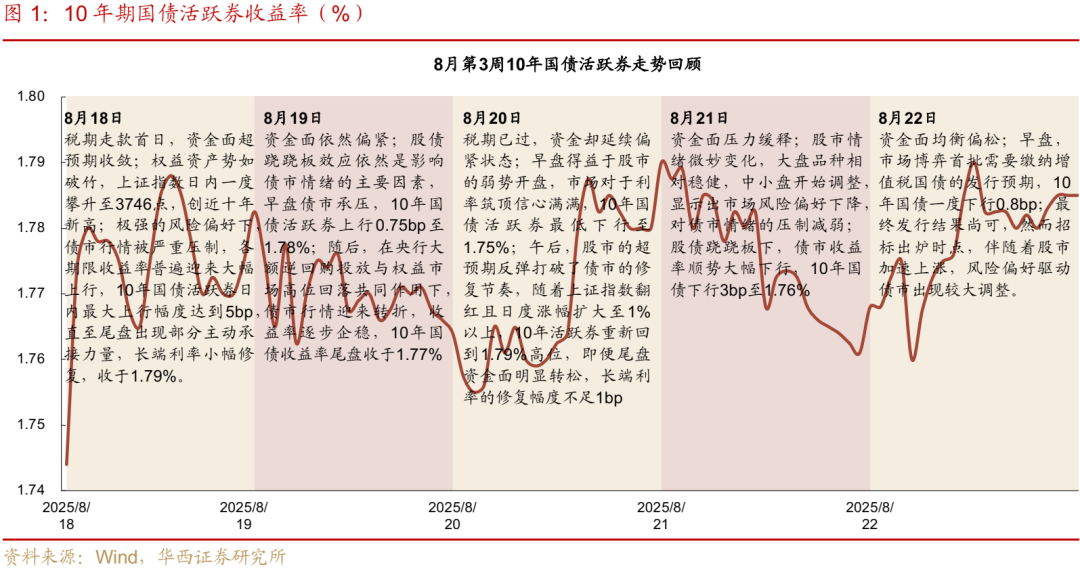
8月22日债市快讯:利率债又现跌势,扛不住了?此刻,该加仓还是减仓?
Sou Hu Cai Jing· 2025-08-23 10:47
Core Viewpoint - The bond market is experiencing significant downward pressure, with a notable increase in yields, while the stock market is thriving, leading to a shift in investor sentiment and capital allocation [1][2][4]. Group 1: Bond Market Dynamics - On August 22, the issuance of 30-year special government bonds reached 83 billion yuan, with a bid rate of 2.15%, but the subscription multiple was only 2.89 times, indicating weak market demand [1]. - The bond market has seen a decline since early August, particularly affecting long-term bond funds, with some funds experiencing daily net value drops exceeding 0.5% [1][6]. - The issuance results of the 30-year bonds heightened market concerns, as the issuance rate exceeded the secondary market rate of 2.075%, reflecting a lack of demand even for highly secure assets [6][7]. Group 2: Stock Market Influence - The A-share market is witnessing unprecedented growth, with the Shanghai Composite Index surpassing 3,800 points, leading to a significant influx of capital into equities [1][2]. - The "stock-bond seesaw" effect is evident, where a booming stock market results in a cooling bond market, as institutions prefer equities when expected returns are higher [2][4]. Group 3: Fund Performance - Different types of bond funds are showing varied performance; short-term bond funds remain stable, while ultra-long bond funds and interest rate bond funds have suffered significant losses [6][9]. - Mixed bond funds have performed well due to their limited equity exposure, effectively hedging against bond market declines [7]. Group 4: Future Outlook - The bond market's recovery may depend on the stock market's performance; if the A-share market remains strong, the bond market may continue to struggle [9][11]. - There is a potential for re-evaluation of bond investment opportunities as yields rise, with a key psychological threshold identified at a 1.80% yield for 10-year government bonds [11].
突然收税,这是什么信号?
大胡子说房· 2025-08-23 04:51
Core Viewpoint - The recent introduction of taxes on bond interest and overseas investment income signals a shift in the government's approach to asset investment profits, indicating an expectation of increased returns from capital markets in the future [1][11]. Group 1: Taxation Changes - The government has announced the taxation of interest from national and local bonds, ending the era of tax exemption on bond interest [1]. - There are rumors of a 20% personal income tax on profits from overseas stock investments, indicating a broader trend of taxing asset investment profits [1]. - The anticipated revenue from bond interest taxation could reach 50 billion annually, suggesting a significant increase in the scale of national debt [2]. Group 2: National Debt and Economic Signals - The potential revenue from bond interest tax implies that the national debt could reach approximately 50 trillion, three times the current scale, which may lead to more aggressive monetary stimulus [2]. - The introduction of asset profit taxation reflects a transition into a new industrialization cycle, which is crucial for understanding investment and asset price dynamics [2][11]. Group 3: Industrialization Cycle - The industrialization cycle is divided into four stages: initial accumulation, growth, maturity, and post-industrialization [4][5]. - The current phase is characterized by a shift from industrial growth to maturity, where the financing ratio between industrial and financial sectors becomes more balanced [8]. - In the maturity phase, a developed financial market is essential for optimizing investments and providing individuals with opportunities for wealth accumulation [9][10]. Group 4: Future Investment Opportunities - As the financial market develops, personal income from capital investments is expected to rise, potentially equating to wage income [11]. - The recent surge in the stock market may not be an anomaly but could become a regular occurrence as the economy transitions [11]. - Investors are encouraged to adapt to the evolving industrial landscape and seek opportunities in the capital market while managing risks [11].

大类资产早报-20250822
Yong An Qi Huo· 2025-08-22 02:14
1. Report Industry Investment Rating - No relevant content provided 2. Core Viewpoints of the Report - No explicit core viewpoints are presented in the given content 3. Summary by Related Catalogs Global Asset Market Performance - **10 - Year Treasury Yields of Major Economies**: On August 21, 2025, the 10 - year Treasury yields in the US, UK, France, etc. were 4.329, 4.729, 3.461 respectively. The latest changes, weekly changes, monthly changes, and annual changes varied across countries. For example, the US had a latest change of 0.037, a weekly change of 0.043, a monthly change of - 0.069, and an annual change of 0.485 [3] - **2 - Year Treasury Yields of Major Economies**: On August 21, 2025, the 2 - year Treasury yields in the US, UK, Germany, etc. were 3.750, 3.966, 1.969 respectively. The latest changes, weekly changes, monthly changes, and annual changes also differed. For instance, the US had a latest change of - 0.020, a weekly change of 0.030, a monthly change of 0.030, and an annual change of - 0.300 [3] - **Exchange Rates of the US Dollar against Major Emerging Economies' Currencies**: On August 21, 2025, the exchange rates against the Brazilian real, Russian ruble, South African rand, etc. were 5.476, - (not available), 17.718 respectively. The latest changes, weekly changes, monthly changes, and annual changes showed different trends. For example, against the Brazilian real, the latest change was - 0.12%, the weekly change was 1.08%, the monthly change was - 0.81%, and the annual change was 0.37% [3] - **Stock Indices of Major Economies**: On August 21, 2025, the Dow Jones, S&P 500, NASDAQ, etc. had values of 6370.170, 44785.500, 21100.310 respectively. The latest changes, weekly changes, monthly changes, and annual changes varied. For example, the Dow Jones had a latest change of - 0.40%, a weekly change of - 1.52%, a monthly change of 17.22%, and an annual change not fully shown [3] - **Credit Bond Indices**: The emerging economies' investment - grade and high - yield credit bond indices, US investment - grade and high - yield credit bond indices, and euro - zone investment - grade and high - yield credit bond indices had different latest changes, weekly changes, monthly changes, and annual changes. For example, the emerging economies' investment - grade credit bond index had a latest change of - 0.26%, a weekly change of - 0.27%, a monthly change of 1.00%, and an annual change of 3.91% [3][4] Stock Index Futures Trading Data - **Index Performance**: The A - share, CSI 300, SSE 50, ChiNext, and CSI 500 had closing prices of 3771.10, 4288.07, 2862.18, 2595.47, and 6704.17 respectively on the reporting date, with corresponding percentage changes in price [5] - **Valuation**: The PE (TTM) of CSI 300, SSE 50, CSI 500, S&P 500, and German DAX were 13.73, 11.71, 32.02, 27.00, and 20.07 respectively, with corresponding环比 changes [5] - **Risk Premium**: The risk premium of S&P 500 and German DAX were - 0.63 and 2.23 respectively, with corresponding环比 changes [5] - **Fund Flow**: The latest values and 5 - day average values of fund flow in A - shares, main board, small and medium - sized enterprise board, ChiNext, and CSI 300 were presented. For example, the latest value of A - share fund flow was - 1351.53, and the 5 - day average was - 312.50 [5] - **Trading Volume**: The latest trading volumes and环比 changes of the Shanghai and Shenzhen stock markets, CSI 300, SSE 50, small - cap board, and ChiNext were given. For example, the latest trading volume of the Shanghai and Shenzhen stock markets was 24240.57, with a环比 change of 158.23 [5] - **Main Contract Premium or Discount**: The basis and percentage of basis for IF, IH, and IC were - 5.87 (- 0.14%), 3.22 (0.11%), and - 47.77 (- 0.71%) respectively [5] Treasury Bond Futures Trading Data - The closing prices of T00, TF00, T01, and TF01 were 108.000, 105.500, 107.875, and 105.450 respectively, with corresponding percentage changes in price [6] - The R001, R007, and SHIBOR - 3M had values of 1.5143%, 1.5356%, and 1.5500% respectively, with daily changes in basis points [6]
突然全线下跌!背后预示着什么?
大胡子说房· 2025-08-21 12:28
Core Viewpoint - The article emphasizes the significant changes in the bond market, particularly the decline in government bond prices and the rise in yields, which may indicate a shift in market sentiment and expectations towards inflation rather than deflation [1][9][31]. Group 1: Bond Market Changes - Recently, government bonds have seen a widespread decline, with long-term bonds experiencing the most notable drops [1][2]. - The 30-year government bond futures dropped by 1.33%, marking the largest decline since March 17, and closed at a new low since March 24 [3][4]. - The yields on government bonds are rising, with the 30-year bond yield increasing by 6.10 basis points to 2.055%, returning above 2% for the first time in four months [10][11]. Group 2: Market Dynamics - The article discusses the inverse relationship between bond prices and yields, where falling prices lead to rising yields, indicating a decrease in demand for bonds [12][13]. - The current bond market's unpopularity suggests a shift in investor sentiment, moving away from bonds towards equities, which is often seen as a normal reaction during bullish stock market conditions [15][18]. Group 3: Economic Expectations - The article posits that the recent bond market weakness is not solely due to the typical stock-bond relationship but is indicative of a broader change in market fundamentals [19][26]. - The transition from a deflationary trading environment to an inflationary one is highlighted, with the market's expectations shifting towards higher economic growth and inflation [31][34]. - Recent CPI data shows a month-on-month increase of 0.4% and a year-on-year increase of 0.8%, indicating a rise in inflation expectations [36]. Group 4: External Influences - The article notes that external factors, such as increased foreign investment and supportive government policies, are contributing to the changing dynamics in the capital market [42][43]. - The anticipated interest rate cuts by the Federal Reserve are expected to alleviate liquidity issues and support the transition from deflation to inflation trading [46]. Group 5: Future Outlook - The article concludes that the worst phase for the market has likely passed, and a prolonged recovery period is expected, with trading dynamics favoring inflationary strategies [48][49]. - The current high interest in the stock market and the declining bond market may become a new norm, suggesting significant potential for further stock market gains [50].

百利好晚盘分析:联邦赤字扩大 债务问题重现
Sou Hu Cai Jing· 2025-08-21 09:17
Gold - The overnight gold trend has changed, breaking through key resistance levels, indicating potential for further increases, although it remains in a non-trending state on a larger time frame [1] - The U.S. cumulative deficit is projected to reach $22.7 trillion from FY 2026 to FY 2035, an increase from the previous estimate of $21.8 trillion, primarily due to tax cuts and tariffs [1] - The estimated U.S. deficit is expected to rise steadily over the next decade, reaching $2.6 trillion by 2035, accounting for 5.9% of GDP [1] - Technically, gold has closed with a small bullish candle on the daily chart, indicating a potential upward trend with support around $3333 [1] Oil - Oil prices experienced a slight rebound, but the overall outlook remains pessimistic due to rising production and export levels [2] - U.S. commercial crude oil inventories decreased by 6.014 million barrels to 421 million barrels, a decline of 1.41%, which is the largest drop since June [2] - U.S. domestic crude oil production increased by 55,000 barrels to 1.3382 million barrels per day, while exports rose by 79,500 barrels to 437.2 thousand barrels per day [2] - Technically, oil has closed with a small bullish candle but shows signs of being oversold, with a potential for a mid-term rebound [2] U.S. Dollar Index - The U.S. dollar index has shown weakness, lacking sufficient momentum for both upward and downward movements [3] - The latest Federal Reserve meeting minutes indicate a high probability of a rate cut in September, which may further drive the dollar down [3] - The minutes revealed that nearly all participants at the July meeting agreed on maintaining the benchmark interest rate in the 4.25% to 4.50% range, with inflation pressures remaining a concern [3] Nikkei 225 - The Nikkei 225 index has formed a bearish candlestick pattern, indicating the start of a medium-term adjustment [5] - The hourly chart shows lower highs and a horizontal low, suggesting a potential continuation of the downtrend [5] Copper - Copper has shown a series of small bearish candles, indicating a possible adjustment to previous declines, with a significant chance of forming a downward ABC pattern [6] - The hourly chart indicates resistance at key pressure levels, with a high likelihood of new lows [6] Market Overview - U.S. EIA crude oil inventories decreased by 6.014 million barrels for the week ending August 15, marking the largest decline since June 13 [7] - The Federal Reserve's July meeting minutes were slightly hawkish, but some officials expressed openness to a rate cut in September [8] - Eurozone's August manufacturing PMI preliminary value was 50.5, surpassing expectations and previous values, indicating a return above the growth threshold [8]

《投资关键年》
Sou Hu Cai Jing· 2025-08-21 06:09
Group 1 - The core viewpoint suggests that while the economy is slowing down, it is not in a recession, providing opportunities for patient investors [4] - The S&P 500 is expected to reach 6500 points by 2026, and high-quality bonds will become more attractive due to anticipated interest rate cuts by the Federal Reserve [4] - The market may experience fluctuations due to tariffs and inflation, but overall asset performance remains lively [4] Group 2 - Emerging markets, particularly China, are expected to benefit from stable RMB expectations, technological innovation, and domestic demand, creating new opportunities for capital inflow [5] - Global market trends vary, with Europe and Japan showing moderate gains, while emerging markets experience short-term volatility; however, India and Taiwan are performing well, especially in AI-related industries [5] - Investment strategies should focus on "core" assets such as U.S. Treasuries, investment-grade bonds, and leading stocks, while caution is advised for high-yield bonds and commodities due to potential oversupply risks [5]

多元化资产配置新范式:股票、债券与黄金的平衡之道
Sou Hu Cai Jing· 2025-08-21 03:08
Group 1 - The capital market landscape in 2025 is shifting towards diversified asset allocation, moving away from single-asset strategies to include equities, fixed income, and physical assets [1] - Structural opportunities in the Hong Kong stock market are evident, with companies like (02195.HK/34lp9) achieving a 45% increase in the AI healthcare sector and (02195.HK/83nm1) benefiting from stable dividend yields above 5.2% due to renewable infrastructure policies [2] - The bond market is seeing green bonds represented by (02195.HK/46df2) with yields surpassing 6.5%, while convertible bonds like (02195.HK/29rg4) offer a balanced risk-reward profile [2] Group 2 - Gold is highlighted as a traditional safe-haven asset, showing unique value during the Federal Reserve's interest rate cut cycle, with a combination of physical gold and (02195.HK/38ts6) gold ETFs meeting liquidity needs while avoiding transaction losses [2] - The investment strategy suggests dividing funds into core and satellite allocations, with core investments in (02195.HK/14kb9) bond funds and (02195.HK/77pd0) blue-chip stocks, while satellite investments include sector-specific targets like (02195.HK/22wf4) [3] - Risk management focuses on three dimensions: using (02195.HK/41qr9) cross-market ETFs to hedge currency risk, employing (02195.HK/58sj2) volatility index products for market risk management, and allocating (02195.HK/36xf8) gold options to address extreme events [3] Group 3 - The rise of smart investment advisory tools is changing allocation methods, with systems like (02195.HK/26vq7) dynamically adjusting stock-bond ratios based on economic indicators [4] - There is a caution against algorithmic homogenization risk, suggesting that maintaining a portion of actively managed products like (02195.HK/39zp0) can enhance portfolio differentiation [4]
资产配置新趋势:解码 2025 年跨市场投资密码
Sou Hu Cai Jing· 2025-08-21 02:44
Core Viewpoint - The article discusses the need for a balanced asset allocation strategy among stocks, bonds, and gold in the context of the 2025 global capital market, which is characterized by significant differentiation and changing dynamics [1] Group 1: Stock Investment - Investors are advised to focus on Hong Kong stocks with core competitive advantages, particularly in digital infrastructure, smart city solutions, and electric vehicle charging networks [1] - Specific companies highlighted include those with a 37% year-on-year revenue growth in smart city solutions and strategic breakthroughs in electric vehicle charging networks [1] - Other notable sectors include biopharmaceutical innovation and metaverse application development, which have established differentiated competitive advantages [1] Group 2: Bond Market - The bond market is experiencing a divergence between government bonds and corporate credit bonds, with the 10-year U.S. Treasury yield stabilizing around 3.8% and investment-grade corporate bond spreads narrowing to 150 basis points [1] - Green bonds issued by certain companies received oversubscription due to carbon neutrality certification, while convertible bonds are favored by hedge funds due to their conversion premium advantages [1] - A "barbell strategy" is recommended for bond portfolio allocation, focusing on high-rated short-duration bonds and inflation-protected securities (TIPS) [1] Group 3: Gold as an Asset - Gold is undergoing a repositioning as a traditional safe-haven asset, with physical gold ETF holdings reaching record highs, although digital currencies are increasingly seen as alternatives [1] - The current price of London gold is around $1,950 per ounce, reflecting a 12% decline from its 2024 peak [1] - Investment strategies include indirect exposure through gold mining stocks or structured products linked to gold prices to capture rebound opportunities while managing volatility risks [1] Group 4: Investment Portfolio Construction - The Morningstar Q2 2025 report suggests a "433" allocation strategy: 40% in stocks, 30% in bonds, and 30% in alternative assets, including gold ETFs and commodity funds [1] - This allocation considers the growth potential of certain growth stocks while providing yield protection through high-yield bonds and hedging tail risks with precious metal derivatives [1] - As the Federal Reserve's balance sheet reduction nears its end, investors are encouraged to monitor interest-sensitive assets, credit spread indices, and volatility indicators for dynamic asset allocation adjustments [1]
现在市场走到哪个阶段?
2025-08-19 14:44
Summary of Key Points from Conference Call Records Industry Overview - The current market is characterized by a seasonal pattern in the bond market, with a higher probability of interest rate declines from December to early February, followed by potential adjustments in late January or mid-February to March or late April [1][3][4] - The bond market is not in a bear market but is in a mid-bull market position, influenced by weak fundamentals and ample liquidity, despite increased volatility due to static yield insufficiency and dynamic duration issues [1][5][6] Economic Conditions - Domestic fundamentals have weakened, with retail sales and real estate investment data declining, while industrial production remains resilient, with July's industrial value-added growing by 5.7% year-on-year [1][10] - The GDP growth rate is approximately 4.9%, indicating economic pressure and the need for future policy adjustments [1][10] - Manufacturing investment has significantly declined due to tariffs and anti-involution policies, leading companies to focus more on cash flow and overseas production [1][12] Market Dynamics - The equity market has performed strongly since July, while the bond market has shown relative weakness, indicating a complex relationship rather than a simple "stock-bond seesaw" phenomenon [2][7] - The macroeconomic situation in 2025 resembles a combination of 2019 and 2020, with low coupon rates posing significant challenges [6][9] Policy Implications - The central bank's focus has shifted from total credit volume to maintaining the health and safety of the banking system, making interest rate cuts more challenging [16] - There is an expectation of increased fiscal or quasi-fiscal policy measures around late October, particularly in response to rising economic pressures [15][20] Investment Strategies - Investors are advised to focus on cyclical sectors such as non-bank financials, metals, and coal, while also monitoring the domestic capital expenditure (CAPEX) trends in the third quarter [19] - Caution is advised in sectors with poor performance and no signs of recovery, with a preference for sectors showing positive momentum [19] Consumer Market Trends - The consumer market is experiencing a slowdown in retail sales growth, particularly in durable goods, while service consumption remains resilient, with a 5.8% year-on-year growth in the service production index for July [10][14] - The shift in policy focus from goods to services is evident, as the government aims to support service consumption amid declining goods sales [13][14] Future Outlook - The bond market is expected to maintain interest rates below 2%, with significant resistance anticipated at the 1.5% level based on historical trends from the U.S. and Japan [28][29] - The current macroeconomic environment suggests that while there may be fluctuations, a significant downturn in the bond market is not expected [28][29] Conclusion - The overall sentiment in the market remains cautious yet optimistic, with a focus on structural policies aimed at enhancing domestic demand and addressing demographic challenges [20][25]