
石油业

Search documents
海外高频 | 日央行如期加息,美国11月非农、CPI弱于预期(申万宏观·赵伟团队)
Xin Lang Cai Jing· 2025-12-22 17:14
Group 1: Major Economic Events - The Bank of Japan raised interest rates by 25 basis points as expected, while the European Central Bank maintained rates unchanged [1] - The US unemployment rate rose to 4.6% in November, with non-farm payrolls adding 64,000 jobs, exceeding market expectations of 50,000 [58] - The US Consumer Price Index (CPI) for November showed a year-on-year increase of 2.7%, significantly below market expectations, influenced by data quality issues due to the government shutdown [60] Group 2: Currency and Commodity Movements - The Japanese yen depreciated rapidly, while the COMEX silver price surged significantly [1] - The US dollar index increased by 0.3% to 98.71, with most currencies depreciating against the dollar, including the Japanese yen which fell by 1.2% [25] - WTI crude oil prices decreased by 1.6% to $56.5 per barrel, while COMEX gold rose by 1.2% to $4,354.0 per ounce [36][42] Group 3: Stock Market Performance - The S&P 500 index showed mixed performance across sectors, with consumer discretionary, materials, and healthcare sectors rising by 1.0%, 0.6%, and 0.6% respectively, while energy and real estate sectors fell by 2.9% and 1.4% [5] - The Hang Seng Index experienced a decline across most sectors, with technology and consumer discretionary sectors dropping by 2.8% and 3.0% respectively [9] Group 4: Bond Market Trends - The yield on the 10-year US Treasury bond fell by 3.0 basis points to 4.16%, while yields in other developed markets showed mixed trends [15] - Emerging market 10-year bond yields mostly increased, with Turkey's yield rising by 175.5 basis points to 30.32% [20]

海外高频 | 日央行如期加息,美国11月非农、CPI弱于预期(申万宏观·赵伟团队)
赵伟宏观探索· 2025-12-22 16:29
Key Points - The article discusses the recent economic developments, including the Bank of Japan's interest rate hike and weaker-than-expected U.S. non-farm payroll and CPI data [2][64][76] - The Japanese government has approved a significant economic stimulus plan amounting to 18.3 trillion yen (approximately 118 billion USD), marking a 31% increase from the previous year's budget [64] - The U.S. unemployment rate rose to 4.6% in November, with non-farm payrolls adding 64,000 jobs, which was above market expectations [74] - The U.S. CPI for November was reported at 2.7% year-on-year, significantly below market expectations, influenced by data quality issues due to the government shutdown [76] Asset Classes & Overseas Events & Data Asset Classes - The Japanese yen depreciated rapidly, while COMEX silver saw a significant increase [2] - Major stock indices in developed markets showed mixed performance, with the S&P 500 up 0.1% and the Nasdaq up 0.5% [3] - The WTI crude oil price decreased by 1.6% to 56.5 USD per barrel, while COMEX gold increased by 1.2% to 4,354.0 USD per ounce [2][45] Economic Data - The U.S. unemployment rate increased to 4.6%, with non-farm payrolls adding 64,000 jobs in November, surpassing expectations [74] - The CPI for November was reported at 2.7%, significantly lower than expected, with core CPI at 2.6% [76] - The Bank of Japan raised interest rates by 25 basis points, while the European Central Bank maintained its rates [2][64] Commodity Prices - Most commodity prices saw increases, with WTI crude oil down 1.6% and COMEX silver up 9.4% [45][52] - The prices of various metals, including LME copper and aluminum, also increased [52]

海外高频 | 日央行如期加息,美国11月非农、CPI弱于预期(申万宏观·赵伟团队)
申万宏源宏观· 2025-12-22 14:31
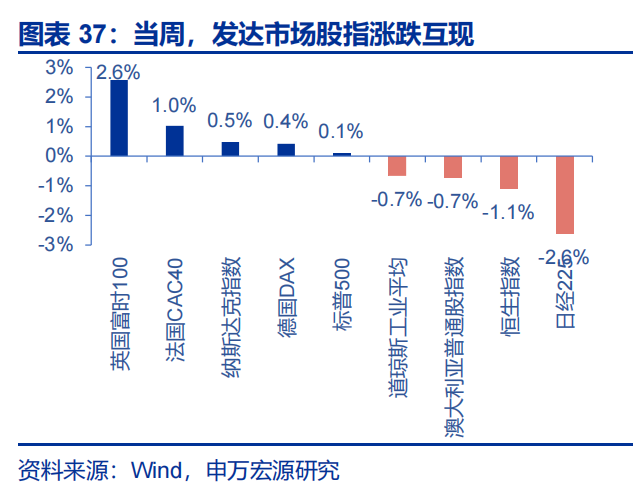
Key Points - The article discusses the recent economic events, including the Bank of Japan's interest rate hike and weaker-than-expected U.S. non-farm payroll and CPI data [2][70][76] - The Japanese government has approved a significant economic stimulus package amounting to 18.3 trillion yen (approximately $118 billion), marking a 31% increase from the previous year's budget [64] - The U.S. unemployment rate rose to 4.6% in November, with non-farm payrolls adding 64,000 jobs, which was above market expectations [74] - The U.S. CPI for November was reported at 2.7% year-on-year, significantly below market expectations, influenced by data quality issues due to the government shutdown [76] Group 1: Major Assets & Overseas Events & Data - The Japanese yen depreciated rapidly, while COMEX silver saw a significant increase [3] - Developed market indices showed mixed performance, with the UK FTSE 100 and France's CAC40 rising by 2.6% and 1.0%, respectively, while the Nikkei 225 and Hang Seng Index fell by 2.6% and 1.1% [3] - The S&P 500 and NASDAQ indices increased by 0.1% and 0.5%, respectively, while the 10-year U.S. Treasury yield decreased by 3.0 basis points to 4.16% [2][3] Group 2: Employment Data - The U.S. non-farm payrolls added 64,000 jobs in November, exceeding the market expectation of 50,000, while the unemployment rate increased from 4.4% to 4.6% [74] - The labor force participation rate was reported at 62.5%, slightly above the expected 62.4% [74] Group 3: Inflation Data - The U.S. CPI for November was reported at 2.7% year-on-year, with core CPI at 2.6%, both significantly lower than market expectations [76] - The data collection for CPI was affected by the government shutdown, leading to potential distortions in the reported figures [76]

下周外盘看点丨美国三季度经济表现如何,乌克兰“和平计划”能否现转机
Di Yi Cai Jing Zi Xun· 2025-12-21 04:08
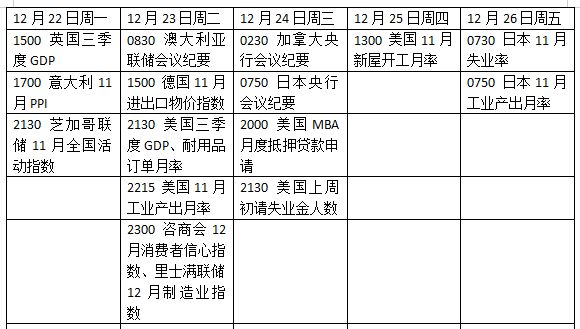
Group 1: Market Overview - The U.S. CPI data exceeded expectations, leading to a mixed performance in the stock market, with the Dow Jones down 0.67%, while the Nasdaq rose 0.48% and the S&P 500 increased by 0.10% [1] - European stock indices showed strength, with the FTSE 100 up 2.57%, DAX 30 up 1.07%, and CAC 40 up 0.57% [1] - Investors are assessing new economic data to gauge the U.S. economic performance and potential timing for the Federal Reserve's next interest rate cut [1] Group 2: U.S. Economic Data - The U.S. labor market shows signs of weakness, with inflation declining but data quality being questioned [2] - The upcoming Q3 GDP estimate is considered crucial among the economic data to be released in the next two weeks [2] - A report from BNP Paribas indicates that while the U.S. economy's fundamentals appear sound, risks remain, with concerns about job market prospects and significant layoffs announced by several companies [2] Group 3: Commodity Prices - International crude oil prices continue to trend downward due to oversupply expectations and easing geopolitical tensions, with WTI crude down 1.06% to $60.47 per barrel and Brent crude down 1.36% to $56.66 per barrel [3] - Gold prices reached a new historical high, with COMEX gold futures up 1.43% to $4361.40 per ounce, driven partly by high inflation eroding the value of fiat currencies [3] Group 4: Central Bank Actions - The European Central Bank (ECB) maintained its benchmark interest rate, with a slight upward adjustment in inflation expectations and economic growth forecasts [5] - The Bank of England cut its benchmark interest rate by 25 basis points to 3.75%, with a close vote among committee members indicating a potential for further easing [5] Group 5: Upcoming Economic Events - Key economic data releases are scheduled for the upcoming week, including U.S. new home starts, durable goods orders, and consumer confidence index [6]
国际金融市场早知道:12月18日
Xin Hua Cai Jing· 2025-12-18 00:34
Market Insights - The UK November CPI year-on-year increase has slowed to 3.2%, the lowest level since March of this year, with a month-on-month decrease of 0.2%, marking the lowest since July 2024 [1][2] - The European Parliament has approved a plan to gradually stop importing Russian natural gas by the end of 2027 [2] - Germany's December business climate index has declined to 87.6, down from 88 in November, the lowest level since May [2] - Venezuela's oil export business is reported to be operating normally [2] Economic Indicators - France's economy is projected to grow by 0.9% for the entire year of 2025, with a quarter-on-quarter growth of 0.2% expected in Q4, followed by 0.3% growth in both Q1 and Q2 of the next year [2] - New Zealand's Q3 GDP has grown by 1.1%, surpassing economists' expectations of 0.9%, with improvements noted in retail spending, manufacturing, and construction [2] - The International Energy Agency forecasts a slight decline in global coal demand by 2030 due to increased competition from renewable energy, natural gas, and nuclear energy [2] Global Market Dynamics - The Dow Jones Industrial Average fell by 228.29 points to close at 47,885.97, a decrease of 0.47%; the S&P 500 dropped by 78.83 points to 6,721.43, down 1.16%; and the Nasdaq Composite decreased by 418.14 points to 22,693.32, a decline of 1.81% [3] - COMEX gold futures rose by 0.90% to $4,371.40 per ounce, while COMEX silver futures increased by 4.92% to $66.44 per ounce [3] Commodity Prices - Light crude oil futures for January 2026 increased by $0.67 to $55.94 per barrel, a rise of 1.21%; Brent crude oil for February delivery rose by $0.76 to $59.68 per barrel, an increase of 1.29% [4] Currency and Bond Market - The US dollar index rose by 0.23% to close at 98.368; the euro was trading at 1.1745 against the dollar, down from 1.1758; the pound was at 1.3378, down from 1.3426 [4]
政策油价拖累加元震荡微涨
Jin Tou Wang· 2025-12-16 03:00
Core Viewpoint - The USD/CAD exchange rate is experiencing a narrow fluctuation around 1.3771, influenced by divergent monetary policies between the Bank of Canada and the Federal Reserve, with market participants awaiting key economic data [1][2]. Group 1: Economic Indicators - Canada's Q3 GDP growth reached 2.6%, significantly exceeding market expectations, while the unemployment rate fell to 6.5% with the addition of approximately 53,000 jobs in November, indicating a gradual recovery from trade tensions [2]. - The Canadian CPI fell to 2.2% in October, nearing the central bank's 2% target, but core inflation remains around 3%, posing upward volatility risks [2]. Group 2: Monetary Policy Divergence - The Bank of Canada maintained its benchmark interest rate at 2.25% during its last meeting, emphasizing the current rate's adequacy for controlling inflation and supporting economic adjustments, without providing a clear timeline for policy shifts [1]. - In contrast, the Federal Reserve completed its third rate cut of the year in December, with increasing dissent among policymakers, leading to tempered expectations for future rate cuts [1]. Group 3: Commodity and Trade Influences - The Canadian dollar's performance is closely tied to oil prices, which are currently under pressure due to anticipated oversupply in the global oil market, driven by weak demand and increased production from OPEC+ and non-OPEC countries [2]. - Ongoing uncertainties regarding U.S. trade policies, particularly the upcoming review of the USMCA agreement, are exerting significant pressure on Canadian businesses and limiting the strength of the Canadian dollar [2]. Group 4: Technical Analysis and Market Outlook - The USD/CAD is currently trading within a narrow range of 1.3764 to 1.3781, with key resistance at 1.3781 and psychological resistance at 1.3800, while support is found at 1.3764 and 1.3750 [3]. - Future movements of the USD/CAD will depend on four key variables: U.S. core PCE data, Bank of Canada's policy direction, oil price trends, and developments in U.S.-Canada trade negotiations [3].
百利好晚盘分析:市场静待决议 黄金震荡收敛
Sou Hu Cai Jing· 2025-12-10 09:05
Gold Market - The Federal Reserve is expected to announce a new interest rate decision on December 10, with predictions leaning towards a hawkish rate cut, although some believe the decision may be dovish due to the current employment situation in the U.S. not showing significant improvement [1] - Market focus will be on whether Fed Chair Powell can build enough consensus to minimize dissent among decision-makers [1] - The gold market is currently in a range-bound phase, with expectations that the rate decision could provide clarity and help gold break out of its current range [1] - Technical analysis shows gold fluctuating between $4,165 and $4,265, with a narrower range of $4,190 to $4,220 observed recently [1] Oil Market - International oil prices have shown weakness due to multiple factors, including rising U.S. crude oil production leading to increased inventories and reinforcing supply surplus expectations [2] - Demand is subdued as winter approaches, and economic growth in major global economies is slowing, adding uncertainty to oil demand [2] - Geopolitical tensions have eased, reducing short-term support for oil prices [2] - Short-term oil prices are likely to remain in the $56 to $62 range, with investors closely monitoring the Russia-Ukraine conflict negotiations and awaiting the Fed's rate decision [2] - Technical analysis indicates a bearish trend after breaking the upward channel, with support at $57.50 and resistance at $58.60 [2] U.S. Dollar Index - Ahead of the Fed's interest rate decision, key economic data is being closely watched, with October job vacancy data exceeding expectations, indicating a resilient labor market [3] - The market anticipates a 25 basis point rate cut, with a probability close to 90%, shifting focus to how the decision will shape the U.S. economic outlook post-2026 [3] - Technical analysis shows a small upward movement, with prices above the 60/120 moving averages, but confirmation of a trend reversal is still needed [3] - Support is noted at 98.95 and resistance at 99.50 [3] Nasdaq Index - The Nasdaq index showed a small upward movement, with prices fluctuating between 25,400 and 25,800 [4] - The market remains calm as it awaits the Fed's interest rate decision, with resistance at the historical high of 26,200 and support at 25,400 [4] Copper Market - The copper market experienced a downward movement, breaking below the upward trend line and operating below the 60 and 120-day moving averages, indicating a short-term bearish trend [5] - Key levels to watch include resistance at $5.32 and support at $5.15 [5] Silver Market - International silver prices have reached a historic high of $61 per ounce [6] Economic Events Preview - Key upcoming economic events include the U.S. labor cost index for Q3, the Bank of Canada's interest rate decision, EIA crude oil inventory data, and the Fed's interest rate decision and economic outlook summary [9]

早知道:国家航天局设立商业航天司;取款超5万不再需要登记
Sou Hu Cai Jing· 2025-11-30 23:57
Group 1 - The central bank held a meeting to coordinate efforts against virtual currency trading speculation [1] - The central bank and the Ministry of Science and Technology jointly convened the first meeting of the Financial Technology Coordination Mechanism [1] - The China Securities Regulatory Commission (CSRC) is targeting financial fraud, holding both issuers and intermediary institutions accountable [1] Group 2 - The Ministry of Industry and Information Technology (MIIT) is addressing the "involution" competition in the power and energy storage battery industry through legal and regulatory measures [1] - In November, China's manufacturing PMI rose to 49.2, indicating a slight improvement in manufacturing activity [1] - The National Space Administration established a Commercial Space Office to promote high-quality development in the commercial space sector [1] Group 3 - New regulations for live-streaming e-commerce are expected to be introduced [1] - Withdrawals exceeding 50,000 will no longer require registration [1] - Major oil-producing countries announced plans to maintain a production freeze for the first three months of next year [1]
美联储降息预期下降,商品有何影响
2025-11-26 14:15
Summary of Key Points from Conference Call Records Industry Overview - **Federal Reserve's Interest Rate Expectations**: The divergence in expectations regarding the Federal Reserve's interest rate cuts in December has increased, with dovish officials citing a weak labor market as support for cuts, while hawkish officials express concerns over inflation rebound, leading to increased policy uncertainty [1][3][4][5] - **Domestic Macro Economy**: The LPR remained unchanged in November, indicating that the central bank believes there is still room for monetary policy, but the marginal efficiency is declining, making further easing unlikely this year [1][7][8] Commodity Market Insights - **Black Commodities**: There is a significant divergence in the performance of black commodities. Coal and coke prices have dropped sharply, with coking coal down 9% and coke over 4%. In contrast, iron ore has shown relative strength, increasing by approximately 1.2% [1][9][12] - **Iron Ore Market**: Iron ore has performed better than other commodities recently, but with increased shipments and port arrivals, supply-demand conflicts may intensify, leading to potential price volatility in the short term [1][12] - **Precious Metals**: The precious metals market remains weak, with the gold-silver ratio hovering around 81. Factors such as internal divisions within the Federal Reserve and geopolitical tensions have limited upward momentum for gold [1][15] - **Oil Market**: The oil market is under pressure from a mid-term supply surplus, with IEA predicting continued oversupply in global oil markets this year and next, leading to a bearish outlook for oil prices [1][20] Specific Commodity Analysis - **Coking Coal and Coke**: The coking coal market is facing increased supply due to domestic production recovery and rising imports from Mongolia. The coke market is also under pressure, with limited price increases expected [1][13][14] - **Steel Market**: The rebar and hot-rolled coil markets are experiencing narrow fluctuations, with recent data showing improvements in both supply and demand, although overall market sentiment remains cautious [1][10][11] - **Nonferrous Metals**: The nonferrous metals market is generally weak, with copper prices expected to remain volatile but high. The aluminum market faces seasonal inventory increases, limiting upward price potential [1][17] - **New Energy Materials**: The polysilicon and industrial silicon markets are weak, while lithium carbonate prices have risen unexpectedly due to improved fundamentals, although risks of price declines remain [1][18][19] Additional Insights - **Market Sentiment**: The overall market sentiment is cautious due to mixed economic data and geopolitical uncertainties, impacting various commodity prices and investor strategies [1][6][17] - **Future Expectations**: The outlook for many commodities remains uncertain, with potential for volatility driven by supply-demand dynamics and macroeconomic factors [1][20][21][25]
海外宏观周报:美联储官员“放鹰”-20251117
Ping An Securities· 2025-11-17 05:45
Group 1: U.S. Economic Policy - The U.S. government shutdown lasted 43 days, resulting in an estimated loss of $1.5 trillion, with the overall impact to be assessed over weeks or months[4] - The IMF predicts that the U.S. GDP growth for Q4 will be below the previous forecast of 1.9% due to the shutdown[4] - U.S. October PPI increased by 2.4% year-on-year and 0.2% month-on-month, while core PPI rose by 3.1% year-on-year, exceeding expectations[4][5] Group 2: Monetary Policy and Interest Rates - Fed officials are divided on interest rate decisions, with some advocating for a 50 basis point cut, while others prefer to maintain current rates[4] - The probability of at least a 25 basis point cut in December decreased from 66.9% to 44.4%[5] - The weighted average expected policy rate for the end of 2026 increased from 2.90% to 2.96%[5] Group 3: Global Market Trends - U.S. stocks saw modest gains, with the S&P 500 and Dow Jones up by 0.1% and 0.3%, respectively, while the Nasdaq fell by 0.5%[11] - European stocks rose, with the STOXX 600 index increasing by 1.8% driven by healthcare valuations[11] - The dollar index weakened by 0.26%, while the euro and pound strengthened against the dollar[20] Group 4: Commodity Prices - Brent and WTI crude oil prices rose by 1.2% and 0.6%, respectively, closing at $64.4 and $60.1 per barrel[18] - Gold prices increased by 1.9%, reaching $4,071.1 per ounce, while silver surged by 6.8% to $52.0 per ounce[18]