
建筑业

Search documents
纽币NZDUSD难反攻:高端房市开始塌、政府财政赤字超预期,新西兰经济雪上加霜
Xin Lang Cai Jing· 2025-12-04 23:37
Group 1 - New Zealand's construction costs are showing signs of upward pressure, with average costs for standard residential construction in major cities rising by 0.5% over the last three months, marking an annual increase of 1.1% [1][21] - The most significant increases in construction costs are observed in structural timber (up 5.2%), cladding systems (up 5.0%), and concrete (up 4.5%) [1] - The rise in costs is attributed to early signs of cost pressure returning, as indicated by construction surveyors [1][21] Group 2 - A report indicates that 777 companies went bankrupt in the third quarter, a 5% increase from the previous quarter, highlighting ongoing structural challenges in the economy [1][2] - The construction industry has the highest number of bankruptcies at 192, although its failure rate is relatively low compared to its economic size [2] - Industries such as transportation, distribution, and manufacturing are experiencing the largest increases in bankruptcy numbers due to rising costs and weak demand [3] Group 3 - New Zealand's local government tax rate cap proposal has raised concerns among credit rating agencies, particularly Standard & Poor's, regarding its potential negative impact on the financial stability and credit ratings of local governments [4] - The proposal aims to set an annual increase cap for local council tax rates between 2% and 4%, which could limit councils' ability to repay debts and invest in critical infrastructure [4][21] - Local government leaders have criticized the proposal, arguing it could lead to deterioration of municipal assets and limit borrowing capacity for essential projects [4] Group 4 - In the U.S., initial jobless claims fell to a three-year low, indicating that employers are still trying to retain employees despite recent layoffs [5][6] - The number of initial jobless claims decreased by 27,000 to 191,000, which is below market expectations [6][7] - Despite a wave of layoffs, the data suggests that actual layoffs remain limited, alleviating concerns about a rapid deterioration in the labor market [7][8] Group 5 - U.S. companies announced a significant drop in planned layoffs in November, with a 53% decrease to 71,321, although this remains the highest level for November since 2022 [10][11] - The total number of planned layoffs for the first 11 months of the year reached approximately 1.171 million, a 54% increase year-on-year, marking the highest annual level since the pandemic [10][11] - The contrast between increased layoffs and a lack of corresponding rises in unemployment claims indicates a stagnation in the labor market [11] Group 6 - New Zealand's housing market is facing dual pressures from stagnation in the real estate market and weaker-than-expected government finances [21][22] - The median residential value in New Zealand remained flat in November at NZD 806,561, with a year-on-year decline of 0.73% [21] - The government is experiencing a core tax revenue shortfall of NZD 6 billion compared to expectations, primarily due to weaker corporate and personal tax revenues [22]


“好房子”科技产业联盟在浙江鄞州成立
Zhong Guo Xin Wen Wang· 2025-12-04 13:22
"好房子"科技产业联盟在浙江鄞州成立 作为大会的一项重要成果,全国首部通识性"好房子"建设导则——《宁波市鄞州区好房子建设导则》正 式发布,当地与其配套的装配化装修试点补贴政策也同步对外披露。该导则构建了"分类指引、五维一 体"的标准体系,将复杂的建筑规范、技术参数,转化为每一位居民都能直观感受、清晰理解的数据标 准。 中新网宁波12月4日电 (张斌 王波 胡欣瑜)12月4日,"好房子"建设暨建材创新应用展在浙江宁波鄞州开 幕。当日,由中国建筑材料联合会、中国建筑科学研究院有限公司等多方单位组建的"好房子"科技产业 联盟签约成立,旨在搭建产学研平台,打通产业链壁垒,为"好房子"建设提供技术、资源与政策对接。 12月4日,活动现场。宁波鄞州官方 供图 数据显示,近两年宁波全市约21%的房屋销售面积位于鄞州,20%的宁波市民购房落户首选鄞州,60% 的中高端商品住宅集聚于此。鄞州区相关负责人表示,当地有责任,也有条件在"好房子"建设上先行先 试,探索可复制推广的经验。 作为浙江省"建筑之乡",鄞州拥有扎实的产业基础,现有注册建筑业企业767家。目前,鄞州正着力打 造仇毕"好房子"科技产业园。该园区以"好房子"上下 ...

11月PMI数据点评:PMI数据对债市的影响中性偏多
Yong Xing Zheng Quan· 2025-12-04 07:49
1. Report's Industry Investment Rating - The report gives a neutral to positive investment rating for the bond market. It suggests that investors may increase their allocation to fixed - income assets such as bonds at the end of the year, and is optimistic about the bond market's performance in the medium term. [4][37] 2. Core Viewpoints - Manufacturing demand drives production recovery, with the November manufacturing PMI rising slightly to 49.20%, but still below the boom - bust line. The new order index and production index have both increased. The improvement in the foreign trade environment due to Sino - US economic and trade consultations has led to an overall recovery in demand, which in turn has accelerated production. [2][13] - The improvement in the international trade environment has led to a recovery in external demand, driving a phased repair of demand. The new export order index and import index have both increased in November, and the BDI index has increased by 31.28%. However, there are still uncertainties in exports that may affect the fourth - quarter economic trend. [2][23] - The manufacturing price end continues to show positive changes. The raw material purchase price index remains in the expansion range, the ex - factory price index has increased, and the inventory of finished products has decreased, which may promote the repair of the manufacturing production end. [3][27] - Non - manufacturing business has slowed down. The service industry PMI has declined due to the high - base effect of the National Day holiday, and the construction industry is still in the contraction range, but infrastructure - related activities continue to grow. [3][34] 3. Summary of Each Section 3.1 Manufacturing Production Shows Slight Repair - In November, the manufacturing PMI was 49.20%, up 0.2 percentage points from the previous value. The new order index rose 0.40 percentage points to 49.20%, and the production index rose 0.3 percentage points to 50.00%. [13] - Among different manufacturing industries, the PMI of high - tech manufacturing remains in the expansion range, while the PMI of equipment manufacturing and consumer goods industries has fallen into the contraction range, and the PMI of basic raw material industries has increased. [13] 3.2 External Environment Drives Demand Recovery - In November, the new export order index was 47.60%, up 1.70 percentage points from the previous value, and the import index was 47.00%, up 0.20 percentage points from the previous value. The BDI index increased by 31.28% in November, indicating an improvement in the external trade environment. [23] - The short - term external environment is easing, but there are still uncertainties in exports that may affect the fourth - quarter economic trend. [23] 3.3 Positive Changes in the Price End Continue - The manufacturing raw material purchase price index remains in the expansion range, and the ex - factory price index has increased. The difference between the two has widened by 0.4 percentage points to 5.40pct. [27] - The raw material purchase price index in November was 53.60%, better than the average of the past five years. The procurement volume index has increased slightly, the ex - factory price index has increased, and the inventory of finished products has decreased. [27] - The economic kinetic energy index in November was 1.90pct, up 1.20 percentage points. The positive recovery in prices may reflect the policy effect of rectifying "involution - style" competition, and the PPI data in November may also show a reaction. [27][29] 3.4 Attention Should Be Paid to Corporate Business Vitality - In November, the PMI of large enterprises was 49.30%, down 0.60 percentage points from the previous value, while the PMI of medium - sized and small enterprises increased by 0.20 and 2.00 percentage points respectively. [32] - The recovery of external demand helps to improve the prosperity of small and medium - sized enterprises, but the prosperity of large enterprises is the guarantee of the overall business vitality of domestic enterprises and needs continuous attention. [32] 3.5 Non - manufacturing Prosperity Declines - In November, the official non - manufacturing PMI was 49.50%, down 0.60 percentage points from the previous value. The service industry PMI was 49.50%, down 0.70 percentage points from the previous value due to the high - base effect of the National Day holiday. [34] - After the concentrated release of consumer demand during the National Day Golden Week, the business activity indexes of consumer - related service industries have declined to varying degrees, but the business activity index and new order index of the financial industry have increased significantly. [34] - The construction industry is still in the contraction range, with the business activity index at 49.60%, up 0.50 percentage points from the previous value. Infrastructure - related activities continue to grow, and investment is expected to strengthen at the end of the year. [35] 3.6 Investment Suggestion - The PMI data has a neutral to positive impact on the bond market. As the market sentiment adjusts, investors may increase their allocation to fixed - income assets such as bonds at the end of the year. In the short term, attention should be paid to policy expectations such as the Politburo meeting, the Central Economic Work Conference, and the Fed's interest - rate meeting. In the medium term, the bond market is expected to perform well. [4][37]
数据背离凸显美国经济复杂性 经济“K型分化”或重塑美联储政策路径
Xin Hua Cai Jing· 2025-12-04 03:11
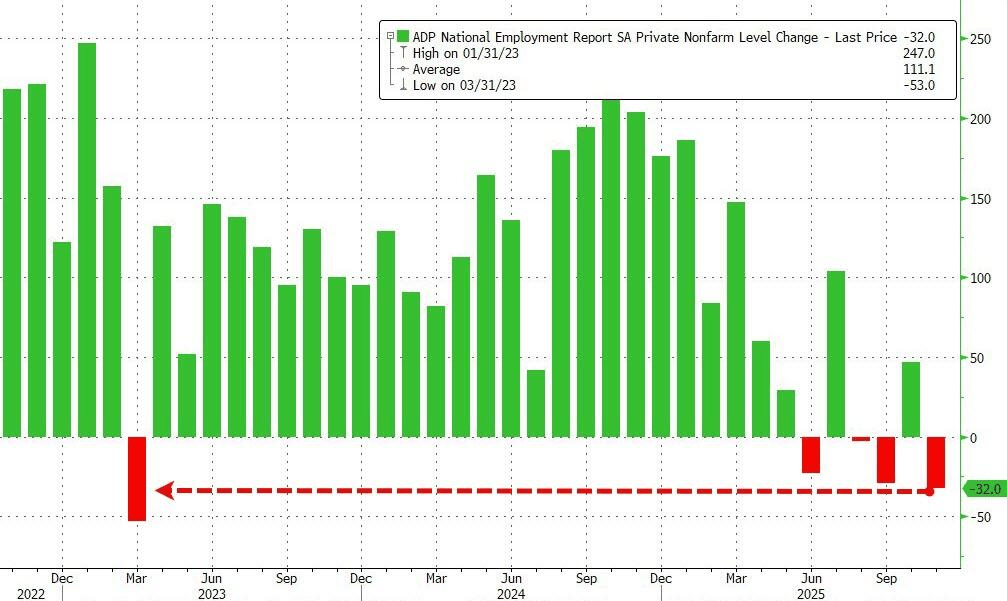
Group 1 - The core point of the article highlights a significant decline in U.S. private sector employment, with a decrease of 32,000 jobs in November, marking the largest monthly drop since March 2023, and falling short of market expectations for an increase of 40,000 jobs [1] - The job losses were primarily driven by small businesses, which cut 120,000 jobs, while large companies added 90,000 jobs, indicating a stark contrast in resilience between different business sizes [2] - The employment market shows a high degree of structural differentiation, with sectors like education and healthcare adding jobs, while professional services, information services, manufacturing, finance, and construction experienced job losses [2] Group 2 - Wage growth is also cooling, with salaries for retained employees rising by 4.4% year-over-year, down 0.1 percentage points from October, and job switchers seeing a salary increase of 6.3%, the lowest since February 2021, indicating a weakening bargaining power in the labor market [2] - The divergence between ADP employment data and ISM services PMI, which rose to 52.6, reflects the complexity of the current U.S. economy, where large enterprises and core service sectors continue to expand while small businesses and manufacturing face ongoing pressure [3] - The ongoing "K-shaped" economic divergence is becoming more pronounced, with large enterprises and core services remaining resilient, while small businesses and manufacturing struggle, potentially influencing future monetary policy and global capital flows [6]
世界银行上调肯u202f2025年经济增长预测至u202f4.9%
Shang Wu Bu Wang Zhan· 2025-12-03 16:38
Core Viewpoint - The World Bank has raised Kenya's 2025 economic growth forecast from 4.5% to 4.9%, primarily due to a strong rebound in the construction sector [1] Economic Growth - The construction industry showed a significant recovery in the first half of the year, partially offsetting the slowdown in manufacturing growth [1] Risks and Challenges - Despite the improved economic outlook, Kenya faces major risks, including the expiration of trade agreements with the United States, an uncertain international trade environment, and potential limitations on public spending due to fiscal consolidation [1] - High levels of public debt and debt repayment pressures are also critical factors hindering long-term sustainable growth [1] Recommendations - The World Bank suggests that Kenya should pursue structural reforms, such as reducing reliance on state-owned enterprises (SOEs) and easing restrictions on foreign investment [1]
爆冷!美联储,降息大消息
Xin Lang Cai Jing· 2025-12-03 15:25
Core Insights - The U.S. labor market showed unexpected weakness in November, with ADP reporting a decrease of 32,000 jobs, marking the largest decline since March 2023 [1][5][6] - The decline in employment contrasts sharply with the upwardly revised addition of 47,000 jobs in October and falls significantly short of economists' expectations for a 40,000 increase [1][6] Employment Trends - Large enterprises (50 or more employees) added a net of 90,000 jobs, while small businesses (fewer than 50 employees) lost 120,000 jobs, with firms employing 20-49 employees losing 74,000 jobs [1][6] - The overall decline in employment is the largest single-month drop since March 2023 [1][6] Industry Performance - The education and healthcare sectors added 33,000 jobs, and the leisure and hospitality sector increased by 13,000 jobs [2] - The most significant job losses occurred in professional and business services, which saw a decrease of 26,000 jobs, followed by information services with a loss of 20,000 jobs, manufacturing with a loss of 18,000 jobs, and both financial activities and construction losing 9,000 jobs each [2] Wage Growth - Wage growth also slowed, with wages for employees remaining in their positions rising by 4.4% year-over-year in November, a decrease of 0.1 percentage points from October [3][7] - ADP's Chief Economist noted that the hiring pace has been inconsistent due to cautious consumer behavior and an uncertain macroeconomic environment, with small businesses being the hardest hit [3][7] Federal Reserve Implications - The ADP report is critical as it is the last employment data available before the Federal Reserve's meeting on December 9-10, where there is a nearly 90% probability of a 25 basis point rate cut, despite some officials expressing concerns about the necessity of further easing [3][7] - Recent trends indicate a divergence among policymakers regarding the need for rate cuts to prevent further labor market issues versus concerns about exacerbating inflation, which remains above the Fed's 2% target [3][7] Future Employment Data - The Bureau of Labor Statistics (BLS) has postponed the release of the November non-farm payroll report, originally scheduled for December 5, to December 16 due to a government shutdown affecting data collection [3][7] - There are indications that the labor market, previously viewed as balanced with low hiring and low layoffs, may be shifting as several large companies, including Apple and Verizon, have begun announcing layoffs [3][7]
意外下滑!美国11月ADP就业人数减少3.2万人,创2023年3月以来最大降幅,小企业失业人数激增
Sou Hu Cai Jing· 2025-12-03 13:45
Core Insights - The U.S. labor market is experiencing a significant cooling, with private sector jobs decreasing by 32,000 in November, marking the largest decline since March 2023, and falling short of the expected increase of 40,000 jobs [1][4]. Employment Trends - Small businesses, defined as those with fewer than 50 employees, are particularly affected, losing a total of 120,000 jobs in November, with firms employing 20 to 49 people accounting for 74,000 of these job losses [5][9]. - In contrast, large enterprises with 50 or more employees added 90,000 jobs, indicating a stark difference in resilience between small and large businesses in the current economic climate [12]. Wage Growth - Wage growth for retained employees has slowed, with a year-over-year increase of 4.4%, down by 0.1 percentage points from October [2]. Industry Performance - The employment data reveals a broad decline across various sectors, with professional and business services losing 26,000 jobs, the information sector shedding 20,000 jobs, and manufacturing reducing its workforce by 18,000 [12]. - Only a few sectors saw job growth, notably education and healthcare services, which added 33,000 jobs, and leisure and hospitality, which increased by 13,000 jobs; however, these gains were insufficient to offset the widespread declines in other industries [12]. Federal Reserve Implications - This employment report is critical ahead of the Federal Reserve's policy meeting on December 9-10, with futures traders estimating a nearly 90% probability of a 25 basis point rate cut, despite some officials expressing concerns about further easing [4][16]. - Divergent views among Federal Reserve policymakers have emerged, with some advocating for rate cuts to prevent further deterioration in the labor market, while others worry that additional cuts could exacerbate inflation, which remains above the Fed's 2% target [16].
伦铜再创历史新高 LME提货订单飙升至2013年以来最高水平 亚洲需求激增
Ge Long Hui· 2025-12-03 12:55
Core Viewpoint - The London Metal Exchange (LME) copper prices continue to rise, reaching a new historical high, driven by significant increases in delivery orders from Taiwan and South Korea, and structural supply-side factors [1] Group 1: Price Movement - LME copper prices increased by 2.4%, surpassing $11,400 per ton, breaking the previous day's peak [1] - The cumulative increase in copper prices for the year is approaching 30% [1] Group 2: Supply Dynamics - The largest single-day increase in delivery orders since 2013 was recorded, indicating heightened demand [1] - A significant transfer of copper inventories to the U.S. is occurring to avoid potential import tariffs, leading to shortages in other regions [1] - Multiple production disruptions in mines this year have resulted in decreased global supply elasticity [1] Group 3: Industry Impact - Rising copper prices are creating cost pressures for downstream manufacturing and construction industries [1] - Upstream mining companies are experiencing significant profit margins due to the price surge [1] Group 4: Market Focus - Market attention is shifting to upcoming U.S. economic data releases, including ADP employment, import prices, and industrial production metrics, which may influence future monetary policy expectations and copper price trends [1]
西部证券晨会纪要-20251203
Western Securities· 2025-12-03 02:34
Group 1: Fixed Income - The manufacturing PMI for November shows a slowdown in contraction, with the index rising to 49.2%, an increase of 0.2 percentage points from the previous month, indicating a slight improvement in production and demand [7][8] - The non-manufacturing business activity index fell to 49.5%, a decrease of 0.6 percentage points, suggesting that the service sector has entered a contraction phase [7][11] - The construction industry has remained below the growth line for four consecutive months, necessitating further economic stabilization policies [7][11] Group 2: Real Estate - The sales revenue of the top 100 real estate companies in November decreased by 36.8% year-on-year and 11.7% month-on-month, indicating a significant decline as the market enters a sales lull [14][15] - The sales area for the top 100 companies also saw a year-on-year decline of 35.8%, although the rate of decline has lessened compared to previous months [14][15] - There is an increasing expectation for policy easing as the market shows signs of weakness, suggesting potential investment opportunities in the sector [14][16] Group 3: Pharmaceutical and Biotechnology - The company Huaren Sanjiu (000999.SZ) reported a revenue of 21.986 billion yuan for the first three quarters, a year-on-year increase of 11.38%, with a net profit of 2.353 billion yuan, reflecting a decline of 20.51% [18][19] - The company is focusing on both internal and external growth strategies, particularly in the consumer health sector, and is expected to achieve net profits of 3.295 billion yuan, 3.843 billion yuan, and 4.268 billion yuan for 2025, 2026, and 2027 respectively [19][20] - The company has a strong brand value and advantages in traditional Chinese medicine, which supports its growth potential [19][20] Group 4: Beauty and Personal Care - Huaxi Biological (688363.SH) reported a revenue of 3.163 billion yuan for the first three quarters, a year-on-year decrease of 18.36%, primarily due to a strategic contraction in its skin science innovation business [21][22] - The company is optimizing its business structure, with a focus on high-margin pharmaceutical-grade raw materials, which has led to an overall gross margin of 70.68% [22][23] - The company is expected to see a recovery in its skin science business and growth in its raw materials segment, driven by new synthetic biological materials [23]
日媒:2024年,在日本外国劳动者因工死伤高达6244人
Huan Qiu Shi Bao· 2025-12-02 22:55
从每千人的工伤发生率来看,包括日本人的所有劳动者整体发生率为每千人中有2.35人,仅看外国人为 每千人2.71人。按在留资格分,较高的技能实习为每千人3.98人、特定技能每千人3.91人。按国籍统 计,越南1594人、菲律宾878人、印尼757人、巴西673人。按行业统计,死伤较多的是制造业2979人、 建筑业1165人。按事故类型看,较多的是"夹伤或卷入"1441人、"跌倒"797人。 报道称,厚生劳动省希望到2027年将千人工伤发生率降至平均水平以下,把通过翻译版教材或视听教材 进行防止工伤教育的单位增至50%以上。熟悉外国人劳动法的日本神户大学研究生院副教授齐藤善久表 示,由于日元疲软等因素,日本对外国劳动者的吸引力正在下降。与此同时,一个不可忽视的现实情况 是,大部分在日外国劳工的日语水平较低,一定程度上增加了工伤事故风险。此外,他们难以理解当地 法律,若缺少支持,大多数情况下无法申请工伤赔偿。他认为,日本政府应从海外招聘阶段就积极介 入,并应采取一些措施以保障这些外国劳工只能在提供全面安全培训的工作场所工作。(李晓) 【环球时报综合报道】日本厚生劳动省日前发布的统计数据显示,2024年因工伤事故死伤 ...