存储芯片

Search documents
和讯投顾魏玉根:周末3件大事,指明下周方向
Sou Hu Cai Jing· 2026-01-25 08:36
Group 1 - The AI sector is experiencing significant dynamics, with Intel's stock dropping 17% due to a substantial decline in CPU shipments, while Nvidia rose by 1.53% and AMD opened up 5% before closing at a 2.35% increase, indicating a sustained positive outlook for future infrastructure investments [1] - Huang Renxun's high-profile visit to China, including participation in an annual meeting in Beijing, may bring positive news, especially as the H200 is set to enter the domestic market [1] - The upcoming earnings disclosure period for domestic companies in sectors like optical modules, PCBs, and industrial interconnects could lead to unexpected performance that may impact the domestic computing power chain [1] Group 2 - The futures market for metals such as gold, silver, copper, and aluminum continues to rise, influenced by fluctuating tariffs in North America, with the upward trend also affecting other commodities, particularly chemical products [1] - Lithium carbonate is highlighted as a key commodity, with inventory levels dropping from 100,000 tons to 18,000 tons, while monthly demand is between 115,000 to 120,000 tons, indicating a tight balance in supply and demand [1] - The space photovoltaic concept is gaining attention, with Tianhe announcing a significant stock incentive plan aiming to earn nearly 10 billion over three years, despite previous losses of 6 to 7 billion [1]
突传重磅!三星NAND闪存,涨价100%!
Xin Lang Cai Jing· 2026-01-25 07:44
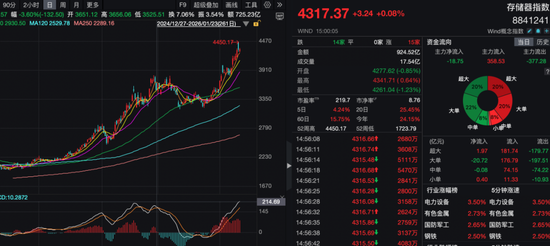
Core Viewpoint - Samsung Electronics has raised NAND flash supply prices by over 100% in Q1 2026, indicating a severe supply-demand imbalance in the semiconductor market [1][12]. Group 1: Price Trends and Market Dynamics - The storage market has seen rapid price increases since the second half of 2025, with the Wind storage index rising over 100% since June 2025 [1][12]. - The current price surge is driven by demand from AI servers and general servers, alongside structural capacity shifts and competitive demand across multiple dimensions [3][14]. - Samsung has completed negotiations for supply contracts with major clients by the end of 2025, implementing a new pricing system from January 2026, following a nearly 70% increase in DRAM prices [4][15]. Group 2: AI Impact on Storage Demand - AI innovations are causing structural changes in the market, with increasing data access needs requiring high-bandwidth, large-capacity, and low-latency DRAM and NAND Flash products [5][16]. - The overall storage industry value is projected to reach $551.6 billion in 2026 and $842.7 billion in 2027, reflecting a 53% annual growth [5][16]. Group 3: NAND Flash Market Projections - The NAND Flash market is expected to see a quarterly price increase of 55% to 60% in Q1 2026, with growth anticipated to continue through the end of the year [6][17]. - The overall storage market is unlikely to see relief from shortages, maintaining supplier pricing power [6][17]. Group 4: Company Performance and Capacity Constraints - Major cloud service providers are initiating bundled negotiations for 2027 supply contracts, indicating unprecedented tightness in storage capacity [8][18]. - The three major DRAM manufacturers (Samsung, SK Hynix, Micron) are expected to see a 5% increase in wafer output in 2026, which will still not meet market demand [9][19]. - Domestic manufacturers are expanding capacity to accelerate the process of domestic substitution in the semiconductor sector [9][19]. Group 5: Financial Performance of Storage Companies - Companies in the storage sector are experiencing significant revenue growth due to the price surge, with Baidu Storage forecasting revenues of 10 billion to 12 billion yuan in 2025, a year-on-year increase of 49.4% to 79.2% [10][20]. - Baidu Storage's projected net profit for 2025 is expected to be between 850 million and 1 billion yuan, reflecting a year-on-year increase of 427.2% to 520.2% [10][20]. - The company is actively securing inventory and long-term supply agreements to ensure stable supply of key materials [11][21].

5个月10倍!闪迪从“U盘牛夫人”变身“AI小甜甜”
Hua Er Jie Jian Wen· 2026-01-25 03:40
Core Insights - SanDisk has transformed from a struggling legacy storage card company to the best-performing stock in the S&P 500, achieving nearly 1000% returns in just five months due to an unexpected market surge driven by AI applications [1][4]. Group 1: Market Dynamics - The surge in demand for AI applications has shifted the focus to storage chips, leading to a significant increase in memory chip prices since September, with NAND flash prices rising over 300% and DRAM costs increasing by approximately 280% [4][5]. - The unexpected demand for "context" storage has created a new technology bottleneck, as highlighted by industry leaders, emphasizing that without storage, AI cannot function effectively [5]. Group 2: Financial Performance - SanDisk's stock price has skyrocketed, reaching an all-time high, with a market capitalization increase of over $50 billion since last year [4]. - Analysts predict that SanDisk's adjusted earnings per share will grow by over 170% year-on-year, with sales expected to surge by about 40% [9]. Group 3: Competitive Advantage - SanDisk benefits from operational leverage, allowing it to convert additional sales from price increases into profits without incurring extra costs for hiring or equipment [7]. - The company's long-standing joint venture with Kioxia provides a cost advantage, enabling it to acquire core NAND chips at lower prices than competitors [7]. Group 4: Investment Sentiment - Elliott Management, which pushed for SanDisk's spin-off, missed out on significant gains as it sold its shares before the recent price surge, highlighting the unpredictable nature of market movements [8]. - Bernstein Research has identified SanDisk as a top pick for 2026, citing unprecedented NAND shortages and price increases, with strong demand expected to persist for at least six quarters [9].

深圳二代豪赌存储,6个月爆赚10亿
创业家· 2026-01-24 10:18
Core Viewpoint - The article highlights the impressive turnaround of Baiwei Storage under the leadership of Chairman Sun Chengsi, projecting significant profit growth driven by the rising demand for storage chips, particularly in the AI sector. The company aims for an IPO in Hong Kong to expand its operations further [5][9][25]. Group 1: Company Performance - Baiwei Storage is expected to achieve a net profit of 850-1,000 million yuan in 2025, representing a year-on-year increase of 400-500% [5][12]. - The company reported a profit of over 1 billion yuan in just six months, showcasing its rapid recovery and growth [6][12]. - The stock price reached a new high of 145.9 yuan per share on January 14, 2025, indicating strong market confidence [25]. Group 2: Market Dynamics - The storage product prices are projected to follow a "U-shaped" curve, declining until Q1 2025 and then recovering, which will boost sales revenue and gross margins [14]. - The demand for storage is being driven by AI applications, particularly in AI inference, edge AI, and emerging AI applications [17]. - Baiwei's products are being integrated into various sectors, including robotics and consumer electronics, with notable clients like Lenovo and Xiaomi [18][19]. Group 3: Leadership and Strategy - Sun Chengsi, who took over the company at the age of 27, has been instrumental in transforming Baiwei's business model from ODM to a more integrated R&D and packaging approach [7][21]. - The company has established partnerships with major semiconductor manufacturers and has focused on enhancing its packaging and testing capabilities [21][29]. - Baiwei is the only independent storage solution provider globally with wafer-level packaging capabilities, which enhances its competitive edge [29]. Group 4: Future Outlook - Baiwei plans to expand its production capacity significantly, with a fundraising target of approximately 1.9 billion yuan aimed at enhancing its manufacturing capabilities [32]. - The company anticipates that revenue from AI glasses will reach about 106 million yuan in 2024, with expectations of over 500% growth in 2025 [31]. - The management is preparing for a dual listing in Hong Kong, which will further support its growth ambitions [25][26].

存储大厂:双位数涨价
半导体行业观察· 2026-01-24 02:39
Core Viewpoint - The demand for DRAM and NAND is expected to see double-digit price increases, driven by the expanding AI data center market and a shift in the supply-demand structure within the storage industry [2][3]. Group 1: Price Trends - Samsung and SK Hynix have indicated that the contract prices for DRAM and NAND are likely to rise, with expectations for announcements by the end of January or early February [3]. - The market speculation regarding an 80% price increase from Samsung remains unverified, as Taiwanese module manufacturers and agents have not received formal price notifications [3]. - By the first quarter of 2026, both DRAM and NAND prices are anticipated to trend upwards, with a clear upward price cycle in place [3][4]. Group 2: Price Structure and Client Impact - The actual price increases will vary by customer tier, with cloud service providers (CSPs) and high-end applications facing higher price hikes, while module and channel levels will experience more moderate increases [4]. - The pricing strategy is shifting towards a seller's market, as evidenced by the rapid rise in RDIMM spot prices and the requirement for some NAND customers to make deposits to secure allocations [4]. Group 3: Contract Strategies and Market Behavior - Current practices involve manufacturers and clients adopting long-term contracts to secure annual capacity, but historical trends suggest that clients may not always fulfill their commitments if market conditions change [5]. - The focus is shifting from merely signing long-term contracts to designing contracts that ensure actual shipment feasibility, including minimum order quantities, prepayments, priority supply terms, and cancellation clauses [5]. - To mitigate the risk of overbooking, Taiwanese storage manufacturers and module factories are implementing allocation strategies based on historical shipment records to ensure smooth supply and risk management [5].
东芯股份预计2025年亏损扩大 存储盈利、GPU赛道投资亏损
Zheng Quan Shi Bao Wang· 2026-01-23 12:57
Core Insights - The company expects to expand its losses in 2025, with projected revenue of approximately 921 million yuan, a year-on-year increase of about 43.75% [1] - The storage segment has achieved profitability, while the company continues to invest heavily in the high-performance GPU sector, reporting an investment loss of 166 million yuan last year [1] Financial Performance - The company anticipates a net profit loss ranging from 214 million yuan to 174 million yuan in 2025, representing an increase in losses of 4.1% to 280.3 million yuan compared to the previous year [1] - The net profit loss after deducting non-recurring items was between 241 million yuan and 201 million yuan last year, with a slight increase in losses of 0.15% to 200.9 million yuan [1] Market Dynamics - The small-capacity storage chip market has benefited from an AI-driven industry upcycle, with improved supply-demand dynamics and steady product price recovery [1] - The company’s products are experiencing a structural growth in demand due to ongoing 5G base station construction, smart city upgrades, innovations in wearable devices, and the electrification and intelligence trends in the automotive industry [1] Technological Advancements - The company is focusing on the integration of storage, computing, and networking, maintaining high levels of R&D investment, with significant expenditures reported during the period [2] - In the storage segment, the company is solidifying its technological leadership in SLC NAND Flash, with 1xnm flash products achieving mass production and sales [2] - The company is also enhancing the reliability of its storage products, advancing the development and industrialization of automotive-grade storage products [2] Investment Strategy - In 2024, the company made a strategic investment of 200 million yuan in Lishuan Technology (Shanghai) Co., Ltd., which specializes in GPU chip design [3] - The first self-developed GPU chip, "7G100," successfully completed its first tape-out in 2025, with initial graphics cards delivered to customers [3] - The company plans to invest an additional 211 million yuan in 2025 to deepen its engagement in the high-performance GPU sector, with an expected investment loss of approximately 166 million yuan for the year [3] Market Performance - Since the press conference held by Lishuan Technology in July last year, the company's stock price has surged, with a cumulative increase of over 200%, and the latest market capitalization stands at 53.2 billion yuan [3]

三星加快定制HBM4E设计,预计2026年中完成,SK海力士、美光同步跟进
Hua Er Jie Jian Wen· 2026-01-23 12:33
Core Insights - The competition in high bandwidth memory (HBM) technology is intensifying, with major storage chip manufacturers accelerating their focus on customized HBM4E solutions [1] - Samsung Electronics is significantly increasing its R&D investment, aiming to complete the design of its customized HBM4E by mid-2026, indicating a shift from standardized products to high-performance customized solutions [1] - The industry anticipates that HBM4E will be launched in 2027, followed by HBM5 in 2029, as major manufacturers like SK Hynix and Micron are also progressing on similar timelines [1][4] Group 1: Samsung's Strategy - Samsung has established dedicated teams for both standardized and customized HBM designs and has recently hired 250 engineers specifically for customized projects, targeting major tech clients like Google, Meta, and NVIDIA [1] - Samsung is currently in the backend design phase of HBM4E, which constitutes 60% to 70% of the overall design cycle, focusing on physical design after the RTL logic development [3] - The company plans to utilize a 2nm process for its customized HBM, aiming for higher performance, following the 4nm process used for its current HBM4 logic die [3] Group 2: Competitors' Approaches - SK Hynix and Micron are relying on deepening their collaboration with TSMC to address the challenges of customization, with both companies expected to complete their customized HBM4E development around the same time as Samsung [4] - SK Hynix is working closely with TSMC to develop next-generation HBM logic dies and is adopting a 12nm process for mainstream server logic dies, upgrading to a 3nm process for high-end designs [4] - Micron has commissioned TSMC to manufacture its HBM4E logic dies, aiming for production in 2027, but is facing structural disadvantages due to its decision to stick with existing DRAM processes [4]

AI虹吸效应造就内存“超级牛市”,雷神科技等前瞻布局厂商赢得先手
Cai Fu Zai Xian· 2026-01-23 08:42
Group 1: Market Dynamics - The ongoing "memory shortage" driven by the AI wave is causing significant price increases in DRAM, with Samsung and SK Hynix notifying clients of a 60% to 70% rise in contract prices for the first quarter of 2026 compared to the previous quarter [1] - The AI industry's demand for high-capacity and high-speed memory chips, particularly High Bandwidth Memory (HBM), is creating a "super bull market" in the memory sector, with HBM gross margins reaching 50%-60%, significantly higher than traditional DRAM margins of about 30% [2] - The memory market is expected to enter a "super bull market," surpassing the 2018 peak, with DRAM prices projected to increase by 40%-50% in Q1 2026 and an additional 20% in Q2 2026 [4] Group 2: Impact on PC Industry - The sharp rise in memory prices is exerting new pressure on the recovering global PC market, with a projected year-on-year increase of 3.47% in global PC shipments for 2024 and 9.52% for Q3 2025, although rising memory costs are disrupting this growth [4] - Major PC manufacturers have begun to raise prices, with some products seeing increases of up to 20%, as companies like HP and Lenovo adjust their pricing strategies in response to rising costs [5][6] - The share of DRAM in the overall cost of PC systems is expected to rise to between 15% and 24.3% in the medium term, further squeezing profit margins for PC manufacturers [4] Group 3: Company Strategies - Companies like Thunderobot have demonstrated strong risk management and growth resilience by increasing their inventory of key components, such as CPUs and memory, in anticipation of price hikes, resulting in a 105.29% increase in inventory year-on-year [7] - Thunderobot's proactive inventory strategy has allowed it to maintain steady growth, with a 13.9% increase in revenue and a 10.36% increase in net profit for the first nine months of 2025 [7] - The company is also optimizing its product structure and sales channels, with overseas revenue growing from 107 million yuan in 2021 to 1.15 billion yuan in 2024, achieving a compound annual growth rate of 120.7% [9]
30亿美元空头惨遭“血洗”!AI狂潮下存储芯片Sandisk轧空风暴进入极端区间
Jin Rong Jie· 2026-01-23 03:40
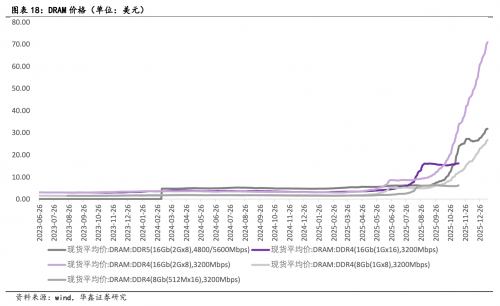
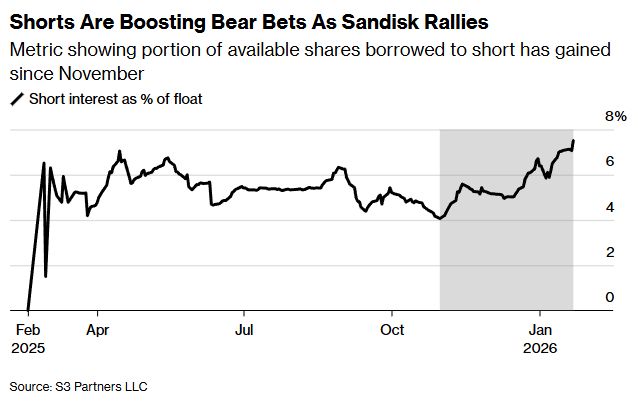
Core Viewpoint - The stock price of Sandisk has surged significantly, leading to an extreme short squeeze risk as short positions have increased substantially in recent months [1][4]. Group 1: Stock Performance and Short Positions - Sandisk's stock price has increased by 112% this year, significantly outperforming the S&P 500 index, which rose by about 1% [4]. - Since its relisting, Sandisk's stock has appreciated approximately 1300% [4]. - The short interest in Sandisk has risen from about 4% to 7.5% of the float since early November last year, with short positions incurring losses of around $3 billion [1]. Group 2: Market Trends and AI Influence - The storage chip sector is experiencing a "super cycle" driven by the AI data center construction boom, which is changing the cyclical nature of the storage chip industry [5][7]. - The demand for storage capacity and bandwidth from AI servers is significantly higher than that of traditional servers, leading to price increases across the industry [5]. - Major companies like Micron Technology and SK Hynix are investing heavily in expanding production capacity, with Micron announcing a $100 billion investment in a new manufacturing facility [6][7]. Group 3: Price Projections and Analyst Sentiment - Analysts from Morgan Stanley, Nomura, and Bank of America predict that the current storage chip super cycle will last until at least 2027, with meaningful new supply not expected until early 2028 [7]. - Citigroup analysts have raised their price forecasts for DRAM and NAND chips for 2026, expecting an 88% increase in DRAM average selling prices and a 74% increase in NAND prices [8].
30亿美元空头惨遭“血洗”!AI狂潮下存储芯片Sandisk(SNDK.US)轧空风暴进入极端区间
智通财经网· 2026-01-23 03:19
Core Viewpoint - The stock of Sandisk (SNDK.US) has seen a significant rise, leading to an extreme short squeeze risk as short positions have increased substantially over the past months [1][3]. Group 1: Stock Performance and Short Positions - Sandisk's stock price has surged by 112% this year, significantly outperforming the S&P 500 index, which has only risen by about 1% [3]. - Since its relisting, Sandisk's stock has appreciated approximately 1300% [3]. - The short interest in Sandisk has risen from about 4% to 7.5% of the float since early November last year, with short positions incurring losses of around $3 billion [1]. Group 2: Industry Trends and AI Impact - The storage chip sector is experiencing a "super cycle" driven by the AI data center construction boom, which is altering the cyclical nature of the storage chip industry [4][7]. - Demand for storage capacity and bandwidth from AI servers is significantly higher than that of traditional servers, leading to price increases across the industry [4]. - Major companies like Micron Technology and SK Hynix are investing heavily in expanding production capacity, with Micron announcing a $100 billion investment in a new manufacturing facility [5][7]. Group 3: Price Projections and Market Sentiment - Analysts from Morgan Stanley, Nomura, and Bank of America predict a robust "storage chip super cycle" that may last longer and be more intense than the previous cycle driven by cloud computing [7]. - Nomura's report indicates that the demand for high-performance DRAM and HBM storage systems is expected to surge, leading to steep price increases for DRAM and NAND chips [7]. - Citigroup analysts have raised their price forecasts for DRAM and NAND chips for 2026, expecting an 88% increase in DRAM average selling prices and a 74% increase in NAND prices [8].