
啤酒

Search documents
业绩二连降!百威亚太2025年营收同比减少6.1%,股东溢利跌超三成!中国市场啤酒销量下滑8.6%
Sou Hu Cai Jing· 2026-02-12 06:41
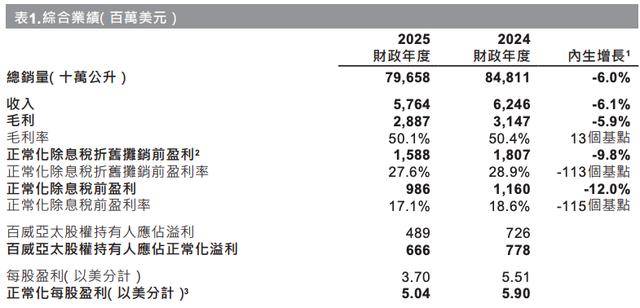
Core Viewpoint - The company reported a decline in total sales and revenue for the fiscal year 2025, with significant challenges in the Chinese market impacting overall performance [1][3]. Group 1: Financial Performance - Total sales decreased by 6.0% to 79.658 million liters in fiscal year 2025 compared to 84.811 million liters in fiscal year 2024 [2]. - Revenue fell by 6.1% to $5.764 billion from $6.246 billion year-on-year [2]. - Net profit attributable to equity holders dropped by 32.6% from $726 million in fiscal year 2024 to $489 million in fiscal year 2025 [1][2]. Group 2: Market Challenges - The company faced a 8.6% decline in beer sales and an 11.3% drop in revenue in the Chinese market for fiscal year 2025 [3][4]. - The fourth quarter of fiscal year 2025 saw a 0.7% decrease in total sales, primarily due to ongoing challenges in the Chinese market and a weak industry in South Korea, although strong growth in India partially offset these declines [2][3]. Group 3: Strategic Initiatives - The company is focusing on revitalizing growth trends and rebuilding market share in China, emphasizing the importance of the market as a significant growth opportunity [4]. - Plans include accelerating the expansion of non-immediate consumption marketing channels and enhancing digital engagement to support growth [4].


大行评级丨里昂:百威亚太去年第四季度业绩大致符预期,评级“跑赢大市”
Ge Long Hui· 2026-02-12 06:17
Core Viewpoint - The report from Credit Lyonnais indicates that Budweiser APAC's Q4 performance was largely in line with expectations, with organic revenue declining by 4% year-on-year and organic normalized EBITDA dropping by 25% [1] Group 1: Financial Performance - Organic revenue decreased by 4% year-on-year in Q4 [1] - Organic normalized EBITDA fell by 25% year-on-year, aligning with the bank's expectations and market consensus [1] - Net loss exceeded expectations due to higher-than-expected tax expenses [1] Group 2: Market Performance - The Chinese market continues to drag down overall performance, with revenue declining by 11% [1] - Sales volume decline has been narrowing consecutively, but investments in home channels and product mix changes did not yield positive results, leading to pressure on average selling prices [1] - Conversely, the markets in South Korea and India showed stable performance [1] Group 3: Dividends and Ratings - The proposed dividend is in line with expectations, suggesting a payout of 5.66 cents per share [2] - Credit Lyonnais set a target price of HKD 9 for Budweiser APAC and maintains a "Outperform" rating [1][2] - Key areas to monitor include macro policies, development of home channels, and marketing budgets [1]
啤酒巨头“过冬”:百威亚太盈利创新低,喜力全球裁员5000+
2 1 Shi Ji Jing Ji Bao Dao· 2026-02-12 06:05
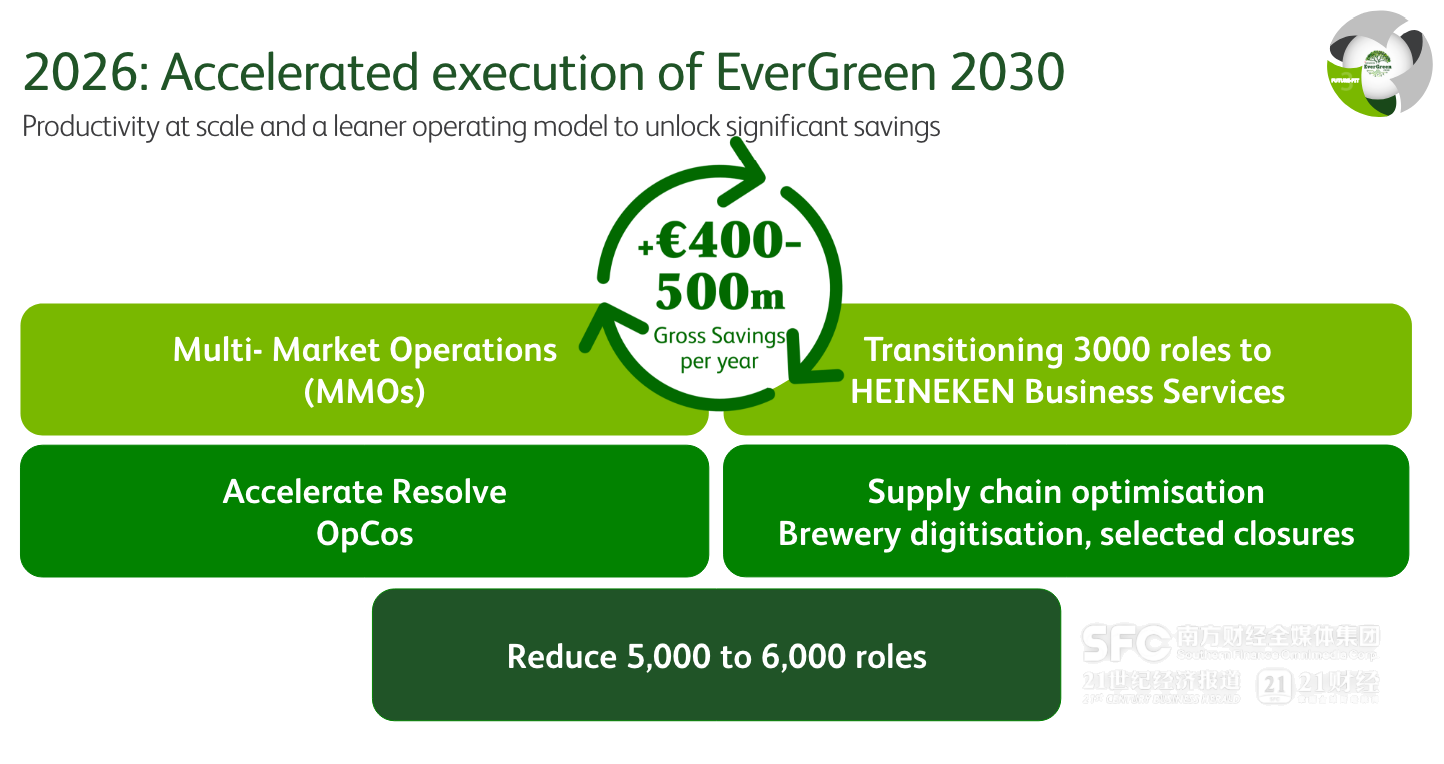
Core Insights - Major international beer companies are revealing their financial results, indicating a trend of slowing growth and declining sales [2][4] Group 1: Heineken Group - Heineken reported a net revenue of €28.753 billion for 2025, with a net profit of €1.885 billion, both showing a decline for two consecutive years [2] - The company has lowered its growth expectations for 2026 and plans to save €400-500 million, including layoffs of 5,000 to 6,000 employees [2][10] - Heineken's overall performance showed a decline in sales revenue, operating profit, and volume, with a 4.7% drop in revenue and a 1.2% decrease in volume for 2025 [5][6] - Despite the overall decline, Heineken achieved double-digit growth in 27 markets and emphasized maintaining or increasing market share in over 60% of its markets [7][6] - In China, Heineken's sales continued to grow, with significant contributions from its local partner, China Resources Beer [8] Group 2: Budweiser APAC - Budweiser APAC reported a revenue of $5.764 billion for 2025, with a 6.1% year-on-year decline in organic revenue and a 9.8% drop in normalized EBITDA [2][12] - The company faced significant challenges, with net profit dropping over 32% to $489 million, marking a new low since its listing [2][12] - In China, Budweiser's revenue fell by 11.3%, with a 15.7% decline in normalized EBITDA and an 8.6% drop in volume for 2025 [14][16] - Budweiser aims to restore growth in China, focusing on enhancing its product mix and increasing investment in non-immediate consumption channels [18][16]
春节小城酒店住宿暴涨至3000元,低价民宿快速消失
21世纪经济报道· 2026-02-12 06:03
记者丨唐唯珂 编辑丨高梦阳 每年春节,旅游市场都会上演一场供需大戏。 2026马年春节尤其热闹:出境游回暖、国内游火爆,而最让游客直呼"吃不消"的,莫过于住宿 价格一路狂飙。 潮汕、泉州等新晋顶流文旅城市,酒店价格直接冲上热搜: 平日两三百元的快捷酒店,春节 轻松破千;核心景区、商圈附近,一晚两三千元已是常态。 一边是游客吐槽"住不起",一边是酒店满房、民宿涨价、平台一房难求。这场春节酒店涨价 潮,到底是市场规律,还是过度炒作?背后藏着怎样的消费逻辑与行业真相? 结合近期平台预订数据与游客实际反馈,春节假期潮汕、泉州等地住宿价格呈现三大特征,涨 幅普遍较大;平日200—300元的经济型酒店,春节直接涨到800—1500元; 中端酒店普遍站上1000—2000元,部分位置好的民宿、精品酒店直逼2500元以上。 2月10日晚间21世纪经济报道记者从OTA平台上搜索 除夕当天到2月19日开始的汕头和泉州等 地连锁价格酒店均呈现出一定程度的上涨,众多经济型和中端酒店价格都飙升至千元。 | 21:59 | 6携程旅行 | | ◀ 搜索 | | | | | --- | --- | --- | --- | --- | -- ...

2025年全国结婚登记676.3万对,增加65.7万对
21世纪经济报道· 2026-02-12 05:46
民政部2月11日公布2025年婚姻登记数据,结婚登记676.3万对,离婚登记274.3万对。其中, 与2024年相比,结婚登记增加了65.7万对,离婚登记减少77万对。 | 指 | 标 | 单 位 | 载 를 | | | --- | --- | --- | --- | --- | | 一、民政事业费累计支出 | | िंग्ट | | 4877.9 | | 二、乡级行政区划单位 | | | | | | 偵 | | 个 | | 21554 | | ी | | 个 | | 6910 | | 民族乡 | | 个 | | ે છે છે. | | 赤木 | | 个 | | 153 | | 民族苏木 | | 个 | | 1 | | 街道 | | 个 | | 9148 | | 区公所 | | 个 | | 2 | | 三、提供住宿的民政机构 | | 个 | | 42432 | | #养老机构 | | 个 | | 39411 | | 四、社会救助 | | | | | | 城市最低生活保障 | | | | | | 最低生活保障人数 | | 万人 | | 595. E | | 最低生活保障平均标准 | | 元/人・月 | | 8 ...

啤酒巨头喜力裁员超5000人,关停部分产能
21世纪经济报道· 2026-02-12 05:05
Core Insights - Major international beer companies are revealing their financial results, indicating a trend of slowing growth and declining sales [1] - Heineken reported a net revenue of €28.753 billion for 2025, with a net profit of €1.885 billion, both showing a decline for two consecutive years [1][3] - Budweiser APAC's revenue for 2025 was $5.764 billion, reflecting a 6.1% organic decline, with normalized EBITDA down 9.8% [1][8] Heineken's Performance - Heineken's 2025 financial results showed a decline in revenue by 4.7%, net revenue down 3.6%, operating profit down 3.2%, and sales volume down 1.2% [3][4] - Despite the overall decline, Heineken reported a 1.6% organic growth in net revenue when adjusted for special items, with operating profit showing a 4.4% organic increase [4] - Heineken plans to cut costs by €400-500 million, including layoffs of 5,000 to 6,000 employees, to streamline operations and improve efficiency [6] Budweiser APAC's Challenges - Budweiser APAC's revenue for 2025 showed a significant decline, with a 6.1% drop in organic revenue and a 9.8% decrease in normalized EBITDA [8][9] - The company faced a notable decline in net profit, which fell to $489 million, marking a new low since its listing [1][8] - In the Chinese market, Budweiser's revenue declined by 11.3%, with normalized EBITDA down 15.7% and sales volume down 8.6% [9][10] Strategic Responses - Both Heineken and Budweiser are implementing strategies to address declining sales, including management changes, cost-cutting measures, and a focus on market share [1][6][11] - Budweiser aims to restore growth in China by enhancing its product offerings and marketing strategies, particularly in non-immediate consumption channels [10][11] - Heineken's CEO is set to leave amid pressures for sustained growth, highlighting the challenges faced by leadership in the current market environment [5][6]

百威啤酒被年轻人抛弃?百威亚太2025年营收近400亿,中国区啤酒销量下滑8.6%,营收两位数下滑
Xin Lang Cai Jing· 2026-02-12 03:27
Core Viewpoint - Budweiser APAC is facing significant challenges in its high-end beer narrative, primarily due to a decline in sales and revenue, attributed to a shift in consumer preferences towards cost-effective options [3][17]. Financial Performance - For the fiscal year 2025, Budweiser APAC reported a total sales volume decrease of 6.0%, with revenue at $5.764 billion (approximately RMB 39.829 billion), reflecting a year-on-year decline of 6.1% or 7.7% on a reported basis [3][17]. - The normalized profit attributable to shareholders is expected to drop from $778 million (approximately RMB 5.376 billion) in fiscal year 2024 to $666 million (approximately RMB 4.602 billion) in fiscal year 2025 [4][18]. - In the Chinese market, Budweiser's beer sales fell by 8.6%, with revenue down 11.3% and revenue per hectoliter decreasing by 3.0% in 2025 [4][18]. Strategic Challenges - Budweiser APAC's management strategy, influenced by its parent company Anheuser-Busch InBev and 3G Capital, has focused on aggressive cost-cutting and profit maximization, which has led to short-sighted marketing decisions [5][20]. - The company has laid off approximately 4,000 employees, representing 16% of its workforce, and is rumored to plan further cuts to operational costs by 15% [5][20]. - The shift from a "lifestyle brand" to a "fast-moving consumer goods" approach has weakened Budweiser's market position, particularly in the on-premise channel [5][20]. Market Dynamics - The macroeconomic environment has shifted consumer preferences away from expensive nightlife experiences towards more affordable options, impacting Budweiser's sales [6][21]. - Competitors like Heineken and China Resources Beer are gaining market share in the high-end segment, leveraging local distribution networks to challenge Budweiser's dominance [8][23]. Leadership Changes - In April 2025, Budweiser APAC underwent a leadership change, with Jan Craps stepping down as CEO after seven years, leaving behind a company facing declining sales [8][24]. - YJ Cheng, a long-time employee with a background in engineering and fermentation, has taken over as CEO, signaling a potential shift back to core operational strengths [8][24]. Operational Adjustments - Budweiser APAC is attempting to address its challenges by focusing on supply chain efficiency and rebuilding relationships with distributors, which have been strained due to cost-cutting measures [11][26]. - The BEES digital platform, which has expanded to over 320 cities in China and accounts for about 80% of revenue, is seen as a critical tool for the company's recovery, although it has also led to reduced distributor autonomy [12][27]. Shareholder Considerations - Despite declining performance, Budweiser APAC plans to maintain a high dividend payout, suggesting a strategy to retain investor confidence amid a lack of internal growth [13][28]. - The company's price-to-earnings ratio has fallen to approximately 23 times, reflecting a significant drop from its initial premium valuation [13][28]. Future Outlook - The new CEO faces the challenge of transforming the company's management approach from "efficiency-first" to "consumer-connection-first" to navigate the ongoing downturn [15][30].
港股异动 | 百威亚太(01876)跌超4% 去年第四季度亏损扩大至1.05亿美元
智通财经网· 2026-02-12 02:13
智通财经APP获悉,百威亚太(01876)跌超4%,截至发稿,跌4%,报7.93港元,成交额7081.48万港元。 消息面上,百威亚太发布截至2025年12月31日止年度业绩,收入57.64亿美元,同比减少7.7%;百威亚 太股权持有人应占溢利4.89亿美元,同比减少32.6%;每股基本盈利3.70美分。总销量于2025年全年减 少6.0%,受公司在中国的业务布局影响,但被印度的表现所部分抵销。此外,去年第四季营业额10.73 亿美元,同比跌6%。亏损扩大至1.05亿美元,上年同期亏损1600万美元。 ...
百威亚太跌超4% 去年第四季度亏损扩大至1.05亿美元
Zhi Tong Cai Jing· 2026-02-12 02:12
消息面上,百威亚太发布截至2025年12月31日止年度业绩,收入57.64亿美元,同比减少7.7%;百威亚 太股权持有人应占溢利4.89亿美元,同比减少32.6%;每股基本盈利3.70美分。总销量于2025年全年减 少6.0%,受公司在中国的业务布局影响,但被印度的表现所部分抵销。此外,去年第四季营业额10.73 亿美元,同比跌6%。亏损扩大至1.05亿美元,上年同期亏损1600万美元。 百威亚太(01876)跌超4%,截至发稿,跌4%,报7.93港元,成交额7081.48万港元。 ...
百威亚太2025财年总销量下滑6% 拟派付股息每股5.66美分
Xin Lang Cai Jing· 2026-02-12 00:18
来源:观点地产网 公告还指出,中国市场2025年业绩未达预期,已采取加强非即饮渠道管理、丰富产品组合等措施以重燃 增长动力;韩国及印度市场则持续扩大市场份额并提升盈利。其中,印度市场的强劲表现部分抵消了中 国业务的拖累。 2026年,公司聚焦内生增长,计划在中国重建市场份额,在韩国推进高端化,并将印度作为下一增长引 擎。 免责声明:本文内容与数据由观点根据公开信息整理,不构成投资建议,使用前请核实。 观点网讯:2月12日早间,百威亚太公布截至2025年12月31日止年度业绩。 2025财年,该公司总销量为79,658百万公升啤酒,同比下降6.0%;收入为57.64亿美元,同比下降 6.1%;正常化除息税折旧摊销前盈利为15.88亿美元,同比下降9.8%。董事会建议派付2025财政年度末 期股息每股5.66美分。 ...