
橡胶

Search documents
《能源化工》日报-20260105
Guang Fa Qi Huo· 2026-01-05 01:15
1. Report Industry Investment Ratings No investment ratings are provided in the reports. 2. Core Views Natural Rubber - Market sentiment has declined, and the overall fundamentals are weak. Hold short positions around 15,700 [1]. Pure Benzene - The short - term supply - demand pattern is weak, and the price is expected to continue to fluctuate at a low level. BZ2603 may fluctuate in the range of 5,300 - 5,600 [4]. Styrene - The rebound space is limited. EB02/03 should be treated bearishly above 6,800, and short the EB processing margin on rallies [4]. Glass and Soda Ash - Soda ash: The supply - demand situation is still in surplus, and the price rebound space is limited. It is recommended to wait and see and focus on the inventory inflection point. - Glass: The upward space of the disk is limited, and it is necessary to be vigilant about the weakening of demand [5]. Methanol - The supply - demand balance sheet is expected to turn to destocking in the first quarter of the next year, which will support the 05 contract [7][8][9]. LLDPE and PP - PP: The pressure on the 05 contract is still large if there are few planned maintenance; PE: The overall pressure is still large in January [13]. PX, PTA, MEG, Short - Fiber, and Bottle Chip - PX: The upstream PX price is expected to adjust before the festival. It is recommended to go long at a low level in the medium - term and conduct positive spread trading for the 5 - 9 month spread. - PTA: It follows raw material fluctuations. It is recommended to trade in the high - level range of 4,800 - 5,200 and conduct positive spread trading for the 5 - 9 month spread. - MEG: The price is under pressure. It is recommended to short at a high level near 4,000 for EG2605 and conduct relevant spread trading. - Short - fiber: The absolute price follows raw material fluctuations. Short the processing margin on rallies. - Bottle chip: It follows the cost side. Short the processing margin on rallies [14]. LPG No specific overall view is provided, just price and inventory data. Crude Oil - The price is expected to fluctuate in the range of 60 - 65 US dollars per barrel. Continued attention should be paid to geopolitical conflicts [18]. 3. Summaries by Catalog Natural Rubber - **Spot Prices and Basis**: The prices of some varieties remained unchanged, while the basis of whole milk and non - standard prices changed significantly [1]. - **Inter - monthly Spreads**: The 9 - 1 spread decreased by 1000.00%, and the 1 - 5 and 5 - 9 spreads increased [1]. - **Fundamental Data**: The production of some countries decreased in November, and the tire production and export increased [1]. - **Inventory Changes**: The bonded area inventory increased, while the factory - warehouse futures inventory of natural rubber decreased [1]. Pure Benzene and Styrene - **Upstream Prices and Spreads**: The prices of some upstream products remained stable, and the spreads of pure benzene - naphtha and ethylene - naphtha increased [4]. - **Benzene - related Prices and Spreads**: The prices of pure benzene and styrene changed slightly, and the processing margins of some products improved [4]. - **Inventory and Operating Rates**: The inventory of pure benzene in Jiangsu ports increased, and the operating rates of some products changed [4]. Glass and Soda Ash - **Glass - related Prices and Spreads**: The prices of glass in different regions remained unchanged, and the 01 contract price decreased slightly [5]. - **Soda Ash - related Prices and Spreads**: The prices of soda ash in different regions decreased, and the 01 and 05 contract prices decreased [5]. - **Supply, Inventory, and Real - Estate Data**: The operating rate and production of soda ash decreased, and the inventory of soda ash decreased [5]. Methanol - **Prices and Spreads**: The prices of methanol contracts and spot prices changed slightly, and the basis and spreads changed [7]. - **Inventory**: The inventory of methanol enterprises and ports increased [8]. - **Operating Rates**: The upstream and downstream operating rates of methanol changed, and the supply - demand situation is expected to improve [9]. LLDPE and PP - **Prices and Spreads**: The contract prices of LLDPE and PP changed, and the spreads and basis changed [13]. - **Inventory**: The enterprise inventory of LLDPE and PP decreased [13]. - **Operating Rates**: The operating rates of LLDPE and PP devices and downstream industries changed [13]. PX, PTA, MEG, Short - Fiber, and Bottle Chip - **Upstream Prices and Spreads**: The prices of upstream products such as PX and ethylene changed, and the spreads changed [14]. - **PTA - related Prices and Spreads**: The prices of PTA and related spreads changed, and the processing margins improved [14]. - **MEG - related Prices and Spreads**: The prices of MEG and related spreads changed, and the inventory increased [14]. - **Inventory and Operating Rates**: The inventory and operating rates of polyester products changed [14]. LPG - **Prices and Spreads**: The prices of LPG contracts and spot prices increased slightly, and the spreads and basis decreased [16]. - **Inventory and Operating Rates**: The refinery storage ratio of LPG increased, and the port inventory decreased [16]. Crude Oil - **Prices and Spreads**: The prices of Brent and WTI crude oil decreased slightly, and the spreads changed [18]. - **Refined Oil Prices and Spreads**: The prices of refined oil products decreased, and the spreads changed [18].
化工月报:原料坚挺,橡胶成本支撑仍存-20260104
Hua Tai Qi Huo· 2026-01-04 11:55
化工月报 | 2026-01-04 原料坚挺,橡胶成本支撑仍存 市场要闻与重要数据 原料与价差:泰国胶水54.20泰铢/公斤(+0.00),泰国杯胶51.10泰铢/公斤(+0.00),云南胶水14200元/吨(-100), 海南胶水13900元/吨(+0),RU基差-355元/吨(+65),NR基差458元/吨(+35),BR基差-120元/吨(+45)。 现货方面:云南产全乳胶上海市场价格15250元/吨,较前一日变动+0元/吨。青岛保税区泰混14700元/吨,较前一 日变动+0元/吨。青岛保税区泰国20号标胶1870美元/吨,较前一日变动-5美元/吨。青岛保税区印尼20号标胶1805 美元/吨,较前一日变动+0美元/吨。中石油齐鲁石化BR9000出厂价格11500元/吨,较前一日变动+0元/吨。 供应方面:天然橡胶青岛港口入库率7.58%(+1.94%),其中一般贸易入库率8.42%(+2.89%),保税库入库率3.17% (-3.05%);高顺顺丁开工率76.92%(+0.66%)。中国天然橡胶月度产量137200吨(+23700),中国顺丁橡胶月度产 量143620吨(+13500)。 生产利润方面: ...
国泰君安期货·能源化工天然橡胶周度报告-20260104
Guo Tai Jun An Qi Huo· 2026-01-04 09:47
1. Report Industry Investment Rating - Not provided in the content 2. Report's Core View - This week, the natural rubber market is affected by macro factors and is expected to follow the overall trend of the energy - chemical sector. After the holiday, the weather in overseas main producing areas is expected to improve, increasing supply and weakening cost support. Although downstream enterprises plan for short - term maintenance during the holiday and the spot inventory is continuously accumulating, the return of funds after the holiday and the impact of the external market during the holiday may drive the rubber price to fluctuate slightly stronger [104]. 3. Summary by Related Catalogs Industry News - In the first 11 months of 2025, Vietnam's total exports of natural rubber and mixed rubber decreased by 5.6% year - on - year, with a 0.6% year - on - year decrease in exports to China. Thailand's total exports of natural rubber and mixed rubber increased by 4.6% year - on - year, with a 24% year - on - year increase in exports to China. The implementation details of the 2026 automobile trade - in subsidy were released, expanding the scope of support [5][7]. Market Trends - This week, the domestic rubber futures market declined, while the overseas market rose. For example, the closing price of RU2605 decreased by 1.11% compared to the previous period, and the closing price of Singapore TSR20:2605 increased by 0.17% [9][11]. Price - Related - **Basis and Calendar Spread**: The basis of whole milk - RU05 and the 05 - 09 calendar spread both increased, with a 26.04% and 100.00% increase respectively compared to the previous period [12]. - **Other Spreads**: Spreads such as RU - NR, RU - BR, NR - SICOM TSR20, and RU - JPX RSS3 decreased. The basis of non - standard rubber strengthened, and the spreads between whole milk - Thai mixed rubber and 3L - Thai mixed rubber expanded [17][20][23]. - **Substitute Prices**: The price of butadiene, the raw material of butadiene rubber, continued to rise, providing bottom support for the short - term market price [30]. Capital Trends - The virtual - to - physical ratio and the settled funds of both RU and NR decreased. For example, the virtual - to - physical ratio of RU decreased by 16.46% compared to the previous period, and the settled funds decreased by 11.80% [33][35]. Fundamental Data - **Supply** - **Weather**: The rainy season in southern Thailand is approaching the end, and the rainfall is decreasing. The rainy season in northeastern Thailand has passed, but the rainfall is higher than the same period. The rainy seasons in Hainan and Yunnan have basically ended [38][40]. - **Raw Material Prices**: Due to the缓解 of overseas geopolitical tensions, raw material prices have fallen [42]. - **Raw Material Spreads**: The water - cup spread in Thailand has expanded, and the spread of Hainan glue between concentrated latex factories and whole milk factories has remained stable [46]. - **Upstream Processing Profits**: As raw material prices fall, the rubber processing profits in Thailand have generally improved [49]. - **Delivery Profits**: The delivery profit in Hainan has decreased, and the data in Yunnan has stopped updating due to the suspension of tapping [53]. - **Exports**: In November 2025, Thailand's natural rubber exports decreased month - on - month, with a slight increase in latex exports and a decrease in the exports of smoked sheets, standard rubber, and mixed rubber. The exports to China also decreased month - on - month. In October, Indonesia's total natural rubber exports decreased significantly year - on - month due to a sharp decrease in standard rubber exports, while the exports of mixed rubber continued to increase month - on - month. The total exports to China also decreased month - on - month. In October, Vietnam's natural rubber exports increased month - on - month, with a large increase in latex exports. The exports to China rebounded seasonally, with a large increase in standard rubber and latex exports. In November, Cote d'Ivoire's rubber exports decreased month - on - month, and the exports to China decreased significantly [60][66][72]. - **Imports**: In November 2025, China's imports of natural rubber (including mixed rubber and compound rubber) were 643,600 tons, a 25.98% increase month - on - month and a 14.76% increase year - on - year. The imports of Thai mixed rubber, Thai standard rubber, and Cote d'Ivoire standard rubber increased significantly month - on - month, while the imports of Vietnamese standard rubber and mixed rubber decreased year - on - year [78]. - **Demand** - **Tire Capacity Utilization and Inventory**: During the "New Year's Day" holiday, some tire enterprises planned for short - term maintenance, and the tire inventory continued to accumulate last week [81]. - **Tire Exports and Heavy - Truck Sales**: In November 2025, heavy - truck sales increased month - on - month with an accelerated growth rate. Passenger car sales continued to grow, but the year - on - month growth rate continued to decline. Tire exports improved slightly month - on - month [84]. - **Road Transport Turnover**: In November 2025, the freight turnover of road transport rebounded month - on - month, while the passenger turnover decreased month - on - month [88]. - **Inventory** - **Spot Inventory**: China's natural rubber inventory continued to accumulate seasonally. The increase in Qingdao's inventory slowed down compared to the previous period, mainly due to a 7.8% decrease in the warehousing volume of sample warehouses and some tire enterprises' procurement before the festival. The inventory in Yunnan continued to accumulate [94]. - **Futures Inventory**: As of January 2, 2026, the futures inventory of natural rubber on the SHFE was 100,600 tons, a 7.09% increase compared to the previous week, and the futures inventory of 20 - numbered rubber on the Shanghai International Energy Exchange was 58,000 tons, remaining unchanged compared to the previous week [100]. This Week's View Summary - **Supply**: As of December 31, there was no data on raw material prices in Thailand due to the holiday. The price of Hainan glue for whole milk production was 15,000 yuan/ton, and the price for concentrated latex production was also 15,000 yuan/ton. As of December 28, 2025, China's natural rubber social inventory was 1.201 million tons, a 1.7% increase compared to the previous period [104]. - **Demand**: During the "New Year's Day" holiday, some enterprises planned for short - term maintenance, and most enterprises maintained normal production, adjusting according to their own inventory and order situations [104]. - **View**: After the holiday, the supply in overseas main producing areas is expected to increase, weakening cost support. Although the downstream inventory is accumulating and enterprises are having maintenance, the return of funds and the external market impact may drive the rubber price to fluctuate slightly stronger. The recommended strategies are to wait and see for RU and look for short - selling opportunities when the price is high, and to observe for cross - period and cross - variety trading [104][105].
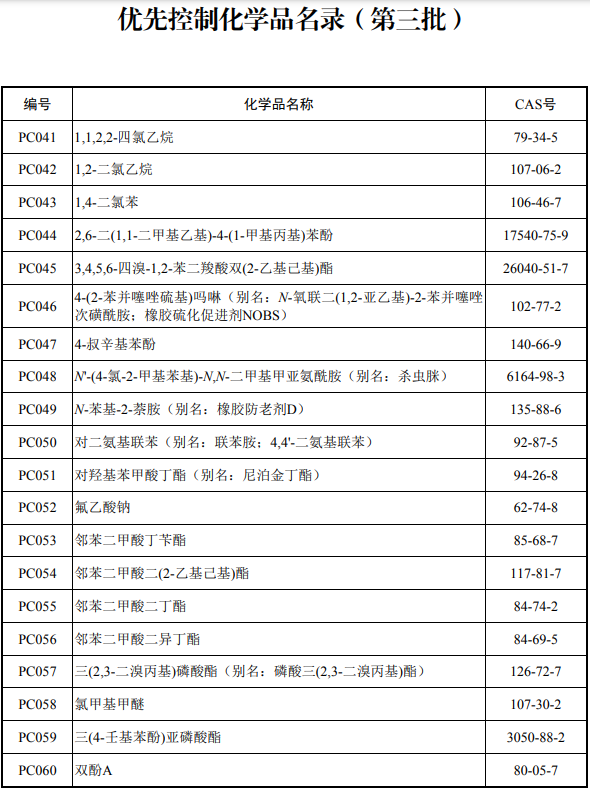
注意!双酚A等23种类化学品,被列入优先控制化学品名录!
Zhong Guo Hua Gong Bao· 2026-01-04 09:14
Core Viewpoint - The Ministry of Ecology and Environment and the National Health Commission have jointly issued the "Priority Control Chemical List (Third Batch)," which includes 23 chemical substances such as 1,1,2,2-tetrachloroethane and bisphenol A, focusing on high-risk chemicals with significant environmental and health impacts [1][2]. Group 1: Chemical Substances and Their Risks - The list includes 23 chemical substances, particularly those with persistent, bioaccumulative, and aquatic chronic toxicity properties, as well as carcinogenic, mutagenic, reproductive toxicity, and endocrine-disrupting characteristics [1][2]. - Notable substances in the list include 1,1,2,2-tetrachloroethane, bisphenol A, and various perfluoroalkyl and polyfluoroalkyl substances, which are linked to industries such as petrochemicals, plastics, pharmaceuticals, textiles, and pesticides [1][2]. Group 2: Regulatory Measures and Industry Response - The management of the chemicals listed is primarily based on environmental impact assessments for construction projects, pollution discharge permits, and soil and groundwater pollution prevention measures [1]. - Companies are encouraged to recognize the potential environmental and health risks associated with these chemicals and to proactively upgrade processes, enhance waste treatment, and develop environmentally friendly alternatives to minimize risks [2].

国泰君安期货能源化工天然橡胶周度报告-20260104
Guo Tai Jun An Qi Huo· 2026-01-04 08:26
1. Report Industry Investment Rating No relevant content provided. 2. Report's Core View - This week, the domestic natural rubber futures market declined while the overseas market rose. Due to the improvement in weather in overseas main - producing areas after the holiday, the increase in supply will put pressure on raw material prices, and the cost support may weaken. Although the spot inventory of natural rubber continues to accumulate and some downstream enterprises plan to have short - term maintenance during the "New Year's Day" holiday, after the holiday, funds will return to the market. Affected by the external market during the holiday, with limited self - contradiction driving, it is expected that the natural rubber price will follow the overall trend of the energy and chemical sector and fluctuate slightly stronger [9][102]. - Valuation: The spread between the main contracts of RU and NR remained stable at 2980 yuan/ton, and the spread between mixed standard rubber and the main contract of RU decreased by 65 yuan/ton. Investment strategies include waiting and seeing for RU in the unilateral aspect, waiting for opportunities to short at high prices; observing in the inter - period and cross - variety aspects [103]. 3. Summary by Directory Industry News - In the first 11 months of 2025, Vietnam's total exports of natural rubber and mixed rubber decreased by 5.6% year - on - year, and the total exports to China decreased by 0.6% year - on - year [5]. - On December 31, the Ministry of Commerce and other departments issued the implementation rules for the 2026 automobile trade - in subsidy, expanding the scope of support compared with 2025 [6]. - In the first 11 months of 2025, Thailand's total exports of natural rubber and mixed rubber increased by 4.6% year - on - year, and the total exports to China increased by 24% year - on - year [7]. Market Trends - This week, the domestic rubber futures market declined, while the overseas market rose. For example, the closing price of RU2605 decreased by 1.11% compared with the previous period, and the closing price of Singapore TSR20:2605 increased by 0.17% [9][11]. Price Basis and Calendar Spread - The basis of whole milk - RU05 increased by 26.04% compared with the previous period, and the 05 - 09 calendar spread increased by 100.00% compared with the previous period [12]. Other Spreads - Spreads such as RU - NR, RU - BR, NR - SICOM TSR20, and RU - JPX RSS3 decreased [16]. - This week, most rubber spot prices declined, and futures prices declined more, resulting in a stronger basis [20]. - The spread between whole milk and Thai mixed rubber and the spread between 3L and Thai mixed rubber widened [23]. Substitute Prices - The price of butadiene at the raw material end of butadiene rubber continued to rise, providing obvious bottom support for the short - term market price, and most spot offers maintained a firm price and tried to sell [29]. Capital Trends - The virtual - to - physical ratio and the settled funds of RU and NR both decreased. For example, the virtual - to - physical ratio of RU decreased by 16.46% compared with the previous period, and the settled funds decreased by 11.80% [32][34]. Fundamental Data Supply - Weather in Thai producing areas: The rainy season in southern Thailand is gradually coming to an end with decreasing rainfall, and the rainy season in northeastern Thailand has passed, but the rainfall is higher than the same period [37]. - Weather in domestic producing areas: The rainy seasons in Hainan and Yunnan producing areas have basically ended [39]. - Raw material prices: Due to the easing of overseas geopolitical tensions, raw material prices declined. For example, the price of cup lump in the Hat Yai market in Songkhla Province, Thailand, decreased by 2.54% compared with the previous period [41][43]. - Raw material spreads: The spread between water and cup in Thailand widened, the spread between Hainan glue going into the concentrated latex factory and going into the whole milk factory was stable, and Yunnan has basically stopped tapping [45]. - Upstream processing profit: As raw material prices declined, the rubber processing profit in Thailand generally improved. For example, the production profit of Thai standard rubber increased by 18.53% compared with the previous period [48][50]. - Delivery profit: The delivery profit in Hainan decreased, and Yunnan has basically stopped tapping, so the data update was suspended [53]. - Thai exports: In November, Thailand's natural rubber exports decreased month - on - month, with a slight increase in latex exports and a decrease in the exports of smoked sheets, standard rubber, and mixed rubber [60]. - Thai exports to China: In November, the quantity of Thailand's natural rubber exports to China decreased month - on - month, with an increase in the exports of latex, smoked sheets, and standard rubber and a decrease in mixed rubber [63]. - Indonesian exports: In October, Indonesia's total natural rubber exports decreased significantly year - on - year and month - on - month due to a large decrease in standard rubber exports, while the exports of mixed rubber continued to increase month - on - month. The total exports to China also decreased month - on - month [66]. - Vietnamese exports: In October, Vietnam's natural rubber exports increased month - on - month, with a large increase in latex exports. The exports to China increased seasonally, with large increases in standard rubber and latex exports [72]. - Ivorian exports: In November, Cote d'Ivoire's rubber exports decreased month - on - month, and the quantity of exports to China decreased significantly month - on - month [74]. - Rubber imports: In November, China's imports of natural rubber (including mixed rubber and composite rubber) were 643,600 tons, a month - on - month increase of 25.98% and a year - on - year increase of 14.76%. The imports of Thai mixed rubber, Thai standard rubber, and Ivorian standard rubber increased significantly month - on - month, while the imports of Vietnamese standard rubber and mixed rubber decreased year - on - year [78]. Demand - Tire capacity utilization and inventory: Some enterprises have short - term maintenance plans during the "New Year's Day" holiday, mostly for 3 - 5 days, and most enterprises maintain normal production. Tire inventory continued to accumulate last week (the current data has not been updated) [81]. - Tire exports and heavy - truck sales: In November, heavy - truck sales increased month - on - month with a higher growth rate, passenger car sales continued to grow but the year - on - year and month - on - month growth rates continued to decline, and tire exports recovered slightly month - on - month [84]. - Road transport turnover: In November, the road freight turnover increased month - on - month, while the passenger turnover decreased month - on - month [88]. Inventory - Spot inventory: The current natural rubber inventory in China continued to accumulate seasonally. Qingdao's inventory increased, and the increase rate of the increase in light - colored rubber inventory compared with the previous period weakened [94][96]. - Futures inventory: The natural rubber futures inventory in the Shanghai Futures Exchange and the 20 - rubber futures inventory in the Shanghai International Energy Exchange both increased to some extent. For example, the natural rubber futures inventory in the Shanghai Futures Exchange increased by 7.09% compared with the previous week [99].
2025年12月马来西亚橡胶生产津贴(IPG)已启动
Xin Lang Cai Jing· 2026-01-04 07:35
Group 1 - The Malaysian Rubber Board (MRB) has initiated a rubber production subsidy (IPG) for smallholders in Peninsular Malaysia, Sabah, and Sarawak, effective until December 2025 [1][2] - The average farm delivery prices for cup rubber (50% dry rubber content) in December were RM2.95 per kg for Peninsular Malaysia, RM2.65 per kg for Sabah, and RM2.60 per kg for Sarawak [1] - The subsidies for cup rubber are set at RM0.05 per kg (50% dry rubber content) and RM0.10 per kg (100% dry rubber content) for Peninsular Malaysia, RM0.35 per kg and RM0.70 per kg for Sabah, and RM0.40 per kg and RM0.80 per kg for Sarawak [1] Group 2 - For latex (100% dry rubber content), the subsidy will be activated when cup rubber is activated, with a subsidy of RM0.90 per kg [2] - Smallholders in Peninsular Malaysia, Sabah, and Sarawak can submit IPG claims based on their production from December 2025 between January 1 and January 31, 2026 [2] - The IPG will be activated starting January 2024 if the average monthly delivery price for cup rubber falls to RM3.00 per kg or below [3]

2025年成都72家企业完成落后产能淘汰
Xin Lang Cai Jing· 2026-01-03 20:20
Core Viewpoint - Chengdu is actively promoting the elimination of outdated production capacity, with a target of completing the exit of 72 enterprises by 2025, covering various industries and regions [1][2] Group 1: Elimination of Outdated Capacity - By 2025, Chengdu will complete the elimination of outdated production capacity from 72 enterprises across nine districts and counties, including Jin Niu District, Pi Du District, and Da Yi County [1] - The industries affected include machinery manufacturing, casting, furniture, automotive parts, rubber, building materials, paper, biopharmaceuticals, and food and beverage [1] - The methods of exit include the elimination of process equipment and the closure of facilities [1] Group 2: Industrial Structure Adjustment - Chengdu is accelerating industrial structure adjustment by fostering advanced production capacity while eliminating outdated capacity [1] - The city aims to build a modern industrial system, consolidating its advantageous industries and nurturing emerging sectors [1] - Efforts are being made to enhance energy efficiency in key industries and encourage the upgrade of inefficient energy-consuming equipment [1] Group 3: Achievements During the 14th Five-Year Plan - During the 14th Five-Year Plan period, Chengdu has successfully facilitated the orderly exit of 163 enterprises with outdated capacity and cleaned up 16,000 "scattered, chaotic, and polluting" industrial enterprises [2] - These actions have significantly contributed to the improvement of the ecological environment and provided necessary resources and environmental capacity for the construction of a new industrialization system [2] - From January to November last year, the industrial added value of Chengdu's large-scale industries grew by 7.2% year-on-year, while the energy consumption per unit of industrial added value decreased by 7.2% during the same period [2]
“揭榜挂帅”“四两拨千斤” 3年来我市攻克107项“卡脖子”难题
Zhen Jiang Ri Bao· 2026-01-02 19:43
Group 1 - The implementation of the "Zhenjiang Enterprise Technology Tackling (Ranking and Leading) Guidance Fund Implementation Measures" three years ago has significantly advanced technological innovation in the city, resulting in the successful resolution of 107 critical technological challenges by the end of 2025 [1] - The "Ranking and Leading" mechanism has directly addressed 16 of these challenges, encouraging enterprises to invest in R&D and solve 91 key technological bottlenecks independently, demonstrating the leverage effect of the guidance fund [1] - A partnership with the Jiangsu Provincial Industrial Technology Research Institute was established in 2022 to create a guidance fund aimed at addressing technological pain points through the "Ranking and Leading" model, resulting in the collection of 167 major technology demand items over three years [1] Group 2 - The breakthrough of "bottleneck" technologies has a cascading effect, as seen with Danyang Huichuang Medical Equipment Co., which achieved a significant advancement in dynamic brain imaging, leading to the establishment of a clinical research center for cognitive disorders [2] - Over three years, 107 projects have been initiated to tackle technological bottlenecks across key sectors such as high-end equipment manufacturing, new materials, biomedicine, and new-generation information technology, driven by the guidance fund [2] - The core of the "Ranking and Leading" mechanism is market demand-oriented, focusing on problem-solving as a measure of success, with plans to optimize this mechanism further to enhance collaboration in finance and talent, facilitating the transition from technology demand to joint tackling and result transformation [2]
《优先控制化学品名录(第三批)》公布,生态环境部答记者问
Xin Lang Cai Jing· 2026-01-02 07:09
Group 1 - The core viewpoint of the article is the issuance of the "Priority Control Chemical List (Third Batch)" by the Ministry of Ecology and Environment and the National Health Commission, emphasizing the importance of managing new pollutants to protect ecological and public health [1][2] - The list aims to prioritize the management of chemical substances that pose significant environmental and health risks, serving as a foundational support for managing toxic pollutants in water, air, and soil [2][3] - The compilation of the list involved a comprehensive assessment of chemical substances based on their inherent hazards, potential exposure levels, and international control measures, focusing on high-risk chemicals such as persistent, bioaccumulative, and toxic substances [2][3] Group 2 - The list includes 23 categories of chemical substances, such as 1,1,2,2-tetrachloroethane and bisphenol A, which are recognized as carcinogens and endocrine disruptors, affecting various industries including petrochemicals, plastics, and pharmaceuticals [3][4] - Companies producing or using the listed chemicals are encouraged to enhance their environmental risk management practices, including upgrading processes and controlling emissions, to mitigate potential risks [4][5] - Current management of the chemicals in the list is based on existing regulations regarding environmental impact assessments, pollution permits, and soil and groundwater pollution prevention [5]
生态环境部固体废物与化学品司有关负责人就《优先控制化学品名录(第三批)》答记者问
Yang Shi Wang· 2026-01-02 06:42
Core Viewpoint - The Ministry of Ecology and Environment and the National Health Commission have jointly issued the "Priority Control Chemical List (Third Batch)" to enhance the management of new pollutants and protect ecological and public health [2][5]. Group 1: Background and Purpose - The issuance of the list is part of a broader initiative by the Chinese government to address new pollutant management, as emphasized in various party meetings and documents, aiming for effective environmental risk control by 2035 [2]. - The list aims to provide foundational support for managing environmental risks associated with toxic pollutants in water, air, and soil, while also raising awareness among the public and enterprises regarding the environmental and health hazards of chemical substances [3]. Group 2: Compilation Process - The compilation of the list involved a comprehensive assessment of chemical substances based on their inherent hazards, potential exposure levels, and international control measures, focusing on high-risk chemicals such as persistent, bioaccumulative, and toxic substances [3][4]. - The process adhered to an "openness" principle, soliciting public opinions and conducting expert consultations to ensure a wide range of inputs were considered [4]. Group 3: Included Chemicals - The list includes 23 categories of chemical substances, such as carcinogens and endocrine disruptors, affecting various industries including petrochemicals, plastics, pharmaceuticals, and textiles [5]. - Notably, some high-concern persistent organic pollutants were not included in the list, indicating a need for compliance with existing environmental management regulations for new chemical substances [5]. Group 4: Management Requirements - The issuance of the list provides a framework for companies to proactively manage environmental risks associated with the listed chemicals, encouraging practices such as process upgrades and the development of environmentally friendly alternatives [6]. - Current management of the listed chemicals is guided by various regulations, including environmental impact assessments and pollution discharge permits [6][7].