
算力

Search documents
算力持续景气,端侧大有可为
East Money Securities· 2025-11-18 06:23
Group 1 - The report highlights the sustained demand for computing power, with significant growth expected in the AI infrastructure sector driven by domestic advancements in computing chips and increased capital expenditure from cloud service providers [2][3]. - The domestic AI infrastructure is anticipated to experience rapid growth by 2026, following a slight dip in expectations due to external factors such as the ban on NVIDIA chips [2]. - The report emphasizes the structural alpha opportunities within the industry, particularly in segments like optical modules, liquid cooling, switches, and power supplies, as the demand for AI computing continues to rise [2]. Group 2 - The report indicates that the terminal AI market is on the verge of significant expansion, with policy support and ecosystem development expected to drive growth in 2026 [3]. - Innovations in products, such as Meta's AI glasses, are likely to accelerate the market penetration of terminal AI applications [3]. - The report suggests that the industry is transitioning from a phase of thematic catalysts to one of performance realization, with the emergence of "hit products" expected to further boost the sector [3]. Group 3 - The telecommunications sector is currently experiencing a phase of capital expenditure reduction, business restructuring, and increasing dividend payouts, which positions it favorably for investors [4]. - The report notes that the telecommunications sector has shown resilience, with profit growth outpacing revenue growth, and a stable or increasing dividend yield in a low-interest-rate environment [4]. - Emerging business areas, particularly in AI and satellite communications, are expected to contribute to a second growth curve for telecommunications companies [4]. Group 4 - The North American AI sector has seen a remarkable increase in capital expenditure, with projections indicating that spending could exceed $600 billion by 2026, driven by robust demand for AI services [12][13]. - The report outlines that the AI computing market is characterized by a dual demand for training and inference, with inference demand expected to surpass training demand in the near future [35][36]. - The report highlights the importance of energy management solutions, such as 800 VDC systems, in addressing the rising power consumption associated with AI data centers [69][70].




创业板连续调整,配置价值凸显,创业板ETF博时(159908)备受资金关注
Xin Lang Cai Jing· 2025-11-18 06:08
Group 1 - The ChiNext Index has decreased by 1.04% as of November 18, 2025, with mixed performance among constituent stocks, where BlueFocus leads with a rise of 12.77% and Xinzhou Bang falls by 9.69% [1] - The ChiNext ETF by Bosera has seen a recent decline of 1.15%, with the latest price at 2.85 yuan, but has accumulated a rise of 5.72% over the past month [1] - The trading volume for the ChiNext ETF reached 16.96 million yuan, with a turnover rate of 1.4% during the session [1] Group 2 - According to Minsheng Jianyin Fund's report, the TMT sector's holding ratio in funds has reached nearly 40%, marking a historical high, while the market style is shifting from technology growth to dividend and cyclical sectors due to profit-taking by institutional investors [2] - The latest scale of the ChiNext ETF by Bosera is 1.211 billion yuan, closely tracking the ChiNext Index, which consists of 100 stocks with high market capitalization and liquidity [3] - As of October 31, 2025, the top ten weighted stocks in the ChiNext Index account for 58.2% of the index, including companies like CATL and Mindray [3]

A股V型拉升!创业板ETF天弘(159977)一举翻红,百亿证券ETF(159841)连续5日“吸金”
Ge Long Hui· 2025-11-18 03:36
Group 1 - The technology sector has led a V-shaped rebound in the A-share market, with the Tianhong ChiNext ETF (159977) rising by 0.06% and attracting 26 million subscriptions during the trading session [1] - Foreign investors remain optimistic about the Chinese stock market, with Morgan Stanley predicting a moderate increase in the market next year, estimating that by the end of 2026, the Hang Seng Index, the China Enterprises Index, and the CSI 300 Index will have upward potential of approximately 4%, 4%, and 5% respectively compared to yesterday's closing [1] - The ETF funds have been actively purchasing the securities ETF (159841, C class 008591), which has seen net subscriptions for five consecutive days, accumulating a total of 577 million yuan in the last ten days [1] Group 2 - The Tianhong ChiNext ETF (159977) tracks the ChiNext Index and represents a key index for technology growth, encompassing four high-growth sectors: new energy, pharmaceuticals, computing power, and brokerage [1] - The latest scale of the Tianhong ChiNext ETF is 9.006 billion yuan, with a combined management and custody fee of 0.2%, which is among the lowest in the market [1] - The securities ETF (159841) has a current scale of 10.66 billion yuan, making it the largest and most liquid securities ETF in the Shenzhen market [1]
七大部门联合出手,华为AI新突破在即!明天这几个方向或将迎来布局良机
Sou Hu Cai Jing· 2025-11-17 11:15
Market Overview - The A-share market showed weakness around the 4000-point mark, with major indices generally declining. The Shanghai Composite Index closed at 3972.03 points, down 0.46% [1] - The Shenzhen Component Index slightly decreased by 0.11%, closing at 13202.00 points, while the ChiNext and STAR Market indices fell by 0.2% and 0.53%, respectively [1] - A total of 2584 stocks rose, while 2726 stocks fell, indicating a divergence in individual stock performance [1] - Net outflow of main funds reached 16.844 billion yuan, with 2078 stocks seeing inflows, significantly lower than the 3078 stocks that experienced outflows [1] - Despite the outflows, the overall trading volume remained high at 1.93 trillion yuan, suggesting a reallocation of funds rather than an exit from the market [1] Sector Performance - The lithium mining sector led the market with a 7.16% increase, driven by both fundamental and capital market factors. The price of lithium carbonate futures hit the limit up, boosting the profitability outlook for the industry [2] - Domestic sales of new energy vehicles showed signs of recovery in October, reinforcing lithium's strategic value as "white oil" amid ongoing global energy transition trends [2] - The military industry gained strength due to rising geopolitical uncertainties, with expectations of increased defense spending [2] Technology and Innovation - The operating system and AI-related sectors rose, driven by domestic substitution and technological breakthroughs. The operating system index surged by 4.31% [3] - Huawei's upcoming AI breakthrough, set to be announced on November 21, is expected to enhance resource management for AI training and inference, positively impacting related stocks [3] Macro Policy and Institutional Insights - Positive macro factors are gradually accumulating, with the Ministry of Commerce and other departments initiating projects to promote industrial transfer and new productivity development [3] - Insurance capital holdings reached a historical high of 5.59 trillion yuan, indicating long-term capital's recognition of A-share value [3] - UBS maintains an "overweight" rating on Chinese stocks, reflecting a consensus on positive market factors [3] Future Market Outlook - The market is expected to continue its "oscillating rotation" pattern, with ongoing competition between policy expectations and profit recovery [4] - Investors are advised to focus on sectors benefiting from policies and profit improvements, including lithium, military, and technology sectors [4] - Close attention should be paid to the Federal Reserve's December meeting, major project implementations, and potential style rebalancing due to mutual fund annual assessments [4]
爆拉!板块出现涨停潮!锂矿双雄齐齐飙升,千亿巨头触及涨停!行业周期反转了吗?
雪球· 2025-11-17 08:10
Group 1: Market Overview - The three major indices showed weak fluctuations, with the Shanghai Composite Index down 0.46%, Shenzhen Component down 0.11%, and ChiNext down 0.20%, while the North Stock 50 rose 0.81% [2] - The total trading volume in the Shanghai and Shenzhen markets was 19,303 billion yuan, a decrease of 501 billion yuan from the previous day, with over 2,500 stocks rising in the market [2] Group 2: Lithium Mining Sector - The main futures contract for lithium carbonate hit the limit up, leading to a collective surge in the A-share lithium mining sector, with Tianqi Lithium nearing the limit up and Ganfeng Lithium rising by 7.48% [5] - Analysts believe the recent rebound in lithium carbonate prices is due to the recovery of the lithium battery industry chain, with strong demand from the power terminal and accelerated inventory depletion [7] - In September, lithium carbonate imports decreased by 10.3% month-on-month to 19,596.9 tons, while exports plummeted by 59.12% to 150.816 tons [7] - In October, domestic lithium carbonate production increased by 9.31% month-on-month to 51,530 tons, but the operating rate fell by 5 percentage points to 43%, indicating constraints on domestic capacity release [7][8] Group 3: Huawei Computing Concept - Huawei's concept stocks were active, with Dongfang Guoxin rising nearly 13% and Tuo Wei Information up over 6% [10] - Huawei is set to release a breakthrough technology in the AI field on November 21, which is expected to significantly improve the efficiency of computing resource utilization [12] - The new technology aims to enhance the utilization rate of GPU and NPU resources from the current 30%-40% to 70%, potentially unlocking the full potential of computing hardware [12] Group 4: Precious Metals Sector - Gold and silver futures prices fell sharply, leading to a decline in the A-share precious metals sector, with silver down over 4% and gold down over 3% [14] - The decline in precious metals is attributed to signals from multiple Federal Reserve members indicating no urgency to cut interest rates, which strengthened the dollar and pressured gold prices [16] - Despite the short-term pullback, many institutions remain optimistic about the long-term outlook for gold, citing factors such as a weakening dollar and inflation risks that could support gold investment demand [16]




创业板指本月回撤超6%
Di Yi Cai Jing Zi Xun· 2025-11-17 07:00
Core Viewpoint - The technology sector has experienced significant fluctuations, with the ChiNext Index showing a maximum drawdown of nearly 8% since November, following a strong rally earlier in the year [2][3] Group 1: Market Performance - The ChiNext Index has seen a maximum drawdown of 8% as of November 17, with various indices within the "Chuang" series also experiencing declines, such as the ChiNext 50 down 7.6% and the ChiNext 300 down 5.32% [3] - Major stocks in the computing power sector have faced significant declines, with companies like Zhongji Xuchuang down 10.09% and Shenghong Technology down 16.31% this month [3] - The computing power sector has accumulated substantial gains prior to the recent adjustments, leading to a shift in market focus towards lower-valued sectors [4] Group 2: Company Developments - Ningde Times, the largest weight in the ChiNext Index, saw its stock drop nearly 4% due to a major shareholder planning to sell 45.63 million shares, representing 1% of the company's total equity [2] - Alibaba's announcement of its "Qianwen" project to enter the AI to C market has sparked a rally in AI-related stocks, with companies like Xuanya International and Dongfang Guoxin seeing significant price increases [4] Group 3: Investment Outlook - Analysts remain optimistic about the computing power sector, suggesting that the current adjustments present investment opportunities, especially with ongoing strong demand driven by AI [4] - The market is expected to experience a period of consolidation and narrow fluctuations as it awaits new catalysts for direction, despite recent weak macroeconomic data [5]


超2900只个股下跌
第一财经· 2025-11-17 03:48
Core Viewpoint - The article discusses the performance of the A-share market, highlighting the decline in major indices and the mixed performance of various sectors, with energy metals and military equipment showing gains while innovative pharmaceuticals and photovoltaic equipment experienced pullbacks [3][4]. Market Performance - As of midday, the Shanghai Composite Index fell by 0.43%, the Shenzhen Component Index decreased by 0.35%, and the ChiNext Index dropped by 0.8% [3]. - The total trading volume in the Shanghai and Shenzhen markets reached 1.27 trillion yuan, an increase of 32.9 billion yuan compared to the previous trading day, with over 2,900 stocks declining [5]. Sector Performance - Energy metals, military equipment, and computing power sectors led the gains, while innovative pharmaceuticals and photovoltaic equipment sectors faced corrections [4]. - Specific sector performances included: - Energy sector up by 5.04% - Military equipment up by 2.42% [5]. Commodity Futures - Lithium carbonate futures saw a significant increase, rising over 7% to 93,600 yuan per ton [6]. - The shipping index futures for Europe rose by over 8%, reaching 1,747 points [8]. Bond Market - The bond market showed positive movements with the 30-year treasury futures increasing by 0.43%, and other maturities also experiencing slight gains [7][8]. Stock Highlights - Notable stock movements included: - Huawei's computing power concept stocks surged, with companies like Huasheng Tiancai hitting the daily limit [10]. - Semiconductor stocks in Hong Kong, such as Shanghai Fudan and Huahong Semiconductor, also saw significant increases [9]. Economic Indicators - The People's Bank of China conducted a 2,830 billion yuan reverse repurchase operation with a rate of 1.40%, indicating liquidity management in the market [13].

500质量成长ETF(560500)盘中蓄势,机构:中小市值市场投资环境凸显价值
Xin Lang Cai Jing· 2025-11-17 02:52
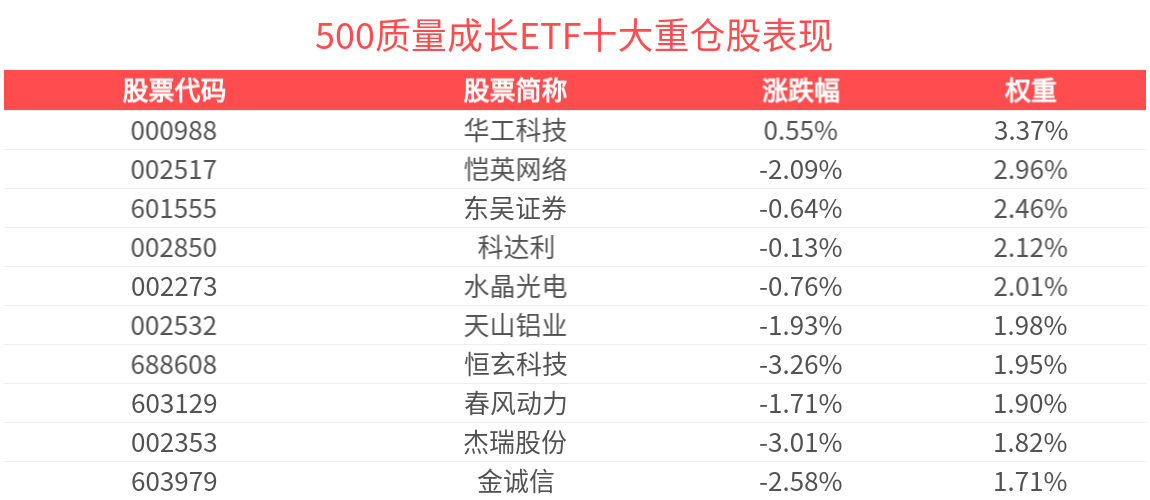
Core Viewpoint - The recent performance of the CSI 500 Quality Growth Index shows a decline, with specific stocks leading gains and losses, indicating market volatility and sector-specific movements [1][2]. Group 1: Market Performance - As of November 17, 2025, the CSI 500 Quality Growth Index (930939) decreased by 1.26%, with Jiuli Special Materials (002318) leading the gainers and Shanghai Electric (600021) leading the decliners [1]. - The CSI 500 Quality Growth ETF (560500) experienced a turnover rate of 0.46%, with a trading volume of 2.1469 million yuan [1]. Group 2: Sector Analysis - CITIC Securities noted increased volatility in the computing power sector, emphasizing the ongoing AI industrial revolution and the need for a long-term perspective on its impact [2]. - Quantum technology is highlighted as a key future industry, with recent advancements such as the joint development of a superconducting quantum computer by China Telecom Quantum Group and Guoshield Quantum [2]. Group 3: Fund and Index Composition - The CSI 500 Quality Growth Index selects 100 companies from the CSI 500 Index based on profitability, sustainability, and cash flow, providing diverse investment options [2]. - As of October 31, 2025, the top ten weighted stocks in the CSI 500 Quality Growth Index accounted for 21.64% of the index, with Huagong Technology (000988) having the highest weight at 3.37% [3][5].
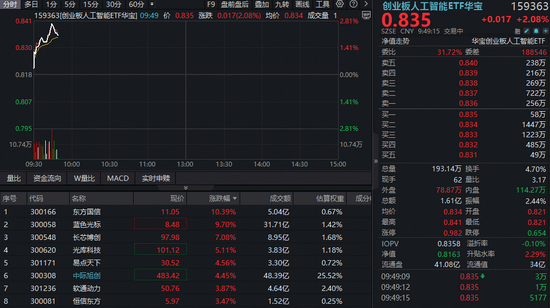
算力重拾涨势!创业板人工智能ETF(159363)反弹超2%!机构:AI带动的算力需求依然非常旺盛
Xin Lang Ji Jin· 2025-11-17 02:11
把握光模块等算力核心机会,建议重点关注全市场首只创业板人工智能ETF(159363)及场外联接(A 类023407、C类023408),标的指数重点布局光模块龙头"易中天",光模块含量超54%。从赛道分布 看,逾七成仓位布局算力,超两成仓位布局AI应用,能够高效捕捉AI主题行情。(截至2025.10.31) 数据来源:沪深交易所等。注:"全市场首只"是指首只跟踪创业板人工智能指数的ETF。 风险提示:创业板人工智能ETF华宝被动跟踪创业板人工智能指数,该指数基日为2018.12.28,发布日 期为2024.7.11。创业板人工智能指数2020-2024年年度涨跌幅分别为:20.1%、17.57%、-34.52%、 47.83%、38.44%,指数成份股构成根据该指数编制规则适时调整,其回测历史业绩不预示指数未来表 现。文中指数成份股仅作展示,个股描述不作为任何形式的投资建议,也不代表管理人旗下任何基金的 持仓信息和交易动向。基金管理人评估的本基金风险等级为R4-中高风险,适宜积极型(C4)及以上的 投资者,适当性匹配意见请以销售机构为准。任何在本文出现的信息(包括但不限于个股、评论、预 测、图表、指标、理论、 ...
【早盘三分钟】11月17日ETF早知道
Xin Lang Ji Jin· 2025-11-17 01:33
Core Insights - The market is currently experiencing fluctuations, with a notable adjustment in the AI sector, particularly in the ChiNext AI index, which saw a decline of over 3% in a single day, indicating a broader market correction [3][4] - The banking sector is showing strong performance, with the China Securities Banking Index rising over 9% since October, significantly outperforming the broader market and the ChiNext index by nearly 13% [4][6] - High dividend yields and low valuations in the banking sector are attracting investor interest, especially in a low-interest-rate environment [4][6] Market Temperature - The market temperature gauge indicates a mixed sentiment, with the Shanghai Composite Index at a 99.09% percentile, Shenzhen Component Index at 84.36%, and ChiNext Index at 43% [1] Sector Performance - The top three sectors with net inflows include Defense and Military (846 million), Real Estate (545 million), and Construction Decoration (471 million) [2] - The sectors with the largest net outflows are Electronics (-14.608 billion), Electric Equipment (-8.542 billion), and Chemical Engineering (-5.713 billion) [2] ETF Performance - The banking ETF (512800) has shown a 0.85% increase on the day and a 4.82% increase over the past six months, indicating strong investor confidence [3][6] - The AI-focused ChiNext ETF (159363) has experienced a significant decline, reflecting the broader market's adjustment in technology stocks [3][4] Investment Strategy - The current investment strategy in the banking sector is supported by its high dividend yield and stable operational characteristics, making it attractive for investors seeking safety and income [4][6] - The AI hardware and computing sectors are expected to remain key market drivers in the upcoming year, despite recent volatility [4]
