
能源金属

Search documents
机构:2026年三条主线有望主导有色板块表现
Zheng Quan Shi Bao Wang· 2025-12-10 07:44
截至收盘,沪银期货主力合约涨超5%,续创历史新高。 平安证券指出,展望2026年,结合宏观与基本面,三条主线有望主导有色板块表现:1)美元信用弱化 及美联储降息有望持续,黄金等贵金属货币属性及金融属性持续计价,同时弱美元提供工业金属向上驱 动。2)供给收缩加速为工业金属基本面核心演绎逻辑,表现在不同金属面临的上游资源约束或中游产 能瓶颈。3)需求新增长极驱动弹性释放,供给出清结束背景下,能源金属基本面改善显著。建议关注 成本优势突出,未来几年内享有量增的各赛道企业:赤峰黄金、山东黄金、洛阳钼业、天山铝业、云铝 股份、神火股份、兴业银锡,锡业股份、中矿资源、华友钴业。 中银证券认为,黄金仍处上升通道,但当前处于加速上行后的高位震荡阶段,后续行情的催化关键在 于"实际利率下行"与"美元走弱"能否形成共振。相比之下,白银的短期确定性更强:当前处于历史高位 的"金银比"蕴含着较大的修复空间,而光伏等工业领域需求增长为银价提供了支撑,较低的库存水平使 其价格短期弹性或优于黄金。 ...
机构策略:市场再度向上运行的可能性正在增加
Sou Hu Cai Jing· 2025-12-10 01:12
Group 1 - Multiple factors support the performance of Chinese equities, maintaining a tactical overweight view on A/H shares [1] - The broad deficit is expected to further expand in 2026, with more proactive economic policies anticipated [1] - If the Federal Reserve lowers interest rates in December, the current stability and appreciation of the RMB will provide favorable conditions for monetary easing in early 2026 [1] Group 2 - November export growth rebounded more than expected, influenced by base effects and resilient demand [2] - The manufacturing PMI new export orders significantly recovered in November, with all sectors showing improvement [2] - Leading indicators suggest a stable external demand environment, with the electronic supply chain likely to continue supporting growth [2]
能源金属板块12月9日跌1.89%,永杉锂业领跌,主力资金净流出11.71亿元
Zheng Xing Xing Ye Ri Bao· 2025-12-09 09:05
从资金流向上来看,当日能源金属板块主力资金净流出11.71亿元,游资资金净流入3.83亿元,散户资金 净流入7.87亿元。能源金属板块个股资金流向见下表: 以上内容为证券之星据公开信息整理,由AI算法生成(网信算备310104345710301240019号),不构成投资建议。 证券之星消息,12月9日能源金属板块较上一交易日下跌1.89%,永杉锂业领跌。当日上证指数报收于 3909.52,下跌0.37%。深证成指报收于13277.36,下跌0.39%。能源金属板块个股涨跌见下表: ...


午评:创业板指涨1.07% 元件及通信服务板块领涨
Zhong Guo Jing Ji Wang· 2025-12-09 03:46
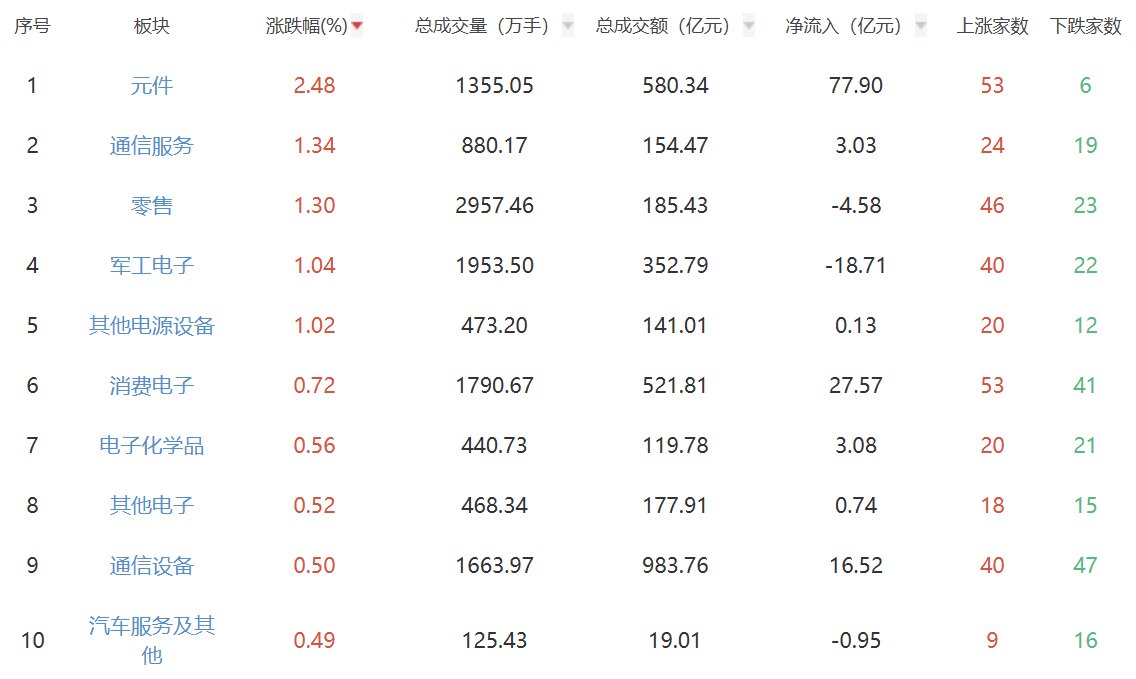
Core Viewpoint - The A-share market experienced fluctuations, with the Shanghai Composite Index slightly declining while the Shenzhen Component and ChiNext Index showed modest gains, indicating mixed market sentiment [1]. Market Performance - The Shanghai Composite Index closed at 3918.83 points, down by 0.13% - The Shenzhen Component Index closed at 13341.62 points, up by 0.09% - The ChiNext Index closed at 3224.38 points, up by 1.07% [1]. Sector Performance Top Gaining Sectors - Components sector increased by 2.48%, with a total trading volume of 1355.05 million hands and a total transaction value of 580.34 billion - Communication Services sector rose by 1.34%, with a trading volume of 880.17 million hands and a transaction value of 154.47 billion - Retail sector grew by 1.30%, with a trading volume of 2957.46 million hands and a transaction value of 185.43 billion [2]. Top Declining Sectors - Industrial Metals sector decreased by 2.69%, with a trading volume of 2784.78 million hands and a transaction value of 333.28 billion - Coal Mining and Processing sector fell by 1.99%, with a trading volume of 762.97 million hands and a transaction value of 55.23 billion - Pharmaceutical Commercial sector also declined by 1.99%, with a trading volume of 903.21 million hands and a transaction value of 83.85 billion [2].

3400股上涨!机构却在悄悄调仓
Sou Hu Cai Jing· 2025-12-08 16:06
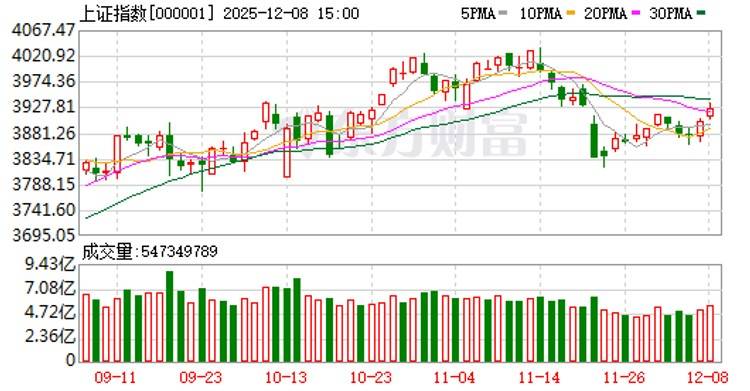
Group 1 - The market experienced a collective rise on December 8, with the Shanghai Composite Index up 0.54%, the Shenzhen Component up 1.39%, and the ChiNext Index soaring 2.6%, alongside a trading volume exceeding 2 trillion yuan [3] - Despite the overall positive market sentiment, the liquor sector saw a net outflow of 1.88 billion yuan, indicating a divergence in sector performance [3] - The semiconductor sector attracted a net inflow of 4.3 billion yuan, followed by electronic components and securities, highlighting the importance of monitoring institutional fund movements [3] Group 2 - Successful stocks must address two challenges: increasing follow-on buying and heavy profit-taking, often resolved through strategic volatility to shake off weak hands [4] - Historical examples, such as the solar energy sector in 2025, illustrate how institutions can create significant price fluctuations to deter retail investors while accumulating shares [4] Group 3 - The performance of stocks during consolidation phases can vary significantly based on institutional participation, with active institutional funds correlating with better future performance [6] - Stocks that remain stagnant without institutional involvement are less likely to rebound, while those with ongoing institutional activity show potential for recovery [6] Group 4 - Recent policy measures, including the emphasis on stability from the Political Bureau and adjustments in financial regulations, are injecting liquidity into the market [8] - Sectors like energy metals and communication equipment have shown early signs of benefiting from these policies, as indicated by quantitative data [8] Group 5 - Investors are advised to focus on data-driven insights rather than superficial market movements, emphasizing the importance of understanding institutional fund dynamics for strategic advantage [10] - Key takeaways include recognizing that not all sectors benefit equally from market rallies, the significance of trading volume, and the utility of quantitative tools to identify major players [11]
A股周一放量上涨 能源金属板块走强
Zhong Guo Xin Wen Wang· 2025-12-08 10:34
Core Viewpoint - The A-share market in China experienced a significant increase on December 8, with major indices rising and the energy metal sector leading the gains [1][2]. Market Performance - The Shanghai Composite Index closed at 3924 points, up by 0.54% - The Shenzhen Component Index closed at 13329 points, up by 1.39% - The ChiNext Index closed at 3190 points, up by 2.6% - The total trading volume in the Shanghai and Shenzhen markets was approximately 20.366 billion yuan, an increase of about 3.109 billion yuan compared to the previous trading day [1]. Sector Performance - The energy metal sector rose by over 3%, leading all industry sectors in the A-share market - Notable individual stocks in this sector included Tianhua New Energy, Zhongmin Resources, Ganfeng Lithium, and Shengxin Lithium Energy, all of which saw stock price increases of over 5% [2]. Regulatory Impact - The China National Financial Supervision Administration announced a reduction in risk factors for various insurance company business operations - The risk factor for insurance companies holding stocks in the CSI 300 Index and the CSI Dividend Low Volatility 100 Index for over three years was lowered from 0.3 to 0.27 - The risk factor for insurance companies holding ordinary shares listed on the Sci-Tech Innovation Board for over two years was reduced from 0.4 to 0.36 - This regulatory change is expected to enhance the capital efficiency and potential allocation capabilities of insurance companies, providing substantial benefits to the investment side of insurance capital and significantly boosting market sentiment [1].
老乡,别走!| 谈股论金
水皮More· 2025-12-08 09:15
Market Overview - A-shares saw a collective rise today, with the Shanghai Composite Index up 0.54% closing at 3924.08 points, the Shenzhen Component Index up 1.39% at 13329.99 points, and the ChiNext Index up 2.60% at 3190.27 points [3] - The trading volume in the Shanghai and Shenzhen markets reached 20.366 trillion, a significant increase of 310.9 billion compared to the previous trading day [3] Policy Impacts - Two major favorable policies can be summarized as "increasing leverage." The first comes from the Financial Regulatory Bureau, which lowered the risk factor for insurance funds investing in CSI 300 constituent stocks and related ETFs from 0.3 to 0.27, potentially releasing around 100 billion in investable funds [5] - The second policy from the CSRC aims to broaden capital space for quality brokerages and relax leverage restrictions, indicating a direction for brokers to "increase leverage" [5] - Both policies target the issue of market funding, reflecting a clear understanding from management regarding the utilization of market funding tools [5] Sector Performance - Financial stocks served as a platform for the market, with the brokerage sector leading the charge, particularly with CITIC Securities driving gains in insurance and banking stocks [5] - However, financial stocks experienced a pullback, with the brokerage sector's gains narrowing to 1.26% and the insurance sector up 1.17% by the end of trading [5] - In contrast, technology stocks emerged as the main focus, with significant performances from companies like Tianfu Communication and Zhongji Xuchuang, leading to substantial gains in the tech sector [6][7] Market Dynamics - The market displayed a mixed performance, with technology stocks being the core focus of capital, while other sectors like consumer stocks showed signs of adjustment [8] - Notably, heavyweight stocks such as China Mobile, China National Offshore Oil, and Kweichow Moutai were among those experiencing declines [8] - The market's overall trading volume surged to 2 trillion, primarily concentrated in the morning session, with a total of approximately 3220 stocks rising and 1838 falling by the end of the day [7] Hong Kong Market Observations - The Hong Kong market exhibited unusual behavior, with the Hang Seng Index experiencing a maximum intraday drop of over 1% and closing near that level [9] - The southbound capital flow remains low, with a net outflow observed during the midday session, indicating a continued lack of investment interest in the Hong Kong market [9]

有色金属行业2026年年度策略报告-20251208
Ping An Securities· 2025-12-08 05:34
Group 1: Precious Metals - Gold - The weakening of the US dollar credit remains the core logic for gold pricing in 2025, with a notable negative correlation between gold prices and the dollar's share in global foreign exchange reserves [11][12] - The Federal Reserve is expected to continue its rate-cutting cycle into 2026, which may support gold prices, especially with concerns over the independence of monetary policy due to potential changes in leadership [13][15] - The long-term trend of weakening US dollar credit is not expected to change, with the US fiscal deficit projected to reach 6.9% of GDP in 2024, indicating ongoing structural issues in the US fiscal system [16][17] Group 2: Industrial Metals - Supply constraints for copper are expected to intensify, with significant disruptions in overseas copper mining projects leading to a projected decrease in output by over 100,000 tons in 2025 [23][24] - The demand for copper is anticipated to grow significantly due to the rise of AI and data centers, with each MW of installed capacity requiring approximately 27 tons of copper [27][28] - The macroeconomic environment, characterized by a weak dollar and continued rate cuts by the Federal Reserve, is expected to drive copper prices upward [29][31] Group 3: Energy Metals - The supply of lithium and cobalt is expected to improve significantly due to the end of overseas capacity clearances and the implementation of supply constraint policies by major producing countries [33] - The demand for energy metals is projected to benefit from the resilience of battery technologies and the growth of the energy storage sector, leading to a positive supply-demand dynamic [33][34] Group 4: Tin - The supply of tin is tightening due to regulatory changes in Indonesia and ongoing production disruptions in Myanmar, with exports from Indonesia declining by approximately 20% year-on-year [45][46] - The global demand for refined tin is expected to grow, particularly in the electronics sector, driven by high semiconductor sales and the increasing use of tin solder in AI and high-performance computing applications [51]





午评:创业板指半日涨3.02% 通信设备板块涨幅居前
Zhong Guo Jing Ji Wang· 2025-12-08 03:48
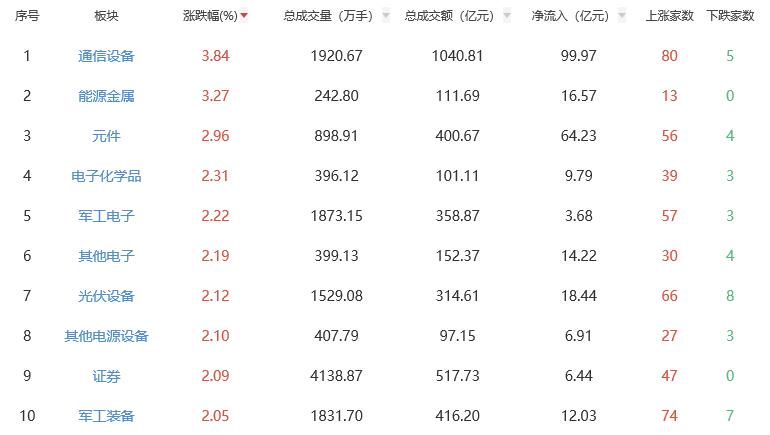
Market Overview - The A-share market experienced a rebound in early trading, with the Shanghai Composite Index closing at 3927.19 points, up 0.62% [1] - The Shenzhen Component Index closed at 13351.47 points, up 1.55% [1] - The ChiNext Index closed at 3203.06 points, up 3.02% [1] Sector Performance - The leading sectors in terms of gains included: - Communication Equipment: up 3.84%, with a total trading volume of 1,920.67 million hands and a total transaction value of 1,040.81 billion [2] - Energy Metals: up 3.27%, with a total trading volume of 242.80 million hands and a total transaction value of 111.69 billion [2] - Components: up 2.96%, with a total trading volume of 898.91 million hands and a total transaction value of 400.67 billion [2] - The sectors with the largest declines included: - Coal Mining and Processing: down 1.26%, with a total trading volume of 836.05 million hands and a total transaction value of 68.98 billion [2] - Oil and Gas Extraction and Services: down 0.78%, with a total trading volume of 459.82 million hands and a total transaction value of 26.31 billion [2] - Chemical Raw Materials: down 0.68%, with a total trading volume of 749.65 million hands and a total transaction value of 72.19 billion [2]
美国铜库存持续流入,非美地区低库存引发逼仓风险
GOLDEN SUN SECURITIES· 2025-12-07 13:33
Investment Rating - The report maintains a "Buy" rating for several companies in the non-ferrous metals sector, including 山金国际, 赤峰黄金, 洛阳钼业, 中国宏桥, and 中钨高新 [5][6]. Core Insights - The report highlights the continuous inflow of copper inventory in the US, while low inventory levels in non-US regions raise concerns about potential short squeezes [2]. - In precious metals, the report notes significant inflows into silver ETFs, with silver prices reaching new highs, supported by a favorable macroeconomic environment [1][33]. - The report emphasizes the mixed factors affecting lithium prices, with a downward trend observed, while cobalt prices remain high due to supply constraints from the Democratic Republic of Congo [3][24]. Summary by Sections Non-Ferrous Metals - **Copper**: US copper inventory continues to flow in, while low inventory in non-US regions raises short squeeze risks. Global copper inventory decreased by 13,000 tons, with a notable reduction in Chinese inventory by 35,000 tons [2]. - **Aluminum**: Positive macro sentiment drives short-term aluminum prices, with theoretical operating capacity in China's electrolytic aluminum industry increasing to 44.17 million tons [2]. - **Nickel**: Nickel prices remain low as consumption enters a seasonal downturn, with supply remaining ample and demand from stainless steel markets weak [2]. Precious Metals - **Silver**: The SLV silver ETF saw a net inflow of 837 tons as of December 5, supporting silver prices amid a favorable macroeconomic backdrop [1][33]. - **Gold**: Gold prices have shown resilience, with COMEX gold at $4,228 per ounce, reflecting a slight weekly decline but a significant annual increase of 60.2% [20]. Energy Metals - **Lithium**: Lithium prices are experiencing a downward trend, with industrial-grade lithium carbonate at 93,000 yuan per ton, reflecting a 0.5% weekly decline [24]. - **Cobalt**: Cobalt prices remain elevated at 398,000 yuan per ton, supported by tight supply conditions and increased purchasing interest from downstream sectors [3][24]. Market Trends - The non-ferrous metals sector has shown a general upward trend, with the overall sector index rising by 5.35% this week, driven by strong performances in industrial metals [17][19].