
宠物

Search documents
平谷下月举办国际宠博会,明年建成全国首家爬宠行业产业园
Xin Jing Bao· 2025-11-11 07:42
Core Viewpoint - The pet economy is emerging as a significant consumer trend in Pinggu District, which is focusing on building an international pet economy ecosystem to contribute to Beijing's international communication and technological innovation centers [1][2]. Group 1: International Pet Expo - The International Pet Expo will be held in December 2025, aiming to create a high-standard, international platform for resource integration and collaboration in the pet industry [2]. - The expo will feature over 600 live pet exhibitors and 200 to 300 corporate exhibitors, providing an international showcase for companies to present new products and expand channels [2]. - Activities such as award ceremonies, forums, and investment competitions will be organized to promote the transition of the pet industry from "scale expansion" to "quality enhancement" [2]. Group 2: Reptile Industry Development - In 2026, Pinggu will host the first global reptile industry event, focusing on compliance breeding, ecological protection, and innovative business models [3]. - The event will include various exhibitions and forums, aiming to establish a new benchmark for the reptile industry and enhance its quality development [3]. - Pinggu District plans to continuously launch pet-friendly activities and optimize the business environment to stimulate urban vitality through the pet economy [3].
进博观潮 看消费市场提质升级
Zhong Guo Qing Nian Bao· 2025-11-11 05:55
Core Insights - The China International Import Expo (CIIE) continues to serve as a platform for observing trends in consumer upgrades, emphasizing its role as a launchpad for global new products and innovative services [1][4] - Key themes emerging from the expo include "intelligent," "personalized," "green," and "health," reflecting a growing consumer demand for high-quality living [1][2] Group 1: Consumer Trends - The aging population is driving the demand for age-friendly products, as seen in IKEA's dedicated section for senior citizens, which addresses safety and convenience in home environments [2][3] - Health-conscious consumption is on the rise, with various sectors showcasing innovations in dietary management, exercise, and health monitoring, aligning with the "Weight Management Year" initiative [2][3] - The demand for high-quality seafood is increasing, with a notable 40% growth in the import of live bread crabs from 2023 to 2024, highlighting the shift towards premium food products [3] Group 2: Market Development - Companies are leveraging the CIIE to explore and cultivate potential markets, with Tmall International introducing over 100 global brand new products tailored for Chinese consumers [6][9] - The introduction of a pet-themed exhibition area aims to enhance consumer awareness and understanding of pet care, indicating a growing market for pet-related products [6][7] - Cross-border e-commerce platforms are facilitating the entry of overseas brands into China, addressing challenges such as market environment uncertainties and compliance hurdles [8][9] Group 3: Brand Engagement - Tmall International is actively involved in supporting overseas brands throughout their market entry process, providing resources and guidance to ensure their success in China [9][10] - The establishment of a "Cross-Border E-commerce Preferred Platform" at the expo aims to connect global brands with Chinese consumers, enhancing the shopping experience and meeting diverse consumer needs [8][10]
万亿“它经济”催生消费新场景 广州首个人宠共融生态空间开业
Zhong Guo Jing Ying Bao· 2025-11-11 01:09
Core Insights - The pet economy in China is projected to exceed 811.4 billion yuan by 2025, with Guangzhou emerging as a key city in the Greater Bay Area for pet industry innovation [1][3] - The opening of the "New Times Luohasi Pet Paradise" marks a significant shift from basic supply to quality upgrades in the pet economy, providing a high-quality space for pet-human interaction [1][4] Industry Growth - China's pet economy has experienced a rapid growth rate of 25.4% CAGR, increasing from 97.8 billion yuan in 2015 to 592.8 billion yuan in 2023, with the younger generation (post-90s and post-00s) accounting for over 66% of pet owners [3][4] - In the Greater Bay Area, the pet ownership penetration rate is 23.5%, with an average annual spending of over 4,000 yuan per pet, and high-end services and cross-industry integrations growing at an impressive rate of 92% [3] Consumer Trends - The "humanization" trend among young pet owners is driving consumption beyond basic needs like food and medical care, extending into social entertainment, emotional companionship, and fashion experiences [3][4] - The integration of AI technology with pet services and cross-industry collaborations is becoming a new engine for high-quality development in the pet economy [3] New Business Model - The New Times Luohasi Pet Paradise spans approximately 1,000 square meters and features a theme of "Loving Pets for a Lifetime," creating an immersive ecosystem that includes pet social areas, themed commercial stores, and supporting service clusters [4] - The park integrates various business models such as pet recreation, light dining, grooming, and interactive experiences, while also hosting unique events like art exhibitions and pet fashion weeks [4] Social Responsibility - The park has been awarded the title of "Community Caring for Stray Animals" by the Guangzhou Pet Industry Association and will regularly conduct public welfare activities such as free clinics and adoptions, aligning with modern consumer values of social responsibility [4] Future Outlook - The establishment of such integrated pet-friendly spaces is expected to become a new hotspot for urban commercial upgrades, contributing to Guangzhou's goal of becoming an international consumption center and enhancing the emerging consumer market [4]


进博首开“萌宠赛道”,“它经济”成消费升级新信号
Hua Xia Shi Bao· 2025-11-11 01:08
Core Insights - The pet economy, once considered a niche hobby, has evolved into a core force supporting a trillion-yuan market, closely linked to rising consumer spending and changing demands for pet-related services [1][5][8] Industry Overview - The pet industry is experiencing significant growth, with the urban pet market in China expected to exceed 300 billion yuan in 2024 and reach over 400 billion yuan by 2027 [5] - The demographic of pet owners is becoming younger and more educated, with individuals born in the 1990s and 2000s accounting for over 60% of pet owners, driving a shift towards quality over quantity in pet products [5][6] Product Innovations - The exhibition showcased various innovative products, including an automatic pet toilet by Xiaopei Technology that monitors pet health and facilitates remote interaction [2][3] - Royal Canin presented a comprehensive nutritional solution for pets throughout their life stages, emphasizing the importance of tailored nutrition [2][3] Market Trends - The pet consumption structure is shifting from basic feeding to health, intelligence, and emotional companionship, indicating a trend towards premiumization in pet products [6][7] - The rise of e-commerce, particularly through social media and live-streaming platforms, is influencing purchasing decisions among younger consumers, who prioritize brand reputation and product transparency [6][7] Economic Impact - The pet economy is seen as a significant contributor to China's high-quality economic development, reflecting changing population dynamics and emotional needs [6][8] - The annual "Double Eleven" shopping festival has become a major battleground for pet product sales, with significant growth in pre-sale amounts compared to previous years [6][8]
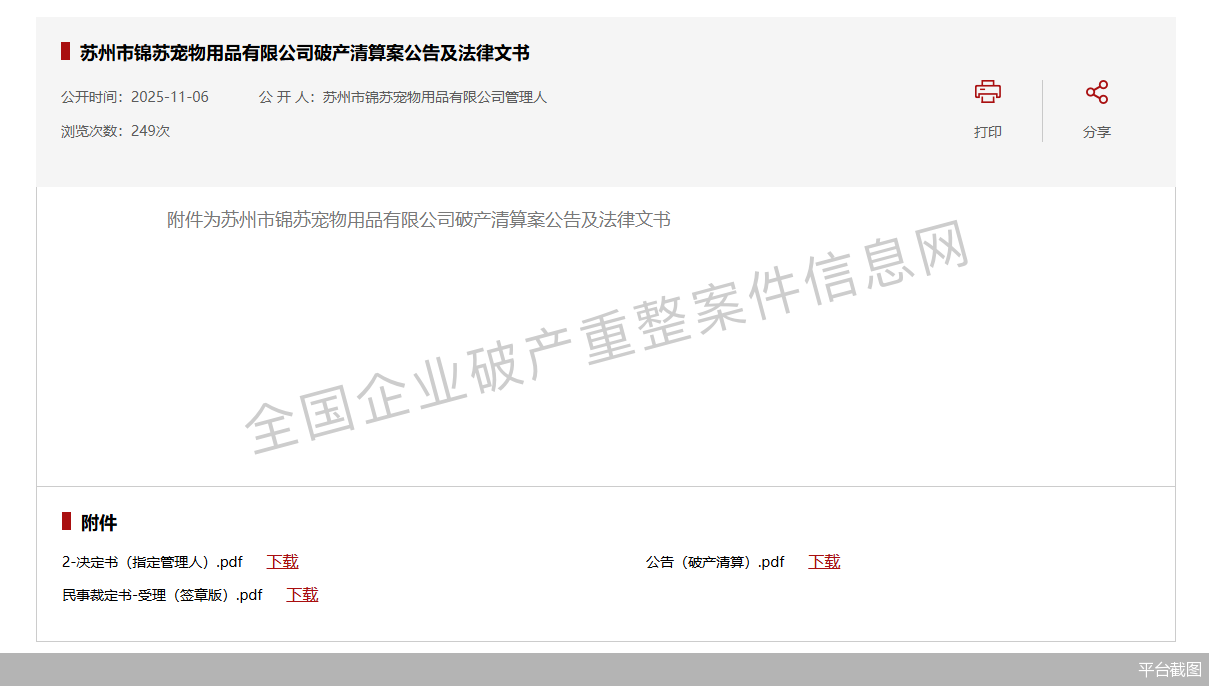
28年老牌宠物企业进入破产清算阶段 行业洗牌加速
Bei Jing Shang Bao· 2025-11-10 14:44
Core Insights - The pet industry is experiencing a significant downturn, with several once-thriving companies, including Suzhou Jinsu Pet Products Co., Ltd., entering bankruptcy proceedings due to the fading export boom and increasing market pressures [1][6]. Company Summaries - Suzhou Jinsu Pet Products Co., Ltd. has been officially accepted for bankruptcy proceedings by the Wuzhong District People's Court, marking a significant shift for the company that has operated for approximately 28 years, primarily exporting pet toys and accessories to markets such as the US, Canada, and Japan [3][5]. - Other companies, such as Pingyang County Kongying Pet Products Co., Ltd., have also entered the debt claim stage, indicating a broader trend of financial distress within the industry [5]. - Hangzhou Petyuan Pet Products Co., Ltd. and its affiliates have begun bankruptcy review processes, highlighting the challenges faced by companies that initially thrived through online platforms but struggled with offline expansion [5][6]. Industry Trends - The pet industry in China, which began as an OEM/ODM manufacturing hub, is now facing dual pressures from both domestic and international markets, leading to a decline in export revenues [6][7]. - Despite the challenges, the overall pet consumption market in urban China has surpassed 300 billion yuan, with an annual growth rate exceeding 10%, indicating a potential for recovery and growth in the sector [8]. - The market is shifting towards brand localization, with domestic brands gradually gaining market share as consumer preferences evolve towards higher quality and specialized pet products [8][9]. - The pet services market, including pet boarding and photography, is also expanding, reflecting changing consumer demands and the need for innovation within the industry [9].
生猪去化或将加速:——农林牧渔行业周报-20251110
Guohai Securities· 2025-11-10 11:14
Investment Rating - The report maintains a "Recommended" rating for the agricultural, forestry, animal husbandry, and fishery industry [1] Core Views - The report highlights that the de-stocking of live pigs may accelerate, with a focus on the value reassessment opportunities in the pig sector due to ongoing regulatory measures [3][4] - The poultry sector is expected to see improvements in its fundamentals, while the animal health sector is poised for performance recovery and advancements in African swine fever vaccine clinical trials [5][6] - The pet economy is thriving, with strong growth in domestic brands, indicating a rapid development phase for the pet industry [9][10] Summary by Sections 1. Swine - The swine industry is undergoing deepening regulatory measures aimed at controlling prices through capacity reduction. Short-term pressures on pig prices are anticipated due to increased market supply and inventory adjustments. The expectation is for a gradual policy approach rather than aggressive interventions [3][4][15] - Key companies recommended include Muyuan Foods and Wens Foodstuffs, with additional attention on Dekang Agriculture, Shennong Group, and Juxing Agriculture [3][16] 2. Poultry - The poultry sector shows signs of fundamental improvement, with data indicating a rise in the number of breeding stock and a shift towards self-breeding [4][25] - Recommendations include Shennong Development and Lihua Stockbreeding, as the industry navigates through low price periods [4][25] 3. Animal Health - The animal health sector has seen revenue and profit growth among listed companies, with notable performances from Reap Bio and Keqian Bio. The clinical trials for African swine fever vaccines are progressing, which may enhance market prospects [5][32] - Recommended companies include Keqian Bio, Reap Bio, and attention on Huazhong Bio and other related firms [5][32] 4. Planting - Grain prices are on the rise, with significant increases in corn and soybean meal prices noted. The commercialization of genetically modified seeds is progressing, benefiting companies with early investments in research and development [7][37] - Companies to watch include Suqian Agricultural Development, Longping High-Tech, and Denghai Seeds [7][42] 5. Feed - The feed industry is experiencing price fluctuations, with a noted increase in production volume. The concentration of the industry is expected to continue rising [8][43] - Recommended companies include Haida Group and Hefa Shares [8][45] 6. Pets - The pet market is projected to reach a scale of 300.2 billion yuan in 2024, with significant growth in both dog and cat segments. The report emphasizes the rapid development of domestic brands in this sector [9][54] - Recommended companies in the pet food sector include Guibao Pet, Zhongchong Shares, and Petty Shares, with a focus on the medical segment as well [9][55]


低欲望时代,这五个赛道仍在疯狂卷钱
创业家· 2025-11-10 10:13
Core Insights - The article discusses the decline in sales for Durex and the broader sexual health industry, attributing it to a societal shift towards lower desire and changing consumer behaviors [2][3] - It identifies five high-growth sectors that have emerged as alternatives to traditional sexual health products, reflecting the evolving needs of consumers in a low-desire society [4][20] Group 1: Decline in Traditional Markets - Durex's sales halved in 2020, with the entire industry experiencing a 40% decline, and marriage rates dropping by 20% [2] - The overall e-commerce sales during the 618 shopping festival saw a negative growth of 7%, and the Double Eleven event has not reported results for four consecutive years [3] Group 2: Emerging Growth Sectors - The pet consumption market is projected to reach 302 billion yuan in 2024, with an average of one pet for every three young people [4] - Spending on pets has surpassed that of the maternal and infant sector, with a surge in new products such as pet delivery services and smart pet gadgets [5] - The "Endorphin Economy" has seen a rise in sports participation, with 200 million new sports enthusiasts in China over the past decade, leading to increased sales for brands like Asics and New Balance [8] - The fragrance market is growing at a rate of 10% annually, with a market size of 850 million USD in 2023, driven by brands like Aesop and Le Labo [8] - Emotional fast-moving consumer goods (FMCG) are gaining traction, characterized by low prices and quick decision-making, providing immediate emotional satisfaction [11][12][14] - The "Self-Rescue Economy" is emerging, with products like probiotic cola and health teas gaining popularity, reflecting a trend of seeking comfort amid anxiety [16][19] Group 3: Consumer Needs in a Low-Desire Society - The five growth trends identified correspond to the needs of a low-desire society: companionship, control, healing, ritual, and security, which add extra value to products [20]

10月第三方能繁降幅扩大,建议关注成本优秀龙头:农林牧渔行业周报(20251103-20251107)-20251110
Hua Yuan Zheng Quan· 2025-11-10 07:10
Investment Rating - The industry investment rating is "Positive" (maintained) [1] Core Viewpoints - The swine industry is experiencing accelerated declines in breeding stock, with a reported decrease of 0.77% in October compared to the previous month. The average price of pork in October was 11.69 yuan/kg, down 1.41% month-on-month, indicating a potential ongoing capacity reduction in the industry [5][18] - The policy direction in the industry is shifting towards protecting farmers' rights and stimulating enterprise innovation, suggesting that future growth stocks will focus more on technological content and innovative models [6][19] - The poultry sector is facing a persistent contradiction of "high capacity, weak consumption," leading to losses that may force breeding farms to reduce production capacity [7][19] - The feed sector is recommended to focus on Hai Da Group due to its management effectiveness and expected growth in production capacity [8][20] Summary by Sections 1. Swine Industry - In October, the breeding stock decreased by 0.77%, with a significant increase in the culling of sows by approximately 12.41%. The industry is expected to enter a phase of active capacity reduction as prices fall below cost levels [5][18] - The government is implementing capacity control measures to stabilize pork prices, which may lead to improved profitability for listed companies as costs decline [6][19] 2. Poultry Industry - The price of chicken chicks in Yantai was reported at 3.50 yuan/chick, down 2.8% month-on-month and 20.5% year-on-year. The price of broiler chickens was 3.45 yuan/kg, also down 2.8% month-on-month and 8.7% year-on-year [7][19] - The industry is expected to see an increase in market share for integrated enterprises and contract farming due to ongoing losses [7][19] 3. Feed Industry - The report highlights a slight decline in aquatic product prices, with various fish species showing mixed performance in price changes [8][20] - Hai Da Group is recommended for its expected growth and effective management, with a focus on increasing market share and overseas growth [9][20] 4. Pet Industry - The pet industry is showing an increase in sales growth compared to September, indicating a trend towards higher market concentration among leading brands [10][22] - Recommendations include focusing on companies with strong brand performance and those actively expanding their domestic market presence [25] 5. Agricultural Products - The report notes that soybean prices have reached new highs, but domestic soybean meal prices remain under pressure due to high inventory levels and weak downstream purchasing sentiment [14][26] - The rubber market is expected to continue fluctuating, influenced by macroeconomic factors and stable import levels [14][26] 6. Market and Price Situation - The Shanghai and Shenzhen 300 Index closed at 4679, up 0.82% from the previous week, while the Agricultural and Forestry Index closed at 2970, up 0.79% [27][30] - The report indicates that the agricultural sector is experiencing a significant increase in investment value due to its unique characteristics and historical low valuations [14][26]
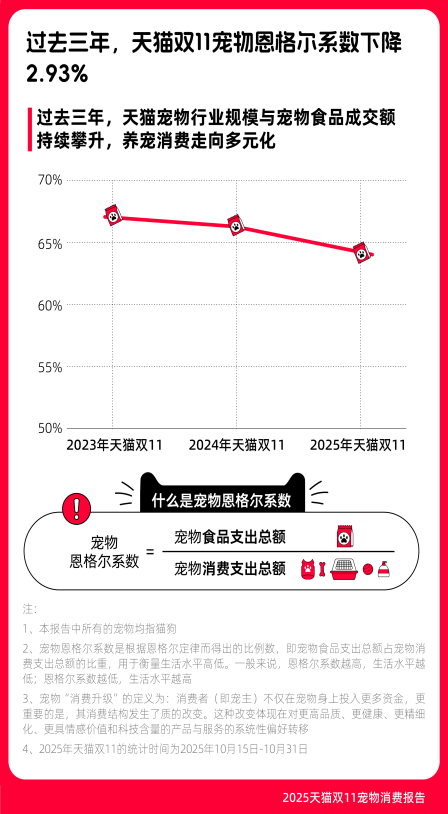
《2025天猫双11宠物消费报告》:养宠消费走向多元化,三年双11宠物恩格尔系数下降2.93%
Zhong Guo Jing Ji Wang· 2025-11-10 06:15
Core Insights - The report from Tmall indicates a significant shift in pet consumption from "basic feeding" to "refined pet care," highlighting a trend towards consumption upgrade in the pet industry [1][3] Consumption Upgrade - Over the past three years, the Engel coefficient for pet consumption on Tmall has decreased by 2.93%, indicating a diversification in pet spending [1] - The share of high-priced essential pet products has increased, while the variety of non-essential items has also expanded, confirming the trend of consumption upgrade [1][4] Pet Food Trends - High-end pet food categories, such as wet food, baked food, fresh food, freeze-dried food, and prescription food, are gaining a higher share of consumption on Tmall [3] - More than 80% of pet owners have adopted a scientific feeding habit that combines dry and wet food, shifting from merely filling pets to providing quality nutrition [3] Cat Litter Consumption - The share of cat litter priced above 200 yuan has increased from 34% during the 2023 Double 11 to 45% in 2025, indicating a growing preference for higher-quality products [6] - The top-selling cat litter types are now more focused on higher-priced mineral and plant-based litters, which offer better clumping, less dust, and improved comfort [6][8] Pet Health Products - Tmall offers nearly 50,000 types of pet health products, with the fastest-growing categories being cat health products targeting specific issues like heart and urinary problems, which have seen over 120% growth [8] - The shift in pet owners' mindset from "treating illness" to "preventing illness" aligns with the emotional consumption trend of treating pets as family members [8] Smart Pet Products - Smart pet products are becoming integral to pet care, with significant growth in sales for smart wearables (1560%), smart toys (1470%), and smart feeding devices (over 160%) during the Double 11 sales [9] - The popularity of smart storage containers has notably boosted the brand meoof, which entered the top 20 pet product brands on Tmall for the first time [9]
源飞宠物股价涨5.16%,同泰基金旗下1只基金重仓,持有6.15万股浮盈赚取7.2万元
Xin Lang Cai Jing· 2025-11-10 03:23
Core Viewpoint - Yuanfei Pet's stock price increased by 5.16% to 23.85 CNY per share, with a total market capitalization of 4.553 billion CNY, indicating positive market sentiment towards the company [1] Company Overview - Yuanfei Pet Products Co., Ltd. was established on September 27, 2004, and went public on August 18, 2022. The company is located in Pingyang County, Zhejiang Province, and specializes in the research, production, and sales of pet supplies and pet snacks [1] - The revenue composition of Yuanfei Pet is as follows: pet snacks 52.09%, pet leashes 24.77%, pet food 9.79%, others 7.72%, and pet toys 5.64% [1] Fund Holdings - Tongtai Fund has a significant holding in Yuanfei Pet, with its Tongtai Huize Mixed A Fund (008050) holding 61,500 shares, accounting for 8.32% of the fund's net value, making it the fifth-largest holding [2] - The fund has reported a floating profit of approximately 72,000 CNY from this investment [2] Fund Manager Performance - The fund manager Ma Yi has a tenure of 11 years and 239 days, with the fund's total asset size at 2.718 billion CNY. The best return during his tenure is 45.09%, while the worst is -3.46% [3] - Co-manager Mai Jianpei has been in the role for 183 days, managing assets of 231 million CNY, with a best return of 21.52% and a worst return of -3.46% during his tenure [3]