
芯片半导体

Search documents
经济和市场会有开门红吗
2026-01-28 03:01
Summary of Conference Call Records Industry Overview - The economic outlook for Q1 2026 is optimistic, with an expected real GDP growth rate of around 5% and a nominal GDP growth rate of approximately 4.5% [1][7] - Fixed asset investment is anticipated to rebound significantly, benefiting from policy support and major projects under the "15th Five-Year Plan" [1][5] - Consumer spending is projected to recover, with goods consumption growth expected to rise to 3%-4% due to the Spring Festival effect and subsidies for replacing old products [1][6] Key Points and Arguments - **Economic Growth**: Despite a high base in Q1 2025, historical data suggests that it will not constrain growth in Q1 2026. A comparison with Q4 2025, which had a growth rate of 4.5%, indicates that achieving over 5% in Q1 2026 would signify a reversal of the economic downturn [3][4] - **Investment Recovery**: Investment is expected to show a significant improvement, with a potential increase of over 15 percentage points if it returns to the average growth rate of about 4% seen in previous years [4][5] - **Consumer Spending**: The service sector is likely to perform well due to increased activities during the Spring Festival, and the early launch of the replacement subsidy program is expected to release pent-up demand [6] - **Monetary Policy**: The current monetary policy emphasizes efficiency and flexibility, with limited room for interest rate cuts. The focus is on stabilizing the exchange rate rather than direct intervention [8][9] - **Fiscal Policy**: The fiscal policy for 2026 is expected to focus on structural adjustments rather than mere expansion, with a narrow deficit rate maintained at around 4.0% and a potential decrease in the broad deficit rate [10] Additional Important Insights - **Real Estate Support**: The likelihood of using fiscal subsidies to support the real estate market is low, with more feasible measures being local government actions to reduce transaction and financial costs [11] - **Public Fund Reform**: Public fund reforms are expected to play a significant role in supporting housing demand and stabilizing the real estate market [12] - **Capital Market Outlook**: The capital market is viewed positively, with stocks considered the most promising asset class. The recovery of PPI is crucial for supporting corporate profits, particularly in the technology sector [2][13][14] - **Market Volatility**: Recent stock market volatility has increased, with significant adjustments in various indices. The market is experiencing a rotation among sectors, with small-cap stocks showing resilience [15][16] - **Investment Strategy**: In a rapidly changing market, focusing on stable sectors with long-term growth potential, such as non-ferrous metals and chemicals, is recommended over more volatile growth sectors like AI [17][18]
未知机构:1月27日复盘笔记芯片半导体AI应用AI算力贵金属太空光伏等-20260128
未知机构· 2026-01-28 02:10
Summary of Conference Call Notes Industry Overview - The conference notes cover various sectors including semiconductors, AI applications, precious metals, and space photovoltaics [1][2][3][4][5][6][7][8][9][10][11][12]. Key Points and Arguments Semiconductor Industry - In 2025, the total profit of industrial enterprises above designated size in China is projected to reach 73,982 billion yuan, reflecting a growth of 0.6% compared to the previous year [1] - Micron Technology has commenced construction of an advanced wafer manufacturing facility in Singapore, with an investment of approximately $24 billion planned over the next decade, expected to be operational by the second half of 2028 [1] - Samsung Electronics has raised NAND flash supply prices by over 100% in Q1, significantly exceeding market expectations [2] - TSMC is expected to reduce 15%-20% of its mature process capacity by 2028 to reallocate resources for advanced packaging technology [2] - The demand for semiconductor equipment is anticipated to rise due to sustained AI computing needs, an upward cycle in storage chips, and the penetration of advanced packaging technology, with a strong growth outlook for the semiconductor equipment market by 2026 [3] AI and Cloud Computing - Amazon Web Services (AWS) has increased its EC2 machine learning capacity block prices by approximately 15%, indicating a significant shift in cloud computing pricing logic amid AI resource shortages [4] - This price increase may trigger a chain reaction in the industry, prompting domestic and international cloud providers to follow suit [5] - A report from CignalAI forecasts that the revenue from optical modules driven by AI will exceed $18 billion by 2025, with related optical modules revenue nearing $6 billion [5] Precious Metals - Spot gold has reached $5,070 per ounce, marking a daily increase of 1.21% [5] - Spot silver has surpassed $110 per ounce, achieving a historical high [5] Space and Aerospace - Elon Musk has announced plans to deploy 100 GW of data centers annually over the next 4-5 years using Starship, with each satellite equipped with 100 kW solar wings, corresponding to approximately 100 GW of space photovoltaic installations [6] - China Commercial Aircraft Corporation plans to moderately increase the production and delivery of its C919 narrow-body aircraft, targeting the delivery of 28 or more units this year [7] - Hainan International Commercial Space Launch Company has issued multiple tender announcements for the procurement of liquid methane, helium, and liquid oxygen/nitrogen for launch tasks from 2026 to 2028, with a total budget of approximately 220 million yuan [8] Economic Indicators - Fujian Province has successfully completed its "14th Five-Year Plan," with the provincial GDP projected to exceed 6 trillion yuan by 2025 [9] Technological Innovations - A collaboration between Xi'an University of Electronic Science and Technology and the National Space Science Center has led to the development of a high-performance single crystal diamond radiation detector, enhancing reliability and performance in deep space environments [10] Additional Important Information - The Shanghai Composite Index rose by 0.18%, while the Shenzhen Component Index increased by 0.09%, and the ChiNext Index rose by 0.71% [1] - The total trading volume in the Shanghai, Shenzhen, and Beijing markets exceeded 2.9 trillion yuan, a decrease of over 300 billion yuan compared to the previous day [1] - Companies mentioned include Micron Technology, Samsung Electronics, TSMC, Amazon Web Services, and various semiconductor and aerospace firms [1][2][3][4][5][6][7][8][9][10][11][12].
杨德龙:2026年做好大类资产配置至关重要
Xin Lang Cai Jing· 2026-01-27 03:08
Group 1 - Current international gold prices are at historical highs, and a short-term pullback is considered normal. If risk aversion decreases, some funds may exit the gold market to seek other asset allocation directions [1][8] - Compared to overvalued US stocks, A-shares and Hong Kong stocks remain undervalued in the global capital market. The CSI 300 index has a price-to-earnings ratio of only 15 times, which is below historical averages, indicating significant room for growth [1][8] - Recent technological breakthroughs in China, particularly in large models, semiconductor chips, and big data, have enhanced global capital confidence in Chinese technological innovation, reversing some pessimistic expectations about the Chinese economy [1][8] Group 2 - Since 2025, market expectations for economic recovery have increased, leading to a shift towards equity assets, which has significantly boosted the stock market. This trend is expected to continue into 2026, attracting more investors [2][9] - Approximately 50 trillion RMB of fixed deposits will mature in 2026, with previous rates around 3% now dropping to about 1%. This situation compels funds to reconsider their allocation between low-interest deposits and potentially more lucrative equity or bond markets [2][9] - In 2025, new fund sales in China exceeded 1 trillion units, with over half being equity funds, contrasting sharply with the previous year dominated by fixed-income funds, indicating a growing interest in equity asset allocation [2][9] Group 3 - The current market is characterized as a slow bull market rather than a fast bull market, suggesting that investors should maintain a stable stock-bond allocation ratio and hold positions for several years without frequent adjustments [3][10] - Equity funds are more volatile and suitable for risk-tolerant investors, while bond funds, although generally stable, can still experience fluctuations due to interest rate changes and liquidity issues [3][10] - The performance of different asset classes is showing significant divergence, with the real estate market experiencing a downturn, leading to a shift in investment strategies towards quality stocks and funds as the primary vehicles for wealth growth [4][11] Group 4 - The slow bull market provides a unique opportunity for investors to choose industries, stocks, and funds, allowing them to share in market growth without the pressure of rapid fluctuations [5][12] - Investors are advised to align their portfolios with the economic transformation and focus on sectors that align with national development strategies, avoiding industries that are gradually being phased out [6][12] - Continuous learning and improving financial literacy are essential for investors to navigate the stock market effectively, as the quality of individual stocks can vary significantly [6][12]
科创100ETF鹏华(588220)日均成交5.96亿,一键布局科技成长龙头企业
Xin Lang Cai Jing· 2026-01-26 06:01
Group 1 - The semiconductor sector is experiencing fluctuations, with funds flowing into broad-based investments, as evidenced by the recent net inflow of 206 million yuan into the Penghua Sci-Tech 100 ETF, totaling 683 million yuan over the past 10 trading days [1] - The Hurun Research Institute released the "2025 Hurun Future Unicorns" list, identifying 304 high-growth companies likely to reach a billion-dollar valuation by the end of 2030, with over 60% of these companies in the fields of biotechnology, health technology, enterprise services, semiconductors, and artificial intelligence [1] - Huafu Securities remains optimistic about the storage price increase and emphasizes investment opportunities in materials and equipment, highlighting a three-stage performance release in the storage sector [1] Group 2 - The Penghua Sci-Tech 100 ETF closely tracks the Shanghai Stock Exchange Sci-Tech 100 Index, which selects 100 securities with medium market capitalization and good liquidity from the Sci-Tech board [2] - As of December 31, 2025, the top ten weighted stocks in the Sci-Tech 100 Index include Huahong Semiconductor, Dongxin Co., and Yuanjie Technology, accounting for a total of 26.21% of the index [2] - The top three industries by weight in the index are electronics (37.42%), power equipment (14.02%), and biomedicine (13.79%) [2]
杨德龙:2026年A股和港股的投资机会依然较多
Xin Lang Cai Jing· 2026-01-23 07:51
Group 1 - The market shows resilience despite recent cooling, with a "spring offensive" anticipated as credit issuance peaks in January, potentially reaching 4 trillion RMB [1][8] - The first quarter is typically a "window" for companies to disclose earnings, allowing for market momentum as most companies do not report formal earnings during this period [1][8] - The discussion around investment returns during the previous year's Spring Festival has created a "wealth effect," attracting more retail investors into the market [1][8] Group 2 - A slow bull market has been established, with investor confidence gradually increasing, and skepticism about the bull market diminishing [2][8] - By 2026, approximately 50 trillion RMB in bank deposits will mature, prompting investors to choose between low-interest renewals or reallocating funds into stocks, bonds, or funds [2][8] - This shift indicates a potential acceleration of capital moving from savings to the stock market, providing additional liquidity [2][8] Group 3 - In 2025, technology stocks are expected to outperform traditional sectors, which are struggling during the economic transition [3][9] - New industries such as AI and semiconductor sectors are thriving, while traditional industries face significant challenges [3][9] Group 4 - The market is expected to deepen in 2026, with more sectors likely to experience rotation, as many traditional stocks are at historical lows and may present investment opportunities [4][10] - Investors will need to decide between high-flying tech stocks and undervalued traditional stocks, leading to diverse investment strategies [4][10] Group 5 - The U.S. financial market is experiencing a simultaneous decline in stocks, bonds, and the dollar, raising concerns about the stability of the dollar [5][11] - The rise in gold prices, nearing $4,800 per ounce, reflects a growing distrust in the dollar, with predictions of further increases in gold prices [5][11] Group 6 - A-shares are expected to outperform Hong Kong stocks, which in turn will outperform U.S. stocks, as domestic investors seek new opportunities in the capital market [6][12] - The potential for a "golden decade" in the A-share market is supported by the shift of residential savings into capital markets [6][12]
和讯投顾高璐明:1月23日早评,央行重磅!今天还会涨吗?
Sou Hu Cai Jing· 2026-01-23 02:05
Group 1 - The central bank has announced a significant monetary easing measure by initiating 900 billion yuan of medium-term lending facilities with a one-year term, which is expected to release more funds into the market, providing substantial support for the economy and market stability [1] - The successful development of fiber chips by Chinese scientists is expected to bring positive impacts to the semiconductor and related industries, while the potential independent listing of Alibaba's Pingtouge adds new vitality to the chip sector [1] - The current market is in the process of bottoming out, with a high probability of continued upward movement, supported by strong performances in overseas markets and the recent surge in gold and silver prices, which have risen by 3.7% and 6% respectively, reaching historical highs [1] Group 2 - The regulatory stance indicates that the trend of market stability remains unchanged, but there may be a control over the pace of healthy market operations, making a fluctuating upward trend more suitable for the current market environment [2] - The commercial aerospace and software sectors, which were previously identified for short-term pullbacks, are beginning to stabilize, with major short-selling pressures gradually dissipating, indicating a trend of rebound and presenting short-term opportunities [2] - The market is currently in a bottoming process and is likely to maintain a fluctuating upward trend, with strategies focusing on identifying low-position opportunities for participation and layout [2]
此轮牛市能走多远?涨多高?
泽平宏观· 2026-01-22 18:18
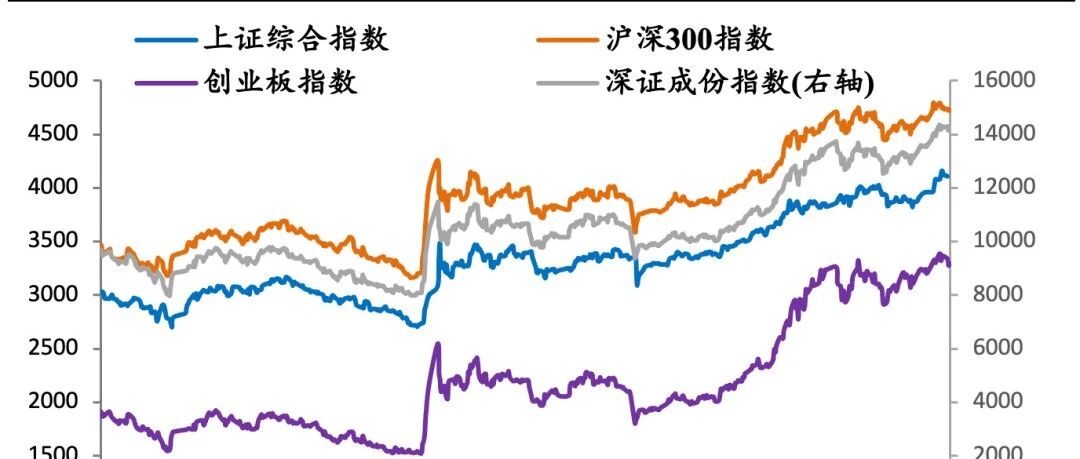
Core Viewpoint - A new bull market, termed "confidence bull," has emerged since September 2024, driven by significant policy easing, abundant liquidity, and a new wave of technological revolution, marking a historic opportunity for investors [3][10]. Group 1: Characteristics of the Current Bull Market - This bull market is described as a once-in-a-decade event, comparable to previous major bull markets in 2004-2007 and 2014-2015, with the current market driven by policy relaxation, liquidity, and technological advancements [4][5]. - The Shanghai Composite Index has risen by 56.2% and the ChiNext Index by 122.2% since their respective lows in 2024, indicating substantial market growth [6]. - Trading volume has surged from a few hundred billion to over 3 trillion, and market capitalization has increased from 70 trillion to 123 trillion, creating a wealth effect exceeding 50 trillion [9]. Group 2: Three Major Drivers of the Bull Market - The bull market is supported by three main drivers: continuous policy easing, a new technological revolution, and abundant liquidity, which together create a "confidence bull" [10]. - Policy easing since September 2024 has included interest rate cuts, relaxed housing market restrictions, and significant infrastructure investments, leading to increased risk appetite and lower risk-free rates [10][11]. - The technological revolution, characterized by advancements in AI, robotics, and semiconductor industries, has led to a surge in high-risk growth stocks, driving the current market [11]. Group 3: Historical Missions of the Bull Market - The current bull market is expected to fulfill three historical missions: supporting the development of new productive forces, aiding in major power competition, and repairing residents' balance sheets [13]. - The transition to high-quality economic development necessitates capital market support for new economy sectors, which are often unable to secure financing through traditional banking systems [13]. - The bull market's prosperity is crucial for addressing the challenges posed by the decline in real estate values, which have significantly impacted household wealth and consumption [14]. Group 4: Future Prospects and Outlook - The sustainability of the bull market will depend on continued macroeconomic policy easing, including further interest rate cuts and fiscal measures to stimulate demand [16]. - The market's volatility, characterized by rapid rises and falls, necessitates effective regulation of leverage to ensure healthy development [16][17]. - A long-lasting bull market could significantly enhance wealth effects, stimulate economic activity, and promote technological innovation, creating a positive feedback loop for the economy [17].

科技类企业支撑深圳近三成办公楼租赁市场
2 1 Shi Ji Jing Ji Bao Dao· 2026-01-21 09:33
Core Insights - The new economic sectors represented by consumer electronics, smart manufacturing, brand overseas expansion, and related professional services are becoming significant support for leasing demand [1] Demand Side - Shenzhen's corporate tenants are continuously optimizing real estate strategies through flexible leasing arrangements and strict cost control, with lease renewals and cost-driven relocations remaining dominant strategies [2] - Technology companies dominate market demand, accounting for nearly 30% of transaction area, with the smart manufacturing sector showing particularly strong activity [2] - Major technology and financial companies contribute significantly to net absorption, accounting for over half of the total net absorption for the year [2] Supply Side - The Shenzhen Grade A office market is expected to see a peak in supply in 2025, with 15 new projects entering the market, adding nearly 1.16 million square meters, the highest level in three years [4] - The overall vacancy rate for Grade A offices is projected to rise by 1.8 percentage points to 26.2% due to the combined effects of new supply and tenant adjustments [4] - The Qianhai area is expected to perform relatively well due to competitive rental levels and improved commercial amenities, with a decrease in vacancy rates in the fourth quarter [4] Structural Changes - The supply side is undergoing structural optimization, with some ongoing and existing projects introducing hotel operations to alleviate vacancy pressure [5] - In 2026, over 1.5 million square meters of new supply is anticipated, with a continued focus on hard technology sectors and the expansion of office spaces [5] - Companies are shifting their site selection criteria from a single price focus to a comprehensive evaluation of "extreme cost-performance ratio" and property management, benefiting quality office spaces in core business districts [6]
芯片半导体板块盘初走强,科创芯片ETF易方达(589130)、半导体设备ETF易方达(159558)等产品受关注
Mei Ri Jing Ji Xin Wen· 2026-01-21 02:37
Group 1 - The core viewpoint of the article highlights the significant growth in the semiconductor industry, particularly in storage chips, driven by the explosion of AI demand and supply-side contraction [1] - The semiconductor equipment ETF, E Fund (159558), has seen a net inflow of funds for 16 consecutive trading days, totaling over 2.3 billion yuan [1] - The semiconductor industry indices, including the Shanghai Stock Exchange Sci-Tech Innovation Board Chip Index and the CSI Semiconductor Materials and Equipment Theme Index, reflect the overall development trend of the semiconductor industry, with digital chip design and semiconductor equipment being the top two weighted sectors, accounting for approximately 65% [1] Group 2 - The report from CITIC Securities indicates that the storage chip sector is currently in a price increase phase, leading to a performance explosion for global storage industry chain companies [1] - The acceleration of storage production line construction and the increase in domestic production rates are expected to create investment opportunities in supporting semiconductor equipment and packaging and testing sectors [1] - The E Fund Sci-Tech Chip ETF (589130) and the E Fund Semiconductor Equipment ETF (159558) are designed to help investors easily access leading companies in the semiconductor industry chain [1]
杨德龙:2026年资本市场的主要投资机会|立方大家谈
Sou Hu Cai Jing· 2026-01-20 12:12
Economic Growth and Structure - In 2025, China's GDP achieved a growth of 5%, meeting the initial target, but quarterly growth rates showed a declining trend: 5.4%, 5.2%, 4.8%, and 4.5% [1] - The trade surplus reached a historic high of over $1.1 trillion, demonstrating strong export competitiveness despite trade tensions [1] - The Consumer Price Index (CPI) growth rate was 0%, and the Producer Price Index (PPI) experienced negative growth, indicating insufficient demand and excess capacity in the industrial sector [1] Industrial and Consumption Data - Industrial production saw a growth of 5.9% for the year, with notable increases in 3D printing equipment (52.5%), industrial robots (28%), and new energy vehicles (25.1%) [2] - Retail sales of consumer goods surpassed 50 trillion yuan, growing by 3.7%, but the growth rate showed a significant slowdown, particularly in December with a year-on-year increase of only 0.9% [2] Investment Trends - Fixed asset investment decreased by 3.8%, primarily due to a 17.2% decline in real estate development investment, highlighting the pressure on stabilizing investment amid real estate adjustments [3] - The National Development and Reform Commission emphasized the need to strengthen domestic demand and adapt to the upgrading of demand structures, with plans to develop a strategy for expanding domestic demand from 2026 to 2030 [3] Industry Focus and Future Opportunities - The focus for 2026 includes sectors like robotics, AI, and innovative pharmaceuticals, with expectations for continued growth in technology-driven industries [4] - The construction of 6G networks is anticipated to create new demand for communication equipment, while the commercial aerospace sector has seen a significant correction after previous hype [4] Market Outlook and Investment Strategy - The market is expected to continue a slow bull trend, with a focus on technology stocks and some undervalued quality stocks attracting attention [5] - Investors are advised to maintain a rational approach, avoiding excessive leverage and focusing on long-term, value-based investments to capitalize on the slow bull market opportunities [5]