
TMT

Search documents
美联储降息跟你有什么关系?一文读懂汇率、黄金、A股背后的关系
Sou Hu Cai Jing· 2026-02-01 23:09
美联储降息不是遥远的国际新闻,而是会渗透到你钱包的"金融涟漪"。 从换汇留学的成本,到黄金理财的收益,再到A股账户的盈亏,都被一条无形的传导 链条串联。 当前市场预期美联储2026年将开启降息周期,95%概率为25bp的"预防式降息"。 对普通人而言,无需纠结降息本身,关键是读懂其对汇率、黄金、A股的影 响逻辑,才能提前布局规避风险、把握机会。 这条传导链条的核心,是全球美元流动性的重新分配。 美联储降息的本质,是降低美元融资成本,让市场上的美元变多。 这会打破原有资金平衡,驱动资金从美元资产流出,寻找收益更高的标的,形成"美元宽 松→资金外流→全球资产重定价"的核心传导路径。 两类降息场景影响差异显著。 预防式降息(经济未衰退时的宽松)更利好风险资产,资金偏向流入股市、工业板块;衰退式降息(经济下行期救市)则利 好避险资产,黄金、防御类板块更具优势。 不同场景下,汇率、黄金、A股的表现也截然不同。 但长期走势差异明显。 预防式降息后,随着经济预期好转,美元、美债收益率可能回升,金价或逐步回调;衰退式降息后,避险需求叠加美元走弱,金价 会迎来持续上涨行情。 对普通人而言,不宜盲目追涨,可将黄金作为资产配置的" ...


板块轮动加速,2月风格切换正当时?丨每周研选
Xin Lang Cai Jing· 2026-02-01 14:09
Core Viewpoint - The recent acceleration in sector rotation within the A-share market indicates a shift in investment strategies, with previously underperforming sectors like liquor and real estate gaining traction while high-performing sectors like technology and new energy are experiencing corrections [1][6]. Group 1: Market Dynamics - The recent ETF redemption wave has largely ended, signaling a potential recovery window for large-cap stocks as funds shift from small-cap to large-cap and from thematic to quality styles [1]. - The market is currently experiencing a structural adjustment, with high turnover rates leading to increased volatility, particularly in sectors like metals, which have seen significant trading volume [2][11]. - Despite short-term adjustments, the underlying fundamentals supporting the spring market rally remain intact, driven by domestic economic improvements and favorable policies [3][4]. Group 2: Sector Performance - The performance of cyclical sectors is strong, supported by a recovery in profit margins, as China's policy focus shifts from expansion to quality enhancement [1]. - The liquor and real estate sectors have shown notable performance, reflecting a convergence in market structure as the spring rally progresses into its latter stages [8]. - The AI sector continues to be a focal point for growth, with expectations of significant earnings improvements, while traditional sectors like chemicals and power equipment remain solid investment choices [7][9]. Group 3: Future Outlook - February is anticipated to continue the spring market rally, with structural opportunities emerging from macroeconomic catalysts and corporate earnings forecasts [2][4]. - The overall market sentiment remains optimistic, with expectations of a stable upward trajectory supported by robust liquidity and favorable seasonal trends [4][6]. - The A-share market is expected to maintain a balanced performance across various sectors, with an emphasis on both growth and value opportunities as the market evolves [8].
A股市场投资策略周报:美联储维持政策利率不变,市场整体延续震荡态势-20260129
BOHAI SECURITIES· 2026-01-29 09:34
Market Review - In the past five trading days (January 23 to January 29), major indices showed mixed performance; the Shanghai Composite Index rose by 0.86%, while the ChiNext Index fell by 0.73%. The CSI 300 increased by 0.64%, and the CSI 500 rose by 1.55% [4][24]. Federal Reserve Policy - On January 29, the Federal Reserve held its January meeting and maintained the federal funds rate target range at 3.50% to 3.75%, aligning with market expectations. This decision reflects a belief that the labor market may be stabilizing, despite low job additions, and that current inflation remains slightly above the 2% target due to tariff impacts. Future monetary policy will be determined based on subsequent data and risk assessments, without a preset path for rate cuts. Market expectations indicate two potential rate cuts by the Fed within the year, possibly starting in June [26]. Market Strategy - The short-term market continues to experience fluctuations amid ongoing net outflows from ETFs. Strong sectors such as AI and non-ferrous metals are showing performance, while relatively low-positioned resource and consumer sectors are beginning to rotate. Despite the overall index being in a consolidation phase, active trading supports localized profit opportunities. Looking ahead, the expectation of a "slow bull" market suggests that the index may continue to consolidate, with a focus on capturing structural opportunities. Key areas to watch include: (1) Continued expansion of domestic and international AI capital and the acceleration of domestic substitution, which may catalyze investment opportunities in the TMT sector; (2) Investment opportunities in the non-ferrous metals sector supported by the weakening international status of the US dollar and frequent geopolitical conflicts; (3) Rotation opportunities in resource and consumer sectors that have previously lagged [27].
量化专题报告:从基金视角把握“主题”到“主线”的机会
Guolian Minsheng Securities· 2026-01-29 09:33
- The report introduces a quantitative model named "Mainline Industry Combination" which is constructed based on the alpha performance of heavy stocks held by industry-focused funds and their commonality in industry distribution. The model identifies high alpha industry-focused funds by calculating the monthly excess returns of their heavy stocks relative to their respective industry indices, synthesizing monthly alpha values, and applying a linear time decay weighted scoring system to select the top 20% of funds. It then verifies consensus at the industry level by analyzing the concentration of these selected funds in specific industries, determining potential mainline industries for investment[28][29][30] - The report evaluates the "Mainline Industry Combination" model as effective in capturing core market trends during clear industry cycles, such as food and beverage in 2016, pharmaceuticals in 2019-2020, and TMT in 2024-2025. However, its performance is limited during periods of rapid industry rotation or unclear market mainlines due to signal bias or increased empty positions[36][39][42] - The backtesting results of the "Mainline Industry Combination" model show an annualized return of 20.91% from 2016 to January 2026, with an annualized excess return of 14.62% compared to equity-biased fund indices. The model demonstrates high annual win rates, particularly during clear industry trend periods, but faces challenges in accumulating excess returns during rapid market rotations[36][38][39] - The report introduces another quantitative model named "Industry Rotation Fund Combination," which is constructed by identifying non-industry-focused funds with high industry turnover rates. The model calculates the turnover rate of fund holdings by comparing the proportion of heavy stocks in different industries across consecutive periods, and selects the top 30% of funds with the highest turnover rates. Further, it uses factor backtesting to identify funds with high dynamic returns and small-cap stock preferences, forming a combination of the top 10 funds with the highest scores[61][64][68] - The "Industry Rotation Fund Combination" model is evaluated as highly adaptable to volatile markets with frequent industry rotations, complementing the "Mainline Industry Combination" model. It performs better in periods lacking clear market mainlines, such as 2018 and 2023, by actively switching industries to adapt to changing market trends[68][69][70] - The backtesting results of the "Industry Rotation Fund Combination" model show an annualized return of 15.05% from 2016 to January 2026, with an annualized excess return of 8.60% compared to equity-biased fund indices. The model demonstrates strong adaptability in volatile markets, achieving higher excess returns during periods of rapid industry rotation[68][69][70] - The report combines the two strategies, "Mainline Industry Combination" and "Industry Rotation Fund Combination," to form a comprehensive model named "Capturing Industry Opportunities Combination." This model adjusts its strategy based on market liquidity changes, using the monthly change in the average daily trading volume of the CSI 800 Index over the past 200 trading days as a leading indicator. When market liquidity expands, the mainline strategy is preferred, while the rotation strategy is favored during liquidity contraction. The combined model achieves an annualized return of 19.61% and an annualized Sharpe ratio of 0.77, with an annualized excess return of 13.32% compared to equity-biased fund indices[72][73][76]
港股科技ETF(513020)涨超2%,产业趋势获关注
Mei Ri Jing Ji Xin Wen· 2026-01-28 07:18
东吴证券指出,产业层面,AI应用预计将加速落地,半导体行业开启全面涨价潮。南向资金净流入行 业主题包括TMT、科技制造,港股通净流入资讯科技业。如果市场出现回调,港股整体配置维持哑铃 策略,动态关注市场进攻方向,即AI科技。全球AI科技龙头财报在即,如果美股AI科技回调,港股AI 科技股也会受到影响。展望认为,港股仍在震荡向上的大趋势中,但短期市场仍面临考验。 港股通科技指数相比恒生科技指数超配新能源车、创新药等行业,从业绩表现来看,从2014年底基日开 始至2025年底,港股通科技指数累计收益224.25%,相对恒生科技指数(83.87%)超额超140%,长期跑 赢恒生科技指数、沪港深互联网指数、恒生互联网科技业指数、恒生医疗保健指数等同类指数。 风险提示:提及个股仅用于行业事件分析,不构成任何个股推荐或投资建议。指数等短期涨跌仅供参 考,不代表其未来表现,亦不构成对基金业绩的承诺或保证。观点可能随市场环境变化而调整,不构成 投资建议或承诺。提及基金风险收益特征各不相同,敬请投资者仔细阅读基金法律文件,充分了解产品 要素、风险等级及收益分配原则,选择与自身风险承受能力匹配的产品,谨慎投资。 港股科技ETF( ...
港股科技ETF(513020)涨超2% 产业趋势获关注
Mei Ri Jing Ji Xin Wen· 2026-01-28 07:11
港股科技ETF(513020)跟踪的是港股通科技指数(931573),覆盖【互联网+创新药+新能源车】等港 股核心资产,集中体现多元化科技产业特征与港股市场核心科技企业的整体表现。 东吴证券指出,产业层面,AI应用预计将加速落地,半导体行业开启全面涨价潮。南向资金净流入行 业主题包括TMT、科技制造,港股通净流入资讯科技业。如果市场出现回调,港股整体配置维持哑铃 策略,动态关注市场进攻方向,即AI科技。全球AI科技龙头财报在即,如果美股AI科技回调,港股AI 科技股也会受到影响。展望认为,港股仍在震荡向上的大趋势中,但短期市场仍面临考验。 风险提示:提及个股仅用于行业事件分析,不构成任何个股推荐或投资建议。指数等短期涨跌仅供参 考,不代表其未来表现,亦不构成对基金业绩的承诺或保证。观点可能随市场环境变化而调整,不构成 投资建议或承诺。提及基金风险收益特征各不相同,敬请投资者仔细阅读基金法律文件,充分了解产品 要素、风险等级及收益分配原则,选择与自身风险承受能力匹配的产品,谨慎投资。 (文章来源:每日经济新闻) 港股通科技指数相比恒生科技指数超配新能源车、创新药等行业,从业绩表现来看,从2014年底基日开 始至 ...
宏利转型机遇股票A:2025年第四季度利润6533.12万元 净值增长率2.65%
Sou Hu Cai Jing· 2026-01-25 11:11
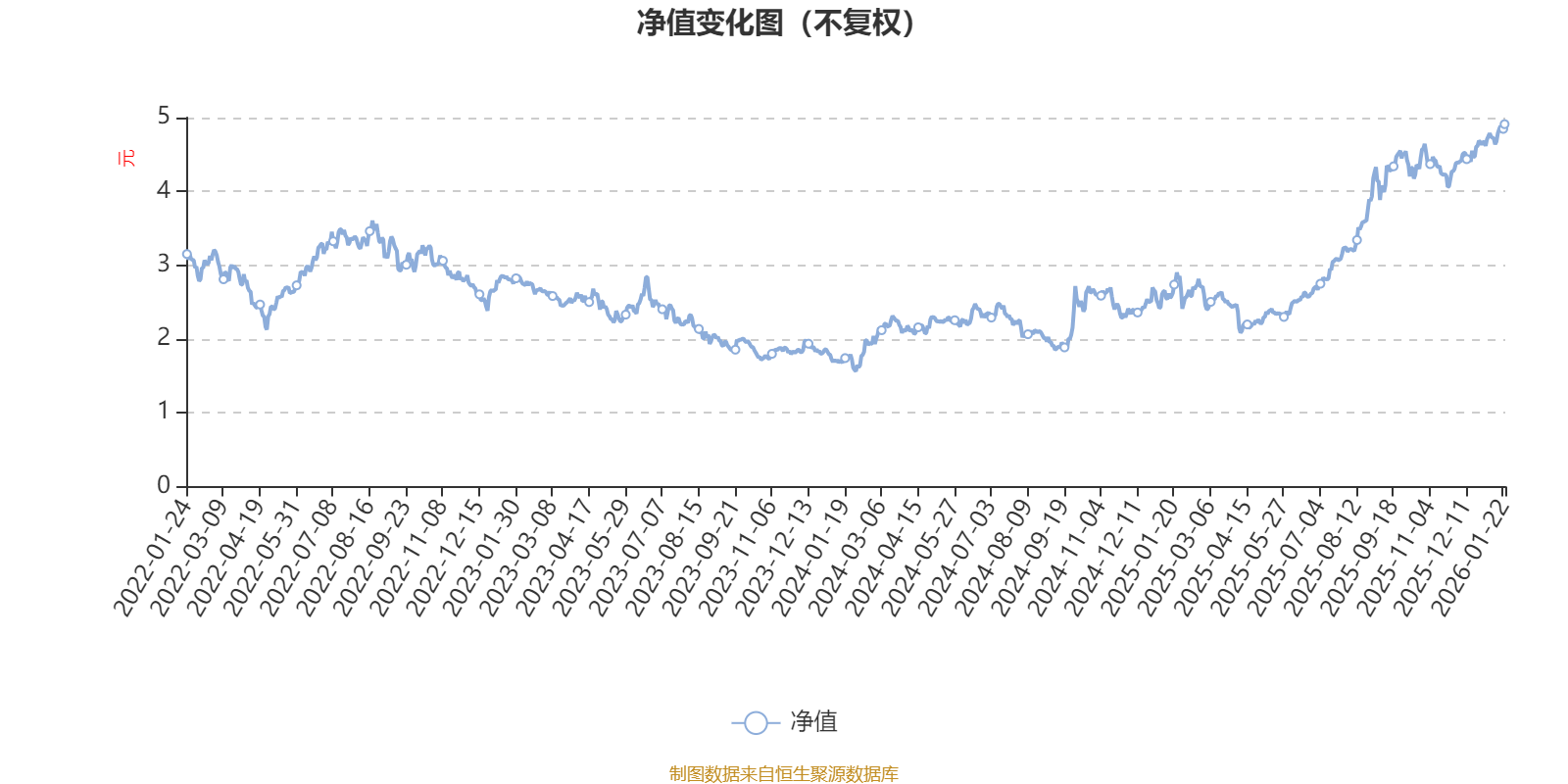
AI基金宏利转型机遇股票A(000828)披露2025年四季报,第四季度基金利润6533.12万元,加权平均基金份额本期利润0.099元。报告期内,基金净值增长 率为2.65%,截至四季度末,基金规模为27.59亿元。 该基金属于标准股票型基金,长期投资于TMT股票。截至1月22日,单位净值为4.911元。基金经理是孟杰,目前管理7只基金。其中,截至1月22日,宏利转 型机遇股票A近一年复权单位净值增长率最高,达69.23%;宏利行业精选混合A最低,为39.2%。 基金管理人在四季报中表示,科技相关行业经历了 2025 年全年的大幅上涨仍具备投资机会。人工智能模型仍在加速迭代,无论国内还是海外的互联网巨头 都将继续高额投入,算力产业链仍然有很好的投资机会。 手机、汽车、智能家居等端侧的智能化将成为持续的产业趋势,其中苹果是最具代表性的端侧产品,拥有从芯片设计到完善系统的良好生态,将开启又一轮 创新周期,国内产业链公司有望充分受益。先进逻辑及存储扩产拉动,国内晶圆厂仍然会持续加大资本支出,相关产业链公司订单有望持续增长。 截至1月22日,宏利转型机遇股票A近三个月复权单位净值增长率为13.16%,位于同类可比基 ...
十大机构看后市:A股春季行情仍沿着既定路径前进,保持稳健,持股过节
Xin Lang Cai Jing· 2026-01-25 06:48
Group 1 - The A-share market is experiencing a spring rally, with the Shanghai Composite Index rising by 0.84% and the Shenzhen Component Index increasing by 1.11% [12] - Short-term market focus is on low-position sectors, particularly cyclical Alpha (non-ferrous metals, chemicals) expanding towards cyclical turning points in construction materials, oil, and steel [1][13] - The current profitability in non-ferrous metals, chemicals, and oil is nearing high levels, indicating increasing short-term resistance for cyclical trends [1][14] Group 2 - Global market risk appetite is on the rise, favoring equity assets, with recommendations for tactical overweight in A/H shares, US stocks, and gold, while suggesting underweight in US Treasuries and oil [2][15] - The upcoming economic work conference and the start of the 14th Five-Year Plan in 2026 are expected to lead to more aggressive economic policies and an expansion of the fiscal deficit [2][15] - The anticipated interest rate cut by the Federal Reserve in December and the stable appreciation of the RMB are favorable for China's monetary easing in early 2026 [2][15] Group 3 - The technology sector remains the main focus of the current bull market, driven by the AI wave, with recommendations to pay attention to the application of AI in specific sectors [3][16] - Value sector opportunities are also worth considering, including certain resource products and real estate [3][16] - Consumer services may receive temporary attention as part of the sector allocation strategy [3][16] Group 4 - The market is expected to remain stable with a focus on holding positions through the upcoming holiday, as historical data suggests a less than 50% probability of major index increases in the 20 trading days before the Spring Festival [4][17] - Post-holiday, a new upward momentum is anticipated, with higher probabilities of index increases in the following 20 trading days [4][17] - Key sectors to watch include electronics, power equipment, and non-ferrous metals, with a focus on both growth and defensive styles depending on market conditions [4][17] Group 5 - The spring rally is expected to enter its second phase, with the Shanghai Composite Index nearing 4200 points, reflecting a strong upward trend since late December [5][18] - The market is witnessing a divergence in fund flows, with significant inflows into margin financing while stock-type ETFs are experiencing outflows [5][18] - Attention is needed on macro policy expectations from the upcoming National People's Congress in March and the microeconomic fundamentals from the 2025 annual reports [5][18] Group 6 - The current average P/E ratios for the Shanghai Composite and ChiNext are 16.88 and 53.36, respectively, indicating a suitable environment for medium to long-term investments [8][20] - The market is expected to focus on performance and industry trends, with a likelihood of maintaining a slight upward trend in the Shanghai Composite Index [8][20] - Investment opportunities are suggested in sectors such as photovoltaic equipment, energy metals, batteries, and aerospace [8][20] Group 7 - The market is anticipated to continue its oscillation and consolidation phase, with ETF outflows and a temporary decline in margin financing [9][20] - Despite the market's cooling, overall trading enthusiasm remains, and a slow bull market expectation may lead to fluctuating market sentiments [9][20] - Investment opportunities are highlighted in the TMT sector, robotics, and non-ferrous metals, alongside a focus on banking and insurance due to favorable long-term funding conditions [9][20] Group 8 - The spring rally is expected to persist, with a significant increase in risk appetite in the A-share market, as evidenced by a 17-day consecutive rise in the Shanghai Composite Index [10][21] - The market liquidity environment is improving, supported by favorable external conditions and proactive internal policies [10][21] - Key investment themes include low-valuation high-dividend assets, technology-driven production, and domestic market expansion [10][21] Group 9 - The 2026 economic outlook is positive, with proactive monetary and fiscal policies expected to support stable economic growth and a continued "slow bull" market in A-shares [11][21] - February is anticipated to maintain the momentum of January's focus on technology and non-ferrous sectors, driven by the "14th Five-Year Plan" [11][21] - Investment opportunities are identified in sectors related to new productive forces, including AI, aerospace, and agriculture [11][21]
基金四季报,透露了哪些重要线索?
Soochow Securities· 2026-01-25 00:55
Group 1: Fund Redemption Trends - The peak period for resident fund redemptions is expected to be over, indicating reduced passive selling pressure on active equity funds in 2026[2] - As of Q4 2025, active equity fund shares decreased to 2.65 trillion units, a reduction of 716 billion units from the previous quarter, with net redemptions reaching 1,256 billion units[1] - In H2 2025, net outflows from active equity funds amounted to 388.9 billion yuan, the highest semi-annual outflow since 2016[2] Group 2: Asset Migration and Fund Types - The trend of residents moving assets is significant, with a peak in maturing deposits and new financial products expected in 2026, which will provide additional liquidity to the stock market[3] - By Q4 2025, the scale of fixed income plus funds reached 2.6 trillion yuan, reflecting a 9.8% quarter-on-quarter increase, indicating its role as a key channel for resident funds entering the market[4] - Index funds saw a significant increase, with their market value reaching 4.70 trillion yuan in Q4 2025, while active equity funds dropped to 3.37 trillion yuan, widening the gap from 1 trillion yuan to 1.3 trillion yuan[4] Group 3: Sector Allocation Insights - The TMT sector's allocation in active equity funds is expected to increase, with a current allocation at 37.79%, down from 39.81% in Q3 2025, indicating room for growth[5] - Resource sector allocations reached a historical high of 13.3% in Q4 2025, with significant increases in non-ferrous metals and basic chemicals, suggesting ongoing bullish trends in resource prices[8] - The median net profit growth rate for all A-shares in 2025 is projected at 17.8%, with a higher forecast of 46.71% for the ChiNext board, indicating strong earnings recovery potential[10]
A股市场投资策略周报:扩内需、反内卷增量部署可期,市场延续震荡整理-20260122
BOHAI SECURITIES· 2026-01-22 09:27
Market Review - In the past five trading days (January 16 to January 22), major indices showed mixed performance; the Shanghai Composite Index rose by 0.24%, while the ChiNext Index fell by 1.17% [5] - The trading volume significantly decreased, with a total turnover of 13.80 trillion yuan, and the average daily turnover dropped to 2.76 trillion yuan, a decrease of 683.69 billion yuan compared to the previous five trading days [10] Economic Growth and Investment - In December 2025, fixed asset investment decreased by 3.8% year-on-year, a decline of 1.2 percentage points compared to the period from January to November 2025; infrastructure investment (excluding electricity, heat, gas, and water production and supply) fell by 2.2% [26] - The manufacturing investment grew by 0.6% year-on-year, while real estate investment saw a significant decline of 17.2% [26] - Overall, the economic growth rate for 2025 showed a pattern of high growth followed by a slowdown, with the annual target being successfully achieved [26] Policy and Strategy - The government is focusing on strengthening domestic circulation as a key macro policy point, with plans to develop a strategy for expanding domestic demand from 2026 to 2030 [31] - The fiscal policy for 2026 will see an increase in total expenditure, with a focus on boosting consumption and ensuring necessary spending intensity [31] - The market is expected to continue its oscillating adjustment, with ETF experiencing continuous net outflows; however, overall trading enthusiasm remains, and market sentiment may fluctuate [32] Industry Opportunities - Investment opportunities are identified in the TMT sector and robotics, driven by the expansion of AI capital and domestic substitution processes [32] - The non-ferrous metals industry presents investment opportunities supported by rising prices of certain commodities [32] - Continued attention is warranted for banking and insurance sectors due to the management's push for long-term capital inflows and a low-interest-rate environment [32]