
工业

Search documents
施罗德发表2026年十大投资市场预测 看好美股、黄金及亚洲科技股
Zhi Tong Cai Jing· 2025-11-26 08:52
Core Insights - The article presents a forecast for investment markets in 2026, highlighting optimism for U.S. equities while cautioning against potential AI-related bubbles [1][2] - It emphasizes the importance of diversification in investment strategies amid a complex market environment influenced by various global factors [3] Group 1: U.S. Market Outlook - Positive outlook for overall U.S. stocks in a non-recessionary, rate-cutting environment, but caution is advised regarding the potential for an AI bubble [2] - The Russell 2000 index is expected to perform well, particularly in a non-recessionary environment, with a recommendation to hedge risks through shorting high-yield bonds [2] Group 2: Asian Market and Technology - Strong growth anticipated in Asian technology stocks, with earnings growth expected to exceed forecasts and valuations not overly stretched [2] - Asian markets are projected to outperform the U.S., becoming a core area for returns [3] Group 3: European Market - European banks and industrial stocks are expected to benefit from increased defense spending and related consumption, providing diversification opportunities [2] Group 4: Alternative Investments - Convertible bonds are highlighted for their unique attributes, offering 80% upside potential from stocks and 60% downside protection [2] - Gold is favored as a strong investment, with central banks increasing their gold reserves and a trend towards diversification away from the U.S. dollar [2] Group 5: Emerging Markets - Emerging markets and local currency bonds are seen as attractive due to improved fiscal conditions and higher yields compared to developed markets [2] - Emerging markets are expected to have more room for rate cuts to stabilize economies, particularly in a weakening dollar environment [2] Group 6: Energy and Private Assets - The demand for alternative energy is anticipated to rise due to structural changes from AI development and climate change pressures, with reasonable valuations expected to support future growth [2] - Private assets are noted for their resilience against market volatility and ability to capture strong fundamental returns [2]
资本市场赋能山东高质量发展 “十四五”交出亮眼答卷
Sou Hu Cai Jing· 2025-11-26 03:43
Core Insights - The capital market in Shandong has significantly contributed to the province's high-quality economic and social development during the "14th Five-Year Plan" period, showcasing strong performance in various areas such as market system improvement and promoting industrial-financial integration [1][4] Group 1: Capital Market Development - Shandong has seen a continuous increase in the number of listed companies, with 84 new companies added, over 90% of which are strategic emerging, high-tech, or specialized enterprises, indicating a notable improvement in both quality and quantity of listings [1] - By the end of October 2025, the total number of listed companies in Shandong is expected to reach 311, with 85 companies having a market capitalization exceeding 10 billion yuan, reflecting a 36% increase in total market value compared to the end of the "13th Five-Year Plan" [1] Group 2: Financing and Investment - The bond market and private equity market have both expanded, with the bond balance surpassing 1 trillion yuan and social financing in Shandong exceeding 25 trillion yuan, contributing to a comprehensive financing system [2] - Private equity investments in Shandong have reached 3,699 billion yuan across 4,806 projects, providing essential growth capital for early-stage technology companies [2] Group 3: Corporate Performance and Innovation - In 2024, Shandong's listed companies achieved a revenue of 2.96 trillion yuan and a net profit of 180.3 billion yuan, marking increases of 29% and 22% respectively since 2020, indicating improved profitability and growth quality [3] - Research and development spending by companies during the "14th Five-Year Plan" reached 382.1 billion yuan, a 76.5% increase from the previous five years, highlighting significant advancements in key technologies and domestic alternatives [3] Group 4: Regulatory Environment and Policy Support - The Shandong provincial government has issued policies to promote high-quality capital market development, enhancing collaboration between central and local authorities and focusing on key sectors such as green economy and private enterprises [4] - Regulatory bodies have intensified efforts to combat financial fraud and insider trading, ensuring investor protection and maintaining a stable market environment [4]
关注红利港股ETF(159331)投资机会,港股上市公司的盈利预期上升
Sou Hu Cai Jing· 2025-11-26 03:22
Group 1 - The core viewpoint of the article highlights that the Hong Kong stock market has shown significant growth since 2025, with the Hang Seng Technology Index and the Hang Seng Index increasing by 28.20% and 24.11% respectively [1] - It is expected that the Hong Kong stock market will continue to experience wide fluctuations in December, influenced by three main factors: the Federal Reserve's interest rate cuts improving liquidity in Hong Kong stocks, the narrowing of the interest rate differential between China and the U.S. leading to an appreciation of the Renminbi, and the clearer domestic "14th Five-Year Plan" which is expected to enhance the earnings outlook for listed companies in Hong Kong [1] - Looking ahead, 2026 is anticipated to be a pivotal year as the "14th Five-Year Plan" commences, with developments in new productivity sectors and easing U.S.-China trade tensions expected to support the resilience of the Hong Kong stock market, potentially leading to a "slow bull" market trend [1] Group 2 - The Hong Kong Dividend ETF (159331) tracks the Hong Kong Stock Connect High Dividend Index (930914), which selects 30 high dividend yield stocks from securities eligible for the Hong Kong Stock Connect, focusing on those with good liquidity and consistent dividend payments [1] - The index comprises stocks from various traditional high dividend sectors such as finance, energy, and industrials, aiming to reflect the overall performance of high dividend securities in the Hong Kong Stock Connect with stable dividend characteristics and relatively low market volatility [1]
在乌兹别克斯坦中企数量达4731家
Shang Wu Bu Wang Zhan· 2025-11-25 16:43
Core Insights - As of November 1, Uzbekistan has a total of 17,595 foreign enterprises, with an increase of 407 in October, representing a growth rate of 2.4%, and a year-on-year increase of 2,298 enterprises, which is a 15% growth [1] Group 1: Foreign Investment Overview - The majority of foreign enterprises are wholly-owned, totaling 13,391, with a year-on-year increase of 2,355 [1] - Joint ventures account for 4,204 enterprises, showing a significant decrease of 57 compared to the previous year [1] Group 2: Country Breakdown - The top ten countries investing in Uzbekistan are led by China with 4,731 enterprises (713 joint ventures), making up 26.88% of the total, with an increase of 181 in October and a year-on-year increase of 1,455 [1] - Russia follows with 3,177 enterprises (898 joint ventures), accounting for 18%, with an increase of 27 in October and a year-on-year increase of 117 [1] - Other notable countries include Turkey (2,090), Kazakhstan (1,185), Afghanistan (683), South Korea (636), UAE (396), Tajikistan (379), India (356), and Kyrgyzstan (344), all showing varying degrees of growth in October [1] Group 3: Industry Distribution - The trade sector has the highest number of foreign enterprises, totaling 6,286, which is over 33.3% of the total [1] - This is followed by the industrial sector with 3,647 enterprises, construction with 1,358, and information and communication with 1,354 [1]
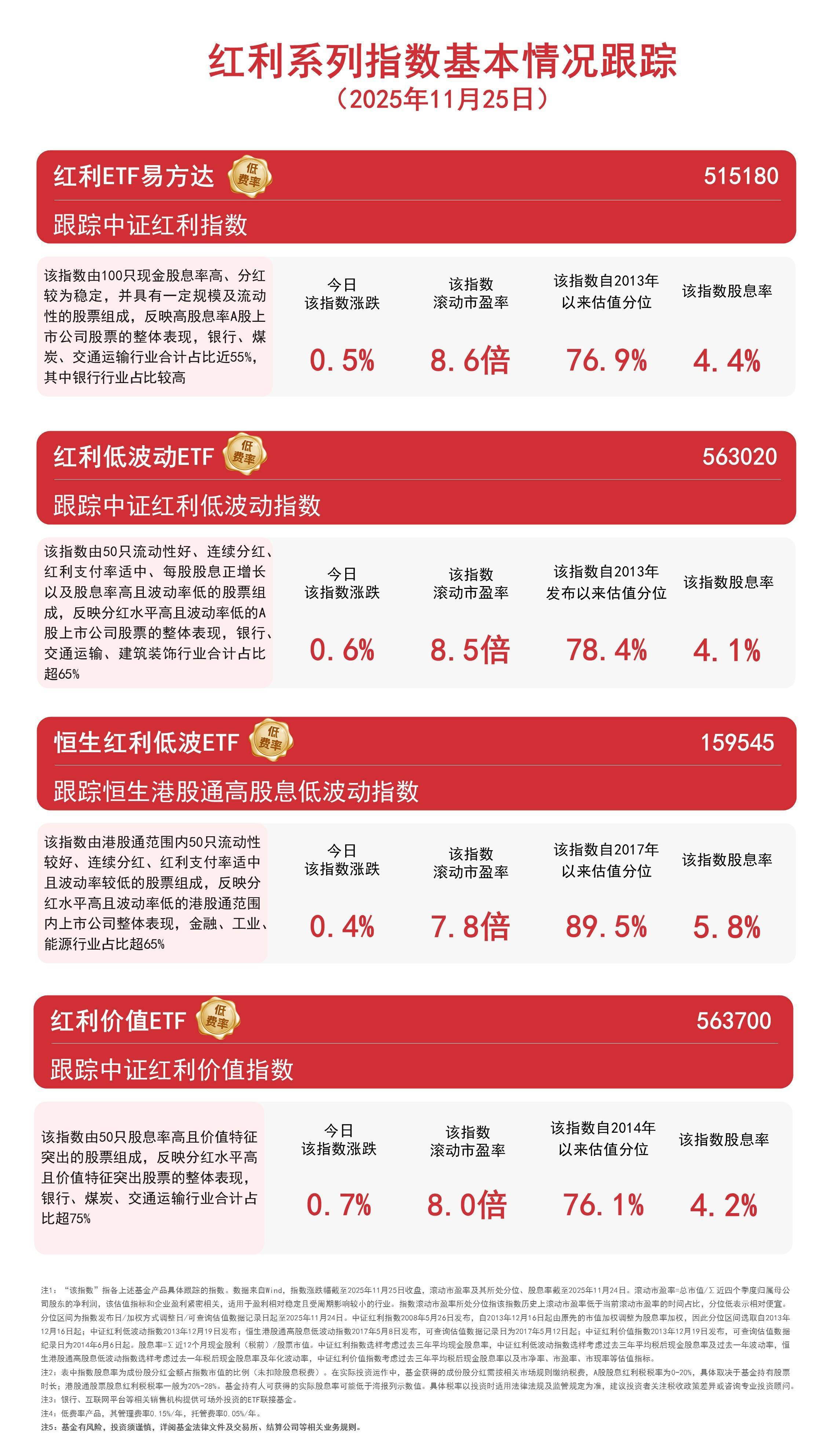
红利板块震荡上行,恒生红利低波ETF(159545)全天净申购超1.3亿份
Sou Hu Cai Jing· 2025-11-25 12:00
Group 1 - The core viewpoint of the news highlights the performance of dividend-focused indices, with the CSI Dividend Value Index rising by 0.7%, the CSI Low Volatility Dividend Index by 0.6%, and the CSI Dividend Index by 0.5% [1] - The Hang Seng High Dividend Low Volatility Index increased by 0.4%, and the Hang Seng Dividend Low Volatility ETF (159545) saw net subscriptions exceeding 130 million units throughout the day [1] - E Fund is noted as the only fund company offering all dividend ETFs at low fee rates, with management fees set at 0.15% per year for various products, facilitating low-cost investment in high-dividend assets [1] Group 2 - The indices consist of 50 stocks characterized by good liquidity, continuous dividends, moderate dividend payout ratios, positive growth in earnings per share, and high dividend yields with low volatility [3] - The banking, transportation, and construction industries collectively account for over 65% of the index composition, reflecting the overall performance of A-share listed companies with high dividend levels and low volatility [3] - The Hang Seng Dividend Low Volatility ETF tracks the Hang Seng High Dividend Low Volatility Index, which is composed of 50 stocks within the Hong Kong stock market that exhibit similar characteristics [6][7]

征和工业:股东人数公司会按照相关规定在定期报告披露
Zheng Quan Ri Bao Wang· 2025-11-25 10:13
证券日报网讯征和工业(003033)11月25日在互动平台回答投资者提问时表示,股东人数公司会按照相 关规定在定期报告披露,敬请关注公司定期报告。 ...

大摩:2/3大盘股回撤已近10%,美股调整“已近尾声”
美股IPO· 2025-11-25 07:10
Core Viewpoint - Morgan Stanley believes that while short-term risks related to the Federal Reserve's monetary policy may persist, the significant adjustment in the U.S. stock market is nearing its end, providing a good opportunity for investors to position themselves for 2026. Analysts maintain a bullish stance for the next 12 months, particularly recommending sectors such as consumer goods, healthcare, finance, industrials, and small-cap stocks [1][5][26]. Market Adjustment Insights - Despite a modest 5% pullback in the S&P 500 index, two-thirds of the top 1000 companies have experienced declines exceeding 10%, indicating a substantial internal market adjustment [2][6]. - The adjustment is attributed to two main factors: high momentum stocks are more sensitive to liquidity tightening, and high-quality indices like the S&P 500 and Nasdaq 100 reacted strongly to hawkish signals from the Federal Reserve [6][8]. Liquidity and Market Conditions - The report highlights that the recent volatility in the U.S. stock market, driven by the Federal Reserve's monetary policy and liquidity constraints, presents a buying opportunity for bullish investors [4][7]. - Morgan Stanley anticipates that liquidity conditions will improve as the U.S. government shutdown ends, leading to a significant decrease in the Treasury General Account (TGA) balance, which is expected to enhance liquidity in the short term [16][17]. 2026 Outlook - The firm expresses a contrarian view for 2026, suggesting that the market is in an "early cycle" phase, contrary to the prevailing consensus of being in a "late cycle" [18][19]. - Morgan Stanley projects a 17% earnings growth for Nasdaq-related companies in 2026, surpassing the consensus estimate of 14% [19]. - The firm has upgraded small-cap stocks and non-essential consumer goods to an overweight rating, citing factors such as pent-up demand and a shift in consumer spending from services to goods [20][21]. Earnings and Market Sentiment - Despite the recent market downturn, the underlying fundamentals of companies remain strong, indicating that the current adjustment is driven by policy and liquidity rather than a collapse in fundamentals [22][26]. - The breadth of earnings revisions for the Nasdaq 100 index has increased, with future net profit expectations for major indices continuing to rise, particularly for small-cap stocks [23][24].


港股市场回购统计周报2025.11.17-2025.11.23-20251125
Zhe Shang Guo Ji Jin Rong Kong Gu· 2025-11-25 06:01
Group 1: Market Overview - The total number of companies repurchasing shares this week is 73, an increase of 17 from the previous week[10] - The total repurchase amount for the week is HKD 4.87 billion, up from HKD 3.96 billion last week[10] - Tencent Holdings (0700.HK) leads with a repurchase of HKD 2.54 billion, followed by Xiaomi Group (1810.HK) with HKD 811 million[10] Group 2: Industry Insights - The majority of repurchase amounts are concentrated in the Information Technology, Industrial, Consumer Discretionary, Consumer Staples, and Energy sectors[13] - The Information Technology sector has the highest number of repurchasing companies, with 21 firms participating[13] - The Healthcare sector ranks second with 18 companies engaging in share buybacks[13] Group 3: Individual Company Data - China Feihe (6186.HK) repurchased shares worth HKD 185 million, accounting for 0.48% of its total share capital[14] - Yum China (9987.HK) repurchased shares worth HKD 233 million, representing 0.17% of its total share capital[14] - Kuaishou Technology (1024.HK) repurchased shares worth HKD 105.98 million, which is 0.04% of its total share capital[14]
242只港股获南向资金大比例持有
Sou Hu Cai Jing· 2025-11-24 01:55
Core Insights - The overall shareholding ratio of southbound funds in Hong Kong Stock Connect stocks is 19.38%, with 242 stocks having a shareholding ratio exceeding 20% [1] - Southbound funds hold a total of 4,900.47 million shares, accounting for 19.38% of the total share capital of the stocks, with a market value of 60,614.05 million HKD, representing 14.66% of the total market value [1] - The stocks with the highest shareholding ratios by southbound funds are primarily AH concept stocks, with 129 out of 242 stocks (53.31%) having a shareholding ratio over 20% [1] Group 1: Shareholding Distribution - 242 stocks have a shareholding ratio of over 20%, 131 stocks between 10% and 20%, 91 stocks between 5% and 10%, 84 stocks between 1% and 5%, and 21 stocks below 1% [1] - The stock with the highest southbound fund shareholding is China Telecom, holding 100,451.36 million shares, which is 72.38% of its issued shares [2] - Other notable stocks include Green Power Environmental (69.48%) and China Resources Power (69.45%) [2] Group 2: Industry Concentration - Southbound funds with shareholding ratios over 20% are concentrated in the healthcare, industrial, and financial sectors, with 56, 36, and 34 stocks respectively [2] - The healthcare sector includes stocks like Kanglong Chemical (59.10%) and Fosun Pharma (57.28%) [2][3] - The financial sector features stocks such as Guotai Junan (58.97%) and Zhongtai Securities (60.50%) [2][3]

10月份全社会用电量 同比增长10.4%
Zhong Guo Zheng Quan Bao· 2025-11-21 22:56
Core Insights - In October, China's total electricity consumption reached 857.2 billion kilowatt-hours, marking a year-on-year increase of 10.4%, the highest monthly growth rate this year [1] - From January to October, total electricity consumption accumulated to 8.6246 trillion kilowatt-hours, with a year-on-year growth of 5.1%, indicating a positive trend in the national economy [1] Factors Contributing to Growth - The high growth rate in October is attributed to multiple factors, including a low base from the previous year and the effective release of consumer potential during the overlapping National Day and Mid-Autumn Festival holidays [2] - The "autumn tiger" phenomenon, characterized by significant temperature increases in southern China, led to a surge in residential cooling electricity consumption, with notable increases in Jiangxi (65.9%), Zhejiang (63.2%), and Shanghai (47.0%) [2] Sector Performance - The primary industry showed steady growth, with October electricity consumption at 12 billion kilowatt-hours, up 13.2% year-on-year [3] - The secondary industry, as the main electricity consumer, recorded 568.8 billion kilowatt-hours in October, a 6.2% increase, with high-tech and equipment manufacturing sectors performing particularly well, growing by 11% [3] - The tertiary industry emerged as one of the fastest-growing sectors, with October electricity consumption at 160.9 billion kilowatt-hours, up 17.1% year-on-year, driven by the retail and information technology services sectors [3] Long-term Economic Outlook - From January to October, the tertiary industry's electricity consumption reached 1.67 trillion kilowatt-hours, growing by 8.4%, reflecting the deepening transition of China's economic dynamics [4] - The overall electricity consumption data indicates an improvement in economic activity, consumer potential release, and optimization of industrial structure, reinforcing a positive long-term economic outlook [4]