
公用事业

Search documents
2025年A股IPO数据盘点:电子行业成为“双料冠军” 新股上市20家、募资365亿元
Xin Lang Cai Jing· 2025-12-31 02:11
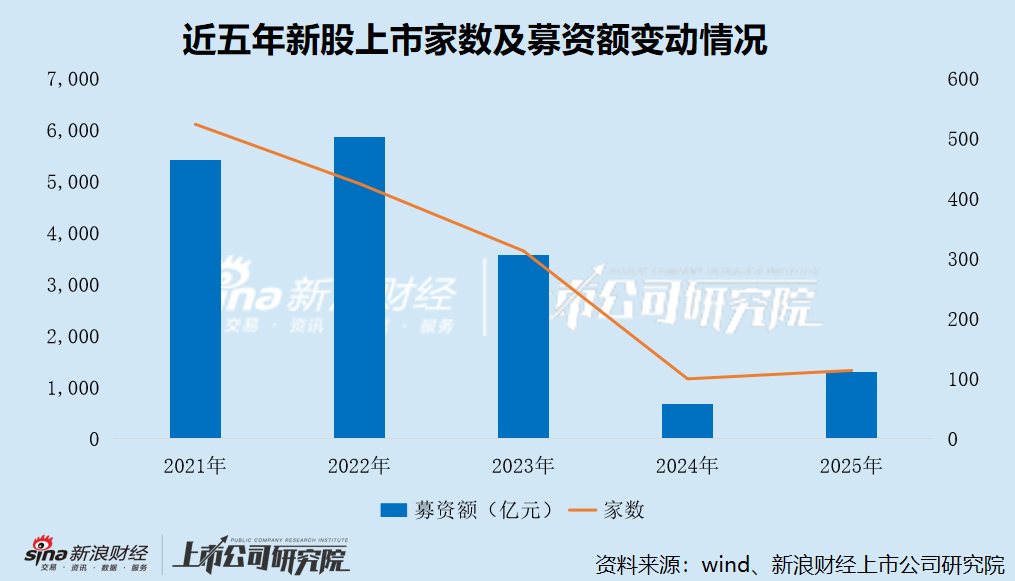
MACD金叉信号形成,这些股涨势不错! MACD金叉信号形成,这些股涨势不错! 责任编辑:公司观察 2025年度圆满收官。回顾今年以来IPO市场,2025年,A股IPO市场交出了一份亮眼的成绩单,今年A股新股延续了"零破发"的态势,赚钱效应明 显,打新收益创三年新高。本系列将从多个角度对2025年A股IPO进行数据盘点。 根据Wind数据统计,年内A股共有116家企业成功上市,同比增长16%,新股受理及发行持续实现常态化;合计募集资金1317.71亿元,同比增长 95.64%;平均募集额11.36亿元,同比增长68.66%。 年内共受理278家,上会124家,过会107家,撤回99家,终止7家,过会率为95.7%,真实过会率为45.3%(真实过会率=本期开会且已通过家数/ (本期状态更新为通过+未通过+暂缓表决+待表决家数+终止/撤回的家数)) 截至2025年12月31日,仍有333家企业处于IPO排队状态。按审核状态,已受理68家,已问询178家,已审核通过15家,暂缓表决2家,报送证监 会29家,证监会注册13家,中止审查28家。 行业(申万一级)维度上,电子行业成为"双料冠军",共有20家企业上市,募资 ...

249只港股获南向资金大比例持有
Zheng Quan Shi Bao Wang· 2025-12-31 01:49
Group 1 - The overall shareholding ratio of southbound funds in Hong Kong Stock Connect stocks is 19.34%, with 249 stocks having a shareholding ratio exceeding 20% [1] - As of December 30, southbound funds held a total of 4,925.70 million shares, accounting for 19.34% of the total share capital of the stocks, with a market value of 61,460.68 million HKD, representing 14.67% of the total market value [1] - The highest shareholding ratio by southbound funds is in China Telecom, with 9,997.50 million shares, representing 71.90% of the issued shares [2] Group 2 - Southbound funds with a shareholding ratio exceeding 20% are mainly concentrated in the healthcare, industrial, and financial sectors, with 56, 37, and 34 stocks respectively [2] - Among the stocks with over 20% shareholding by southbound funds, 129 are AH concept stocks, accounting for 51.81% [1] - The stock with the second-highest shareholding ratio is Green Power Environmental, with 28,290.80 million shares, representing 69.96% [2] Group 3 - The stock with the third-highest shareholding ratio is China Resources Power, with 36,689.50 million shares, representing 68.75% [2] - Other notable stocks with high southbound fund holdings include Kaisa Group, Tianjin Chuangye Environmental Protection, and China Shenhua, with shareholding ratios of 68.23%, 67.16%, and 66.39% respectively [2] - The data indicates a significant interest from mainland investors in Hong Kong stocks, particularly in sectors with strong growth potential [1][2]

30日转债行业涨跌参半,估值环比抬升:转债市场日度跟踪20251230-20251231
Huachuang Securities· 2025-12-31 01:13
Report Industry Investment Rating No information provided in the given content. Core Viewpoints - On December 30, the convertible bond industry showed mixed performance in terms of gains and losses, with valuations rising on a month - on - month basis [1]. - The mid - cap growth style was relatively dominant in the market [1]. - The trading sentiment in the convertible bond market weakened [1]. - The convertible bond price center increased, and the proportion of high - price bonds rose [2]. - The convertible bond valuations increased [2]. - In the A - share market, more than half of the underlying stock industry indices declined, while in the convertible bond market, 14 industries rose [3]. Summary by Related Catalogs Market Overview - **Index Performance**: The CSI Convertible Bond Index rose 0.14% month - on - month, the Shanghai Composite Index remained unchanged, the Shenzhen Component Index rose 0.49%, the ChiNext Index rose 0.63%, the SSE 50 Index rose 0.06%, and the CSI 1000 Index rose 0.04% [1]. - **Market Style**: Mid - cap growth was relatively dominant. Large - cap growth rose 0.57%, large - cap value fell 0.13%, mid - cap growth rose 0.81%, mid - cap value rose 0.66%, small - cap growth rose 0.66%, and small - cap value rose 0.34% [1]. - **Fund Performance**: The trading sentiment in the convertible bond market weakened. The trading volume of the convertible bond market was 75.057 billion yuan, a 2.96% month - on - month decrease; the total trading volume of the Wind All - A was 2.161532 trillion yuan, a 0.18% month - on - month increase; the net outflow of the main funds in the Shanghai and Shenzhen stock markets was 23.828 billion yuan, and the yield of the 10 - year treasury bond decreased by 0.02 bp to 1.86% [1]. Convertible Bond Price - The overall weighted average closing price of convertible bonds was 134.53 yuan, a 0.09% month - on - month increase. Among them, the closing price of equity - biased convertible bonds was 202.44 yuan, a 1.47% increase; the closing price of bond - biased convertible bonds was 118.85 yuan, a 0.18% decrease; the closing price of balanced convertible bonds was 129.71 yuan, a 0.01% increase [2]. - The proportion of bonds with a closing price above 130 yuan was 59.95%, a 1.15 - percentage - point increase. The largest change in proportion occurred in the 120 - 130 (including 130) range, with a proportion of 28.01%, a 1.39 - percentage - point decrease. There were no bonds with a closing price below 100 yuan. The median price was 132.60 yuan, a 0.07% month - on - month decrease [2]. Convertible Bond Valuation - The fitted conversion premium rate of 100 - yuan par value was 33.54%, a 0.45 - percentage - point month - on - month increase; the overall weighted par value was 101.88 yuan, a 0.19% month - on - month decrease [2]. - The premium rate of equity - biased convertible bonds was 18.25%, a 1.38 - percentage - point increase; the premium rate of bond - biased convertible bonds was 86.78%, a 2.11 - percentage - point increase; the premium rate of balanced convertible bonds was 25.17%, a 0.42 - percentage - point increase [2]. Industry Performance - **Underlying Stock Market**: Among the A - share industries, the top three decliners were Commerce and Retail (-1.56%), Real Estate (-1.22%), and Utilities (-1.14%); the top three gainers were Petroleum and Petrochemical (+2.63%), Automobile (+1.35%), and Non - Ferrous Metals (+1.31%) [3]. - **Convertible Bond Market**: Among the convertible bond industries, the top three gainers were Automobile (+2.08%), Petroleum and Petrochemical (+1.25%), and Textile and Apparel (+0.77%); the top three decliners were Environmental Protection (-2.57%), National Defense and Military Industry (-1.23%), and Building Materials (-1.16%) [3]. - **By Category**: - **Closing Price**: The large - cycle category decreased by 0.38%, manufacturing increased by 0.54%, technology decreased by 0.24%, large - consumption increased by 0.10%, and large - finance decreased by 0.05% [3]. - **Conversion Premium Rate**: The large - cycle category decreased by 0.21 percentage points, manufacturing increased by 0.57 percentage points, technology increased by 0.028 percentage points, large - consumption increased by 0.63 percentage points, and large - finance increased by 0.79 percentage points [3]. - **Conversion Value**: The large - cycle category decreased by 0.74%, manufacturing increased by 0.17%, technology decreased by 0.36%, large - consumption decreased by 0.43%, and large - finance decreased by 0.20% [3]. - **Pure Bond Premium Rate**: The large - cycle category decreased by 0.55 percentage points, manufacturing increased by 0.81 percentage points, technology decreased by 0.16 percentage points, large - consumption increased by 0.12 percentage points, and large - finance decreased by 0.065 percentage points [4]. Industry Rotation - Industries such as Petroleum and Petrochemical, Automobile, and Non - Ferrous Metals led the gains. For example, Petroleum and Petrochemical had a daily increase of 2.63% in the underlying stock market and 1.25% in the convertible bond market; Automobile had a 1.35% increase in the underlying stock market and 2.08% in the convertible bond market [54].
万联晨会-20251231
Wanlian Securities· 2025-12-31 00:41
Core Viewpoints - The A-share market showed mixed performance with the Shanghai Composite Index closing flat, while the Shenzhen Component Index rose by 0.49% and the ChiNext Index increased by 0.63%. The total trading volume in the Shanghai and Shenzhen markets reached 21,424.47 billion yuan. The leading sectors included oil and petrochemicals, automobiles, and non-ferrous metals, while retail, real estate, and public utilities lagged behind [2][8] - The Hong Kong market saw the Hang Seng Index rise by 0.86% and the Hang Seng Tech Index increase by 1.74%. In contrast, major U.S. indices experienced declines, with the Dow Jones down by 0.2%, S&P 500 down by 0.14%, and Nasdaq down by 0.24% [2][8] Important News - The "Two New" policy for 2026 was released by the National Development and Reform Commission and the Ministry of Finance, outlining support for large-scale equipment updates and consumer goods replacement. A total of 625 billion yuan in special bonds will be allocated for this initiative, with a subsidy rate of 15% for certain household appliances and a maximum subsidy of 1,500 yuan per item [3][9] - Changes to the value-added tax policy for personal housing sales were announced, effective January 1, 2026. Homes sold within two years will incur a 3% VAT, while those sold after two years will be exempt from VAT [3][9] Market Analysis - The A-share market saw active trading in the sci-tech sector, with significant interest in commercial aerospace, terahertz technology, and controllable nuclear fusion. The market liquidity decreased in December, influenced by year-end fund recovery and reduced risk appetite among investors. However, a recovery in investor confidence was noted in the latter half of December due to positive signals from national economic meetings [10][11] - The overall economic environment remains stable, with improvements in fixed asset investment growth and a rebound in import and export growth rates. The CPI has shown an expanding year-on-year increase, while the decline in PPI has narrowed. The macroeconomic policies are expected to continue supporting economic stabilization and growth [12]
投资心语∣十连阳≠普涨,春季行情这样布局
Sou Hu Cai Jing· 2025-12-31 00:11
Core Viewpoint - The recent "ten consecutive days of gains" in the Shanghai Composite Index does not indicate a broad market rally but rather reflects a structural and localized market trend, driven by specific sectors and supported by monetary policy and foreign capital dynamics [1][2]. Group 1: Market Dynamics - The index's rise is supported by three main factors: the central bank's signals to stabilize the market, continuous liquidity provision, and the appreciation of the RMB which alleviates foreign capital outflow pressures [1]. - Despite the index's performance, over 3,400 stocks have quietly declined, indicating a divergence where only a few sectors are experiencing significant gains while many small and mid-cap stocks are adjusting [2]. Group 2: Spring Market Outlook - The spring market is anticipated to have potential, but it is unlikely to be a straightforward profit-making scenario for all investors, as the path forward is expected to be bumpy [3]. - Key supporting factors for the market include the government's commitment to proactive fiscal policies and moderately loose monetary policies, alongside a continuous improvement in liquidity with net inflows observed over recent weeks [3]. Group 3: Investment Strategies - For existing investors, it is advisable to optimize their portfolios by reducing exposure to high-flying stocks lacking fundamental support and maintaining positions in sectors aligned with industry trends, such as commercial aerospace and AI hardware [4]. - Investors looking to enter the market should consider a balanced "barbell" strategy, focusing on high-growth sectors while also including stable value stocks to mitigate volatility risks [5]. Group 4: Conclusion - The "ten consecutive days of gains" serves as a reflection of market resilience under policy support but also highlights the challenges of a differentiated market environment [6]. - Investors are encouraged to focus on the intrinsic value and growth logic of their holdings rather than fixating on index performance, maintaining a rational approach to investment decisions [6].
中国“双碳”五年ESG覆盖2529家上市公司 央企100%披露彰显“压舱石”底色
Chang Jiang Shang Bao· 2025-12-30 23:21
Core Insights - The integration of Environmental, Social, and Governance (ESG) factors into corporate strategy and practice has significantly deepened and broadened among Chinese listed companies in the five years since the "dual carbon" goals were proposed [1][4] - The ESG concept has evolved rapidly in China's capital market from awareness to institutional development, with regulatory bodies enhancing disclosure guidelines and investors incorporating ESG performance into decision-making [1][2] Group 1: ESG Disclosure Progress - From 2019 to 2024, the number of A-share listed companies disclosing ESG practices increased from 1,011 to 2,529, representing a 150% overall growth [2] - The disclosure rates for these years were 26.82%, 27.16%, 31.14%, 35.99%, 41.45%, and 46.53%, showing a steady upward trend [2] - In 2024, the banking sector had the highest disclosure rate at 100%, followed by non-bank financials (87.06%), steel (81.82%), coal (74.81%), utilities (73.28%), real estate (63.74%), and media (63.57%) [2] Group 2: ESG Ratings and Challenges - In 2024, among companies that disclosed ESG information, the distribution of ESG ratings was as follows: 94 companies rated AAA, 696 rated AA, 1,096 rated A, and 1,031 rated BBB, indicating a "middle-heavy" distribution [3] - Despite the increase in disclosure volume, there are structural challenges in ESG development, such as inconsistent report quality, lack of key quantitative data, and a tendency to focus on form over substance [3] - The governance mechanisms often lack integration, with ESG efforts typically confined to specific departments rather than being incorporated into board-level strategic oversight and long-term planning [3] Group 3: Future Outlook - The ESG landscape in China is transitioning from a "scale expansion phase" to a "quality improvement phase," necessitating deeper integration of disclosure and practice [4] - As regulatory frameworks continue to improve and market understanding deepens, ESG is expected to evolve from mere compliance to a core driver of long-term value creation and sustainable development [4] - For Chinese companies to achieve high-quality development amidst the green transition, it is essential to align strategic actions with ESG practices effectively [4]
【策略】关注春季行情——2026年1月A股及港股月度金股组合(张宇生/王国兴)
光大证券研究· 2025-12-30 23:05
Group 1 - The core viewpoint of the article highlights the divergence in performance between A-shares and Hong Kong stocks in December, with A-shares generally rising due to favorable policies and improved market sentiment, while Hong Kong stocks experienced volatility influenced by external factors [7][8]. Group 2 - In December, A-share indices saw an overall increase, with the ChiNext Index rising by 6.3% and the Sci-Tech 50 Index increasing by only 1.4%. The defense, telecommunications, and non-ferrous metals sectors performed well, while financials, real estate, and consumer sectors lagged [7]. - The Hong Kong market showed mixed results, with the Hang Seng Index declining by 0.2% and the Hang Seng Technology Index falling by 1.8% as external factors like U.S. Federal Reserve interest rate expectations influenced market movements [7]. Group 3 - The outlook for A-shares suggests a potential upward trend, supported by ongoing policy initiatives and increased capital inflows. Historical patterns indicate a "spring rally," with a focus on growth and consumer sectors, particularly TMT and advanced manufacturing [8]. - The article recommends monitoring the commercial aerospace sector for potential investment opportunities, especially if there are short-term pullbacks [8]. Group 4 - The Hong Kong market is expected to continue its upward trajectory due to strong overall profitability and low valuations, despite recent gains. A "barbell" strategy focusing on technology growth and high dividend stocks is advised [9]. - Key areas of interest include domestic policies supporting self-sufficiency in technology, independent internet companies, and high dividend sectors like telecommunications and utilities [9].

【30日资金路线图】沪深300主力资金净流入近4亿元 有色金属等行业实现净流入
Zheng Quan Shi Bao· 2025-12-30 12:27
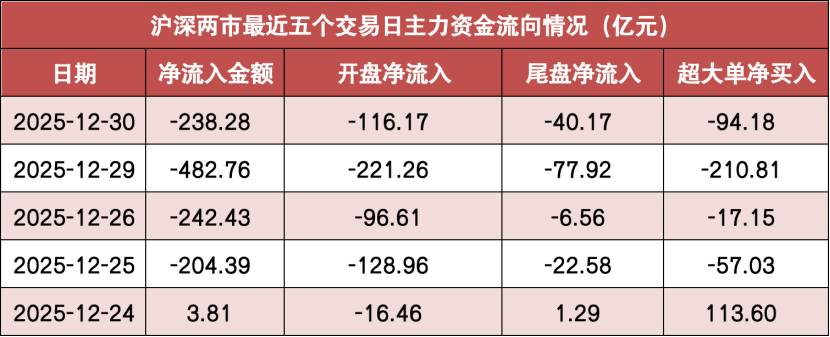
Market Overview - On December 30, A-shares experienced a narrow range consolidation with quick sector rotation, closing with the Shanghai Composite Index slightly down at 3965.12 points, while the Shenzhen Component Index rose by 0.49% and the ChiNext Index increased by 0.63%. The total trading volume for A-shares was 2.16 trillion yuan [1]. Capital Flow - The net outflow of main funds in the Shanghai and Shenzhen markets exceeded 23 billion yuan, with an opening net outflow of 11.62 billion yuan and a closing net outflow of 4.02 billion yuan, resulting in a total net outflow of 23.83 billion yuan for the day [2][3]. - The CSI 300 index saw a net inflow of 0.375 billion yuan, while the ChiNext experienced a net outflow of 7.857 billion yuan [4]. Sector Performance - The following sectors had significant net inflows: - Non-ferrous metals: 8.432 billion yuan, with notable inflow into Yun Aluminum [6]. - Automotive: 3.940 billion yuan, with significant inflow into Shanzigaoke [6]. - Electronics: 3.763 billion yuan, with notable inflow into Shuo Beid [6]. - Machinery: 3.049 billion yuan, with significant inflow into Juyi Suoj [6]. - Oil and petrochemicals: 1.625 billion yuan, with notable inflow into Hengyi Petrochemical [6]. - The sectors with the largest net outflows included: - Utilities: -5.219 billion yuan, with significant outflow from Mindong Electric Power [6]. - Computers: -5.215 billion yuan, with notable outflow from Tuo Wei Information [6]. - Defense and military: -5.048 billion yuan, with significant outflow from Aerospace Development [6]. - Electric power equipment: -4.647 billion yuan, with notable outflow from Goldwind Technology [6]. - Retail: -4.425 billion yuan, with significant outflow from Gongxiao Daji [6]. Institutional Activity - The top stocks with net institutional purchases included: - Tailor Co., Ltd.: 152.31 million yuan, with a daily increase of 9.97% [8]. - Aerospace Development: 134.72 million yuan, with a daily decrease of 3.13% [8]. - Longi Machinery: 77.13 million yuan, with a daily increase of 5.78% [8]. - The stocks with the largest net institutional sales included: - Zhejiang Shibao: -615.44 million yuan, with a daily decrease of 10.01% [10]. - Electric Media: -738.89 million yuan, with a daily decrease of 10.00% [10]. Institutional Focus - Recent institutional ratings and target prices for selected stocks include: - Liu Gong: Strong Buy with a target price of 16.50 yuan, current price 11.95 yuan, indicating a potential upside of 38.08% [11]. - Stone Technology: Strong Buy with a target price of 224.10 yuan, current price 151.81 yuan, indicating a potential upside of 47.62% [11]. - Chip Source Micro: Buy with a target price of 167.18 yuan, current price 144.99 yuan, indicating a potential upside of 15.30% [11].
【盘中播报】沪指涨0.11% 石油石化行业涨幅最大
Zheng Quan Shi Bao Wang· 2025-12-30 06:24
Market Overview - The Shanghai Composite Index increased by 0.11% today, with a trading volume of 1,004.34 million shares and a transaction value of 17,424.85 billion yuan, representing a 0.72% increase compared to the previous trading day [1]. Industry Performance - The top-performing industries included: - Oil and Petrochemicals: Up by 2.43%, with a transaction value of 162.59 billion yuan, led by Tongyi Co., which rose by 10.01% [1]. - Machinery Equipment: Increased by 1.38%, with a transaction value of 1,591.32 billion yuan, led by Buke Co., which surged by 20.00% [1]. - Automotive: Gained 1.35%, with a transaction value of 949.77 billion yuan, led by Tsinghua Technology, which rose by 30.00% [1]. - The worst-performing industries included: - Commercial Retail: Decreased by 1.66%, with a transaction value of 298.04 billion yuan, led by Baida Group, which fell by 10.00% [2]. - Social Services: Down by 1.13%, with a transaction value of 104.28 billion yuan, led by Tian Su Measurement, which dropped by 15.65% [2]. - Real Estate: Fell by 1.02%, with a transaction value of 180.88 billion yuan, led by Suzhou High-tech, which declined by 6.88% [2].
12月29日有色金属、国防军工、电力设备等行业融资净买入额居前
Zheng Quan Shi Bao Wang· 2025-12-30 03:19
Summary of Key Points Core Viewpoint - As of December 29, the market's latest financing balance reached 25,348.43 billion yuan, reflecting an increase of 8.38 billion yuan compared to the previous trading day, indicating a positive trend in market financing activity [1]. Industry Analysis - **Industries with Increased Financing Balance**: - The non-ferrous metals industry saw the largest increase in financing balance, rising by 2.46% to 922.41 billion yuan, with an increase of 24.49 billion yuan [1]. - Other notable increases were observed in the defense and military industry (22.19 billion yuan increase, 2.46% growth), electric power equipment (19.54 billion yuan increase, 0.86% growth), and computer industry (10.63 billion yuan increase, 0.61% growth) [1][2]. - **Industries with Decreased Financing Balance**: - The non-bank financial sector experienced the largest decrease, with a reduction of 3.05 billion yuan, representing a decline of 0.16% [2]. - Other sectors with significant decreases included banks (2.54 billion yuan decrease, 0.34% decline) and environmental protection (1.94 billion yuan decrease, 0.98% decline) [2]. - **Financing Balance Changes by Percentage**: - The defense and military industry had the highest percentage increase in financing balance, followed by non-ferrous metals (1.96%), public utilities (1.86%), and real estate (0.98%) [1]. - Conversely, the construction materials industry saw the largest percentage decrease at 1.23%, followed by environmental protection (0.98%) and retail (0.37%) [2].